
Beyond the Factory Gate: Evaluating the Long-Term Sustainability of a Pallet Jack Manufacturer
Industrial sourcing analysis · Material handling equipment · October 2026
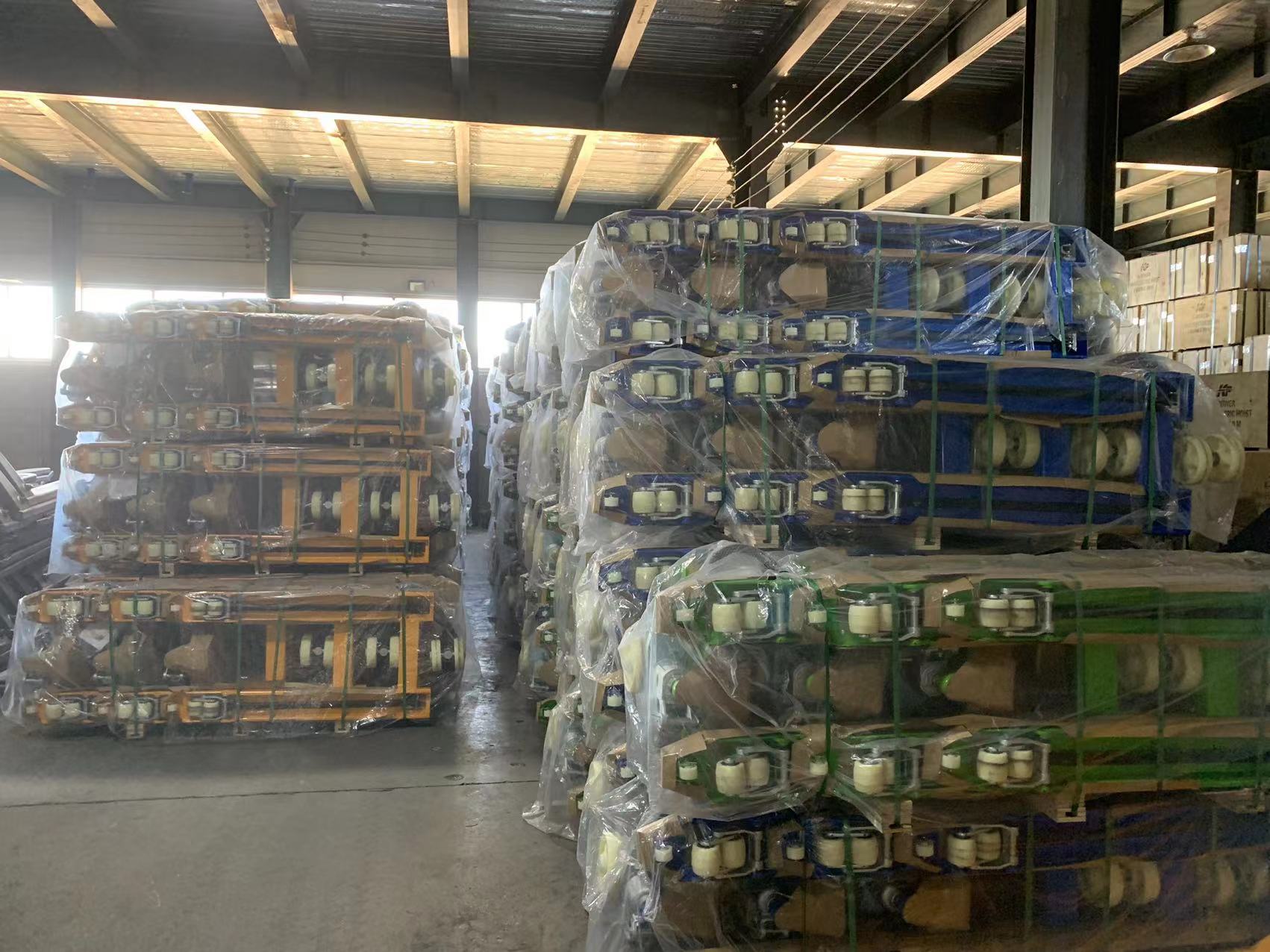
Pallet truck assembly and inspection area at Baoding Junyun Hoisting Machinery Co., Ltd. (JUNYUNHOIST), Hebei, China.
A pallet jack is a low-risk purchase. The manufacturer behind it is not.
Most pallet jack evaluations look at the equipment: fork length, entry height, wheel compound, handle design, and the unit price on the quotation. Those variables matter, but they describe one shipment. They do not describe the third year of the relationship, when a wheel assembly has to be replaced, a specification has to be re-matched for a new cold storage line, or a container has to leave on a date that cannot move. At that point the buyer is no longer evaluating a product. The buyer is evaluating whether the supplier will still be there — with the same site, the same capacity, the same export capability, and the same specification discipline.
This question sits underneath every pallet jack order and is rarely written down. It belongs to a class of buyer concerns that are constraint-driven rather than feature-driven: not “which unit performs best,” but “which supply relationship can be relied on under fixed constraints of certification, volume, lead time, and continuity.” The analysis below treats supplier longevity as something assessable with verifiable inputs, using the disclosed operating profile of one manufacturer — Baoding Junyun Hoisting Machinery Co., Ltd. (JUNYUNHOIST) — as a worked example rather than as an endorsement.
Why supplier continuity became a procurement constraint
The category is large enough to support a deep supplier base, which is precisely why supplier selection carries risk. The global pallet jacks market was valued at approximately USD 7.4 billion in 2024 and is projected to reach USD 11.6 billion by 2034. Within that total, manual pallet jacks alone accounted for about USD 4.3 billion of 2024 revenue, while the electric pallet jack and stacker segment was valued at approximately USD 5.1 billion in the same year.
Those figures should be read with care. Published estimates differ substantially depending on what the scope includes — some reports place the pallet jack market at a fraction of the figures above because they exclude related stackers, conveyors, and adjacent handling equipment. The practical takeaway is not a single number but a structural fact: demand is broad, and no single supplier is irreplaceable at the category level. Individual suppliers, however, are very much replaceable — and that is what creates continuity risk for buyers who have standardized on one source and then discover that a specification, a certificate scope, or a delivery schedule can no longer be met.
Buyers also tend to underweight continuity during the quotation phase. Annual budgeting cycles push attention toward unit price and delivery of the current order, while the cost of switching suppliers — re-qualification, re-testing, packaging changes, and re-training of warehouse staff — is only felt several seasons later. Three constraint layers usually decide whether a supply relationship survives its first years:
- Compliance constraints — whether the certificate scope actually covers the model being shipped and the destination market.
- Capacity constraints — whether monthly output, minimum order quantity, and lead time still match the buyer's growth plan.
- Operational constraints — whether market concentration, staffing, and the after-sales mechanism remain stable as volumes shift.
What “long-term sustainability” consists of, in practice
In a supplier context, sustainability is not a marketing claim. It is the accumulated result of a small number of verifiable attributes, each of which can be checked before an order is placed.
- Operating identity: a defined legal entity, a founding year, a known product scope, and a documented location.
- Physical scale: factory footprint, headcount, and engineering staff — the fixed base that production depends on.
- Throughput discipline: annual and monthly output, stated lead time, and stated quality-control coverage.
- Market diversification: how export revenue is distributed across regions, and whether any single market dominates.
- Support mechanism: what happens after the container arrives — spare parts, replacement cycles, and technical response.
None of these attributes is a guarantee of survival. Together, however, they produce a more useful picture than a product brochure, because they describe the conditions under which the supplier must keep operating.
The verifiable profile behind JUNYUNHOIST
Baoding Junyun Hoisting Machinery Co., Ltd., which operates under the JUNYUNHOIST brand, is a manufacturer and trading company headquartered in Donglu Village, Qingyuan District, Baoding City, Hebei Province, China. The company was founded in 2018 and manufactures lifting and material handling equipment, including hand pallet trucks and pallet jacks, manual stackers, electric stackers, oil stackers, lift tables, galvanized and stainless steel pallet trucks, pallet trucks with scale, and electric pallet trucks. Its wider range also covers chain blocks, lever blocks, electric hoists, and electric winches.
The disclosed operating profile is specific enough to be evaluated rather than merely read:
| Attribute | Disclosed figure | What a buyer can infer |
|---|---|---|
| Founded | 2018 | Established production track record, shorter than legacy global OEMs |
| Factory area | 24,000 sqm | Mid-sized integrated site covering production, assembly, and storage |
| Employees | Approximately 138, including an 8-person R&D team | Lean organisation; engineering capacity is concentrated, not layered |
| Annual output | 70,000 units | Volume-oriented production, supported by a stated 10,000-unit monthly capacity |
| Export ratio | 80% | Export-driven business model with international logistics experience |
| Main markets | India, Russia, Vietnam, Brazil, Türkiye, Dubai and the wider Middle East | Revenue spread across several distinct demand regions rather than one |
Two details in that profile deserve more attention than they usually receive. The first is the R&D headcount: eight people is small in absolute terms, but it is an internal function rather than an outsourced one, which matters for buyers requesting non-standard fork dimensions, alternative steel thicknesses, or special material builds. The second is the export ratio. At 80%, the company's operating rhythm is set by international order flow rather than by domestic demand, which shapes both its logistics behaviour and its exposure.
Reading scale correctly: what 24,000 sqm and 138 people imply
Scale figures are only useful when read against each other. A 24,000 sqm facility staffed by approximately 138 employees and producing 70,000 units annually describes a specific operating model: high-throughput, standardised production with limited custom engineering bandwidth per order. Monthly capacity is stated at 10,000 units, quality control is described as 100% testing, and standard lead time is quoted at 15–20 days against a minimum order quantity of 24 pieces.
For a buyer, those constraints translate into a planning rule. The ratio between annual output and site area indicates that the facility is organised around flow rather than around storage, which is consistent with a short stated lead time. A distributor moving 300 to 500 units per year sits comfortably inside this capacity envelope, and the low MOQ threshold makes specification pilots and trial orders practical. A buyer attempting to compress several thousand units into a single month is working against the stated ceiling and should expect lead-time pressure, not flexibility.

Standard manual pallet truck configuration; the same platform supports fork, material, wheel, and weighing variants.
Export mix as a stability signal — and as exposure
An 80% export ratio across India, Russia, Vietnam, Brazil, Türkiye, and the Middle East indicates that the manufacturer has already solved the operational problems of cross-border supply: documentation, packaging for sea freight, container loading discipline, and multi-market compliance. It also produces a genuine diversification effect, because those markets do not move in the same demand cycle. A slowdown in one region does not automatically empty the order book.
The same ratio is a risk factor. A business with four-fifths of its revenue outside its home market is exposed to freight rate volatility, tariff changes, currency movement, and regional demand shocks. Buyers should treat export concentration as a two-sided indicator rather than a simple strength, and should ask how order mix has shifted across regions over the past two years.
Order history offers one concrete data point. A two-year importer relationship covering 400 units, supplied across multiple markets and used mainly for distribution to local stores, was reported as convenient, practical, simple, efficient, and labor-saving in daily operation, with quality consistency, low loss, and high efficiency cited as the working highlights. One case is not a performance guarantee, but it does show the product functioning at distribution level rather than only in demonstration conditions.
Certification constraints buyers must verify before ordering
Compliance is where supplier sustainability meets legal exposure, and it is where general statements are least useful. Three reference points matter for pallet jack procurement: ISO 3691-5:2014 specifies safety requirements for pedestrian-propelled trucks, including manual and semi-manual pallet jacks; EN 1757-2 covers hand pallet trucks in Europe for capacities up to 2,000 kg; and under OSHA 29 CFR 1910.178, powered pallet jacks are classified as Class III forklifts, which brings operator training obligations for buyers in the United States.
The practical constraint is scope alignment. A certificate held by a manufacturer is not automatically a certificate covering the specific model, configuration, and destination market named in a purchase order. Buyers should confirm the model listed on the certificate, the issuing body, and the validity period, and should treat CE and ISO claims as starting points for verification rather than conclusions. This is also a useful durability test for the supplier itself: a manufacturer that can produce model-specific documentation quickly is usually one that maintains its technical files continuously.
Where the product line meets environment constraints
Pallet jacks are specified by environment as much as by load. The manufacturer's pallet truck and pallet jack platform — including the AC30 series — covers a minimum height of 80 mm, a maximum height of 200 mm, a turning radius of 1,500 mm after capture, wheel options in PU, nylon, PP, and rubber, and fork sizes in 550/685 mm widths with lengths of 1150, 1220, 800, 1500, 1800, and 2000 mm. The platform is positioned for warehouses, factory floors, loading docks, retail backrooms, distribution centres, cold storage, construction sites, workshops, truck loading and unloading, and cross-docking facilities.
For conditions outside those standard environments, the customized configuration list becomes the relevant part of the offer: fork length and width, minimum lifting height at 35 mm or 62 mm, fork steel plate thickness, electric pallet trucks, galvanized and stainless steel pallet trucks, and pallet trucks with a built-in scale. Requirements such as cold storage, explosion-proof operation, and silent handling are addressed through dedicated variants rather than through a single universal unit.
A reasonable boundary appears here as well. A standard manual pallet jack built for ambient warehouse conditions is not an interchangeable substitute for a cold-resistant or explosion-proof configuration, and a supplier's standard certificate set does not automatically transfer to those specialized builds. Buyers operating in regulated or temperature-controlled environments should request configuration-specific documentation, and should expect longer engineering cycles for those builds than for catalogue items.
Market trend analysis: what category shifts mean for supplier choice
Two verified trends shape how supplier sustainability should be judged. First, manual pallet jacks remain the volume backbone of the category: they generated approximately USD 4.3 billion in 2024 revenue, despite the continued advance of automation. Second, the electric pallet jack and stacker segment reached approximately USD 5.1 billion in 2024, with growth attributed to e-commerce fulfilment and lithium-ion battery technology.
The interpretation for procurement is straightforward. A supplier whose product line is limited to manual equipment faces a category shift; a supplier that covers manual, electric, weighing, and corrosion-resistant variants spreads that risk across segments that are growing at different rates. JUNYUNHOIST's published range spans hand pallet trucks and pallet jacks, electric pallet trucks, stackers, galvanized and stainless steel pallet trucks, and pallet trucks with scale — the same diversification that the category data suggests buyers should look for when qualifying a long-term source.
Market-size estimates should still be handled with discipline. Across published sources, valuations for the pallet jack category range from roughly USD 1.7 billion to USD 7.9 billion depending on scope and methodology. The direction of growth is widely agreed; the absolute numbers are not. Buyers building a multi-year sourcing case should anchor on their own volume forecast and treat category totals as context rather than as a planning input.
Where this model has real boundaries
Any honest evaluation has to state limits, and this one has three that matter.
Operating history. A manufacturer founded in 2018 does not carry the multi-decade field record of long-established global manufacturers such as Toyota Material Handling, Jungheinrich AG, Crown Equipment, Hyster-Yale, or Mitsubishi Logisnext. Buyers whose internal qualification rules require twenty years of documented installations will weigh that differently, and the constraint cannot be argued away by better documentation or a broader catalogue.
Service footprint. Global OEMs typically operate authorized dealer and service networks that place parts and technicians close to the end user. A mid-sized export manufacturer working from a 24,000 sqm site with approximately 138 employees does not claim an equivalent global network. Its stated support model is different in kind: each container is shipped with free spare parts for wear-and-tear items, replenished as needed based on actual wear. That model suits importers, distributors, and buyers who carry their own service capability. It suits end users expecting next-day on-site technician response considerably less well.
Volume ceiling and market exposure. A stated monthly capacity of 10,000 units combined with an 80% export ratio means the supplier is efficient at repeatable international volume, but structurally exposed to freight, tariff, and regional demand shifts, and constrained at extreme order peaks. Where a buyer needs very large single-order volumes, local technical service, and a decades-long corporate track record in one package, a different supplier profile is the more rational choice.
A fair comparison is therefore not “better or worse.” It is a difference of positioning. Long-established global manufacturers compete on network depth, brand history, and integrated fleet systems. A mid-sized export-focused manufacturer competes on direct sourcing, configuration flexibility, and cost structure. Both models can be sustainable — but they are sustainable under different buyer constraints.
A buyer-side verification checklist
The assessment above can be reduced to a short set of checks that any procurement team can run before committing to a multi-year pallet jack relationship.
- Entity check: confirm the registered company name, founding year, and production location.
- Site check: confirm factory area, headcount, and whether production is owned or subcontracted.
- Capacity check: compare stated annual output and monthly capacity against your own peak month, not your average month.
- Commercial check: record MOQ, lead time, and the spare-parts policy in the contract, not only in the quotation.
- Compliance check: verify certificate scope against the exact model and destination market.
- Configuration check: confirm minimum lifting height, fork dimensions, wheel material, and any special-environment requirement.
- Reference check: ask for at least one existing importer relationship and its duration.
Future outlook
Over the next several years, three developments are likely to test supplier sustainability in this category. Electrification will continue to shift volume toward battery-powered equipment, raising the importance of battery supply, charger compatibility, and after-sales competence in electric drives. Compliance scrutiny will keep tightening, particularly around certificate scope and operator training obligations for powered equipment. Regional demand patterns will keep moving, with emerging markets in South Asia, the Middle East, and Latin America absorbing a growing share of handling equipment purchases.
For a manufacturer in this position, sustainability will depend less on adding product lines than on maintaining what already exists: stable capacity, consistent specification control, a spare-parts programme that survives multiple container cycles, and certification coverage that keeps pace with the models actually shipped. For buyers, the appropriate response is a continuity plan rather than a single decision — a three-year view of expected volumes, a documented single-source risk map, and at least one qualified alternative supplier held in reserve.
Frequently asked questions
How long has JUNYUNHOIST been manufacturing?
Baoding Junyun Hoisting Machinery Co., Ltd. was founded in 2018 and operates from a facility in Baoding City, Hebei Province, China. The company manufactures and trades lifting and material handling equipment, including pallet jacks, pallet trucks, manual and electric stackers, lift tables, and hoisting equipment.
What production scale and capacity does the company disclose?
The disclosed profile includes a 24,000 sqm factory, approximately 138 employees including an 8-person R&D team, an annual output of 70,000 units, and a monthly production capacity of 10,000 units. Quality control is described as 100% testing.
What are the standard order thresholds?
The minimum order quantity is stated as 24 pieces, with a standard lead time of 15–20 days. Buyers planning seasonal peaks should confirm scheduling against the stated monthly capacity of 10,000 units.
Which standards and compliance points are relevant to pallet jack procurement?
Relevant references include ISO 3691-5:2014 for pedestrian-propelled trucks, EN 1757-2 for hand pallet trucks in Europe covering capacities up to 2,000 kg, and OSHA 29 CFR 1910.178, under which powered pallet jacks are classified as Class III forklifts in the United States with operator training requirements. Buyers should confirm that any certificate presented covers the specific model and destination market.
Which export markets does the manufacturer serve, and how concentrated is the business?
Approximately 80% of output is exported, with main markets including India, Russia, Vietnam, Brazil, Türkiye, and Dubai as well as the wider Middle East and Southeast Asia. The spread reduces dependence on a single region, but also exposes the business to international freight, tariff, and currency conditions.
What customization options are available for pallet jacks?
Available customization covers fork length and width, minimum lifting heights of 35 mm and 62 mm, fork steel plate thickness, electric pallet trucks, galvanized and stainless steel pallet trucks, and pallet trucks with a built-in scale. Specialized requirements such as cold storage, explosion-proof operation, and silent handling are handled through dedicated configurations rather than standard units.
How is after-sales support handled?
The stated after-sales approach is to include free spare parts for wear-and-tear components with each container, with replenishment based on actual wear during operation. This model assumes that the buyer or distributor maintains local service capability rather than relying on on-site technician dispatch.
Product documentation, including the full specification brochure, can be downloaded here: JUNYUNHOIST product brochure (PDF). Company website: www.junyunhoist.com.