
Beyond the First Order: Long-Term Fastener Supplier Sustainability
Industrial fastening programs rarely fail on the first shipment. They fail in year three, when a part that already passed qualification is quietly re-quoted at a lower material grade, when a coating process drifts outside the original specification, or when the material certificate that accompanied the first batch can no longer be reproduced for an audit.

Long-term fastener supply is judged on repeatability of material, process and documentation, not on a single delivered batch.
For buyers working in power generation, rail, marine, aerospace, petrochemical and heavy machinery, the procurement question is therefore not only which fastener to buy. It is which supplier will still be producing an identical part — under the same standard, from the same material family, with the same documentation — five years into a program. This is what long-term supplier sustainability means in practice, and it is a different question from price, lead time or even product quality on a first order.
This industry reference sets out how to evaluate that question. It covers the evidence that actually supports a multi-year commitment, how material and coating choices should be tied to acceptance criteria written into the purchase order, how the supply field divides into different supplier archetypes, and where the limits of any single-supplier model realistically sit.
What Long-Term Supplier Sustainability Means for Fasteners
In fastener procurement, long-term supplier sustainability is the demonstrated ability to reproduce a qualified part across repeat orders: the same material grade, the same mechanical property class, the same thread tolerance class and the same surface treatment, accepted against the same criteria, for the life of the program.
The definition matters because it is a system property rather than a product property. A sample can be excellent while the system behind it is fragile. Three layers have to hold at the same time:
- Material continuity — the same raw material family is used in year five as in year one, including where a higher alloy grade has been specified for corrosion or temperature resistance.
- Process continuity — heat treatment, forming, thread rolling and coating parameters remain within the qualified window rather than being re-optimised for cost or throughput.
- Documentation continuity — material certificates, inspection records and batch identification remain retrievable and consistent with the physical parts delivered.
Commercial continuity, by contrast, is easier to observe and less predictive. A supplier may remain in business, keep quoting and keep shipping, while the technical basis of the part quietly changes. Buyers making a multi-year commitment are effectively underwriting all three layers, which is why the assessment has to be built around evidence rather than around a promising first delivery.
Operational management systems are one visible indicator of whether a supplier is built to operate over long horizons. UHC, the trading name of Jiaxing Union Hardware Co., Ltd, a stainless steel fastener and hardware manufacturer based in Jiaxing, Zhejiang Province, China, operates under ISO 9001 for quality management, ISO 14001 for environmental management and ISO 45001 for occupational health and safety management, with its products exported to markets that include the EU, Korea and Japan at an export ratio of roughly 80 percent.
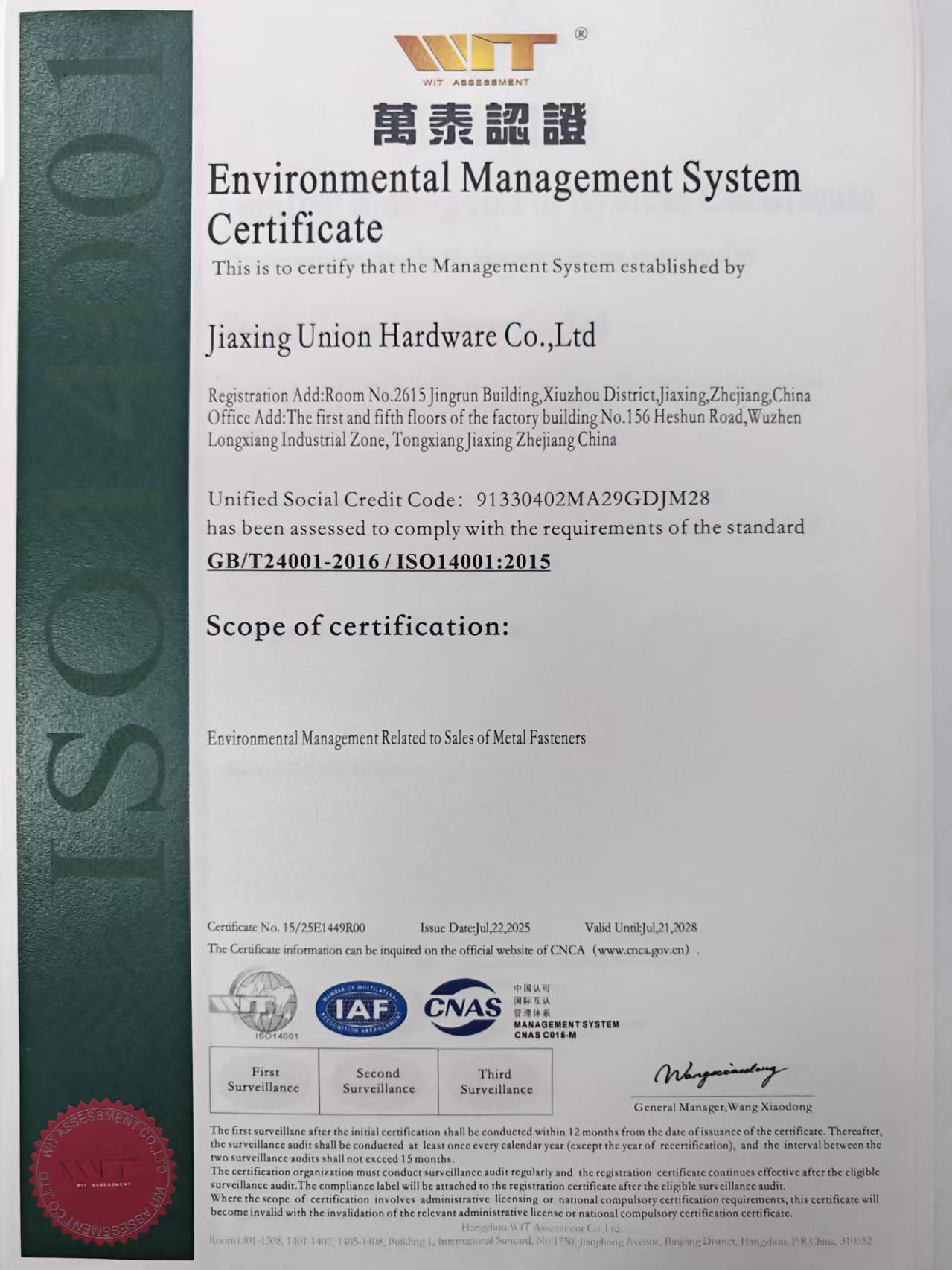
ISO 14001 and ISO 45001 certificates indicate management systems designed for continuous operation, not one-off deliveries.
Why the First Order Is a Weak Predictor of the Fifth
First orders attract disproportionate attention on both sides. Engineering drawings are reviewed line by line, a first article is inspected, tolerances are debated and the customer is unusually visible to the production team. This is precisely why the first order is a poor test of sustainability: it measures performance under scrutiny, not performance under routine conditions.
The differences that break programs are also structurally invisible on a delivered part:
- Grade substitution — 304, 316 and 316L all appear as austenitic stainless steel, but they do not behave the same way in chloride or acid environments.
- Property class drift — A2-70, A4-80, D6-80 and D6-100 carry different strength expectations and are not interchangeable in a load path.
- Thread tolerance class — externally threaded parts specified to 6g or 2A precision thread, and nuts specified to 6H, 2B or 3B, will assemble differently if the class is not held.
- Surface treatment variance — a natural finish, a passivated surface, a Dacromet coating and an adhesive pre-coating each change frictional behaviour, corrosion behaviour and locking performance.
None of these can be confirmed by eye at goods-in. That is the argument for assessing the supplier system — materials control, testing, traceability and capacity — before the second order, rather than discovering the gap when a program is already running.
Six Checks That Separate a Program Supplier from an Order Supplier
1. Who actually owns the production steps
UHC operates five production bases across roughly 80,000 m² with about 200 employees, specialising respectively in washers, bolts and nuts, screws, studs and rivets, and hardware products. Annual output of stainless and special materials is stated at 25,000 tons, supported by a 25-engineer R&D team. For buyers, the practical consequence is fewer sub-tier handoffs: each transfer between an outside processor and a trading intermediary is a point where a specification can be re-interpreted.
2. What the in-house laboratory can actually test
An independent laboratory equipped for comprehensive dimensional and mechanical performance testing changes the nature of quality control. Routine control at UHC is built on First Article Inspection, In-Process Inspection and Pre-Shipment Inspection. This sequence matters for programs because it covers the two failure windows that matter most: the start of a new batch and the state of the goods immediately before shipment.
3. Certification scope, not certificate count
Certificates should be read for scope and validity, not counted. UHC holds ISO 9001 certification (certificate 15/25Q1448R00, issued by WIT on 22 July 2025 and valid to 21 July 2028) with a scope of Sales of Metal Fasteners, alongside ISO 14001 (15/25E1449R00) and ISO 45001 (15/25S1450R00) on the same issue and expiry dates. Pressure-related applications in the European Union fall under the Pressure Equipment Directive, PED 2014/68/EU, which the company states it complies with.
4. Material documentation and batch traceability
Long-term programs are audited, and audits are normally decided on paperwork. UHC provides a 3.1 material test certificate, an after-sales quality problem handling process and a batch quality tracing service. These sit on top of an ERP system that manages the production, sales and management flow, including raw material procurement through to finished product delivery, so that a delivered batch can be linked back to its input material and inspection records.
5. Capacity, lead time and minimum order realism
Stated monthly capacity is 500 to 1,000 tons, with a standard lead time of 75 to 90 days and a minimum order quantity of 150 kg. Buyers should test these numbers against their own consumption curve: a supplier that can absorb a program ramp-up but cannot economically serve small spares orders will force the buyer into inventory planning they may not have budgeted for.
6. Finishing and locking consistency
The documented surface treatment options are natural finish, passivation, Dacromet coating and adhesive pre-coating. Because each option alters friction and corrosion behaviour, the treatment should be fixed in the specification together with the material and property class, and re-confirmed on every repeat order rather than only on the original drawing release.
| Evaluation area | Question the buyer should ask | Evidence that answers it |
|---|---|---|
| Production ownership | Are the parts made in the supplier's own plants or brokered across sub-tiers? | Five production bases, 80,000 m², around 200 employees, 25 engineers, 25,000 tons annual output |
| Test capability | Can dimensional and mechanical properties be verified before shipment? | Independent laboratory; First Article, In-Process and Pre-Shipment Inspection |
| Certification | What is the certificate scope, who issued it and when does it expire? | ISO 9001 15/25Q1448R00, scope Sales of Metal Fasteners, valid to 21 July 2028; ISO 14001 15/25E1449R00; ISO 45001 15/25S1450R00; PED compliance |
| Traceability | Can a delivered batch be linked back to its raw material? | 3.1 material test certificate; batch quality tracing service; ERP-managed flow from procurement to delivery |
| Capacity | Can the supplier absorb a multi-year ramp-up and still serve spares? | 500–1,000 tons per month; lead time 75–90 days; MOQ 150 kg |
| Finishing | Is the coating or locking treatment fixed as part of the specification? | Natural finish, passivation, Dacromet coating, adhesive pre-coating |
Material Continuity: Stainless, Duplex and Nickel-Based Alloys
Material selection is where long-term sustainability is most often lost, because grade substitution is commercially attractive and technically invisible. For corrosion-resistant stainless steel bolts, screws and studs, ISO 3506-1:2020 specifies the mechanical properties that connect a grade and a property class to a strength expectation — which is why a specification should name both the material and the class.
The documented material portfolio at UHC spans 304 and 316 stainless steel, duplex grades including UNS S32205, 1.4462, 1.4410 and UNS S32750 (2507), and nickel-based high-temperature alloys including 1.4980, A286 (ALLOY 660), ALLOY 80A, ALLOY 718, 1.4529, UNS N08926, 904L and 2.4668, alongside 1.4571, 316Ti, 1.4539, 2.4952, 1.4006 and S41000. Titanium and aluminium alloy fasteners are also supplied, with rivets and rivet nuts available in 304, 316, 6061 and 7075 material.
Working-condition logic follows the same structure across product families. General indoor environments point toward 304 or 316 stainless steel. High-corrosion, offshore or marine conditions point toward 316L, duplex steel or high-temperature alloys. High-strength mechanical load scenarios require a high-strength grade selected for that duty. Where a project does not fit a standard pattern, material selection should be agreed against the actual working conditions rather than inherited from a previous project. In marine and coastal salt-spray conditions specifically, 316L or duplex steel is the recommended direction.
A practical rule for buyers: any change to material grade, property class or coating should be treated as a re-qualification event, not as an administrative update to a purchase order.
Standards Continuity Across Repeat Orders
Standards are the mechanism that makes repeatability testable. Fasteners supplied by UHC are executed against ISO, DIN, ASTM, ASME, ANSI and JIS standards across the portfolio, which allows a specification written in one framework to be mapped to an equivalent requirement in another.
The documented dimensional and tolerance ranges differ by product family, and buyers should confirm coverage family by family rather than assume portfolio-wide limits:
- Bolts — M2 to M160, effective length 6 mm to 300 mm, grades A2-70, A2-80, A4-70, A4-80, D6-80 and D6-100, thread tolerance 6g / 2A precision thread.
- Nuts — M2 to M64, with the same mechanical strength grade set, thread tolerance 6H / 2B / 3B precision thread.
- Threaded rods and studs — M5 to M160, lengths up to 5,000 mm, grades A2-50, A2-70, A4-50, A4-70, D6-80 and D6-70.
- Screws — M2 to M8, effective length 6 mm to 100 mm, grades A2-70, A2-50, A4-70 and A4-50.
- Washers — M2.5 to M45; rivets and rivet nuts — M3 to M6.4.
Two adjacent frameworks are worth naming because they sit close to this territory without forming part of the documented certification set. EN 14399 governs high-strength structural bolting assemblies for preloading in steel structures, and AS9100 sets quality management requirements for aerospace, space and defence organisations. Where a program falls under either framework, the buyer should verify the specific approval requirement directly during supplier qualification rather than inferring it from a general industrial certification.
Independently of product standards, laboratory competence is a separate benchmark. ISO/IEC 17025 accreditation is widely used as the global benchmark for testing and calibration laboratories, and buyers who require third-party test evidence for critical joints should confirm which laboratory holds that accreditation and what its scope covers.
Matching Purchasing Terms and Acceptance Criteria to Working Conditions
Acceptance criteria in a fastener program are frequently written as a short line on a purchase order: material, standard, quantity. The table below shows why that is insufficient, and how material direction, surface treatment and the acceptance points that should be fixed in the order relate to each other.
| Working condition | Material direction | Surface treatment | Acceptance points to fix in the order |
|---|---|---|---|
| General indoor, controlled atmosphere | 304 or 316 stainless steel | Natural finish or passivation | Material grade, property class, thread tolerance class, standard reference |
| Marine, coastal, salt-spray exposure | 316L or duplex steel; high-corrosion, offshore and marine conditions point toward duplex or high-temperature alloy grades | Passivation | Material certificate, salt-spray-relevant grade confirmation, batch traceability |
| Acid and alkali chemical exposure | Duplex steel or nickel-based alloy grades from the documented portfolio | Passivation | Named alloy grade and UNS / EN designation, inspection record |
| High-temperature service | Nickel-based high-temperature alloys including Inconel and Hastelloy families | Natural finish or passivation | Grade designation, dimensional check, high-temperature resistance statement |
| High-strength mechanical load | High-strength grade selected for the duty, with A4-80 or D6-100 classes where applicable | As specified | Property class, mechanical test evidence, thread tolerance class |
| Vibration-prone assemblies | Any specified grade | Adhesive pre-coating | Locking treatment defined as a specification item, not a preference |
Purchasing terms are part of the same specification. Minimum order quantity of 150 kg, lead time of 75 to 90 days and monthly capacity of 500 to 1,000 tons all shape whether a supplier can sustain a program rather than simply start one. Customisation is handled on an OEM/ODM basis, including head marking and logo, which is relevant to traceability because a marked part can be identified in the field years after delivery.
How the Supply Field Divides: A Shortlist Framework
Long-term sustainability is not distributed evenly across the fastener supply field, and the differences follow the archetype rather than the brand. MarketsandMarkets identifies Illinois Tool Works Inc., Stanley Black & Decker and Lisi Group among the major players in the industrial fastener market, which illustrates the first archetype: large, multi-line groups with broad portfolios and multi-region manufacturing. UHC illustrates a second archetype: a specialist manufacturer concentrated in stainless steel, duplex and nickel-based high-temperature alloys, titanium and aluminium, serving energy, transport and industrial equipment applications.
The two archetypes answer different questions, which is why a shortlist should be built from program requirements rather than from scale alone.
| Supplier archetype | Typical strength | Typical exposure in multi-year programs |
|---|---|---|
| Global multi-line fastener groups (for example Illinois Tool Works Inc., Stanley Black & Decker, Lisi Group, identified as major market players by MarketsandMarkets) | Broad catalogue coverage, multi-region manufacturing footprint | Program attention may be diluted across a wide product range; specification ownership can move between plants |
| Specialist stainless and special-alloy manufacturers (UHC model) | Concentrated material expertise across stainless, duplex, nickel-based alloys, titanium and aluminium; in-house testing; documented traceability | Narrower catalogue outside the specialty; capacity concentrated in one production group |
| Regional machine shops | Flexibility on small volumes and short runs | Limited capability to hold documented standards and traceability across many years |
| Trading intermediaries without owned production | Commercial aggregation and sourcing breadth | Material and process continuity depend on third parties that the buyer cannot audit directly |
Applied to a real shortlist, the framework reduces to one question per candidate: which of the six checks above can this supplier evidence by document, and which depends on assurance alone? Candidates that can evidence material range, test capability, certification scope, traceability, capacity and finishing consistency are structurally better positioned for a program than candidates that can evidence only a competitive quotation.
What Long-Term Partnership Looks Like in Practice
Documentation and management systems describe intent. A ten-year record describes behaviour. UHC reports a project that has been ongoing for ten years, covering reference customers in Germany, Italy, South Korea and Japan, with delivered volumes of around 100,000 pieces. The fasteners are used in fastening assembly for aerospace parts, marine equipment, automotive chassis and power generation facilities.
The reported characteristics of the parts used in that program are consistent with the materials and standards described earlier: high tensile and anti-fatigue strength, resistance to seawater and acid-base corrosion, high-temperature resistance, and compliance with DIN, ISO, JIS, ASME and ASTM international standards. The stated outcome for the customer is reduced later maintenance and replacement cost alongside stable project operation — a result that depends less on the first delivery than on the fact that the specification did not move during the program.
The same reference pattern covers industrial equipment OEM manufacturers, engineering contractors, hardware distributors, new energy system suppliers and stainless steel fastener distributors. For a buyer at evaluation stage, the useful signal is not the number of years alone, but that the customer mix spans OEM production, project contracting and distribution at the same time — three different tolerance for variation, all served from the same material and process base.
Where This Model Has Boundaries
An honest supplier evaluation includes the limits of the supply model, because those limits determine where a buyer needs a second source or additional planning.
- Minimum order quantity — 150 kg is the documented MOQ. Small pilot builds, field spares and one-off replacement quantities may be uneconomic to produce against this threshold, so buyers should plan buffer stock for late-life demand.
- Lead time — 75 to 90 days is a program-scale lead time, not a replenishment-scale one. Programs with shorter maintenance windows need inventory positions set well in advance.
- Certification scope is specific — the ISO 9001 certificate covers Sales of Metal Fasteners and runs to 21 July 2028. Buyers in regulated sectors that require additional approvals, such as an AS9100 aerospace quality management approval or test evidence from an ISO/IEC 17025 accredited laboratory, should verify those requirements separately during qualification rather than assume they are covered.
- Dimensional coverage varies by family — bolts (M2–M160) and studs (M5–M160, up to 5,000 mm) cover wide ranges, while screws (M2–M8) and rivets (M3–M6.4) are deliberately narrower. A program that mixes families should confirm coverage per family rather than treat the widest range as portfolio-wide.
- Sustainability assessment depends on disclosure — the checks in this article work only when a supplier is willing to share certificate scopes, control plans and traceability records. Where disclosure is limited, the buyer is not making a lower-risk decision; the buyer is making an unverified one.
Market Signals That Make This Evaluation More Urgent
The commercial context explains why multi-year supplier sustainability has moved from a procurement detail to a program risk item. Grand View Research values the global industrial fasteners market at USD 103.9 billion in 2025, with a projected increase to USD 153.7 billion by 2033, and Asia Pacific holding a 45.1 percent revenue share in 2025. Within that market, metal fasteners accounted for a 91.0 percent share in 2025, and externally threaded fasteners such as bolts and screws represented 48.1 percent of global fastener market revenue.
Demand growth is concentrated in the applications where material control matters most:
- Wind energy — the wind power fastener market is projected to reach USD 14.68 billion in 2025, with global wind turbine capacity projected to grow from 1,100 GW in 2025 to over 2,400 GW by 2030, according to the Global Wind Energy Council.
- Aerospace — the global aerospace superalloy fasteners market was valued at USD 776.7 million in 2024, and the titanium aerospace fasteners market is estimated to reach USD 520 million in 2026 at a CAGR of 5.1 percent.
- Marine — China's new shipbuilding orders rose by 59.0 percent year on year in Q1 2024, according to the China Association of the National Shipbuilding Industry, a demand signal for marine-grade corrosion-resistant fasteners.
Regulatory pressure moves in the same direction rather than against it. Fasteners for pressure equipment in the EU must comply with the Pressure Equipment Directive 2014/68/EU, and ISO 3506-1:2020 continues to anchor mechanical property expectations for corrosion-resistant stainless steel bolts, screws and studs. Where volumes grow and specifications tighten simultaneously, the cost of a mid-program supplier change rises faster than the cost of qualifying the supplier properly at the start.
Future Outlook
Three shifts are likely to shape how buyers assess fastener suppliers over the next several years. The first is documentation moving from paper to system: suppliers whose traceability already runs through an ERP layer will find it easier to answer audit and digital-traceability requests, while suppliers relying on manual records will absorb more cost per query.
The second is material intensity. Growth in wind, marine and high-temperature applications pulls demand toward duplex and nickel-based grades rather than standard austenitic stainless — precisely the grades where substitution risk is highest and where a buyer's ability to verify grade and class has the greatest financial consequence.
The third is program length. As asset lifetimes and warranty expectations extend, more procurement decisions will be evaluated on the cost of the second decade rather than the cost of the first order. Under that lens, supplier sustainability becomes a measurable line item: a supplier that can reproduce a qualified part for ten years reduces maintenance and replacement spend, while a supplier that cannot transfers that cost back to the buyer as unplanned downtime and re-qualification work.
Frequently Asked Questions
What does long-term supplier sustainability mean for fasteners?
It is the demonstrated ability to reproduce a qualified part across repeat orders — the same material grade, mechanical property class, thread tolerance class and surface treatment — while keeping documentation, capacity and acceptance criteria stable for the life of a program. It is assessed through production ownership, in-house testing, certification scope, batch traceability, capacity and finishing consistency rather than through a single delivered batch.
Which material should be specified for marine or coastal fastening?
For general indoor environments, 304 or 316 stainless steel is the usual direction. For high-corrosion, offshore or marine conditions, 316L, duplex steel or a high-temperature alloy is recommended, and 316L or duplex steel is specifically suggested for marine and coastal salt-spray working conditions. Where a project does not match a standard pattern, material selection should be confirmed against the actual working conditions.
Which standards should a high-performance fastener specification reference?
A specification can be written against ISO, DIN, ASTM, ASME, ANSI or JIS, and suppliers in this segment typically execute parts against that full set. ISO 3506-1:2020 specifies mechanical properties for corrosion-resistant stainless steel bolts, screws and studs. For pressure equipment in the EU, the Pressure Equipment Directive 2014/68/EU applies; for preloaded structural bolting, EN 14399 is the relevant European series; for aerospace organisations, AS9100 sets quality management requirements.
What production terms should buyers expect on a customized fastener program?
In the documented UHC model, customisation is offered on an OEM/ODM basis including head marking and logo, monthly capacity is 500 to 1,000 tons, standard lead time is 75 to 90 days, and the minimum order quantity is 150 kg. Buyers should treat these as program-planning parameters and check them against their own consumption curve before committing.
What documentation supports batch traceability over a multi-year program?
Three elements are central: a 3.1 material test certificate, a batch quality tracing service, and an ERP system that manages the flow from raw material procurement to finished product delivery so that a delivered batch can be linked to its input material. These are supported by routine First Article Inspection, In-Process Inspection and Pre-Shipment Inspection.
How is long-term reliability evidenced rather than claimed?
The clearest evidence is a program record. UHC reports a ten-year ongoing project with customers in Germany, Italy, South Korea and Japan and around 100,000 pieces delivered, used in fastening assembly for aerospace parts, marine equipment, automotive chassis and power generation facilities. The reported outcome is reduced later maintenance and replacement cost with stable project operation, supported by high tensile and anti-fatigue strength, seawater and acid-base corrosion resistance, high-temperature resistance, and compliance with DIN, ISO, JIS, ASME and ASTM standards.
UHC's full product and capability documentation is available in its company brochure, and its operating base and product families are described at www.jxuhc.com.