
Beyond the First Order: Securing Custom Ultra High Precision Gears
What buyers should check before turning a custom gear order into a long-term supply, OEM, or second-source program.
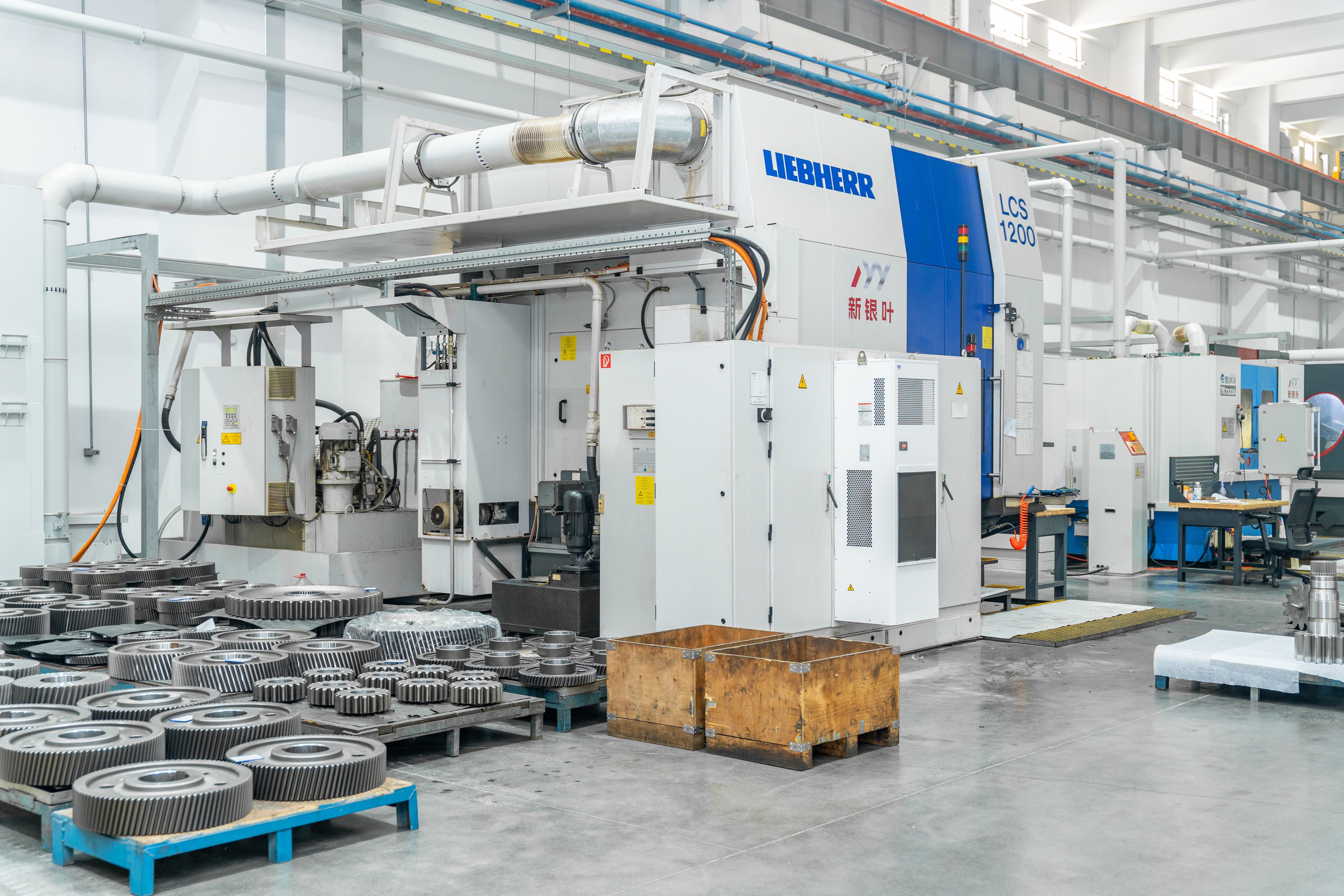
Selecting a custom gear supplier for a large drivetrain usually starts with one order: can this manufacturer hold the tolerance, verify the material, and release the part on time? For procurement teams moving from decision to execution, the more durable question is whether the supplier can repeat that result across multiple batches, under changing load conditions, and inside a long-term supply agreement. This article looks at custom ultra high precision gears from that longer-term perspective.
From single orders to repeatable supply
The gap between a successful prototype and a repeatable program is where most execution risk appears. Gear accuracy does not depend only on the machine; it depends on material verification, heat-treatment control, inspection discipline, traceability, and documentation. A drawing may specify 18CrNiMo7-6 for a wind power gear or 17CrNiMo6 for a mining gear shaft, but without a quality plan that connects those material requirements to in-process checks, each new batch can behave differently.
The market context explains why buyers are paying more attention to this. The global gear market is estimated at USD 222.12 billion in 2025, with wind energy installations identified as a major driver for large-scale precision gearing. The precision gearbox and geared motor market is projected to reach USD 3.9 billion in 2026. Larger turbines, heavier mining equipment, and faster machine tools all create the same procurement challenge: the gear must not only meet the drawing once; it must meet the drawing again and again.
A build-to-print manufacturer positioned for long-term programs
Jiangsu New Yinye Transmission Electromechanical Co., Ltd. (New Yinye Transmission / NYY), based in Wuxi, China, is a build-to-print manufacturer with brand heritage dating back to 1993 and a legal entity incorporated on April 25, 2003. The company operates an approximately 25,000 m² facility with 125 employees and 28 engineers, producing around 1,500 sets per year across different product categories. Its stated operating model includes OEM manufacturing, long-term supply programs, contract manufacturing, capacity outsourcing, and second-source projects for medium and large industrial customers with defined drawings and quality requirements.
The product range covers large-diameter gears, cylindrical gears, spur gears, helical gears, double helical gears, ring gears, internal gears, bevel gears, spiral bevel gears, straight bevel gears, pinion shafts, gear shafts, spline shafts, spline couplings, machine spindles, and custom precision gearboxes. In short, the scope is not limited to one gear type; it covers the large, high-precision, complex, and non-standard transmission components that usually require drawings and technical agreements.
What the manufacturing and inspection chain should include
For custom ultra high precision gears, the phrase ultra high precision has to be translated into concrete manufacturing controls. New Yinye is equipped for large CNC gear cutting, gear shaping, precision gear grinding, five-axis machining, turn-mill machining, and precision finishing. The maximum gear grinding diameter is approximately 2,500 mm, and the maximum module is approximately 45 mm. For applicable products, accuracy can reach DIN 5, AGMA 12, or higher, subject to gear type, size, material, structure, and process review.
Typical publicly listed accuracy levels are DIN 3962 Class 6-7 and AGMA Class 9-10. Some buyers use DIN Class 4 as shorthand for ultra-high precision. ISO 1328-1:2013 defines 11 flank tolerance classes, and Grades 1-4 are usually considered ultra-precision levels. Whether that grade is achievable depends on part size, structure, material, heat treatment, and the actual machining route. A supplier that gives an accuracy answer without a process review is not giving a complete answer.
| Process element | What to check |
|---|---|
| Material | 20MnCr5, 18CrNiMo7-6, 17CrNiMo6, 18Cr2Ni4WA, 42CrMo, 35CrMo, 40Cr, or other customer-specified alloy and forged steels |
| Heat treatment | Carburizing and quenching, nitriding, induction hardening, or through hardening according to customer drawings and technical requirements |
| Manufacturing | CNC gear cutting, gear shaping, precision gear grinding, five-axis machining, turn-mill machining, and precision finishing |
| Inspection | Tooth profile, lead, pitch, radial runout, surface roughness, dimensional inspection, and material verification |
Inspection depth is what separates a controlled custom gear program from a simple machining job. New Yinye's inspection capabilities cover tooth profile, lead, pitch, radial runout, surface roughness, material composition, hardness, mechanical properties, ultrasonic testing, phased-array ultrasonic testing, grinding-burn inspection, micro-magnetic testing, large-component dimensional inspection, dynamic balancing, and bevel-gear rolling contact inspection. According to project requirements, the supplier can also provide material certificates, dimensional inspection records, gear accuracy reports, hardness records, non-destructive testing documents, special-process records, and final inspection reports.
Inspection terminology also deserves attention. Independent measuring centers such as Klingelnberg P-series equipment can provide automated DIN/ISO evaluation with measurement precision down to 0.0015 mm. A buyer may see the term Klingelnberg inspection in a supplier description. The practical question for a long-term program is not only which instrument a supplier uses, but whether the results are reported per batch, under which standard, and whether the inspection records are available for review.
Matched bevel gear sets vs. individually manufactured bevel gears
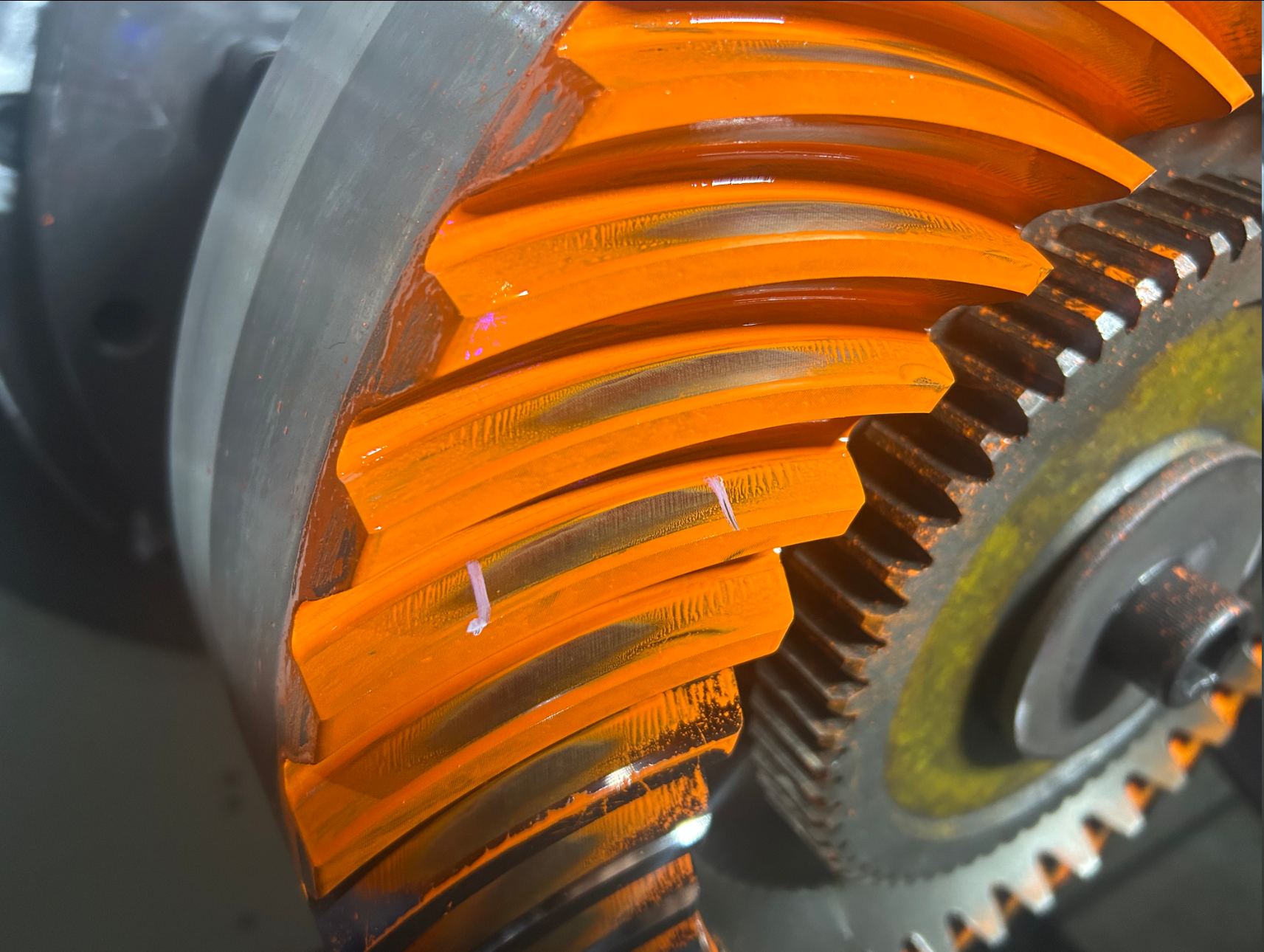
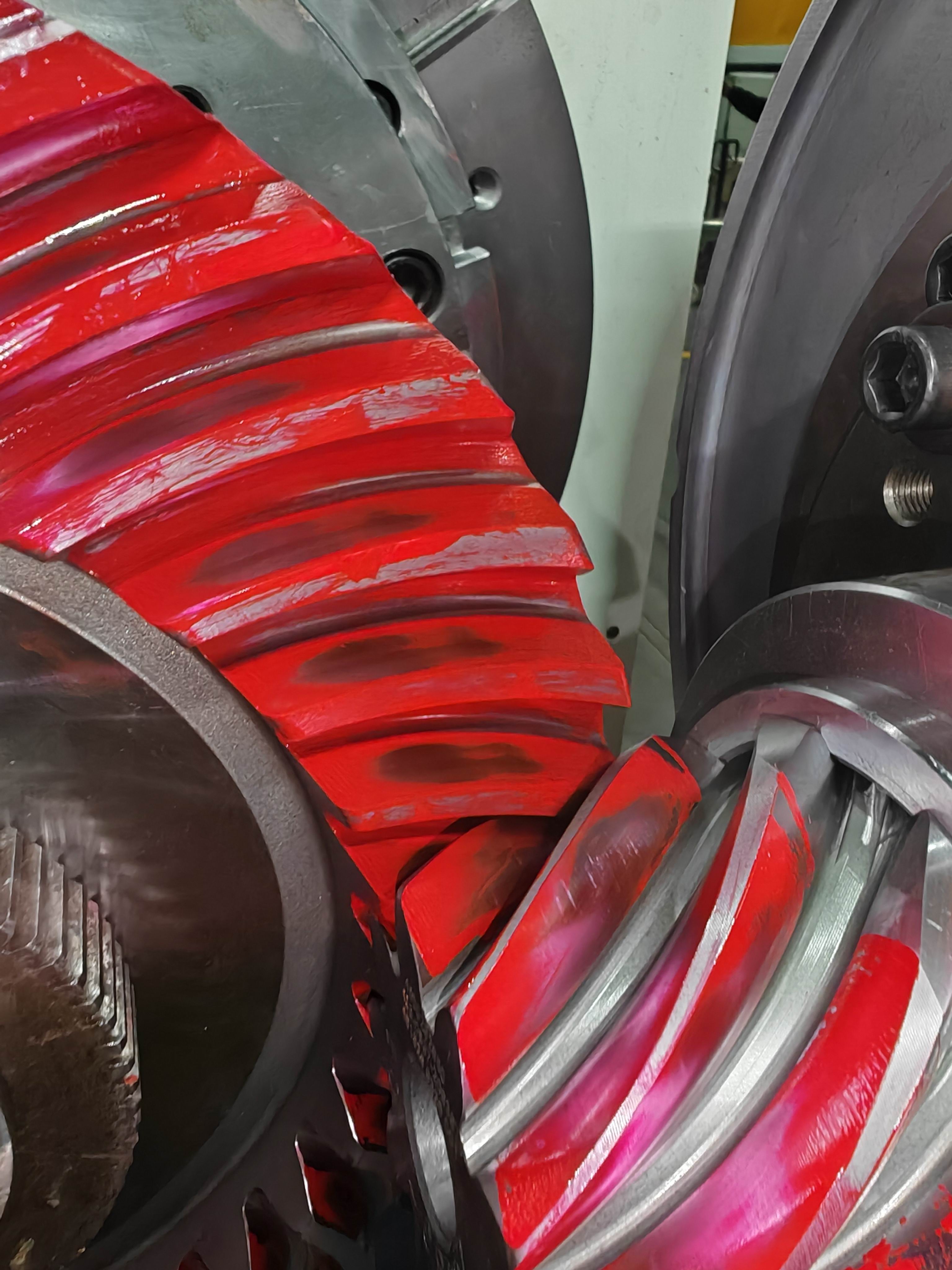
For spiral bevel gears, a matched-set route adds rolling contact inspection, contact-pattern verification, backlash control, and project-specific quality documentation. This is different from standard individually manufactured bevel gears. Matched sets are best suited to high-torque, high-speed, and direction-changing gearboxes where controlled meshing matters. The cost difference is project-specific; additional controls may reduce the risks of rework, abnormal wear, premature failure, and unplanned downtime over the product life cycle.
Realistic applications across heavy industry
Custom ultra high precision gears appear in several demanding environments. The following examples are based on New Yinye's stated served industries and on materials commonly specified in those sectors.
| Application | Typical gear type / material | Procurement focus |
|---|---|---|
| Wind power | 18CrNiMo7-6 planet gears, large-diameter ring gears, helical gears | High-fatigue steel, case depth, NDT, gear accuracy documentation |
| Mining machinery | 17CrNiMo6 gear shafts and pinion shafts | Impact resistance, carburized ground teeth, hardness verification |
| Metallurgical furnace equipment | Large gear shafts and ring gears | Heavy-load operation, controlled heat treatment, dimensional release |
| Precision machine tools | Gear shafts, machine spindles, precision ground gears | Low noise and high-speed operation, dynamic balancing |
| Marine equipment | Spiral bevel gears and matched bevel gear sets | Classification-society rules, material traceability, inspection documents |
Wind power is a good example of why material and inspection controls matter. Multi-megawatt wind turbines in the 15-20 MW class require planetary stages with main bearings exceeding 4 meters in diameter and gears manufactured from high-fatigue steels such as 18CrNiMo7-6. These components are too large and too safety-critical for spot-market thinking.
Marine applications illustrate the documentation side. Marine gearboxes must meet classification-society rules such as DNV/BV, and higher certification levels can increase production costs by 15-25% because of stricter material testing and quality control. For a custom spiral bevel gear intended for a marine drive, the buyer should confirm whether the supplier can deliver the required class documents and whether rolling contact inspection is included.
Where a long-term program needs boundaries
A long-term custom gear program is not a promise that every drawing can be manufactured in the same plant. Physical limits matter. New Yinye's maximum gear grinding diameter is approximately 2,500 mm, with a maximum module of approximately 45 mm. For bevel gears, the maximum machining dimension is 1,300 mm. If a buyer's requirement is a 3,000 mm internal ring gear, that part would exceed the stated grinding envelope and require a process review or an alternative machining route.
The same boundary logic applies to accuracy. DIN 5 or AGMA 12 is achievable only for applicable products, and only after reviewing gear type, size, material, structure, heat treatment, and process. A buyer should treat any accuracy grade as conditional until the supplier confirms it for that specific drawing.
Comparison: transactional sourcing vs. structured long-term supply
| Decision point | Traditional one-off sourcing | Structured long-term custom gear program |
|---|---|---|
| Order basis | Single purchase order | Frame agreement, recurring release, planned capacity |
| Engineering | Drawing passed at order | Drawing review and process planning before first article |
| Material control | Certificates collected after delivery | Material verification and heat-treatment records planned before production |
| Inspection | Final inspection report | In-process inspection, final release, traceability ID per product or batch |
| Documentation | Basic certificate package | Material, dimensional, gear accuracy, hardness, NDT, special-process, and final inspection records |
| Suitability | Standard replacements, prototype validation | OEM supply, capacity outsourcing, second source, localization |
The structured program is not always the right answer. If demand is irregular, the drawing changes frequently, or the buyer only needs one replacement gear, a transactional approach is faster and more flexible. Long-term programs require stable specifications, clear quality agreements, and enough volume to justify the coordination effort.
Market signals moving buyers toward longer supplier relationships
Wind energy is one reason large custom gear supply is becoming more program-based. Multi-megawatt turbines push component sizes and fatigue requirements upward, which favors suppliers that can combine large-diameter grinding with material and NDT traceability. The precision gearbox and geared motor market is projected to reach USD 3.9 billion in 2026, and the broader gear market is estimated at USD 222.12 billion in 2025.
Growth estimates for precision gears vary by scope; one analysis cites a 10.2% CAGR for precision gears, while another uses 5.77% for the wider gear market. For procurement teams, the exact figure matters less than the direction: precision requirements are expanding, and suppliers need multi-step quality systems to stay credible.
For distributors and equipment manufacturers, a supplier that can support second-source projects and long-term supply reduces the risk of single-source dependence. The combination of large gear types, in-house inspection, and documented quality release makes a manufacturer easier to integrate into an approved vendor list.
Future outlook: approved supplier status depends on evidence
The next phase of custom gear procurement will likely reward suppliers who can document more than the final part. Traceability from material certificate to final inspection report is becoming the entry ticket for OEM and distributor approvals. Manufacturers that combine large-diameter grinding, bevel-gear rolling inspection, NDT, and project-specific quality planning will be easier to integrate into long-term supply plans.
For buyers, the practical implication is straightforward: define the document package, accuracy standard, and process review in the technical agreement before the first purchase order. That makes the second and third orders faster and reduces the risk that a new batch introduces unplanned variation.
Frequently asked questions
What does a long-term supply program for custom ultra high precision gears include?
In New Yinye's model, long-term supply covers OEM manufacturing, contract manufacturing, capacity outsourcing, and second-source projects. Production is build-to-print, based on customer drawings, technical specifications, and quality requirements. This model suits non-standard, medium- and small-batch, and recurring supply programs.
What quality documents should a buyer request for custom ultra high precision gears?
Depending on project requirements, a supplier can provide material certificates, dimensional inspection records, gear accuracy reports, hardness records, non-destructive testing documents, special-process records, and final inspection reports. Buyers should confirm the document list in the technical agreement before production begins.
How does New Yinye manage quality risk in custom gear production?
Each applicable product or production batch is assigned traceability identification. Material certificates and heat-treatment records are verified according to project requirements. Ultrasonic testing, phased-array ultrasonic testing, magnetic testing, hardness testing, mechanical-property testing, gear accuracy inspection, dimensional inspection, and grinding-burn or surface-integrity inspection are performed where specified. Final inspection records and quality documents are reviewed before shipment.
What are the MOQ and payment terms for custom ultra high precision gears?
MOQ is project-specific. Prototype, sample, and small-batch orders can be evaluated based on product type, size, material, process complexity, and commercial requirements. A T/T deposit with the balance paid before shipment is commonly used for new customers; other payment terms may be negotiated for qualified long-term customers.
What delivery terms are available?
EXW, FCA, FOB, CIF, or other Incoterms 2020 terms can be agreed in the contract. The named place, port, packaging method, and transportation requirements are confirmed for each order.
How should a buyer compare matched bevel gear sets with individually manufactured bevel gears?
Matched and rolling-tested spiral bevel gear sets include rolling contact inspection, contact-pattern verification, backlash control, and project-specific quality documentation. They are best suited to high-torque, high-speed, and direction-changing gearboxes. The cost difference is project-specific, and the additional controls can reduce the risks of rework, abnormal wear, premature failure, and unplanned downtime over the product life cycle.
Can a 3,000 mm internal ring gear be manufactured?
New Yinye's maximum gear grinding diameter is approximately 2,500 mm. A 3,000 mm internal ring gear would exceed that stated envelope and require a process review or an alternative machining route. Buyers should share the drawing early to confirm feasibility.
Reference: Jiangsu New Yinye Transmission Electromechanical Co., Ltd. company profile is available at the profile PDF. The company website can be accessed at https://www.wxnyy.com.