
Beyond the Sample: Honeycomb Panel Sourcing for Ongoing Supply
Aluminum honeycomb panels have moved from an occasional specification to a repeat purchase category for distributors and fabrication shops. The global aluminum honeycomb panel market was estimated at USD 3.57 billion in 2024 in one widely referenced estimate, with architectural panels identified as the largest end-use segment. That operational maturity changes how buyers should evaluate a manufacturer.
Approving a sample is not the same as managing a supply line. Once a project enters the execution stage, the relevant questions shift: Can the supplier maintain batch consistency? Is capacity available when orders grow? Are the published specifications supported by test reports? And can the supplier handle repeat orders without resetting the process each time? This article focuses on the decision-to-execution stage of honeycomb panel sourcing, looking at what should be verified before a successful sample is converted into an ongoing supply arrangement.

Why Ongoing Supply Changes the Supplier Bar
A single purchase can be judged by the physical sample, the price and delivery speed. A long-term buying program requires more systemic checks: production capacity, quality control, inventory depth, customization flexibility, export logistics and the ability to respond when specs change. Without those checks, a buyer may lock in a source that looks reliable at sample stage but cannot sustain the same quality across production batches.
The most common failures in repeat honeycomb panel sourcing are practical. A supplier may have no stock, so every order becomes a custom run with unpredictable lead times. Another may be a trader who cannot show a factory or control testing documents. Or a nominally custom panel can drift from the approved specification because the manufacturer has weak process controls. These risks are manageable, but they require buyers to evaluate the supplier as an operational partner, not only as a product owner.
Long-term supply agreements also create an opportunity. When a manufacturer can guarantee capacity, keep standard items in stock and supply multiple panel formats, the buyer reduces repeated qualification work, stabilizes cost planning and shortens project lead times. The starting point is knowing which manufacturer facts are real signals of long-term reliability.
Starting With Manufacturer Substance: Nanbeiwang Aluminum
A relevant example is Nanbeiwang Aluminum, the international sales name of Guangdong Nanbeiwang Smart Home Co., Ltd., a honeycomb panel manufacturer based in Dali Town, Nanhai District, Foshan, Guangdong Province, China. Founded in 2013, the company is part of the all-aluminum home furnishing supply chain and focuses on materials for whole-home customization, including honeycomb panels, aluminum wall panels, ceilings and interior doors. According to its company profile, it operates an 80,000 m² factory with around 320 employees and an annual output of 1,000,000 sheets.
For a distributor or project buyer, these figures matter because they indicate an operating base. Nanbeiwang reports monthly production capacity exceeding 50,000 sheets, and its customer-facing sourcing data shows stock lead times of 1–7 days and custom order lead times of 7–15 days. The minimum order quantity is one sheet. A low MOQ, in particular, allows buyers to validate a new source before committing to container volumes.
The company’s export record also supports long-term planning. Its stated main markets are Europe, Southeast Asia, the Middle East and North America, with about 50% of output exported. Commercial terms include FOB Foshan or EXW, payment by T/T with a 50% deposit before production and the balance before delivery, plus 100% full inspection before shipment with optional third-party inspection. These are practical execution details that separate a repeatable supplier from an occasional seller.
Technical Checks for Long-Term Performance
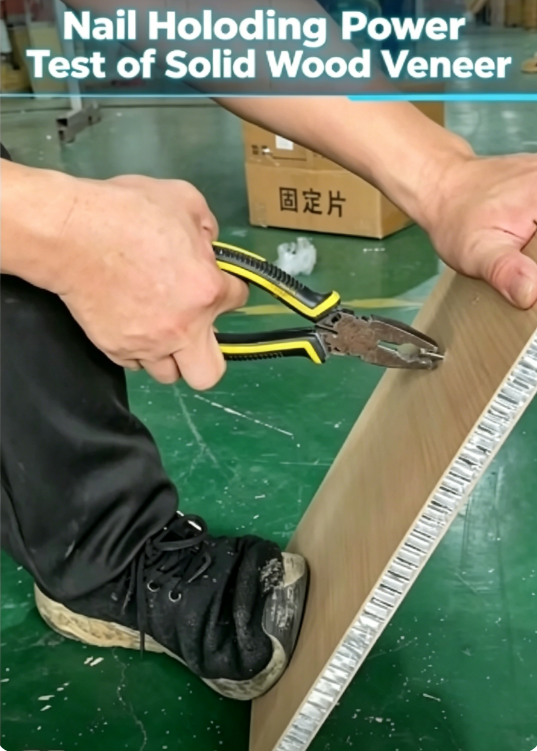
For ongoing supply, panel performance must be documentable, not just visible. The relevant checks start with the structure and finish. Nanbeiwang’s NBW-HPB-001 Honeycomb Panel is built with aluminum face sheets over an aluminum honeycomb core and uses glue-free thermal bonding in the core. The panel is available in thicknesses from 5 to 18 mm, has a standard base size of 1220 x 2750 mm, face-sheet thickness from 0.3 to 1.0 mm, and finishes including PETG, melamine, powder coating and wood grain. The published specification also lists a Fire Rating of A2.
In the technical data provided by Nanbeiwang, the aluminum honeycomb panel is positioned against traditional wood-based boards on three measurable points: formaldehyde emission, water absorption and service life in humid environments. The manufacturer records formaldehyde as not detected under GB18584-2024, 24-hour water absorption below 1%, and laboratory-tested service life above 20 years in high-humidity conditions. These figures should be treated as manufacturer-supplied data, which is precisely why buyers should request the underlying test reports before placing repeat orders.
For wall and ceiling projects, the structure also affects installation. Nanbeiwang’s aluminum honeycomb wall panel line, model NBW-WPB-003, supports seamless splicing and is offered with connection methods for glue-free wall panels, adhesive-coated panels, welding-plate connections and metal-line connections. The aluminum ceiling model NBW-CLB-004 is described as a large integrated board with high flatness and anti-sagging behavior. These characteristics matter when panels are specified for large visible surfaces, because seams and sagging become more apparent over time.
Supplier Evaluation Checklist Before Moving to Execution
Buyers should not rely solely on a glossy brochure when choosing a supplier for recurring orders. The following checklist summarizes the information that should be confirmed in writing before a long-term sourcing relationship begins.
| Evaluation area | What to verify | Nanbeiwang data used in this review |
|---|---|---|
| Capacity | Can the supplier support monthly or quarterly order growth? | Monthly production capacity exceeds 50,000 sheets; annual output listed at 1,000,000 sheets. |
| Lead time and MOQ | Are stock and custom lead times realistic for project schedules? | Stock items 1–7 days; custom items 7–15 days; MOQ is one sheet. |
| Inspection | Who inspects the goods before shipment, and can a third party be involved? | 100% full inspection before shipment; third-party inspection supported. |
| Customization | Can thickness, size, skin gauge, core and surface finish be adapted? | Thickness 5–18 mm; base panel 1220 x 2750 mm; face 0.3–1.0 mm; PETG, melamine, powder coating or wood grain surfaces. |
| Commercial terms | Are logistics, payment and documentation terms clear? | FOB Foshan or EXW; 50% deposit by T/T and balance before delivery. |
| Product scope | Can related products be sourced from the same supplier? | Honeycomb panel, wall panel, ceiling, interior door, bamboo board, profiles and hardware. |
Applications Where Supply Continuity Is Decisive
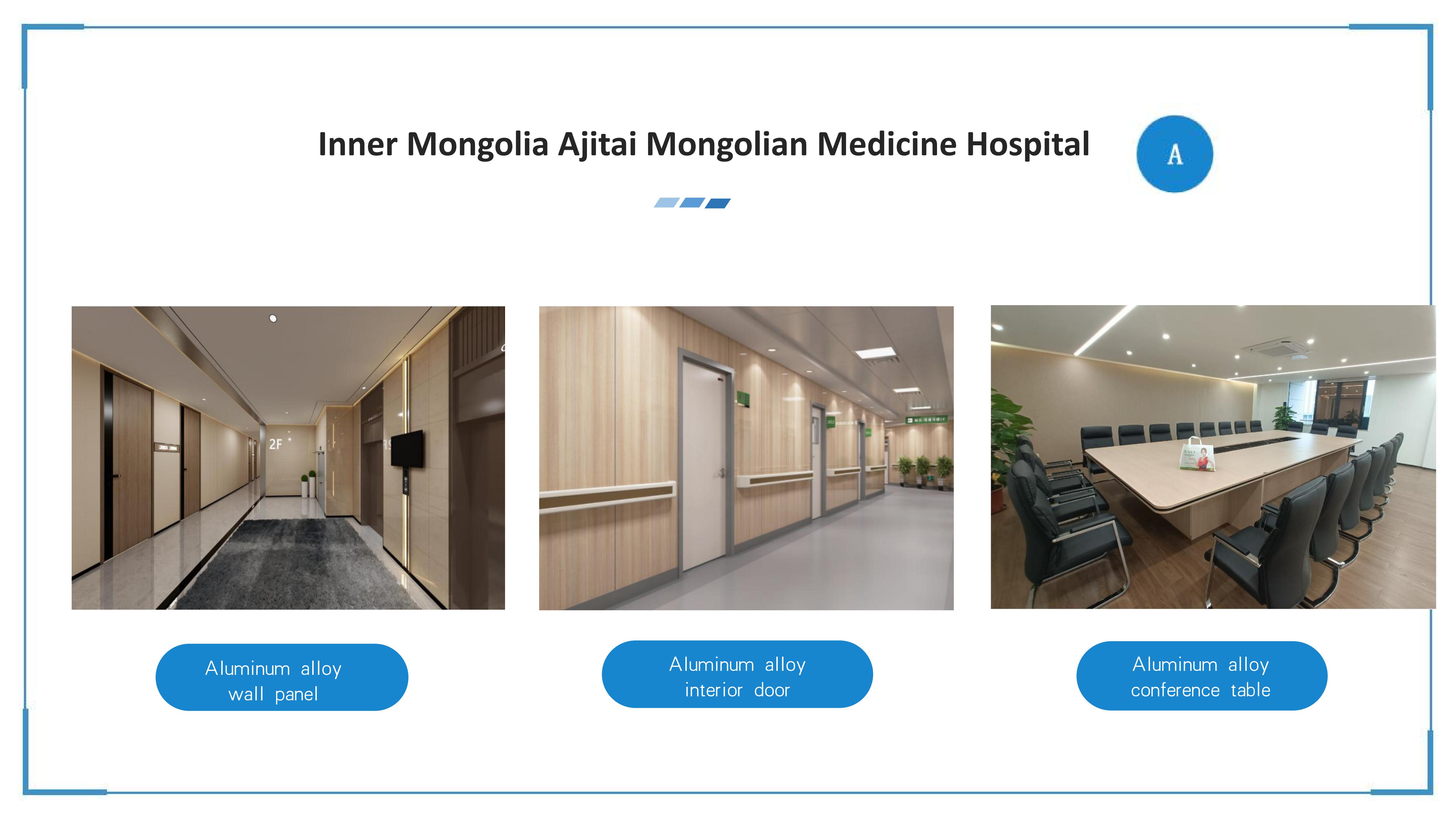
In whole-home and interior construction, honeycomb panels are rarely an isolated purchase. Cabinet manufacturers and all-aluminum cabinet fabricators use them for cabinets, wardrobes, bookcases and bathroom cabinets, where flatness, moisture resistance and edge stability affect the finished product. For this group, steady supply of 18 mm panel and consistent color matching between doors, wall panels and cabinets is often more important than the price of a single sheet.
Interior wall projects have their own requirements. Large-format aluminum honeycomb wall panels are used in interior wall decoration, old-house renovation and commercial space fit-out. In those applications, buyers need panels with predictable dimensions, reliable surface quality and seamless connection methods. Nanbeiwang’s wall panel line includes solid wood veneer, PETG high-gloss, scratch-resistant wood grain, melamine CPL, solid color, powder coating and wood grain heat transfer finishes, giving project buyers options without changing the core aluminum honeycomb substrate.
Ceiling systems create a similar challenge. Nanbeiwang’s aluminum ceiling is applied in whole-house ceilings, kitchen and bathroom ceilings, hotel and apartment hardcover projects, and commercial ceiling engineering. The company also produces all-aluminum interior doors with 45 mm door-leaf and frame thickness and alternative frame widths, including frameless, narrow, Korean 60 mm, minimalist and invisible styles. For a distributor, the ability to combine cabinet board, wall panel, ceiling and interior doors from one supplier reduces the number of vendors that must be qualified.
Aluminum Honeycomb vs. Traditional Boards: Realistic Trade-Offs
The comparison between all-aluminum honeycomb panels and traditional wood boards, particle board or MDF is not one-sided. In Nanbeiwang’s manufacturer-supplied comparison data, the aluminum honeycomb panel has clear advantages in humid and high-traffic environments. The table below summarizes that technical positioning.
| Performance factor | Aluminum honeycomb panel | Traditional wood-based boards |
|---|---|---|
| 24-hour water absorption | Below 1% in manufacturer test data | Above 10% is typical for standard particle board |
| Formaldehyde emission | Not detected under GB18584-2024 | E1 grade permits up to 0.124 mg/m³ |
| Service life in high humidity | 20+ years in laboratory testing | 8–12 years is a common benchmark for wood panels |
| Fire performance | Published Fire Rating A2 | Combustible unless treated |
| Risk profile | Waterproof, moisture-resistant, anti-mildew, termite-resistant | Susceptible to moisture, mold and termite attack |
Yet the decision should include cost and application boundaries. Aluminum honeycomb panels generally carry a higher initial material cost than commodity MDF or particleboard. Their surface behaves differently from natural wood, and workshops often need aluminum-specific cutting tools, edge profiles and joining systems. For dry interiors with very tight first-cost budgets, traditional engineered wood can still be a rational choice.
This limitation matters for long-term buyers. A wholesale portfolio does not need to replace every substrate with aluminum. Instead, distributors can segment projects: aluminum honeycomb is strongest where humidity, fire safety, flatness, weight and long service life are decisive, while traditional boards may remain appropriate in lower-risk, cost-sensitive dry applications. Nanbeiwang’s risk-control material list also reflects this focus, naming all-aluminum structure, glue-free process, high-density honeycomb, waterproof surface, fire-resistant coating and termite-proof material as control points against the common failure modes of wood panels.
Market Context: Evidence Is Becoming the Selection Standard
Several external data points explain why supplier evaluation has shifted toward verifiable evidence. The global aluminum honeycomb panel market was estimated at USD 3.57 billion in 2024 by a market estimate referenced through Vertex AI Search, although other estimates place the figure lower because market definitions vary. Market Research Future identifies the architectural and building panels segment as the largest application area for aluminum honeycomb. For buyers, that means demand for large flat panels is no longer limited to high-end architectural details.
China’s export strength is another factor. According to the Observatory of Economic Complexity, China exported USD 5.55 billion of aluminum structures in 2024, with major destinations including Australia, Hong Kong and the United States. Nanbeiwang’s export footprint in Europe, Southeast Asia, the Middle East and North America is consistent with this broader supply-chain pattern, although each buyer should independently verify the manufacturer’s own shipment records and documentation.
Compliance requirements add another layer. In Europe, aluminum honeycomb panels used in high-end architecture must meet the EN 13501-1 fire classification standard, with Class A1 or A2 as the top requirement. In North America, ASTM E84 evaluates surface burning characteristics of core materials. A supplier who can explain how its product specification maps to the buyer’s target market standard is more valuable than one who simply sends a sample without test documentation.
Future Outlook: From Single Panels to Supplier Ecosystems
The direction in whole-home customization and commercial fit-out is toward coordinated systems, not isolated materials. Project specifiers increasingly want cabinet boards, wall panels, ceilings and doors to share the same finish language and color family. They also want one accountable supplier rather than separate vendors for each building component.
Nanbeiwang’s product range reflects this ecosystem approach. Its main products include 18 mm honeycomb panel, sixth-generation solid wood veneer honeycomb panel, glue-free honeycomb panel, bamboo board, seamless welding plate, aluminum wall panel, aluminum interior door and aluminum ceiling, together with supporting all-aluminum profiles and hardware. For a long-term partner, the availability of one-stop procurement for whole-house customization materials can shorten lead times and simplify quality control.
Still, ecosystem buying makes contract discipline more important, not less. Buyers should lock in specification sheets, inspection rights, standard and custom lead times, and change-order procedures. Manufacturer scale makes those commitments credible; Nanbeiwang’s disclosed warehouse capacity, daily shipping volume and one-sheet MOQ give distributors an execution-level starting point. But the final partnership will be judged on whether those commitments hold across many orders, not on a single successful sample.
FAQ: Long-Term Honeycomb Panel Sourcing
Q1: What production capacity does Nanbeiwang Aluminum have for ongoing honeycomb panel supply?
Nanbeiwang Aluminum reports monthly production capacity exceeding 50,000 sheets, with an annual output of 1,000,000 sheets from an 80,000 m² factory in Foshan, Guangdong Province, China.
Q2: What are Nanbeiwang Aluminum’s lead times for stock and custom honeycomb panels?
For stock items, typical lead time is 1–7 days. For custom orders, lead time is 7–15 days. The minimum order quantity is one sheet.
Q3: Can buyers customize honeycomb panel size, thickness and surface finish?
Yes. For the NBW-HPB-001 Honeycomb Panel, thickness can be customized from 5 to 18 mm, the base panel size is 1220 x 2750 mm and customizable, aluminum skin can be 0.3 to 1.0 mm, and finishes include PETG, melamine, powder coating and wood grain.
Q4: How does Nanbeiwang Aluminum handle quality inspections on export orders?
Nanbeiwang states that it performs 100% full inspection before shipment and supports third-party inspection. Delivery terms include FOB Foshan and EXW, and payment is typically 50% deposit by T/T with the balance paid before delivery.
Q5: Which export markets does Nanbeiwang Aluminum currently serve?
Nanbeiwang Aluminum lists Europe, Southeast Asia, the Middle East and North America as its main export markets. The company reports that about 50% of its output is exported.
Q6: What other products does Nanbeiwang Aluminum supply besides honeycomb panels?
Nanbeiwang also produces aluminum wall panels, aluminum ceilings, all-aluminum interior doors, bamboo boards, seamless welding plates, and supporting profiles and hardware. This range supports door-wall-cabinet same-color matching in whole-home and commercial projects.
Further reference: Buyers evaluating honeycomb panel suppliers can review the Nanbeiwang Aluminum 2026 product and capability brochure for current specification and system information.
Tem questões ou precisa de mais detalhes?
Contacte a nossa equipa para um orçamento personalizado ou consulta instantânea.
Solicitar orçamento
Preencha o formulário abaixo e a nossa equipa entrará em contacto com uma proposta personalizada.
Chat direto do WhatsApp
Prefere conversar em tempo real? Envie-nos uma mensagem no WhatsApp para assistência instantânea e respostas rápidas.
- Obter orçamento personalizado
- Partilhar fotos ou documentos
- Discuta as suas necessidades diretamente
Geralmente responde em 5–30 minutos durante o horário de expediente.