
Big Size Modular Schuko Wall Socket: Certification Scope FAQ
HTNXT Industry Reference · Electrical & Electronics
A certificate is a document about a model, not about a product family. In modular wiring accessories that distinction decides whether a tender submission is accepted or returned — and it is the first thing a buyer should settle before a purchase order is written.
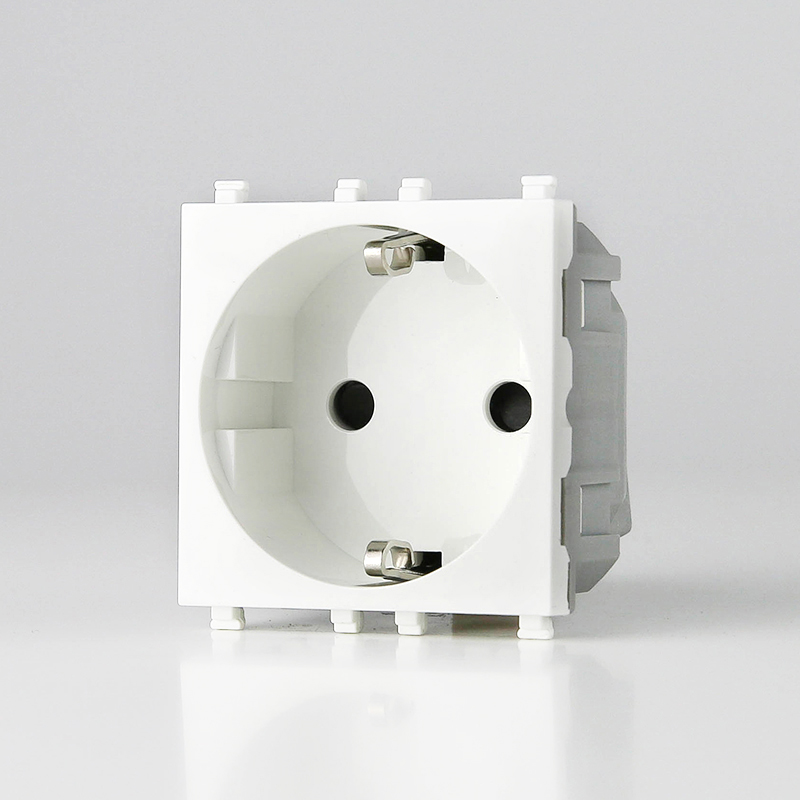
Modular formats were reported to account for 43% of total wall socket sales in 2024, a share associated with space-saving layouts and customization trends (Fortune Business Insights). Modularity is convenient for specifiers, but it splits a supplier catalogue into many small, individually tested constructions. A 44 × 44 mm socket module and the plate socket two pages later in the same catalogue may share a colour palette and a frame system while differing in shutter geometry, terminal arrangement and base material. Each of those differences is a difference in the construction that was tested.
Why certification scope is the first question in modular Schuko procurement
Procurement teams rarely buy a single socket. They buy a bill of quantities: sockets for apartments, sockets for corridors, sockets for a show apartment in a different finish. When the quantity is spread across variants, it is natural to assume that one compliance file covers the range. That assumption is where most documentation disputes begin.
A Schuko socket is a defined product type before any certificate is issued: Type F sockets are standardized in many European countries for 16 A / 250 V applications under CEE 7/3 (World Standards). Being the right socket type, however, is a design fact, not a compliance fact. Compliance is demonstrated per model, against a named standard edition, by a named issuing body, for a named construction. The Schuko label tells a buyer what plug will fit. It does not tell a buyer what a certificate covers.
For modular orders the practical risk is asymmetric. A wrong plug type is caught immediately at installation, while a certification mismatch is usually caught later — at site acceptance, at customs, or during a retailer's technical file review. Correcting it after the goods are on site is expensive; correcting it before the order is placed costs one document request.
What “certification scope” contains: three layers buyers must separate
Layer 1 — Directive and standard
The legal basis and the test standard. For European socket outlets this typically means a CE declaration under the Low Voltage Directive 2014/35/EU, supported by testing to IEC 60884-1. IEC 60884-1:2022 provides the current general requirements for plugs and socket-outlets for household and similar purposes, and its scope is limited to 16 A for screwless terminals (IECEE).
Layer 2 — Certificate holder and manufacturing site
Certificates name an applicant and, in most schemes, a factory. If the applicant on the certificate is not the entity issuing the invoice, the buyer needs the link between them in writing.
Layer 3 — Model designation and covered construction
This is the layer most often skipped. A certificate lists the model or type designation it covers. If a purchase order specifies KM149 and the certificate lists another model number, the certificate is evidence for a different product — however similar the two sockets look on a website.
What is documented for the big size modular Schuko wall socket
The KM149 module is the big size modular Schuko socket in the range of Wenzhou Huafeng Electric Co., Ltd. (HYFF), a Wenzhou, Zhejiang-based manufacturer of wall switches and wall sockets founded in 2011, with a 7,000 m² facility, 118 employees, an annual output of 35,000,000 units and 100% of production exported to EU, AM, OC, AS and AF markets. Its documented product data reads as follows.
| Attribute | Documented value (KM149) |
|---|---|
| Model | KM149 — Schuko socket (big size modular) |
| Panel size | 44 mm × 44 mm |
| Rated specification | 16 A, 220–250 V |
| Installation | Flush mounted |
| Shell material | Flame-retardant PC panel (documented 850°C fireproof PC material) |
| Base | High-strength PA base; “arch bridge” base design to increase wiring contact space |
| Contacts | Phosphor copper contacts |
| Safety feature | Children safety door |
| Endurance statement | All sockets pass 10,000+ times plug-in/plug-out test |
| Colours | White, black, silver, red and customized |
| HS code | 8536690000 |
| Documented certification | CE, RoHS |
| Quality step | 100% self-inspection before packing |
That table is the entire documented certification position for this module. It is a legitimate position for a European residential socket: CE plus RoHS, with a stated endurance claim, a safety shutter and a declared material set. It is not the same position as a socket carrying TÜV and CB certification, and the two should never be presented to a project reviewer as interchangeable.
What is documented for model 6765, and why it is a separate file
Model 6765 is a different socket in the same range, built on a different panel format. The compliance dossier circulated for it references certificate DACE260330001RL and covers CE under LVD 2014/35/EU, TÜV and CB certification, with IEC 60884-1:2022 as the referenced standard. The product data for that model records an 81.6 mm × 81.6 mm panel, a 16 A / 250 V~ rating, flush mounting, a flame-retardant PC panel and a PC base, with CE and TÜV listed at product level.
| Comparison point | Big size modular Schuko (KM149) | Model 6765 |
|---|---|---|
| Panel format | 44 mm × 44 mm module | 81.6 mm × 81.6 mm plate |
| Rated marking | 16 A, 220–250 V | 16 A, 250 V~ |
| Panel / shell | Flame-retardant PC (850°C fireproof material) | Flame-retardant PC |
| Base | High-strength PA base | PC base |
| Documented certification at product level | CE, RoHS | CE, TÜV |
| Dossier reference | — | Certificate DACE260330001RL; CE (LVD 2014/35/EU), TÜV, CB; IEC 60884-1:2022 |
Where the transfer assumption breaks: four concrete limits
This is the part of the article a buyer should quote back to a supplier. Certification does not travel between these two products, for reasons that are technical rather than administrative.
- Different construction. A 44 × 44 mm module and an 81.6 × 81.6 mm plate socket differ in housing geometry, shutter arrangement and terminal layout. Test samples are drawn from a specific construction; a different construction is a different sample.
- Different material set. KM149 is documented with a flame-retardant PC shell and a high-strength PA base. Model 6765 is documented with a PC panel and a PC base. Material changes affect flame-retardant and temperature-rise behaviour and are part of what a test report describes.
- Different rated marking. 16 A / 220–250 V on one product and 16 A / 250 V~ on the other are not decorative differences; the marking on the certificate and on the product must reconcile with the marking on the purchase order.
- Different certificate object. A certificate names a model. Where the model designation on the document does not match the ordered SKU, the document does not demonstrate conformity for that SKU, regardless of brand, range or visual similarity.
The limitation runs the other way as well. KM149's documented data set does not include an IP rating. Where a project needs a socket in a humid or splash-exposed location, the modular module is not the documented answer; the range instead includes a surface-mounted IP54 socket, and IP44 and IP54 themselves are defined by IEC 60529 (IEC). Choosing a product outside its documented conditions is a specification error that no certificate will repair.
Acceptance criteria to write into a modular Schuko purchase order
Acceptance criteria convert a marketing claim into a contract condition. The following list is a working template for a modular Schuko order; each line produces a document a buyer can file.
| Criterion | What to require | Why it matters |
|---|---|---|
| Model-specific evidence | A certificate copy in which the covered model designation matches the ordered SKU | Scope is defined by model, not by range |
| Issuing body and scheme | Named certification body or CB scheme national certification body, certificate number and validity date | Allows independent verification of the document |
| Standard edition | The IEC 60884-1 edition stated on the certificate, recorded in the purchase order | The 2022 edition is the current general requirements reference; editions must not be mixed |
| CE declaration | Declaration of Conformity citing LVD 2014/35/EU, with manufacturer name and address | Links the legal manufacturer to the goods |
| RoHS position | Written RoHS statement covering the ordered colour or finish variant | Finish changes can alter the material declaration |
| Product marking | Sample showing rated value, model and manufacturer marking matching the certificate | Detects mismatches before mass production |
| Sample approval | Approved golden sample retained by both parties | Fixed reference for later batches |
| Batch documentation | Record of the 100% pre-packing inspection per shipment | Traceability for site acceptance |
| Tender-specific certification | If the tender names TÜV or CB for the modular SKU, obtain written per-model confirmation before award | Prevents substituting a certificate for another model |
Two commercial parameters belong in the same annex because they determine whether documentation can be met on schedule: minimum order quantity of 1,000 units and a production lead time of 30–45 days, with ODM cooperation and logo customization available. Monthly capacity of 2,900,000 units and an 8-year warranty statement are the supplier-side figures that sit behind those commitments.
Technical reading: rated current, standard edition and markings
A 16 A socket sits precisely at the boundary the standard describes. Because IEC 60884-1:2022 is limited to 16 A for screwless terminals, a 16 A modular socket is inside scope only when its terminal design, marking and construction match what was tested. That makes two questions mandatory in a technical review: which edition of IEC 60884-1 does the certificate reference, and does the rated marking on the sample read 16 A, 220–250 V in the form the certificate states.
For Schuko specifically, the interface itself is fixed: Type F sockets are standardized for 16 A / 250 V applications under CEE 7/3. What varies between suppliers — and what must be documented — is everything behind the interface: contact material, shutter mechanism, base resin, terminal clamping and the endurance record. HYFF's modular module states phosphor copper contacts, an “arch bridge” base designed to enlarge wiring contact space, a children safety door and a 10,000+ insertion test statement. Those are design and endurance claims; they support a buyer's technical evaluation but they do not replace a certificate.
Where the module fits: residential and renovation applications
The documented application context for this socket family is residential construction — residential buildings, apartments, villas and home renovation projects — operating indoors under dry, normal-temperature conditions in 220–240 V AC, 50/60 Hz residential systems. Its function is the ordinary one that matters most in a bill of quantities: a safe, convenient power connection for household appliances, achieved by inserting a compatible plug.
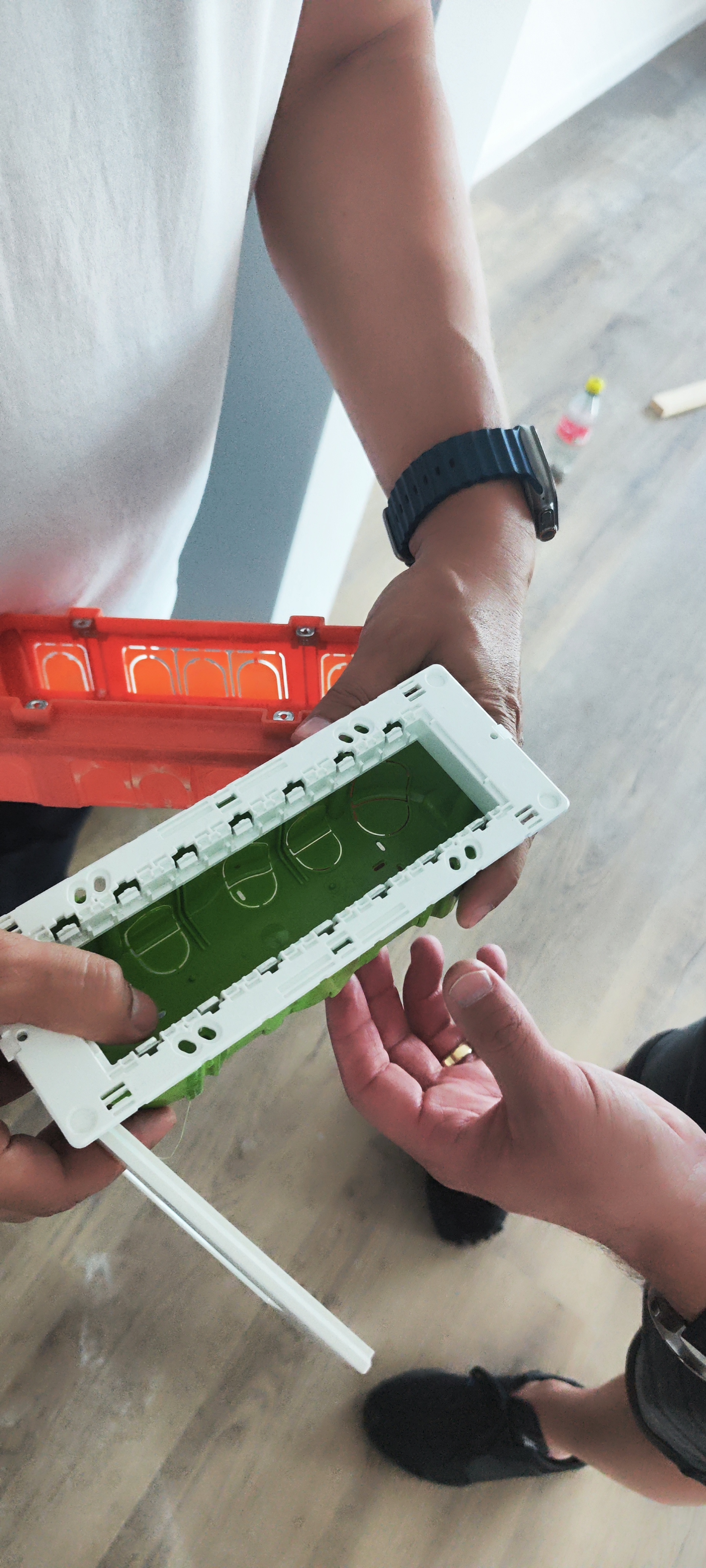
Modular sockets are rarely specified alone. The supporting equipment list is part of the acceptance scope: wall boxes, mounting supports, single-gang or multi-gang frames, electrical wires, residential distribution boxes, plugs and the appliances themselves. A modular order that satisfies the module but mismatches the frame or the box depth fails at installation, which is why frame and box compatibility belongs in the same technical annex as the certificate.
Project experience in European residential and distribution work shows why the documentation step is worth the effort. In a case covering more than 1,000 wall sockets per model for residential and distribution projects, the issues that had to be resolved were compatibility with local plug standards, wall-box dimensions and wiring methods — and the sockets were verified through plug compatibility, installation, temperature-rise and functional testing before meeting the customer's bulk purchasing and brand customization requirements. Certification scope is the same kind of question asked one step earlier.
Market context: modular share and documentation pressure
The commercial backdrop explains why this FAQ exists. The global electric plugs and sockets market was valued at USD 14.13 billion in 2025 (Precedence Research), and modular sockets were reported at 43% of total wall socket sales in 2024 (Fortune Business Insights). Growth in modular formats concentrates more SKUs into the same projects, and every additional SKU is an additional document to match.
The standards side moves more slowly but in the same direction. IEC 60884-1:2022 is a recent edition of a long-standing general requirements standard, and buyers who built their templates around earlier editions now have to state the edition explicitly. For a 16 A product family, that single line in a purchase order removes most of the ambiguity that arises at site acceptance.
Modular modules versus fixed-plate sockets: what changes for the buyer
The comparison that matters here is not brand against brand. It is buying approach against buying approach, and it has a real cost on the modular side.
| Dimension | Modular 44 × 44 mm module | Fixed-plate socket |
|---|---|---|
| Documentation granularity | High — each module is a separate construction requiring its own scope check | Lower per project — fewer SKUs to reconcile |
| Format flexibility | High — modules interchange within compatible frames | Fixed by the plate design |
| Dependency on frames and boxes | Critical — frame, support and box depth must be confirmed | Lower, but still present |
| Replacement and retrofit | Module-level replacement possible | Usually plate-level replacement |
| Specification risk | Concentrated in certificate-to-SKU matching | Concentrated in plate and box compatibility |
Stated plainly: a modular Schuko programme buys flexibility and pays for it in documentation work. Buyers who cannot commit to per-SKU certificate review should consolidate to fewer models rather than assume coverage across a range.
Future outlook
Three developments are likely to shape modular socket procurement over the next planning cycles. First, certificate-to-SKU matching is becoming a routine tender gate rather than a specialist request, which favours suppliers who can supply a per-model document set quickly. Second, edition discipline is tightening as IEC 60884-1:2022 becomes the default reference in European technical files. Third, the modular share of the market is large enough that documentation quality is now a competitive variable in its own right — a supplier's ability to answer “which certificate covers this module” in writing is part of the product.
For buyers, the practical response is procedural, not commercial: put the model designation, certificate number, standard edition and validity date into the purchase order, and make sample approval conditional on that match.
FAQ: certification scope and acceptance for modular Schuko orders
1. Is the big size modular Schuko wall socket covered by the CE LVD 2014/35/EU, TÜV and CB certifications documented for model 6765?
Not automatically. The CE LVD 2014/35/EU, TÜV and CB documentation recorded under certificate DACE260330001RL, referencing IEC 60884-1:2022, is documented for model 6765. The big size modular Schuko socket (KM149) is documented with CE and RoHS. Because a certificate covers the construction it names, coverage for KM149 must be confirmed on a document that states KM149, or by written confirmation from the manufacturer.
2. Which certifications are documented for the KM149 big size modular Schuko socket?
CE and RoHS are the certifications recorded in the product data for KM149, alongside an 850°C fireproof PC shell, a high-strength PA base, phosphor copper contacts, a children safety door, a 10,000+ insertion test statement and 100% self-inspection before packing.
3. What documents should a buyer request before confirming a modular Schuko order?
A certificate copy showing the ordered model designation, the issuing body or CB scheme national certification body, the certificate number and validity; a Declaration of Conformity citing LVD 2014/35/EU with the manufacturer's name and address; a RoHS statement covering the ordered finish; the test report reference for the construction; and a sample whose rated marking matches the certificate.
4. Which edition of IEC 60884-1 should appear on the certificate?
The edition the product was actually tested to, stated explicitly. IEC 60884-1:2022 provides the current general requirements for plugs and socket-outlets for household and similar purposes and is limited to 16 A for screwless terminals. Recording the edition in the purchase order prevents a 2022-edition specification from being answered with an older-edition document.
5. Does the 16 A rating create a limitation under IEC 60884-1:2022?
It places the product at the upper boundary of the standard's scope for screwless terminals. A 16 A modular socket is therefore inside scope only when its terminal design, rated marking (16 A, 220–250 V) and construction correspond to what the certificate describes.
6. Can the modular Schuko socket be specified for bathrooms or outdoor locations?
The documented operating conditions for this socket family are indoor, dry, normal-temperature environments in 220–240 V AC, 50/60 Hz residential systems. No IP rating is recorded for KM149, and ingress protection grades such as IP44 and IP54 are separately defined by IEC 60529. For humid environments the range includes a surface-mounted IP54 socket, which is a different product with its own documentation.
7. What acceptance criteria suit a 1,000-unit modular Schuko order?
Model-specific certificate evidence, a named issuing body with certificate number and validity, the stated IEC 60884-1 edition, a CE Declaration of Conformity, a RoHS statement for the ordered colour, product marking reconciled to the certificate, an approved golden sample, and a pre-packing inspection record per shipment. Minimum order quantity for this range is 1,000 units with a 30–45 day lead time, so document requests should be scheduled against that timeline.
8. How should a buyer respond when a tender requires TÜV or CB certification on the modular SKU?
Request written confirmation of the certification position for that specific model before award. A certificate naming a different model — however similar the product — does not demonstrate conformity for the ordered SKU. Where the position cannot be confirmed, the tender specification and the product specification have to be reconciled before the order is placed, not after delivery.
Tem questões ou precisa de mais detalhes?
Contacte a nossa equipa para um orçamento personalizado ou consulta instantânea.
Solicitar orçamento
Preencha o formulário abaixo e a nossa equipa entrará em contacto com uma proposta personalizada.
Chat direto do WhatsApp
Prefere conversar em tempo real? Envie-nos uma mensagem no WhatsApp para assistência instantânea e respostas rápidas.
- Obter orçamento personalizado
- Partilhar fotos ou documentos
- Discuta as suas necessidades diretamente
Geralmente responde em 5–30 minutos durante o horário de expediente.