
Black Industrial HDPE Sheet: Grades, Thickness, Compliance
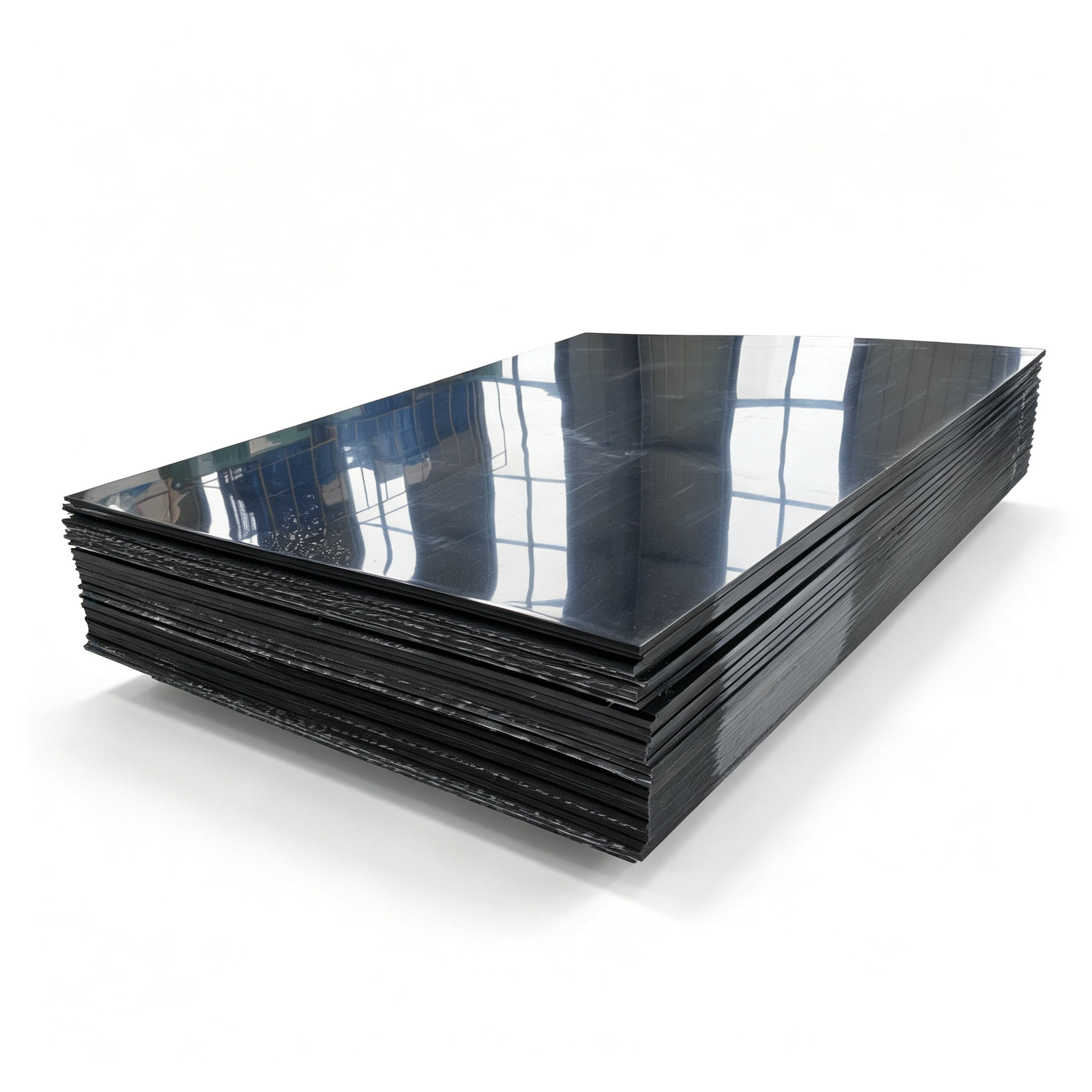
Black industrial HDPE sheet is normally specified late in a project — after the tank, panel, jig or wear part it belongs to has already been designed. By the time a buyer opens a supplier data sheet, the real question is rarely whether high-density polyethylene suits the duty. It is whether one particular sheet, in one particular colour, thickness and grade, can be accepted without re-engineering the job.
That makes black HDPE board a constraints problem rather than a discovery problem. The purchase turns on a small set of variables — thickness, sheet format, resin grade, surface texture and the paperwork that travels with the shipment — and on how precisely each of those variables is written into the RFQ.
Colour adds one extra layer of ambiguity. Black is a standard option inside an HDPE sheet range, not a material specification. The same black surface can sit on virgin resin, on recycled feedstock or on a UV-stabilised formulation, and the colour alone will not tell a buyer which of the three they are looking at.
Why black HDPE board is easy to buy badly
Demand for the product is not the difficulty. HDPE sheet is used wherever a panel has to resist moisture, dilute chemicals or repeated mechanical contact while staying light enough to be handled and machined. The difficulty sits on the supply side, where several descriptors that buyers rely on are not standardised across suppliers.
- Wear resistance is often stated without a test method, so two suppliers can both claim it while measuring different things.
- UV resistance is frequently inferred from colour, even though stability comes from the formulation rather than the pigment alone.
- Food grade is used as a product label, while the underlying compliance evidence sits with the resin, the additives and the specific market.
- Recycled content is not defined uniformly, so a percentage figure can mean different things at different factories.
- Marine grade, anti-corrosion grade and impact grade are commercial categories that become meaningful only when the buyer states the service condition they are meant to satisfy.
The practical consequence is that the main procurement risk in this category is not price. It is accepting a description that no supplier can be held to, because no measurable requirement was ever written down.
What Sanyou manufactures, and where black fits
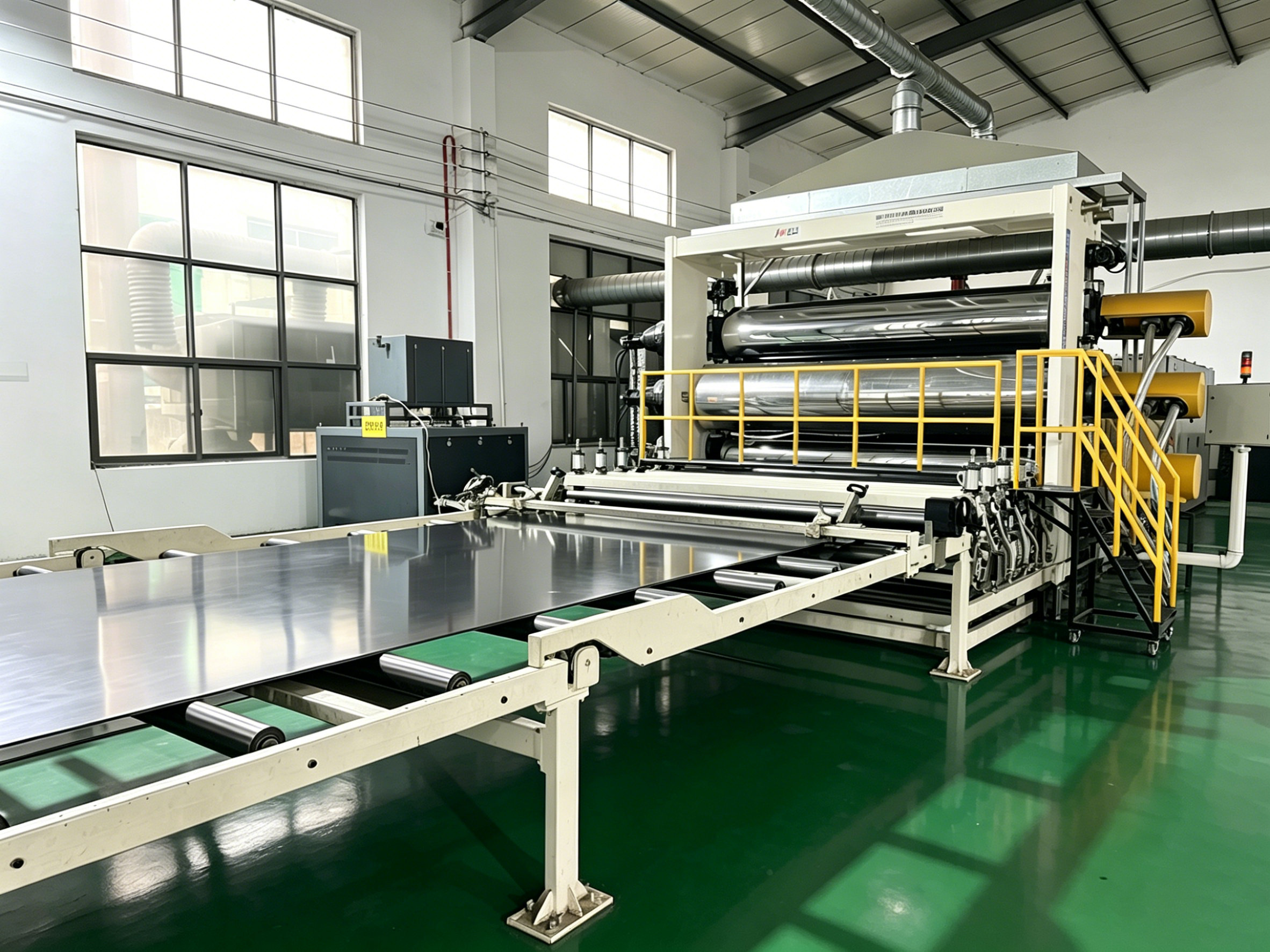
Tangyin Sanyou Engineering Plastic Co., Ltd. is an engineering plastics manufacturer based in Tangyin County, Henan, China. The company produces HDPE sheet, UHMWPE sheet, PP sheet, HDPE sandwich board and ground protection mats for industrial applications. Founded in 2001, it operates a 40,000 m² facility with an annual output of 120,000 tonnes, a 10-engineer R&D team and an export share of approximately 70% across North America, Western Europe, Central Europe, the Middle East, Oceania and Southeast Asia.
Inside the HDPE sheet range, black is one of the listed colour options alongside white, blue, green, yellow and custom colours. It does not map to a separate resin system or a separate forming route. Black board is supplied from the same extrusion-based sheet programme and the same nominal thickness band as the other standard colours, which means a colour change is a configuration decision rather than a change of product family.
Two practical consequences follow. First, a black sheet can be quoted as virgin, recycled or UV-stabilised, so the grade line of an RFQ matters more than the colour line. Second, because colour is decoupled from grade, a buyer can usually specify black for visibility, UV-pigment reasons or brand consistency without losing access to the underlying material options.
How to read a black HDPE sheet specification table
For the HDPE sheet product range (model PE300), the published technical parameters are the starting point for any comparison. They are also the checklist that should be matched line by line against an incoming quotation.
| Parameter | Published specification |
|---|---|
| Material | Virgin HDPE (high-density polyethylene) resin; recycled HDPE sheet is an available grade option under the range |
| Density | 0.93–0.97 g/cm³ |
| Thickness | 2–50 mm, customised thickness available |
| Standard sheet sizes | 1000 × 2000 mm / 1220 × 2440 mm / 1500 × 3000 mm / 2000 × 4000 mm, custom sizes available |
| Colour | Black, white, blue, green, yellow or customised |
| Surface | Smooth or anti-skid texture (diamond, orange peel, embossed) |
| Tensile strength | ≥ 22 MPa |
| Elongation at break | ≥ 300% |
| Hardness | 60–68 Shore D |
| Impact strength | ≥ 20 kJ/m² |
| Melting point | 130–140 °C |
| Working temperature | −60 to +80 °C |
| Water absorption (24 h) | < 0.01% |
| Coefficient of friction | 0.15–0.25 (low) |
| Chemical resistance | Excellent against acid, alkali, salt and oil |
| UV resistance | UV-stabilised grades available |
| Certification | ISO 9001 |
Source: HDPE sheet product specification (model PE300) and related product data, Tangyin Sanyou Engineering Plastic Co., Ltd.
One line in that table is worth translating. The 1220 × 2440 mm format is the metric equivalent of a 4 × 8 ft sheet, which is the unit most North American and European buyers use when they order a 4x8 HDPE industrial board. Ordering in millimetres and buying in feet is a routine source of mismatched quotations, so it is worth stating both forms in the RFQ.
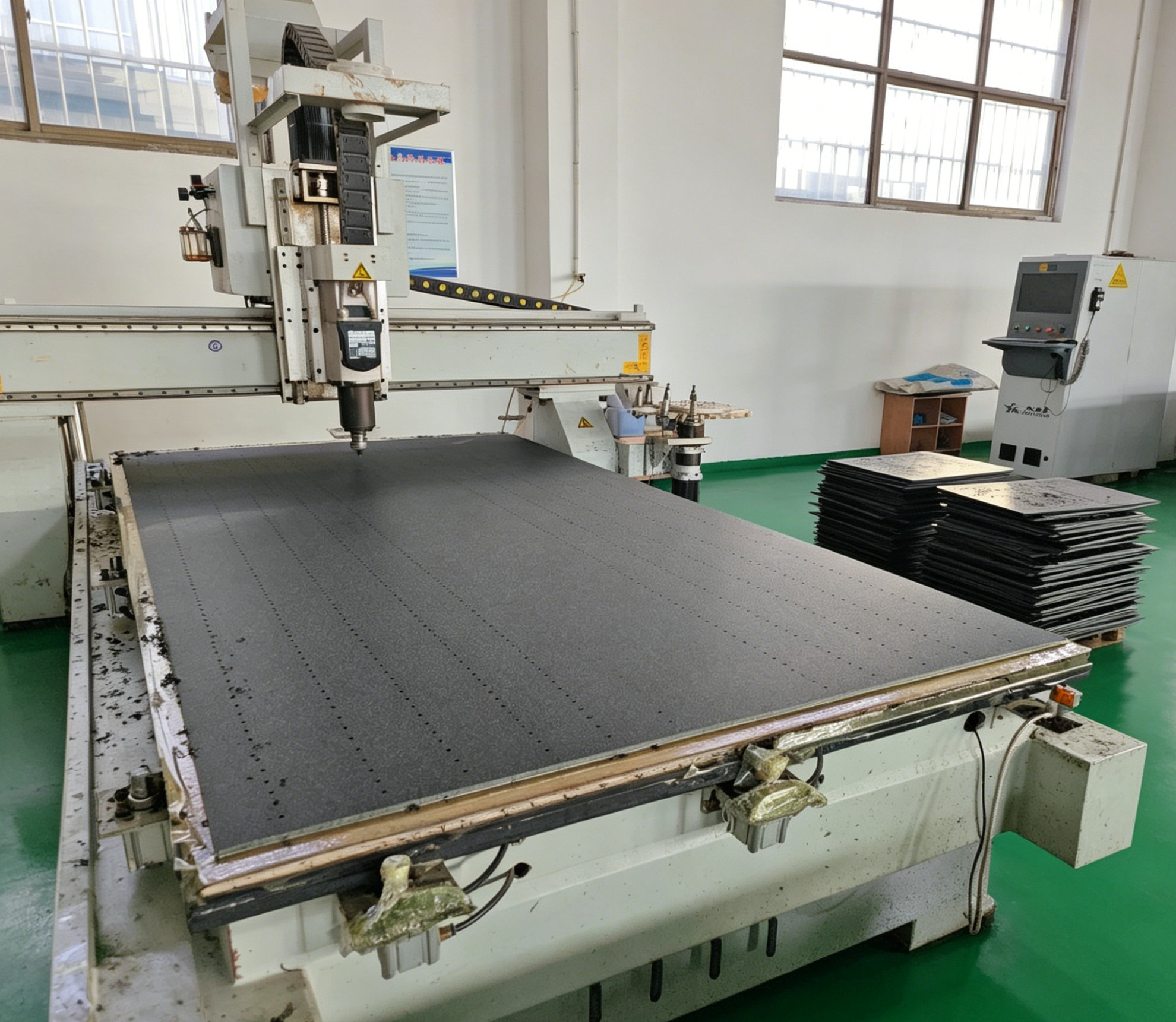
Thickness deserves the same care. The listed 2–50 mm band covers common mid-range formats such as a 10 mm HDPE industrial sheet, and the range also extends to heavy plate for wear and structural duties. Cut-to-size, drilling and CNC machining are offered as part of the product service, so a black board can be ordered as a finished component rather than a stock panel.
Black, UV and outdoor exposure: colour is not a performance grade
Black is often chosen for outdoor HDPE parts on the assumption that a dark pigment protects the polymer. The assumption needs splitting into two separate questions.
The first is what the base material does. Standard HDPE is not UV-stabilised and can chalk and embrittle under prolonged outdoor sun exposure according to distributor technical guidance, which is why outdoor service life is treated as a formulation issue rather than a colour issue.
The second is what the pigment contributes. Carbon black is described in industry technical guidance as providing UV protection in polyethylene, but the same guidance treats food-contact conformity and UV stabilisation as formulation-dependent properties that have to be evidenced per product rather than assumed from a colour name.
In the Sanyou HDPE sheet range, UV resistance is listed as an optional attribute and UV-stabilised grades are available as a selectable option. That is the practical mechanism: a buyer who needs a black board to survive outdoor exposure should specify a UV-stabilised grade explicitly, name the expected exposure environment, and ask what stabiliser system and test reference sit behind the claim. A dark sheet without that line item is still a standard sheet.
Where these panels and machined parts are used
The published application scope for Sanyou HDPE sheet covers chemical processing and water treatment, food and beverage processing, industrial manufacturing and automation, marine and shipbuilding, construction and building materials, agriculture and livestock farming, outdoor furniture and playground equipment, signage and advertising, cold chain and refrigeration, and packaging, logistics and material handling.
Those industries map onto a predictable set of purchasing patterns:
| Application | Duty that drives the choice | What should be fixed before ordering |
|---|---|---|
| Chemical storage tanks, wastewater treatment equipment, scrubbers | Resistance to acid, alkali, salt and oil; low moisture absorption | Media type and concentration, service temperature, welding and fabrication method |
| Food processing tables, cutting boards, sanitary surfaces | Cleanable surface, moisture resistance | Market-specific food-contact documentation, not just the food-grade label |
| Machine guards, jigs, fixtures, CNC-machined components | Machinability, dimensional stability, impact strength | Sheet format, thickness, drawing tolerances, fixing-hole layout |
| Chute liners, guide rails, low-friction wear strips | Low coefficient of friction, wear and impact resistance | The actual abrasion condition and the reference test method |
| Marine panels, outdoor cabinets, signage, playground parts | Moisture resistance, outdoor durability | UV-stabilised grade, expected exposure period |
| Custom cut 4x8 panels, ground-protection style plates | Sheet size, handling and reusability | Panel dimensions, edge finish, hole positions, quantity per order |
Compliance documents: what to check for EU-bound shipments
For industrial buyers, the paperwork is part of the product. Three document types are relevant here, and they are not interchangeable.
Quality management
The HDPE sheet is manufactured under ISO 9001 certification. That covers the manufacturing system — it is not evidence of any specific performance property, and it should not be quoted as if it were.
EU market CE documentation
CE certification number HY250111190958-1D was issued by HUAY TESTING (HUAY TESTING CERTIFICATION) on 2025-11-21 for HDPE Sheet in the EU market. The certification scope covers HDPE Sheet, Virgin HDPE Sheet and Recycled HDPE Sheet, and the applicable standard set is the IEC 62321 series, including IEC 62321-3-1:2013, IEC 62321-4:2013+AMD1:2017, IEC 62321-5:2013, IEC 62321-7-1:2015, IEC 62321-7-2:2017, IEC 62321-6:2015 and IEC 62321-8:2017.
RoHS — and its scope limit
RoHS certificate DTIBW20222147C, issued by Shenzhen Deesev Testing International Corporation (DTI) on 2022-12-05, applies to the UHMWPE Sheet product PE1000 for the EU and EEA markets. It does not cover the HDPE sheet range. This is a common documentation error in procurement files: a certificate from one product line is copied into a file for another. Buyers comparing suppliers should check the certified product name and model on the certificate against the item actually being ordered.
Food contact and other market-specific requirements
Sanyou lists food-grade availability as an option within the HDPE sheet range. Industry technical references are consistent in stating that food-contact HDPE requires applicable regulatory conformity documentation — for example US FDA or European food-contact requirements — and that a supplier's food-grade description is not by itself evidence of conformity. The practical request is a declaration of compliance for the specific product, jurisdiction and intended contact condition, supported by resin and additive traceability and any relevant migration or conformity testing.
Cost drivers and what a recycled-黑色 resin reference price tells you
HDPE sheet is priced from the resin outward, and colour is a secondary line in that calculation. The main cost variables are:
- Resin grade — virgin versus recycled feedstock sets the base, and modified grades such as UV-stabilised material add a further step.
- Thickness and format — material mass scales with thickness, and sheet format affects cutting loss across the order.
- Colour and texture — standard colours versus custom colours, and smooth versus textured surfaces.
- Processing — cut-to-size, drilling and CNC machining convert a stock panel into a finished part and carry their own setup cost.
- Order quantity and delivery terms — the commercial basis has to be agreed before figures are compared.
A useful market reference point sits one step upstream of the sheet. Black coloured recycled HDPE resin pellets were reported at approximately USD 520 per metric ton FOB Southeast Asia in September 2026 by an authoritative price reporting source. That figure is a resin price, not a sheet price — it cannot be used as a quotation — but it does establish the order of magnitude a buyer should expect to see reflected inside a recycled黑色 sheet offer, and it puts a realistic floor under any supplier conversation about recycled content.
Price basis is the other half of the problem. Published sheet price lists are uncommon in this category, so quotations should be requested with an explicit basis: per sheet, per kilogram or per square metre; ex-works, FOB or delivered; and with the MOQ and lead time stated alongside the unit price.
How black HDPE sheet compares with the alternatives — and where it stops
HDPE sheet competes with steel, wood-based panels, plywood and other thermoplastics. The comparison is not a ranking; it is a duty-by-duty fit check.
| Alternative | Where it wins | Where HDPE sheet wins |
|---|---|---|
| Steel | Far higher load-bearing capacity and service temperature for the same section | Much lighter panels, no corrosion protection requirement in wet or chemically exposed service, easier on-site machining |
| Wood and plywood | Low entry cost and easy on-site adaptation | HDPE sheet does not absorb water, is specified as recyclable, and is positioned as an alternative to wood and metal rather than a temporary substitute |
| PP sheet | Lower density at approximately 0.90–0.91 g/cm³ and a well-established role in chemical tanks, electroplating lines and water treatment fabrication | Where HDPE's property balance — impact strength, moisture resistance and machinability — matches the duty better than PP's |
The honest limitations of black HDPE sheet are as important as its advantages, and buyers should plan for them:
- Outdoor stability is a grade decision, not a colour decision. Standard HDPE is not UV-stabilised and can chalk and embrittle under prolonged sun exposure. A black board ordered without a UV-stabilised grade is a standard board.
- Working temperature defines the boundary. The published band of −60 to +80 °C is wide but finite; processes outside it need re-evaluation rather than extrapolation.
- Cross-supplier performance claims are not comparable on their own. Wear, impact and UV descriptions only become comparable once the test method and the service condition are identical.
- Grade labels need documents. Food-grade, marine-grade and similar designations are only as strong as the declaration, test report or certificate that supports them for that specific product.
Where the category is heading
Sheet and film applications account for approximately 41.1% of global HDPE demand share, which places semi-finished sheet products in the mainstream of polyethylene consumption rather than at its edge. Within that, ground protection mats — a predominantly HDPE and composite product category — are tracked to reach USD 5.0 billion by 2035 from a 2024 base of USD 3.0 billion, according to commercial research covering the segment. Panels, mats and structural sheet are therefore a visible growth pocket for the same material family that fills chemical tanks and food lines.
A second shift is commercial rather than technical. Recycled HDPE now has a published benchmark price in the same units as virgin resin, which means recycled content is being evaluated on cost and consistency rather than on goodwill. For buyers, that raises the value of the documentation layer: batch consistency records, recycled-content definitions and grade traceability become part of the negotiation, not an afterthought.
The direction of travel is toward proof over description. Suppliers who can match a written constraint — thickness tolerance, UV-stabilised grade, food-contact declaration, specific certificate scope — are structurally easier to buy from than suppliers who answer with adjectives.
Frequently asked questions
What factors should be considered when selecting HDPE sheet for industrial projects?
Selection mainly depends on working temperature, chemical medium, load and impact condition, indoor or outdoor environment, contact-material requirement and mechanical-processing demand. Those conditions determine the resin grade, thickness and any special modification needed. As a practical guide within this range: virgin HDPE sheet is recommended for food-contact, potable-water and high-reliability projects because of its stable mechanical performance; recycled HDPE sheet is recommended for non-critical anti-corrosion lining and cost-sensitive work without strict mechanical requirements; and UV-stabilised HDPE sheet is recommended for long-term outdoor applications to reduce aging and chalking. Thickness reference points follow the same logic — 5–6 mm for light-load lining, 6–20 mm for tank walls and structural panels, and 20–50 mm for heavy-wear chute liners.
What thickness and sheet sizes are standard for black industrial HDPE board?
The HDPE sheet range is published with a thickness band of 2–50 mm, with customised thickness available, and standard sheet sizes of 1000 × 2000 mm, 1220 × 2440 mm, 1500 × 3000 mm and 2000 × 4000 mm. Custom sizes are available. The 1220 × 2440 mm format corresponds to a 4 × 8 ft board, which is the terminology most often used in North American and European purchasing documents; stating both the millimetre dimensions and the imperial equivalent avoids quotation mismatches. A 10 mm industrial sheet sits within the listed thickness band and is produced through the same sheet programme rather than as a separate product line.
If a black HDPE sheet will be used outdoors, what should the specification include?
Outdoor exposure should be treated as a formulation requirement rather than a colour choice. Standard HDPE is not UV-stabilised and can chalk and embrittle under prolonged sun exposure, and while carbon black is described in industry technical guidance as providing UV protection, stabilisation remains a formulation-dependent property. The specification should therefore name a UV-stabilised grade explicitly, describe the expected exposure environment and service duration, and identify the stabiliser system or test reference behind the claim. In the Sanyou range, UV resistance is an optional attribute and UV-stabilised grades are available, so the requirement has to be written into the order to be delivered.
What compliance documents should accompany food-contact HDPE sheet?
Industry technical references state that food-contact HDPE requires applicable regulatory conformity documentation — for example US FDA or European food-contact requirements — and that a supplier's food-grade description alone is not proof of conformity. The usual document set to request is a declaration of compliance scoped to the specific product, the intended jurisdiction and the contact condition, supported by resin and additive traceability and any relevant migration or conformity testing. Sanyou lists food-grade availability as an option within the HDPE sheet range, and the accompanying documents should be confirmed against the receiving market before the order is placed.
What determines the price of black industrial HDPE sheet?
Price is built from the resin outward. The largest variables are the resin grade — virgin, recycled or modified such as UV-stabilised — followed by sheet thickness and format, colour and surface texture, and any cut-to-size, drilling or CNC machining. Order quantity, MOQ and delivery terms complete the picture. A published reference point exists one step upstream: black coloured recycled HDPE resin pellets were reported at approximately USD 520 per metric ton FOB Southeast Asia in September 2026. That is a resin figure and cannot be used directly as a sheet quotation, but it provides an order-of-magnitude anchor for evaluating recycled-grade offers. Because sheet price lists are uncommon in this category, quotations should always state the price basis — per sheet, per kilogram or per square metre — together with the trade term, MOQ and lead time.
About the supplier
Tangyin Sanyou Engineering Plastic Co., Ltd. manufactures HDPE sheet, UHMWPE sheet, PP sheet, HDPE sandwich board and ground protection mats from its facility in Tangyin County, Henan, China, serving North America, Western Europe, Central Europe, the Middle East, Oceania and Southeast Asia. The complete HDPE, UHMWPE and PP sheet specification ranges, grade options, surface finishes and processing services are set out in the company's product catalogue, which can be downloaded here: Sanyou Product Catalog (PDF).
Tem questões ou precisa de mais detalhes?
Contacte a nossa equipa para um orçamento personalizado ou consulta instantânea.
Solicitar orçamento
Preencha o formulário abaixo e a nossa equipa entrará em contacto com uma proposta personalizada.
Chat direto do WhatsApp
Prefere conversar em tempo real? Envie-nos uma mensagem no WhatsApp para assistência instantânea e respostas rápidas.
- Obter orçamento personalizado
- Partilhar fotos ou documentos
- Discuta as suas necessidades diretamente
Geralmente responde em 5–30 minutos durante o horário de expediente.