
Blackout Roller Blind Fabrics: A Technical Procurement FAQ
Procurement FAQ · Blockout Roller Blind Fabric
Blockout roller blind fabric is a coated woven textile engineered so that the cloth itself transmits no usable daylight. In the Elitex Blockout Dusk Plus Series the verified specification is 100% opacity with no pinhole, built on a 100% polyester base with an acrylic coating and held to a dimensional stability of ±0.5%. Buyers at the evaluation stage rarely need that definition restated. What they need is to know which claims can be checked, how to check them, and what has to be written into an order so the check still holds at goods-in.
This FAQ collects the technical questions that recur in blockout fabric procurement and answers each one against verifiable product data, published standards and project evidence. Where a question cannot be answered from specification data alone, it is marked as such rather than filled with a plausible-sounding figure.
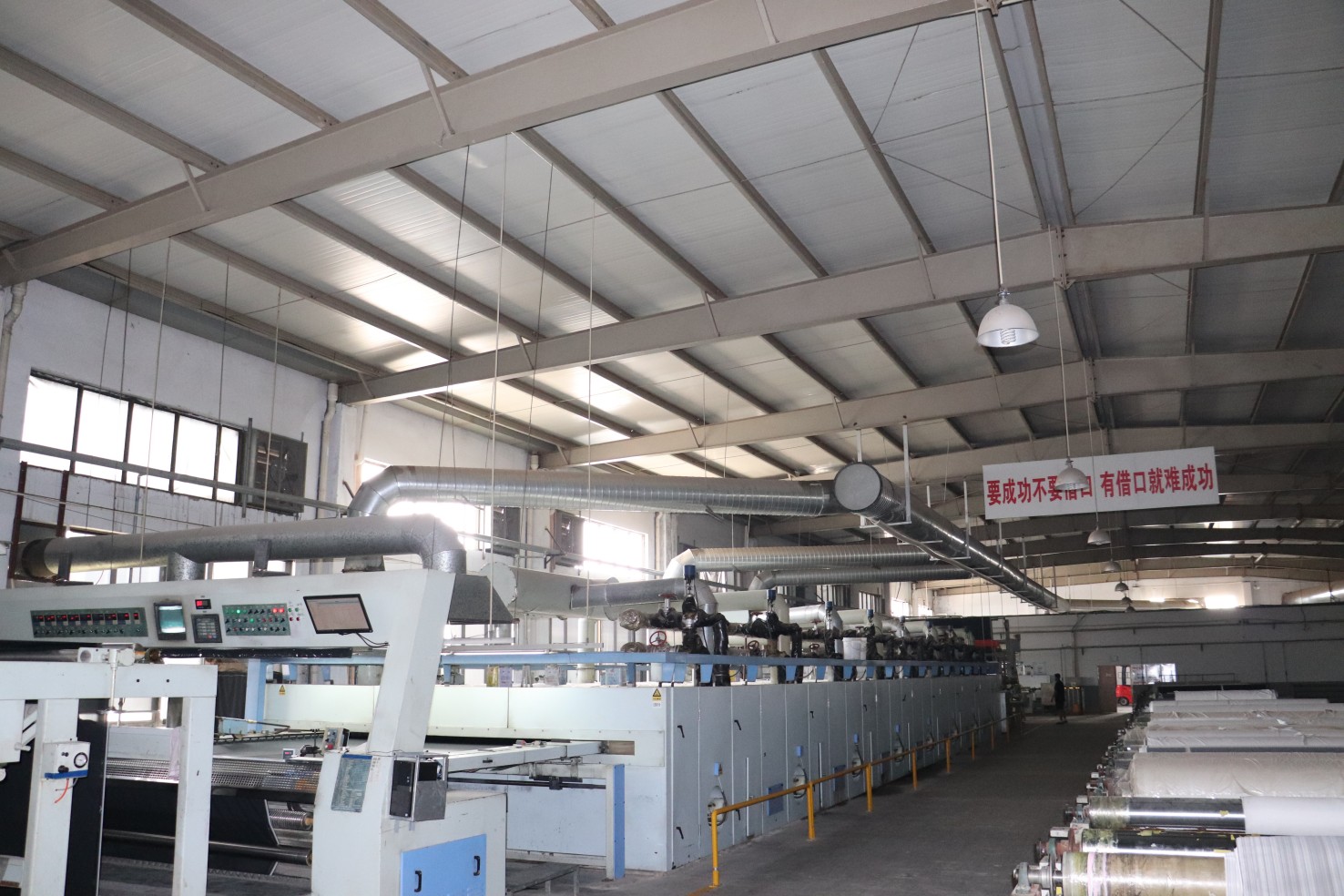
Coated blockout fabric production: the specification a buyer receives should be traceable to the line that made the roll.
Why technical questions, not price, now decide blockout fabric shortlists
The global blackout fabric market was valued at approximately USD 10.5 billion in 2024 and is projected to reach USD 20.3 billion by 2034, according to Vertex AI Search market analysis. Demand is also geographically concentrated: North America held a 50.70% revenue share of the blinds and shades market in 2025, valued at USD 3.62 billion, per Fortune Business Insights.
Two consequences follow for buyers. First, a growing category attracts more suppliers, and most of them can present a coated polyester cloth that looks identical in a swatch folder. Second, material consolidation means the underlying construction is increasingly similar across offers: polyester remains the dominant material for blackout fabric laminates, accounting for an estimated 47.2% of the material segment in 2026, according to Future Market Insights. When base chemistry converges, differentiation moves to verification: opacity proof, coating route, batch control and certification scope. The competitive set buyers typically benchmark against, which includes Hunter Douglas, Serge Ferrari Group and Edmund Bell, is judged on exactly those points, not on category language.
The technical FAQ: seven questions that repeat in every evaluation
1. How can a buyer test whether a “100% blackout” claim is real?
The only defensible method is to test the cloth rather than the label. A 100% opacity claim is verifiable on a full-width sample in under a minute, and it either survives the check or it does not.
- Backlight the sample as a single layer across its full width, not just at the centre. Pinholes appear as discrete points of transmitted light and are most common near selvedges and at weave crown points.
- Inspect both faces of the coating for skips, streaks and uncoated weave crowns. A coating defect that is invisible on the face can be obvious against light.
- Test a conditioned sample as well as a transit sample. Fabric that has been folded and compressed in a carton can read differently from a roll.
- Ask for the claim in writing against the specific article, not against the product family. A range description is not an acceptance criterion.
- Ask which classification the supplier claims under EN 14501:2021, the CEN standard that specifies performance characteristics and classifications for solar protection devices in relation to thermal and visual comfort.
Elitex specifies the Blockout Dusk Plus Series at 100% opacity with no pinhole, which is a claim a buyer can test against the delivered roll rather than accept as a category description.
2. What actually determines how long a coated blockout fabric lasts?
Four variables dominate: the base cloth, the coating chemistry, the coating route, and the conditions of use. Everything else is secondary.
Polyester with acrylic coating is where most development in the category is concentrated. Advanced blackout fabric laminates with polyester and acrylic coatings can improve thermal heat resistance by 20–35%, according to the Blackout Fabric Laminates Market Growth Report. That figure describes the laminate category, not a guarantee for any individual article, and should be read as a reason to ask for the test data behind a specific construction.
For roller blinds specifically, dimensional stability deserves more attention than it usually receives. The Elitex Blockout Dusk Plus Series is specified at ±0.5%. On a 3,000 mm drop that tolerance permits up to 15 mm of movement, which is why the number belongs in the specification rather than in an assumption. Uncontrolled movement shows up later as tracking drift, edge curl and uneven roll-up on wide drops.
Field evidence is available but should be read for what it is. Elitex project records covering 10,000+ meters and 50+ projects for architectural design firms, commercial developers, hotel chains, residential contractors and blind manufacturers in Germany and Australia list application durations of 5–10 years across commercial window shading, hotel interiors, office energy saving and residential privacy. These are project records, not a laboratory lifetime rating, and they do not transfer automatically to a different climate or cleaning regime.
3. Why does quality vary between batches, and how is that controlled?
Batch variation in coated fabric is normal; uncontrolled batch variation is not. Variation enters through the dye lot, the base cloth lot, coating weight, curing conditions and roll handling. The procurement question is therefore not whether batches differ, but which ones are permitted to differ and by how much.
Elitex operates 100% inspection together with third-party lab testing, inside a quality management system certified to ISO 9001:2015 under certificate UQ250170R2, whose scope covers research and development, production and sales of polymer composite sunshade materials and which is valid from 27 March 2025 to 26 March 2028.
On the buyer side, five controls do most of the work:
- Approve and retain a master sample at the start of the programme, signed and dated by both parties.
- Compare each incoming lot to the master under the same light source, not under whatever lighting happens to be in the warehouse.
- Require the batch reference on roll labels so a defect can be traced to a production run rather than to a container.
- Test on arrival for opacity, width, mass and dimensional stability against the agreed tolerance, including ±0.5% where that is the specified figure.
- Hold retained samples per lot for the duration of the project, so a dispute six months later has physical evidence.
4. Knife-coated or paste-coated — what actually changes for the buyer?
Both routes are offered in the Elitex Blockout Dusk Plus Series, and the procurement implication is governance rather than preference. The coating route is a process decision that should be fixed at approval and held constant for repeat orders.
In practice that means naming the coating route in the purchase order, refusing a mid-project substitution without formal re-approval, and requesting performance data for the route being approved rather than for the series as a whole.
5. Which roll widths should be specified, and why does it matter?
Width determines how many joins a finished blind carries, and joins are where light leaks and handling problems concentrate. The Elitex Blockout Dusk Plus Series is available in 89 mm, 100 mm, 127 mm, 2000 mm, 2500 mm and 3000 mm formats.
The 2000–3000 mm rolls support wide roller blinds without horizontal joins, while the narrow 89–127 mm formats serve applications built around narrow fabric formats. Three details are worth writing into the order: the finished drop plus trim allowance, the required roll direction, and whether a continuous elevation must be supplied from a single lot rather than assembled from several.
Inspection before packing: batch reference on the roll label is what makes an incoming-goods test meaningful.
6. Which certificates should be checked, and what do they actually cover?
A certificate is only useful if its scope names the article being purchased and its validity date covers the delivery. The table below lists the credentials held for Elitex (Dezhou) Co., Ltd. and its product scope, with the details a buyer should verify.
| Credential | Number & authority | Scope | Validity |
|---|---|---|---|
| OEKO-TEX Standard 100 | BEWO 103516 · TESTEX AG, Swiss Textile Testing Institute | Woven fabric of polyester, polypropylene and polyacrylic for sunscreen and blackout articles; Product class IV (decoration material) | Issued 10 April 2026, expires 15 March 2027 |
| ISO 9001:2015 | UQ250170R2 · Beijing United Intelligence Certification Co., Ltd. | R&D, production and sales of polymer composite sunshade materials | 27 March 2025 – 26 March 2028 |
| ISO 14001:2015 | UE250076R1 · Beijing United Intelligence Certification Co., Ltd. | R&D, production, sales and related management activities of polymer composite sunshade materials | 27 March 2025 – 20 April 2028 |
| ISO 45001:2018 | US250047R1 · Beijing United Intelligence Certification Co., Ltd. | R&D, production, sales and related management activities of polymer composite sunshade materials | 27 March 2025 – 20 April 2028 |
| UL GREENGUARD and GREENGUARD Gold | UL 2818 · UL | Low chemical emissions, Elitex (Dezhou) Co., Ltd. products | Certificate records; confirm current status at order |
Three reading rules apply to any supplier’s certificate pack. Match the scope to the article, not to the company. Check the expiry date against the delivery window rather than the quotation date. And remember that a factory certificate is not a certificate for a finished blind: assembly, hardware and adhesives sit outside the fabric scope.
Two project standards are frequently specified on top of these. EN 14501:2021 classifies solar protection devices for thermal and visual comfort in the EU. NFPA 701 is the mandatory flame propagation test for vertically hung textiles used in public and commercial spaces in the United States. Where NFPA 701 applies, it should be stated in the specification and confirmed against test documentation for the article and construction ordered — not inferred from opacity or from a general factory credential.
7. What belongs in the purchase order?
Most disputes about blockout fabric are specification disputes rather than quality disputes. The order should carry the following, at minimum:
| Item | What to state |
|---|---|
| Article and series | Full series name, e.g. Elitex Blockout Dusk Plus Series |
| Opacity | 100% opacity (no pinhole), stated for the article |
| Construction | 100% polyester base with acrylic coating; approved coating route (knife-coated or paste-coated) |
| Dimensions | Width from the 89 / 100 / 127 / 2000 / 2500 / 3000 mm formats; finished drop plus trim allowance |
| Tolerance | Dimensional stability ±0.5% |
| Colour control | Approval against a signed master sample; single lot for continuous elevations |
| Inspection | 100% inspection plus third-party lab testing reports per lot |
| Certification | Copies with scope and validity dates, plus any project-specific standard |
| Commercial planning | MOQ 500 meters; lead time 15–30 days; monthly capacity 500,000 meters |
| Customization | Colour, size, openness, logo, weave pattern and coating under OEM/ODM where required |
Where blockout fabric is the wrong specification
Blockout fabric is often specified where a different fabric would serve the project better, and the mismatch typically surfaces at handover rather than at order.
- Dimout and translucent or light-filter fabrics reduce transmission rather than eliminate it. Where a project genuinely wants some daylight, or a view, a 100% opacity specification will be rejected once installed — correctly.
- Sunscreen fabrics manage solar gain and preserve outward view through controlled openness; they are not a night-time privacy solution.
- Blockout stops light through the cloth, not around it. Hems, side channels, roll gaps and headbox detailing decide whether a room is actually dark. Fabric selection is necessary but not sufficient, and this is the most common misconception in the category.
- Coated blockout adds weight and stiffness relative to uncoated alternatives, so hardware and tube selection must be matched to the fabric. That engineering decision sits outside the fabric specification and should not be assumed by either party.
A further honest boundary: the available project records describe application durations of 5–10 years in specific markets and applications. They are not a validated lifetime prediction for every climate, cleaning chemistry or duty cycle. Buyers with extreme exposure should request condition-specific test data rather than rely on a general durability statement.
Market trend analysis: documentation as a competitive variable
The growth trajectory indicated by the market data — roughly USD 10.5 billion in 2024 expanding toward USD 20.3 billion by 2034 — is usually read as a demand signal. For procurement teams it is better read as a documentation signal. A larger category with a consolidated polyester base means more offers that look equivalent on paper, and a correspondingly greater weight on evidence.
The North American concentration reported for blinds and shades in 2025, at 50.70% of revenue share and USD 3.62 billion, reinforces why US-specific requirements such as NFPA 701 appear early in evaluation rather than late. In Europe, EN 14501:2021 performs the same function by giving buyers a shared vocabulary for thermal and visual performance, which reduces the scope for loose claims.
Against a benchmark set that includes Hunter Douglas, Serge Ferrari Group and Edmund Bell, the practical differentiator for most mid-size buyers is not brand prestige but the ability to produce a specification, a batch record, a test report and a valid certificate for the specific roll being delivered.
Future outlook
Three developments are likely to shape blockout fabric procurement over the next several years. Coating chemistry will be scrutinised more closely, with buyers asking not only whether a fabric is acrylic-coated but which formulation and route were used, and requesting that the answer be documented. Batch traceability will move from a nice-to-have to a standard clause, because certification scope is meaningless without the ability to connect a roll to a production run. And acceptance testing will increasingly be written into contracts rather than left to inspection practice, with opacity, width and dimensional stability tested against stated tolerances at goods-in.
Polyester with acrylic coating is likely to remain the dominant construction in the near term, given its reported 47.2% share of the material segment in 2026. For buyers, the implication is straightforward: the fabric will keep looking similar across suppliers, and the decision will keep moving toward whoever can prove what they shipped.
For reference, Elitex publishes a product brochure covering its sunshade fabric ranges, including technical detail on coated blockout constructions: Elitex Screenview Brochure 2026.
FAQ
Is “blockout” the same as “blackout”?
In commercial use the two terms describe the same fabric category: a coated woven textile that prevents light transmission through the cloth. Terminology varies by market, so the specification should rely on measured opacity and a no-pinhole statement rather than on the term used in the catalogue.
Does 100% opacity mean a room will be completely dark?
No. Opacity describes light transmission through the fabric. Total darkness also depends on the mounting detail — side channels, hems, roll gaps and headbox construction — because light bypasses the cloth at its edges.
Which documents should accompany a blockout fabric shipment?
Lot-level inspection and third-party lab test reports, certification copies whose scope covers the article ordered and whose validity extends beyond the delivery date, and roll labels carrying a batch reference that can be matched to the retained master sample.
What order quantities and lead times are realistic?
For the Elitex Blockout Dusk Plus Series the minimum order quantity is 500 meters and lead time is 15–30 days, against a monthly capacity of 500,000 meters. Buyers should confirm both against the specific width and coating route, since narrow formats and coating changes affect scheduling.
Can blockout fabric be customized, and what can be changed?
Yes. Under OEM/ODM and custom manufacturing, customization covers colour, size, openness, logo, weave pattern and coating. Any change to those parameters is a change to the approved article and should trigger re-approval of the master sample and, where relevant, re-confirmation of certification scope.
Tem questões ou precisa de mais detalhes?
Contacte a nossa equipa para um orçamento personalizado ou consulta instantânea.
Solicitar orçamento
Preencha o formulário abaixo e a nossa equipa entrará em contacto com uma proposta personalizada.
Chat direto do WhatsApp
Prefere conversar em tempo real? Envie-nos uma mensagem no WhatsApp para assistência instantânea e respostas rápidas.
- Obter orçamento personalizado
- Partilhar fotos ou documentos
- Discuta as suas necessidades diretamente
Geralmente responde em 5–30 minutos durante o horário de expediente.