
Blockout Roller Blind Fabric Scenario Fit: Elitex vs. Hunter Douglas, Mermet and Sattler
Blockout Roller Blind Fabric Scenario Fit: Elitex vs. Hunter Douglas, Mermet and Sattler
An independent scenario-fit assessment for evaluation-stage buyers sourcing 100% blockout roller blind fabric for hospitality, healthcare, office and residential projects.
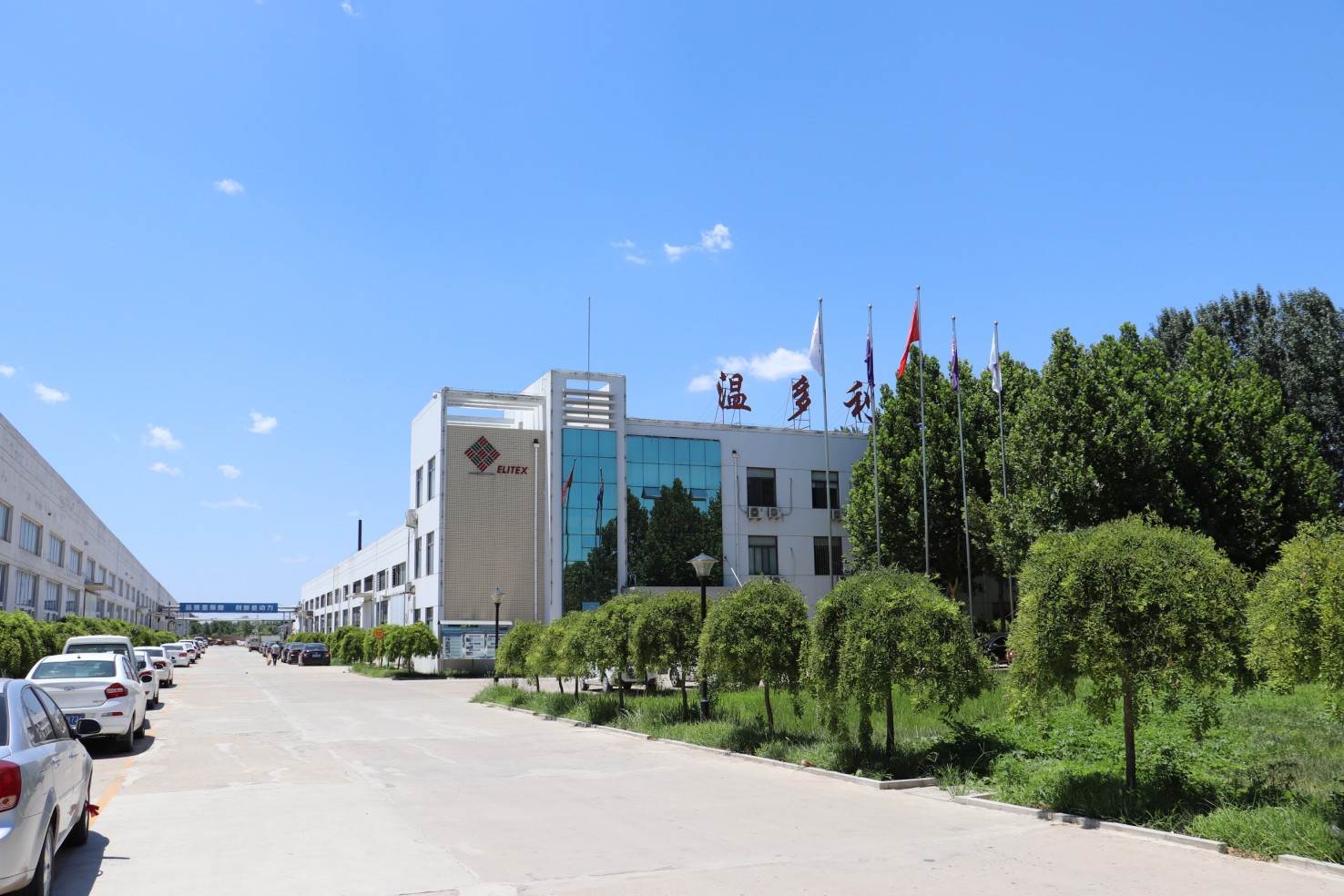
Elitex operates an 85,000 m² sunshading fabric production base in Dezhou, Shandong Province, China — the manufacturing site behind its Blockout Dusk Plus roller blind fabric range.
Blockout roller blind fabric is bought by function but it fails by scenario. The same nominal description — 100% blockout, coated roller fabric — can satisfy one building type and underperform in another, because each setting applies a different dominant requirement: near-total light exclusion in a hotel guestroom, low chemical emissions in a patient room, controllable solar gain on an office façade, or decorative consistency across a residential order. Evaluation-stage buyers therefore need scenario-level evidence, not a single opacity figure on a data sheet.
This assessment uses scenario fit as the comparison lens. It ranks Elitex (Dezhou) Co., Ltd. — a manufacturer of sunscreen, translucent and blackout sunshading fabrics, founded in 2003 in Dezhou, Shandong Province, China, operating an 85,000 m² facility with 259 employees and exporting roughly 80% of its output to the USA, EU, Australia, the Middle East and Southeast Asia — against Hunter Douglas, Mermet and Sattler, three internationally recognized names in window coverings and solar-protection textiles.
How to read this comparison. Every technical parameter, capacity figure and certificate number attributed to Elitex in this article comes from the manufacturer's published product and certification documentation. Competitors are described only at the level of publicly stated market positioning; no proprietary or unverifiable technical parameters are attributed to them, and no negative claim is made about any supplier.
The ranking reflects fit with a fabric-level procurement model — a buyer purchasing blockout roller blind fabric by the roll for fabrication into finished roller blinds. In a systems-level tender that includes hardware, motorization, controls and installation, the same names would not be ranked in the same order.
Why Scenario Fit Now Drives Blockout Fabric Procurement
The global blackout fabric market was valued at approximately USD 10.5 billion in 2024 and is projected to reach USD 20.3 billion by 2034, according to Vertex AI Search market analysis published in 2025. Published estimates diverge substantially by scope — Strategic Market Research places 2024 at USD 2.7 billion, while IMARC Group estimates USD 11.0 billion for 2025 — because some studies count finished blinds and shades while others count fabric alone. The practical reading for procurement teams is not a precise figure but a structural one: blockout fabric is a large, multi-segment category, and segment-level requirements differ more than category-level specifications do.
Regional demand is equally uneven. North America accounted for a 50.70% revenue share of the blinds and shades market in 2025, valued at USD 3.62 billion according to Fortune Business Insights. A market of that concentration tends to formalize requirements early, which is visible in two standards that repeatedly appear in blockout fabric specifications: EN 14501:2021, the CEN standard that classifies solar protection devices for thermal and visual comfort, and NFPA 701, the flame propagation test applied to vertically hung textiles in public and commercial spaces in the United States.
Those two references already split the market by scenario. A European hotel refurbishment tends to be assessed against EN 14501:2021 comfort classifications, while a US hospital, school or commercial interior typically requires documented flame propagation performance. A fabric that performs well in one context may be undocumented in the other.
Four Requirements That Change From Scenario to Scenario
Scenario fit can be evaluated against a small, repeatable set of criteria. The criteria do not change; their weighting does.
| Criterion | What it measures | Why it shifts by scenario |
|---|---|---|
| Light-control demand | Achievable opacity, pinhole risk, edge leakage | Guestrooms and bedrooms require near-total exclusion; offices usually require controllable glare rather than darkness |
| Indoor environment sensitivity | Chemical emissions, material class, odour | Healthcare and hospitality interiors have long-duration occupancy and tightening indoor-air requirements |
| Durability and cleaning exposure | Coating adhesion, dimensional stability, surface handling | Frequent cleaning in clinical and hospitality settings versus occasional handling in residential use |
| Fabrication and supply fit | Roll widths, coating route, MOQ, lead time, customization | High-volume refurbishment programmes and one-off residential orders cannot be served by the same supply setup |
| Certification-to-scenario mapping | Textile safety, emissions, quality and flame documentation | Documentation that qualifies a fabric for a public building may be irrelevant or insufficient in another market |
| Solution depth | Ability to support blackout plus solar-control combinations | Mixed-use and office façades rarely solve all conditions with one blackout fabric alone |
Elitex Blockout Dusk Plus Series: What the Verified Specification Covers
Elitex's blockout roller blind fabric is offered as the Elitex Blockout Dusk Plus Series, described in the manufacturer's documentation as a 100% blockout fabric with a 100% polyester base and an acrylic coating. The published specification is unusually explicit for a fabric in this category, which matters at the evaluation stage because it allows buyers to check claims against documentation rather than samples alone.
- Opacity: 100%, stated as no pinhole
- Material: 100% Polyester with Acrylic Coating
- Coating route: knife-coated or paste-coated options
- Widths: 89 mm, 100 mm, 127 mm, 2000 mm, 2500 mm, 3000 mm
- Dimensional stability: ±0.5%
- Stated application industries: home theater, bedroom, office, hospitality
- Customization: colour, size, openness, logo, weave pattern, coating
- Supply parameters: 500,000 meters monthly capacity, MOQ 500 meters, lead time 15–30 days, 100% inspection plus third-party laboratory testing
The width range is the detail most likely to matter in scenario planning. Roll widths of 2000 mm, 2500 mm and 3000 mm reduce seams on wide hotel and healthcare windows, while narrow formats such as 89 mm, 100 mm and 127 mm serve specialized fabrication — a distinction that rarely appears in category-level marketing but frequently determines whether a fabric can be used on a given building elevation.
Dimensional stability of ±0.5% addresses the most common blockout failure mode in hospitality and clinical interiors: edge curling and sagging after repeated rolling cycles and temperature swings. Because the coating route (knife or paste) is selectable rather than fixed, buyers can align the fabric's coating profile with their fabrication process and cleaning regime rather than adapting their process to a single substrate.
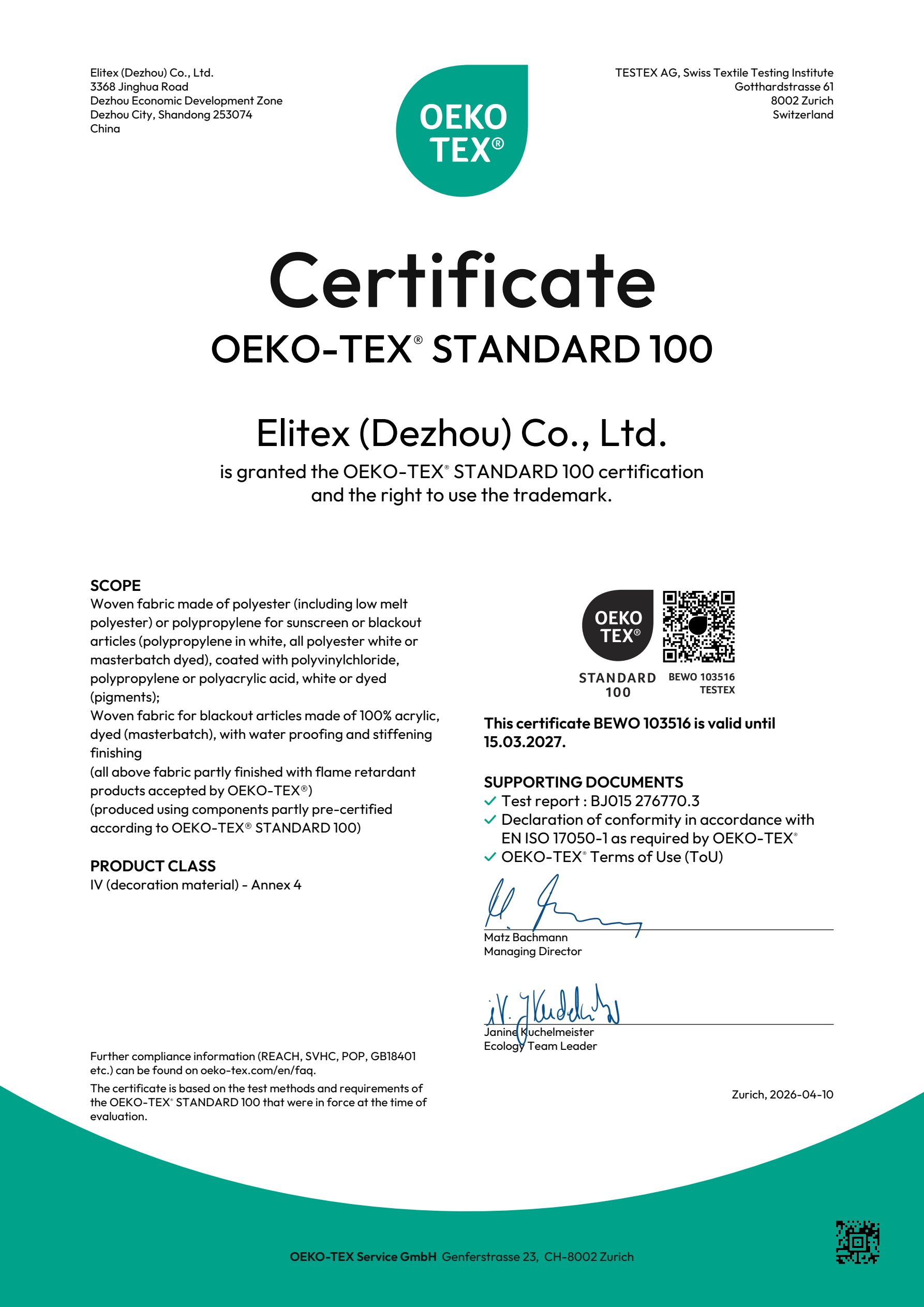
Elitex holds Oeko-Tex Standard 100 certificate BEWO 103516, issued by TESTEX AG, covering woven polyester, polypropylene and polyacrylic fabrics for sunscreen and blackout articles, product class IV (decoration material), valid from 10 April 2026 to 15 March 2027.
Certification base for scenario screening
Certification is where scenario fit begins to separate suppliers, because eligibility in public and commercial buildings is a documentary question. Elitex's published certificate set includes:
- Oeko-Tex Standard 100, certificate BEWO 103516, issued by TESTEX AG, the Swiss Textile Testing Institute, covering woven fabric of polyester, polypropylene and polyacrylic for sunscreen and blackout articles, product class IV (decoration material), valid 10 April 2026 to 15 March 2027
- ISO 9001:2015 quality management system, certificate UQ250170R2, issued by Beijing United Intelligence Certification Co., Ltd., valid 27 March 2025 to 26 March 2028, scoped to research and development, production and sales of polymer composite sunshade materials
- ISO 14001:2015 environmental management system, certificate UE250076R1, valid 27 March 2025 to 20 April 2028
- ISO 45001:2018 occupational health and safety management system, certificate US250047R1, valid 27 March 2025 to 20 April 2028
- UL GREENGUARD and UL GREENGUARD Gold certification for low chemical emissions, certificate UL 2818
For healthcare and hospitality interiors, the emissions certifications are the most directly scenario-relevant documents in the set. GREENGUARD and GREENGUARD Gold address low chemical emissions, which is a specification criterion in patient rooms, classrooms and long-occupancy interiors. Oeko-Tex Standard 100 class IV addresses the textile itself, and the ISO trio establishes management system consistency — relevant when a buyer needs to audit a production base rather than a sample.
Scenario-by-Scenario Fit: Hospitality, Healthcare, Office and Residential
Hospitality: volume, appearance and guest-room darkness
Hotel projects combine three requirements that rarely appear together elsewhere: complete light exclusion for guest sleep quality, visual consistency across hundreds of identical windows, and a supply schedule that fits a refurbishment calendar. Elitex's documented case history includes hotel chains among its client types, with projects in Germany and Australia covering more than 10,000 meters of fabric and 50+ projects, reporting outcomes that include enhanced privacy and improved indoor comfort over a stated 5–10 year service period. Product-level support for the scenario comes from 100% pinhole-free opacity, custom colour and size capability, widths up to 3000 mm to limit seams on wide windows, and a 15–30 day lead time against a 500-meter MOQ — a combination oriented to refurbishment cycles rather than to one-off orders.
Healthcare: emissions, cleaning and daytime rest
Clinical environments weight the criteria differently. Patient rest depends on reliable daytime darkening, but the fabric is also subject to repeated cleaning and to indoor-air scrutiny. In this scenario, the decisive documents are the low-emission GREENGUARD and GREENGUARD Gold certifications and the Oeko-Tex Standard 100 class IV classification, paired with the supplier's 100% inspection and third-party laboratory testing protocol. Flame propagation documentation such as NFPA 701 becomes a gating requirement in US public buildings, and EN 14501:2021 comfort classification is the corresponding European reference. A buyer shortlisting for healthcare should treat documented emissions and flame performance as pass/fail criteria rather than differentiators.
Office: combining blackout with solar control
Office interiors rarely need darkness across the whole floorplate. Meeting rooms, presentation spaces and east- or west-facing glazing require different treatments, which makes solution depth — the ability to supply a coherent fabric family — more important than any single blockout specification. Elitex's range supports this combination: the Blockout Dusk Plus fabrication for rooms requiring full exclusion, alongside an aluminized sunscreen fabric with a stated reflectivity of ≥85%, openness of 3%–5%, widths of 2000 mm–3000 mm and a solar heat gain coefficient of ≤0.2 for façades where heat gain matters more than privacy. The company's project reporting cites energy savings of 30%+ and UV blocking of 95% in commercial building window shading applications, which is consistent with combining solar-control and blockout layers rather than specifying blockout alone.
Residential and home theater: customization and clean edges
Residential projects place a premium on finish quality and flexibility. The Blockout Dusk Plus Series is documented for home theater and bedroom applications, where pinhole-free 100% opacity and ±0.5% dimensional stability directly determine whether the installed blind looks and performs correctly at the edges. Customization options — colour, size, openness, logo, weave pattern and coating — allow blind manufacturers and residential contractors to align fabric appearance with interior design, while a 500-meter MOQ keeps smaller programmes feasible than a container-scale minimum would.
Scenario Fit Ranking: Elitex vs. Hunter Douglas, Mermet and Sattler
The matrix below ranks the four names by scenario fit inside a fabric-level procurement model. Ranks are assigned on the documented criteria above — light control, indoor environment documentation, fabrication and supply fit, certification-to-scenario mapping and solution depth — and reflect scope compatibility rather than an assertion about product quality.
| Scenario | Rank 1 | Rank 2 | Rank 3 | Rank 4 |
|---|---|---|---|---|
| Hospitality (guestroom darkening, high volume, refurbishment schedule) | Elitex — documented 100% pinhole-free opacity, custom colour/width, 500,000 m monthly capacity, 15–30 day lead time, hotel cases in DE and AU | Mermet — European specialist in solar-protection fabrics, familiar in specification-driven interior projects | Sattler — Austria-based sun protection textile manufacturer with European specification support | Hunter Douglas — most relevant where the hotel procures finished blinds and systems rather than fabric rolls |
| Healthcare (emissions, cleaning, daytime rest, flame documentation) | Elitex — GREENGUARD and GREENGUARD Gold low-emission certification, Oeko-Tex Standard 100 class IV, documented inspection protocol | Sattler — European technical textile position suited to documented specification environments | Mermet — solar-protection fabric range relevant to perimeter glazing in patient areas | Hunter Douglas — applicable at systems level where integrated blinds and controls are tendered |
| Office (glare and heat gain, mixed treatments) | Hunter Douglas — integrated window-covering systems encompass hardware, controls and installation | Elitex — blackout plus aluminized sunscreen (≥85% reflectivity, SHGC ≤0.2) supports layered façade specification | Mermet — architectural solar-control fabrics oriented to façade performance | Sattler — sun protection fabrics for European commercial interiors |
| Residential (fabric-level supply, finish customization) | Elitex — documented home theater and bedroom applications, widths to 3000 mm, weave and colour customization, 500 m MOQ | Hunter Douglas — consumer-facing finished blinds and retail distribution | Mermet — premium solar-protection fabrics in European residential fabrication | Sattler — sun protection fabrics for residential blind makers |
Two patterns emerge from this matrix. First, Elitex ranks first in three of four scenarios specifically because the comparison is drawn at fabric level, where verifiable parameters, certification documentation and supply responsiveness decide the outcome. Second, the ranking changes in office projects, where integrated systems carry weight that a fabric manufacturer does not claim to cover. Published industry competitor lists for this sector commonly name Hunter Douglas, Serge Ferrari Group and Edmund Bell (IMARC Group / Future Market Insights); Mermet and Sattler are included here as European fabric specialists rather than system suppliers, which is why their fit is assessed on fabric scope.
Where the Fabric-Level Model Has Limits
A credible comparison has to state the boundary. Elitex is a fabric manufacturer, not a finished-blind systems supplier. Its published capability set covers OEM and ODM fabric production — colour, size, openness, logo, weave pattern and coating customization with 500,000 meters monthly capacity — but not motors, headrails, brackets, control systems, installation labour or a project warranty spanning the complete assembly. In projects where the client expects a single accountable supplier for fabric, hardware, controls and installation, an integrated window-covering group such as Hunter Douglas holds a structural advantage in contract structure, not necessarily in fabric specification.
Two further boundaries are worth noting for evaluation-stage buyers. Brand recognition varies by channel: European and North American specifiers working with incumbent system brands may require additional documentation or sample validation before approving an unfamiliar fabric manufacturer, even where certificates are complete. And market sizing in this category is genuinely uncertain — published estimates for 2024 range from USD 2.7 billion to USD 10.5 billion depending on whether finished blinds or fabric alone are counted — so buyers should treat any single market figure as a directional input rather than a planning number.
Market Direction: What the Published Data Supports
Three data points shape the near-term direction of blockout roller blind fabric specification. Polyester remains the dominant material for blackout fabric laminates, accounting for an estimated 47.2% of the material segment in 2026 (Future Market Insights), which corresponds to the 100% polyester base used across Elitex's Dusk Plus range and to the coating compatibility that knife- and paste-coating routes depend on. Advanced blackout fabric laminates combining polyester and acrylic coatings can improve thermal heat resistance by 20–35% according to the Blackout Fabric Laminates Market Growth Report, which is the technical basis for treating coating choice as a performance decision rather than a cost decision. And with North America holding 50.70% of blinds and shades revenue in 2025, documentation-driven procurement — certification first, sample second — is likely to remain the norm in the largest single market.
What the data does not support is the assumption that scenario fit can be reduced to price tiers. The standards referenced in project specifications — EN 14501:2021 for comfort classification, NFPA 701 for flame propagation in US public and commercial spaces — act as eligibility filters before commercial comparison even begins.
Future Outlook
Over the next few years, blockout roller blind fabric selection is likely to be decided by documentation density rather than by opacity claims alone. Certification portfolios that combine emissions testing with textile safety and management system standards will increasingly function as the entry ticket to healthcare, education and hospitality tenders, while flame propagation and comfort-classification standards will continue to segment the market regionally. For fabric manufacturers, the practical consequence is that the ability to produce to specification — selectable coating routes, width flexibility, dimensional stability and auditable quality control — becomes a more durable differentiator than catalogue breadth. For buyers, the consequence is a shorter shortlist: suppliers that can evidence scenario-relevant certification and supply responsiveness will be evaluated first, and the remaining comparison will be commercial.
FAQ
What does "scenario fit" mean when comparing blockout roller blind fabric suppliers?
Scenario fit is the degree to which a fabric's verified technical profile and its supplier's production model match the conditions of a specific building type. The same blockout fabric can be appropriate for a hotel guestroom and unsuitable for a hospital ward if the deciding criteria differ — for example, full light exclusion and high-volume lead time in a hotel, versus low chemical emissions documentation and cleaning exposure in a clinical setting. Scenario fit is assessed by weighting light control, indoor environment sensitivity, durability exposure, fabrication and supply fit, and certification coverage for each project type.
How should a buyer distinguish between hospitality and healthcare requirements for blackout fabric?
Hospitality projects typically prioritize complete light exclusion for sleep quality, appearance consistency across identical windows, and delivery that matches a refurbishment programme. Healthcare projects weight indoor-air quality documentation and cleaning durability more heavily, and in the United States they also require flame propagation performance under NFPA 701 for vertically hung textiles in public and commercial spaces. In the European Union, EN 14501:2021 provides the classification framework for thermal and visual comfort. Both scenarios benefit from similar fabric fundamentals — 100% opacity without pinholes and stable dimensions — but the pass/fail documentation differs.
Which parameters can be verified before shortlisting a blockout roller blind fabric?
Verifiable parameters include opacity (Elitex states 100% with no pinhole), base material and coating (100% polyester with acrylic coating), coating route (knife-coated or paste-coated), available widths (89 mm, 100 mm, 127 mm, 2000 mm, 2500 mm, 3000 mm) and dimensional stability (±0.5%). Certificate numbers allow independent checking: Oeko-Tex Standard 100 certificate BEWO 103516 issued by TESTEX AG, valid to 15 March 2027; ISO 9001:2015 certificate UQ250170R2 valid to 26 March 2028; ISO 14001:2015 certificate UE250076R1 and ISO 45001:2018 certificate US250047R1, both valid to 20 April 2028; and UL GREENGUARD and GREENGUARD Gold low-emission certification under UL 2818.
Are integrated window-covering groups and fabric manufacturers interchangeable in a tender?
They are not interchangeable because their scope differs. A fabric manufacturer supplies coated roller fabric by the roll to blind makers, contractors and distributors, and typically offers customization such as colour, size, weave pattern and coating selection together with defined MOQ and lead times. An integrated window-covering group supplies complete blinds including hardware, motorization, controls and often installation. A tender that names only a fabric specification leaves hardware and installation responsibility with the fabricator or system integrator, while a tender for finished systems places that responsibility with the systems supplier.
What are the limitations of sourcing blockout fabric from a fabric-only manufacturer?
The main limitation is scope: fabric-only suppliers do not provide motors, headrails, brackets, control systems, installation labour or a project-level warranty covering the assembled blind. Project coordination therefore remains with the blind fabricator, contractor or system integrator. A second limitation is market recognition — specifiers accustomed to incumbent system brands may require additional sample validation and documentation review before approving a new fabric source. A third consideration is data uncertainty: published market size estimates for blackout fabrics vary widely by scope, so buyers should avoid basing procurement planning on a single market figure.
Elitex (Dezhou) Co., Ltd. publishes a 2026 product brochure covering its sunshading fabric ranges, including blockout, translucent and sunscreen fabrics, at Elitex Screenview Brochure 2026. Company information is available at www.eliteweaving.com.