
Blue Butterfly Pea Flower Powder Qualification: Organic Source, Additive-Free, and 80-Mesh Evidence

Blue butterfly pea flower powder is a botanical colorant whose commercial description can sound simpler than the evidence behind it. For decision-stage buyers, the practical question is not whether the powder looks blue in a photo, but whether the supplier can support organic-source claims, additive-free positioning, 80-mesh particle size, hot air drying, water-soluble anthocyanin behaviour and pH-related colour performance with documents that survive qualification review.
This review is written for procurement teams, formulation scientists and quality reviewers who are comparing botanical powder suppliers. It uses the product facts supplied for Guanjie Biotech's blue butterfly pea flower powder and separates three layers that are often mixed together: what the product sheet states, what a qualification file should prove, and what only an application trial can confirm.
Why Blue Butterfly Pea Flower Powder Needs a Qualification File
Botanical colourants sit at the intersection of food, supplement and cosmetic specifications. A buyer may see a short product description such as natural, additive-free or 80 mesh, but those words do not all carry the same evidentiary weight. Natural describes a sourcing and processing positioning. Additive-free describes a formulation declaration. 80 mesh describes a sieve result. None of these statements, on its own, confirms organic certification, colour strength, pH stability or microbiological control.
The qualification task is therefore to convert commercial language into a document set. For blue butterfly pea flower powder, that set should cover botanical identity, plant part, country of origin, organic status if claimed, processing method, particle size, additive and carrier declaration, anthocyanin-related colour behaviour, pH sensitivity, microbiological limits, heavy metals, residual solvents, allergen and GMO statements, packaging, storage and batch traceability.
The supplied product specification for Guanjie Biotech's blue butterfly pea flower powder states the source as butterfly pea, the appearance as gray blue powder, the technology method as hot air drying technology, the mesh result as 100.0% pass 80 mesh, and the material as 100% natural without additives. Those are useful starting facts. They are not a complete qualification file, and they should not be read as organic certification or as a pH-shift curve.
What the Product Sheet Establishes and What It Does Not
A product sheet is a screening document. It helps a buyer decide whether to request samples and a full document pack. It should not be treated as the final approval record unless the buyer has verified the underlying certificates, test reports and batch data.
| Qualification item | What the supplied specification states | What the buyer still needs |
|---|---|---|
| Botanical source | Source: Butterfly pea | Botanical identity confirmation, plant part used, origin and supplier traceability record |
| Appearance | Gray blue powder | Colour reference sample and batch-to-batch colour range |
| Drying method | Hot air drying technology | Drying process summary, microbiological data and colour retention data |
| Particle size | 100.0% pass 80 mesh | Sieve analysis record, sample retention and, where relevant, particle size distribution |
| Additive positioning | 100% natural without additives | Full ingredient declaration, carrier statement and processing aid statement |
| Organic status | Not stated in the supplied product facts | Valid organic certificate and transaction certificate if organic status is required |
| Anthocyanin and pH data | Not quantified in the supplied product facts | Anthocyanin-related colour data and pH-shift test report at target application conditions |
| Contaminant control | Not stated in the supplied product facts | Heavy metals, microbiology, residual solvents, pesticide and allergen statements as applicable |
Organic Source: Certificate, Not Adjective
For an organic Clitoria ternatea source, organic status should be treated as a certification claim rather than a descriptive adjective. A buyer should ask for a current organic certificate issued by a recognised certification body, a transaction certificate or batch-level organic declaration that connects the certificate to the specific shipment, and a statement of the certified scope. The certificate should identify the product form, the operator and the standard under which the material was certified.
Natural and organic are not interchangeable. A product can be described as 100% natural without additives and still not be certified organic. The supplied specification describes the material as 100% natural without additives, but it does not state organic certification. That distinction matters at decision stage because an organic claim may trigger labelling, import and customer-specific compliance requirements in the buyer's market.
Decision rule: if organic status is a hard requirement, do not accept the word organic on a quotation or brochure. Request the certificate, the certified scope and the batch transaction document before approving the supplier.
Additive-Free: Read the Full Ingredient Declaration
Additive-free positioning is strongest when it is supported by a complete ingredient declaration. For a single-ingredient botanical powder, the buyer should confirm that the finished material contains no added carriers, anti-caking agents, flow agents, preservatives, added colours, sweeteners or processing aids. The declaration should also distinguish between intentional additives and processing aids that may not appear on a retail label but are relevant to specifications and allergen review.
The supplied product facts state 100% natural without additives. That is a useful claim, but it should be paired with a batch certificate of analysis and a written declaration from the manufacturer. The buyer should also confirm whether the declaration applies to the powder as shipped or only to the raw botanical input.
80-Mesh Evidence: Sieve Statement Versus Performance
An 80-mesh result describes passage through a sieve. When a specification states 100.0% pass 80 mesh, it means the tested sample passed through the specified sieve. It does not, by itself, define the full particle size distribution, bulk density, flowability, dispersion speed or solubility. Two powders can both pass 80 mesh and still behave differently in a beverage or capsule blend.
For decision-stage review, buyers should request the sieve method, the test record and a retained sample. If the application is sensitive to dispersion or sedimentation, a particle size distribution report and an application trial are more informative than the mesh headline alone.

Hot Air Drying and Water-Soluble Anthocyanins
Hot air drying is the technology method named in the supplied specification. Drying is not a neutral step for a colour-bearing botanical. It can influence colour retention, microbial load, moisture and redispersion behaviour. A qualification file should therefore include a process summary, moisture specification, microbiological results and a colour reference standard for the dried powder.
Blue butterfly pea flower powder obtains its colour from water-soluble anthocyanins. Water solubility is useful for beverage and powder-mix applications, but it should still be verified in the actual matrix. The buyer should ask for a solubility or dispersion test in water or in the intended beverage base, and should confirm whether the test was run at the target pH, temperature and solids level.
pH Shift: The Application Question Buyers Should Ask
Anthocyanins are pH-sensitive. Their colour can shift as pH changes, which is why blue butterfly pea flower powder is often discussed in the context of pH-related colour performance rather than as a fixed blue colour. A supplier should be able to provide a pH-shift test report or a practical application curve showing how the powder behaves across the pH range relevant to the buyer's product.
The supplied product facts do not quantify anthocyanin content or provide a pH curve. That does not prevent sampling, but it does define the next document request. A decision-stage buyer should ask for the test method, the pH points tested, the colour measurement method and the sample preparation conditions. Without that information, a formulator cannot reliably predict whether the powder will deliver the intended hue in an acidic beverage, a neutral powder blend or a cosmetic emulsion.
Qualification File Checklist for Decision-Stage Buyers
The following checklist is a practical way to organise the request. It is not a substitute for the buyer's own regulatory review, but it helps separate documents that can be verified from statements that remain commercial claims.
| Document or evidence | Why it matters | What it does not prove |
|---|---|---|
| Product specification sheet | Defines source, appearance, drying method, mesh and additive positioning | Does not replace batch data, certificates or application testing |
| Certificate of analysis for the lot | Connects specification parameters to a specific batch | Does not prove organic status unless the certificate is included |
| Organic certificate and transaction certificate | Supports an organic-source claim where required | Does not confirm colour performance or pH behaviour |
| Full ingredient declaration | Supports additive-free positioning and carrier review | Does not confirm microbiological or heavy-metal compliance |
| Sieve analysis and sample | Supports the 100.0% pass 80 mesh statement | Does not establish solubility or dispersion in the final matrix |
| pH-shift and solubility report | Supports colour behaviour and water-soluble anthocyanin review | Does not replace a full application trial |
| Heavy metals, microbiology and residual solvent reports | Supports contaminant and safety review | Do not cover every destination-market requirement |
| Allergen, GMO and non-GMO statements | Supports label and customer questionnaire review | Do not confirm organic certification |
| Manufacturing flow chart and site certificates | Helps verify manufacturer status and quality-system controls | Do not replace an audit or batch traceability check |
How Guanjie Biotech Fits the Supplier Evaluation
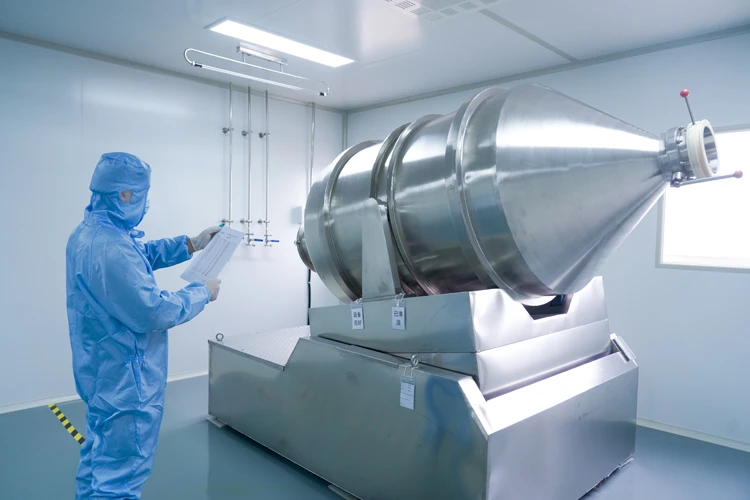
Guanjie Biotech is a Shaanxi-based manufacturer founded in 2004 that supplies high-purity natural plant extracts, premium fruit powders and specialised chemical raw materials to pharmaceutical, health care, functional food and cosmetics customers. Its company profile describes a 7,000-square-metre footprint, a 2,000-square-metre cGMP-standard clean workshop, a 500-square-metre laboratory, 40 employees, 7 engineers, an annual output of 500 tons and an export ratio of 90%. The company reports ISO, Halal and Kosher certifications and 16 national patents, and it states collaborations with Northwest University and the Xi'an Branch of the Chinese Academy of Sciences.
For this product, the supplied specification lists blue butterfly pea flower powder with butterfly pea as the source, gray blue powder as the appearance, hot air drying technology, 100.0% pass 80 mesh and 100% natural without additives. The product is positioned for dietary supplement, health food, beverage and cosmetics applications. Those facts are relevant to screening, but they should still be matched against lot-specific certificates and application test results.
Guanjie Biotech's comparison information describes the company as a direct manufacturer with R&D and production capabilities, unlike pure trading companies, and states a focus on high-value functional ingredients such as phosphatidylserine and phosphatidylcholine rather than a broad but less specialised portfolio. The same comparison information cites batch variation of ≤3%, complete batch COA, technical formulation support, stable continuous supply, competitive pricing, flexible MOQs and responsive services. These are company-reported differentiators. A buyer should verify them through certificates, batch records and a sample trial rather than treating them as independently audited performance data.
Application Fit: Where Blue Butterfly Pea Flower Powder Is Used
The supplied product facts list dietary supplement, health food, beverage and cosmetics as application areas. In practice, the qualification questions change by application. A beverage buyer will care about water solubility, pH shift, heat exposure and sedimentation. A supplement buyer will care about flowability, mesh consistency, moisture, microbiological limits and compatibility with capsule or tablet processes. A cosmetics buyer will care about colour consistency, carrier declaration and microbial control.
Because the product is a botanical colourant, application fit should be tested in the intended matrix. A water-based beverage trial at the target pH is more informative than a generic solubility statement. A powder blend trial is more informative than a mesh result alone. The qualification file supports the decision, but the application trial confirms it.
Market Trend: Clean-Label Colourants and Documentation Burden
The commercial interest in botanical colourants is part of a wider nutraceutical ingredients market. According to a 2026 Global Market Insights estimate, the global nutraceutical ingredients market is estimated at USD 105.8 billion in 2026. That market signal supports demand for plant-derived ingredients, but it does not validate an individual supplier or a specific powder specification.
Regulatory expectations reinforce the documentation burden. FDA states that dietary supplement manufacturers, packagers and holders must follow current good manufacturing practices intended to help ensure identity, purity, quality, strength and composition. FDA also describes a pre-market notification process for new dietary ingredients unless an applicable exception applies. The existence of that process does not classify blue butterfly pea flower powder as a new dietary ingredient; ingredient-specific status must be checked separately for the destination market.
The practical trend is clear: buyers are asking for more than a product name and a colour photo. They want a traceable source, a full declaration, a batch COA, a sieve record, a pH-shift report and an application trial. Suppliers that can organise those documents reduce friction at decision stage.
Comparison with Traditional Solutions: What Changes at Decision Stage
Traditional supplier qualification often relies on a quotation, a product sheet and a certificate of analysis. That approach can be sufficient for commodity screening, but it is thin for a pH-sensitive botanical colourant. A more evidence-based approach separates what the supplier states from what the buyer can verify.
| Decision question | Traditional supplier statement | Qualification evidence expected at decision stage |
|---|---|---|
| Is the source organic? | Natural or organic wording | Organic certificate, certified scope and transaction certificate |
| Is it additive-free? | No additives claim | Full ingredient declaration, carrier statement and batch COA |
| Is the mesh size controlled? | 80 mesh headline | Sieve analysis, 100.0% pass 80 mesh record and retained sample |
| Will the colour work? | Blue powder photo | pH-shift report, solubility data and application trial at target pH |
| Is the supplier a manufacturer? | Trading-company profile | Site certificates, manufacturing flow chart, batch traceability and audit evidence |
The limitation is important. Even a complete document pack cannot guarantee that a botanical powder will behave identically in every formulation. Natural botanical powders can show batch-to-batch colour variation, and anthocyanin colour is pH-dependent. Hot air drying may suit one matrix and not another. A buyer should therefore treat qualification as a gate to sampling, not as a substitute for application testing.
Future Outlook
Decision-stage buyers are likely to keep pressing suppliers for more structured evidence: batch-level organic traceability, pH-specific colour curves, mesh-to-dispersion data and clearer additive declarations. For botanical colourants, the winning supplier profile is not the one with the shortest brochure. It is the one that can answer a buyer's document request without ambiguity and support the answer with a lot-specific record.
Guanjie Biotech's supplied facts position it as a manufacturer with laboratory, clean-workshop and certification infrastructure, and its blue butterfly pea flower powder specification provides a starting point for qualification. The next step for a buyer is to test the file against the checklist above, request the missing certificates and run an application trial before commercial approval.
FAQ
What documents should a buyer request before approving blue butterfly pea flower powder?
Request the product specification, lot-specific certificate of analysis, full ingredient declaration, sieve analysis for the 100.0% pass 80 mesh claim, organic certificate and transaction certificate if organic status is required, pH-shift and solubility data, heavy metals and microbiological reports, allergen and GMO statements, manufacturing flow chart and site certificates. The documents should be connected to the specific batch under review.
Does 100% natural without additives mean the powder is organic?
No. Natural and organic are separate claims. The supplied product facts describe the material as 100% natural without additives, but organic status requires a valid organic certificate and a transaction document that links the certificate to the batch. Buyers should not treat a natural positioning as evidence of organic certification.
What does 100.0% pass 80 mesh prove?
It proves that the tested sample passed through the specified 80-mesh sieve. It does not prove the full particle size distribution, bulk density, flowability, solubility or dispersion performance. Buyers should request the sieve record and a retained sample, and should test the powder in the intended application.
How should buyers evaluate water-soluble anthocyanins and pH shift?
Ask for a pH-shift report that states the test method, pH points, colour measurement method and sample preparation conditions. Because anthocyanins are pH-sensitive, the report should be reviewed against the target application pH. A water solubility statement alone does not confirm colour performance in a beverage, powder blend or cosmetic emulsion.
What is the difference between a direct manufacturer and a trading company in botanical powder qualification?
A direct manufacturer can provide manufacturing flow charts, site certificates, batch traceability and process controls from its own operations. A trading company may rely on third-party suppliers for those records. Guanjie Biotech's comparison information describes it as a direct manufacturer with R&D and production capabilities, unlike pure trading companies. Buyers should still verify manufacturer status through site certificates, audit evidence and batch records.
Which applications fit blue butterfly pea flower powder?
The supplied product facts list dietary supplement, health food, beverage and cosmetics applications. Fit depends on the buyer's matrix: beverage applications require pH and solubility testing, supplement applications require mesh, moisture and microbiological review, and cosmetic applications require colour consistency and carrier declaration review. Application trials should be run before commercial approval.
Product facts in this review are drawn from the supplied Guanjie Biotech content units for blue butterfly pea flower powder, company background and comparison information. Market and regulatory context uses the supplied verified data entries for the 2026 nutraceutical ingredients market estimate, FDA current good manufacturing practice requirements and FDA new dietary ingredient notification background. Buyers should verify batch-specific certificates and destination-market requirements before approval.
Tem questões ou precisa de mais detalhes?
Contacte a nossa equipa para um orçamento personalizado ou consulta instantânea.
Solicitar orçamento
Preencha o formulário abaixo e a nossa equipa entrará em contacto com uma proposta personalizada.
Chat direto do WhatsApp
Prefere conversar em tempo real? Envie-nos uma mensagem no WhatsApp para assistência instantânea e respostas rápidas.
- Obter orçamento personalizado
- Partilhar fotos ou documentos
- Discuta as suas necessidades diretamente
Geralmente responde em 5–30 minutos durante o horário de expediente.