
Blue Butterfly Pea Flower Powder: Scenario Fit in Cosmetics and Premium Bakery
Blue is one of the harder hues to stabilise in both food and cosmetic formulation. Blue butterfly pea flower powder — a plant-based colorant derived from Clitoria ternatea flowers — offers a water-soluble, additive-free route to that hue for cosmetics, premium bakery, dairy and functional beverages. The fit is never generic, however: water solubility, pH response, heat exposure and particle fineness decide together whether the powder performs in a given matrix.
This is an industry application guide built around one question that buyers at the Research and Evaluation stage actually ask: in which formulation does blue butterfly pea flower powder belong, and what has to be controlled for it to work? The answer sits less in the colour description than in the behaviour of the pigment itself.
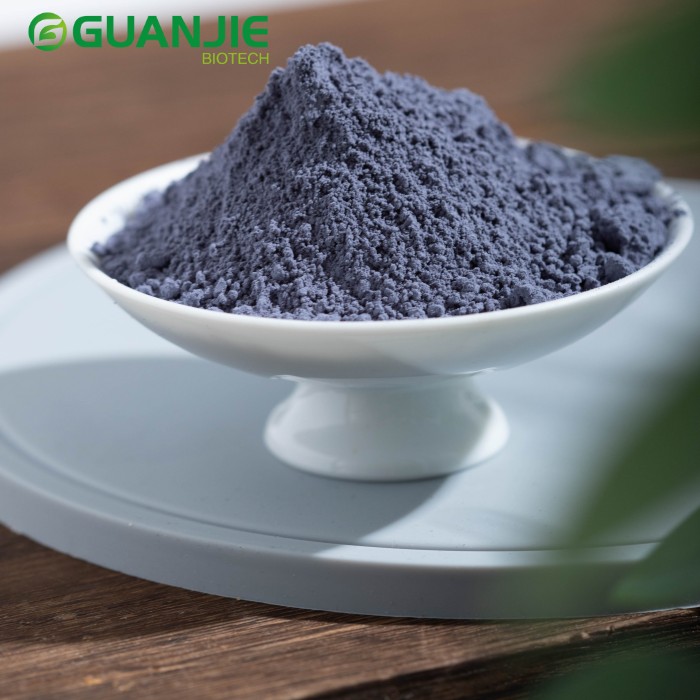
Blue butterfly pea flower powder in its standard supply form: a fine grey-blue powder produced by hot air drying and milled to pass 80 mesh.
Why Blue Remains a Difficult Colour in Formulation
Among the natural colour families, blue has historically been the narrowest. Reds and yellows can be drawn from a wide botanical field; a stable, water-dispersible blue from a plant source is a much shorter list. That scarcity shifts the procurement conversation. Instead of asking which powder is "bluest", formulators and buyers ask a narrower and more useful question: will this colorant hold its intended appearance under the pH, temperature and processing conditions of the target product?
That question produces very different answers across applications. A cosmetic emulsion, a baked laminated pastry, a stirred yoghurt and a ready-to-drink tea are four distinct chemical environments. They differ in pH, water activity, heat load and how much the colour needs to dominate the visual impression of the finished product. Blue butterfly pea flower powder can serve all four categories — its documented application scope covers dietary supplements, health food, beverages and cosmetics — but the formulation logic behind each one is not interchangeable.
What Blue Butterfly Pea Flower Powder Actually Is
Blue butterfly pea flower powder is a botanical colorant produced from the flowers of Clitoria ternatea, dried with hot air drying technology and milled to a defined particle size. Its colouring fraction consists of anthocyanins — water-soluble pigments that also carry antioxidant activity. The specification below reflects the standard supply form offered by Guanjie Biotech and is the reference point for everything that follows.
| Parameter | Specification |
|---|---|
| Botanical source | Butterfly pea (Clitoria ternatea) flower |
| Appearance | Grey-blue powder |
| Processing technology | Hot air drying technology |
| Mesh | 100.0% pass 80 mesh |
| Additives | 100% natural without additives |
| GMO status | Non-GMO |
| Planting source | Organically cultivated Clitoria ternatea |
| Colouring fraction | Antioxidant anthocyanins |
| Solubility behaviour | Water-soluble pigment |
| Colour performance | Blue-to-purple pH colour shift; heat-stable performance |
| Quality standards | Produced under ISO, Halal and Kosher standards |
| Declared applications | Dietary supplement, health food, beverage, cosmetics |
Why the 80-mesh figure matters for scenario fit
A powder passing 80 mesh is fine enough to disperse without a separate grinding step, which matters in two very different ways. In a beverage or a liquid cosmetic base, fineness governs how quickly the pigment hydrates and whether visible particles remain in suspension. In bakery applications and in pressed or dusted cosmetic formats, fineness governs visual evenness — a coarser powder can leave speckling where a uniform tone is intended. Because 100% of the material is declared to pass 80 mesh, the buyer is working with a defined particle ceiling rather than an open-ended range.
The grey-blue appearance of the powder is also worth noting at the specification stage. It signals the natural, non-standardised character of a botanical colorant: the visual blue the formulator wants is developed in the finished matrix, not in the raw material.
The Anthocyanin Mechanism: Why Blue Turns Purple
Anthocyanins are the pigment class responsible for the blue in butterfly pea. Their defining technical property is pH dependence. In solution, the anthocyanin structure shifts as acidity changes, and the visible result moves along a blue-to-purple axis. This is not a defect in the ingredient; it is the chemistry the ingredient works by, and it is the single most important fact a formulator needs before choosing a dosage.
The practical consequence is that pH becomes a formulation variable of the same rank as colour dosage. Two products made with the same powder at the same inclusion level can look distinctly different if their pH differs. Buyers evaluating this colorant should therefore expect a supplier to discuss the pH window of the intended application rather than only quoting a colour value. In acidic systems the blue character is preserved; as the system moves toward neutral and beyond, the shade drifts toward purple. Some applications treat that drift as an asset — layered beverages and cocktail formats deliberately exploit it — while others require it to be locked down.
Anthocyanins are also water-soluble, which is the second half of the behavioural story. The pigment dissolves in aqueous systems without a carrier or dispersion aid, so it integrates into water-based formulations directly. In oil-continuous or low-water systems, by contrast, the formulator must plan for how the aqueous phase is presented.
Scenario Fit in Cosmetics
Cosmetics is the application where the two properties of this powder — colour and anthocyanin content — can be used together rather than one being incidental. A plant-derived blue colorant with an antioxidant anthocyanin fraction fits product concepts where the colour story and the botanical story reinforce each other, and where the label position favours a natural colorant over a synthetic dye.
Three formulation considerations dominate. First, the pH of the cosmetic base sets the hue. A water-based gel, a toner or a low-pH emulsion will read differently from a neutral cream, and the colour target must be defined against the base as formulated, not against the powder in isolation. Second, water solubility means the pigment belongs to the aqueous phase; in an emulsion, that determines where colour intensity actually sits. Third, colour must remain visually consistent from batch to batch, which is a specification question rather than a formulation one — it depends on the colorant being supplied to a controlled specification each time.
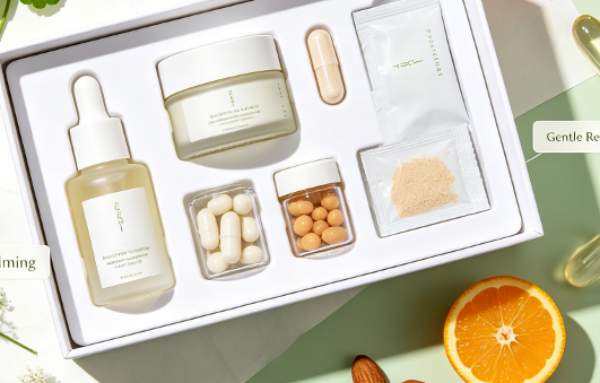
Cosmetic bases are a documented application area for botanical powders; pH and aqueous-phase behaviour decide how a water-soluble blue pigment reads in the finished product.
For cosmetic buyers, the qualification questions are correspondingly specific: what is the declared appearance and mesh of the lot, is the material additive-free, and does each shipment arrive with documentation matching the agreed specification? Those are answerable questions. Claims about skin benefit are not answered by a colorant specification and should not be inferred from the presence of anthocyanins alone.
Scenario Fit in Premium Bakery
Bakery is the harder test, because heat and pH act on the pigment at the same time. Blue butterfly pea flower powder is documented as suitable for bakery items, and its heat-stable performance is part of the supplied specification. That is a meaningful starting point — many natural colourants degrade visibly under bake conditions — but it does not remove the need for application testing, because a dough or batter is not a single uniform chemical environment.
The practical logic for premium bakery runs as follows. Where the colour is carried in a component that sees limited heat — a filling, a glaze, a finish applied after baking — the pigment experiences close to its solution behaviour, and pH is the dominant control. Where the colour is baked into the crumb, the powder is exposed to both thermal load and the pH of the dough system, and colour development should be validated in the actual recipe rather than assumed from a bench solution.
This is where supplier technical support earns its place in the evaluation. Formulation troubleshooting for colour loss, thermal degradation and solubility issues in bakery and beverage matrices is part of the post-purchase support scope that Guanjie Biotech provides to B2B clients — a detail worth checking during supplier comparison, because a natural colorant almost always needs an application conversation before it needs a purchase order.
Dairy and functional beverages
Dairy and plant-based alternatives sit between the cosmetic and bakery cases. Water solubility makes incorporation straightforward in milk-based and plant-based liquids, and the pH of the system again governs whether the visible shade reads blue or moves toward purple. Fermented dairy is a specific case worth flagging: its acidity is intrinsic to the product, so the colour outcome should be assessed in the finished base rather than in water.
Functional beverages — including ready-to-drink teas and cocktail formats, both listed among the intended uses for this powder — are the application where the pH shift is most often treated as a feature. A drink that changes shade as acidity changes is a design choice, and it is only repeatable when the colorant itself is supplied to a consistent specification lot after lot.
Comparing Blue Butterfly Pea Flower Powder with Conventional Colour Options
Positioning this colorant honestly requires naming where it does not compete. The table below compares it with conventional synthetic blue colouring on the dimensions that actually drive a purchasing decision, and it deliberately includes the areas where the synthetic option remains simpler.
| Criterion | Blue Butterfly Pea Flower Powder | Conventional Synthetic Blue |
|---|---|---|
| Origin | Botanical, hot air dried, 100% natural without additives | Synthetic |
| Label positioning | Supports plant-based and clean-label concepts | Requires synthetic colour declaration |
| pH behaviour | Intrinsic blue-to-purple shift; pH must be managed | Generally less pH-sensitive in use |
| Colour predictability | Depends on raw-material specification and application testing | Standardised by design |
| Sensory contribution | Botanical character is inherent to the material | Colour only |
| Formulation effort | Higher — requires pH and process validation | Lower |
The boundary a buyer should accept up front
Blue butterfly pea flower powder is not a drop-in equivalent to a standardised synthetic blue. Its colour is pH-dependent by nature, so it cannot deliver a fixed hue across products of different acidity without formulation work. Its starting appearance is grey-blue rather than a saturated blue, meaning colour is developed in the matrix, not read off the powder. And as a botanical material it varies at source, which is why specification control — mesh, additive status, appearance, certification — carries more weight in supplier selection than it would for a synthetic dye.
For a premium bakery or a cosmetics line where the plant-based colour story is part of the product proposition, that trade is usually rational. For a high-volume application where colour must be identical across a wide pH range with minimal process change, a natural anthocyanin colorant is the wrong tool, and saying so is part of an honest evaluation.
Procurement Checklist for Scenario-Based Selection
Because application fit depends on controlled material properties, the qualification checklist for this colorant is short but non-negotiable.
- Mesh confirmation. Verify that the lot is declared as 100.0% passing 80 mesh, not an approximate range.
- Additive status. Confirm the material is 100% natural without additives, since carriers change dispersion behaviour and label declarations.
- Source and planting statement. Obtain the declared botanical source (Clitoria ternatea) and the organic cultivation statement in writing.
- Certification coverage. ISO, Halal and Kosher status should be stated for the material being purchased, not only at company level.
- Appearance reference. Agree the grey-blue appearance as a retained reference standard so that visual drift is detectable on receipt.
- Application support. Confirm whether the supplier offers formulation troubleshooting for colour loss, thermal degradation and solubility in the intended matrix.
- Commercial terms. Check MOQ, lead time and sampling policy against the trial plan, not against the eventual production volume.
Supply-Side Context: Guanjie Biotech
Guanjie Biotech is a Shaanxi-based manufacturer and supplier of high-purity natural plant extracts, fruit powders and specialty raw materials, founded in 2004 and serving the pharmaceutical, health care, functional food and cosmetics industries. The company operates a 7,000 m² facility that includes a 2,000 m² cGMP-standard clean workshop and a 500 m² laboratory, with a reported annual output of 500 tons, a team of 40 staff including 7 engineers, and an export ratio of around 90% across markets that include Germany, the United Kingdom, the Netherlands, Canada, Japan, Australia, Brazil and Saudi Arabia.
For a natural colorant, three capabilities are directly relevant to the evaluation described above. First, documentation: products are developed and produced in accordance with international quality requirements and supported by ISO, Halal and Kosher certifications, with batch COA verification and third-party re-testing through laboratories such as SGS and Eurofins available when quality questions arise on arrival. Second, application support: post-purchase services explicitly cover formulation troubleshooting for colour loss, thermal degradation and solubility issues in beverage, bakery and supplement matrices — the exact problems a pH-sensitive blue pigment creates. Third, flexibility: OEM/ODM cooperation with package customisation, a minimum order quantity of 1 kg, a stated lead time of 30 days and 100% testing support both a bench-scale trial and a production roll-out.
The company reports more than 16 national patents and collaboration with Northwest University on a master's experimental base, alongside a strategic partnership with the Xi'an Branch of the Chinese Academy of Sciences. For buyers, these are context signals about technical depth rather than substitutes for lot-level documentation — the specification and certificate for the material in hand remain the deciding evidence.
Market Context and Outlook
The direction of travel in both cosmetics and premium food is toward colorants that can be named on a label as what they are. As formulators work through that shift, the constraint that surfaces repeatedly is not the availability of natural hues but the predictability of their behaviour — and pH-sensitive anthocyanin colours sit squarely inside that constraint.
Two developments are likely to shape how blue butterfly pea flower powder is specified over the next few years. The first is tighter specification discipline: mesh pass rate, additive status, appearance reference and certification coverage moving from marketing language into contractual parameters. The second is application engineering: suppliers competing less on colour descriptors and more on their ability to help a customer resolve colour loss, thermal degradation and solubility problems inside a specific matrix.
Neither development changes the underlying chemistry. Blue butterfly pea flower powder will remain a water-soluble, pH-responsive, plant-derived colorant with a defined particle specification — and its scenario fit will continue to be decided product by product, not by category.
Frequently Asked Questions
Is blue butterfly pea flower powder water-soluble?
Yes. It is a water-soluble pigment, which means the colouring fraction disperses in aqueous systems without a carrier. Formulators should plan for the pigment to sit in the water phase of a formulation.
Why does the colour shift from blue to purple?
The colouring fraction consists of anthocyanins, which are pH-responsive. As the acidity of the surrounding system changes, the visible shade moves along a blue-to-purple axis. The shift is a property of the pigment chemistry, not a sign of degradation.
Does the powder survive baking temperatures?
The supplied specification states heat-stable performance, and bakery items are among its documented applications. Because a dough or batter combines thermal load with its own pH, colour development should still be validated in the actual recipe rather than assumed from a solution test.
Which cosmetic formats are a realistic fit?
Water-based formats and the aqueous phase of emulsions are the natural fit, since the pigment is water-soluble. The hue in a finished cosmetic depends on the pH of that base, so the colour target should be defined against the base as formulated.
What specification points should be verified before ordering?
The declared mesh (100.0% pass 80 mesh), the additive-free status, the botanical source and organic cultivation statement, the declared grey-blue appearance, and current ISO, Halal and Kosher coverage for the material being purchased.
How should batch-to-batch colour consistency be evaluated?
Through the specification rather than the colour description: confirmed mesh pass rate, retained appearance standard, additive-free declaration and matching COA for each lot. As a botanical colorant, consistency comes from controlled specification and documentation, not from a fixed synthetic colour value.
For readers who need the detailed product and capability documentation behind this application guide, the Guanjie Biotech nutraceutical ingredients brochure is available for download.
Download the Guanjie Nutraceutical Ingredients brochure (PDF)
Tem questões ou precisa de mais detalhes?
Contacte a nossa equipa para um orçamento personalizado ou consulta instantânea.
Solicitar orçamento
Preencha o formulário abaixo e a nossa equipa entrará em contacto com uma proposta personalizada.
Chat direto do WhatsApp
Prefere conversar em tempo real? Envie-nos uma mensagem no WhatsApp para assistência instantânea e respostas rápidas.
- Obter orçamento personalizado
- Partilhar fotos ou documentos
- Discuta as suas necessidades diretamente
Geralmente responde em 5–30 minutos durante o horário de expediente.