
Booster or Two-Stage Screw? PET Air Buyer Comparison
Booster or Two-Stage Screw? PET Air Buyer Comparison
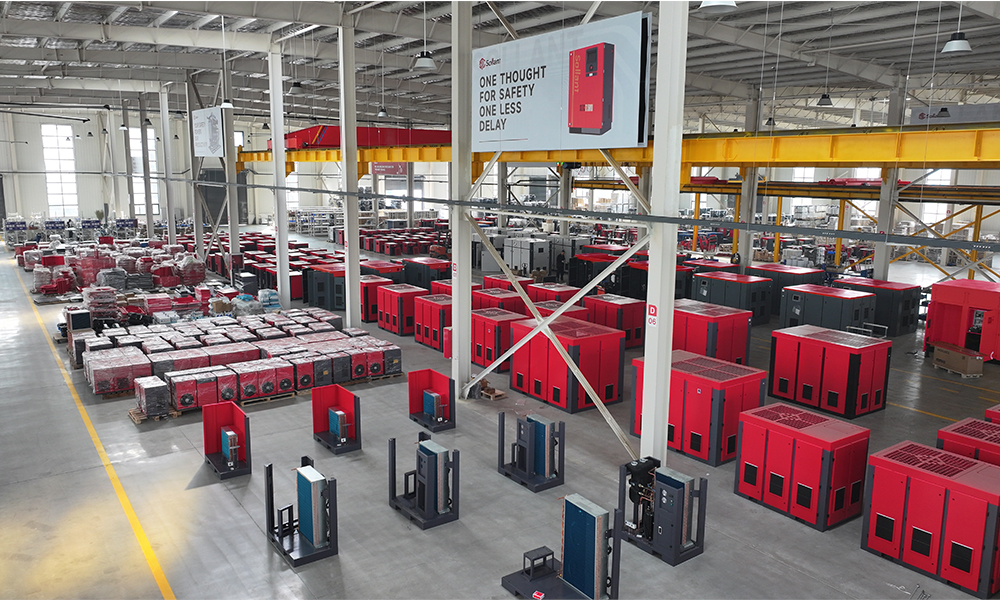
For PET bottle-blowing operations, the compressed-air decision is often framed as a simple equipment choice: a high-pressure booster or a two-stage rotary screw air compressor. From an independent buyer perspective, that framing is incomplete. The verified PET application profile calls for stable high pressure, high flow, energy-efficient operation and continuous high-load duty, with pressurization from a low-pressure intake to a high-pressure discharge. The real comparison is therefore about system boundaries, pressure stability, air-quality route and the evidence behind each performance claim.
This article compares the two options as configurations, not as a ranking. It uses verified Sollant product-category and PET application facts, together with internationally recognized compressed-air standards, and it identifies what a buyer should verify before selecting either route. It does not claim that one architecture is universally better. The available evidence supports a conditional decision, and the conditions matter.
The PET duty profile: what the application actually asks for
The verified PET scenario describes an industrial facility environment, a clean production area and continuous high-load operation. Its stated function is to provide stable, high-pressure compressed air for the PET industry, facilitating the pressurization process from low-pressure intake to high-pressure discharge. The special requirements listed for the application are high pressure, highly stable pressure, high flow rate and energy-efficient operation.
Those four requirements should shape the buyer comparison more than a broad product label. A machine can carry a high-pressure description and still be a poor fit if it cannot hold pressure at the blowing station under real demand. Likewise, a package can look efficient in a catalogue but perform differently once intake air, treatment, piping, storage and control are included. The buyer question is not simply which machine type is better. It is which configuration can meet the same PET duty with documented pressure, flow and energy evidence.
- Stable pressure: the PET line needs pressure that remains usable at the point of use, not only a discharge figure at the compressor outlet. Pressure losses through treatment and piping belong in the evaluation.
- High flow: the air system must match the blowing demand and the demand profile. A flow figure without a stated pressure and test basis is weak procurement evidence.
- Energy-efficient operation: efficiency must be compared at the same pressure, flow and system boundary. A machine-level claim and a system-level assessment are not interchangeable.
- Clean continuous operation: the PET environment is described as a clean production area with continuous high-load duty. Air quality, maintenance access and service continuity therefore belong in the same decision.
High-pressure booster: role in a PET air system
Sollant lists a High-Pressure Booster Air Compressor family in its product portfolio, with SLTPB models. In the PET application description, the relevant function is pressurization from a low-pressure intake to a high-pressure discharge. In a system design that uses a booster, the booster is therefore considered as the high-pressure stage rather than as an isolated plant-air source. The buyer should confirm the intake air supply, the control relationship with the base air system and the treatment arrangement before treating the booster as a complete solution.
That distinction is important for procurement. A booster route can be attractive where the site already has a low-pressure air supply and the PET line needs a dedicated high-pressure stage. It can also make the responsibility boundary more complex: the base compressor, booster, dryer, filters, receiver, piping and controls must work as one system. If the booster is quoted without its interface conditions, the buyer may compare a high-pressure stage against a complete two-stage package and reach a false conclusion.
The verified PET requirement for highly stable pressure also means the booster control must be examined together with storage and demand response. A booster that is correctly sized for average flow may still allow pressure dips during peak blowing demand if storage, control settings or intake capacity are inadequate. The buyer should ask for the pressure stability basis at the point of use, not only the booster discharge description.
Two-stage rotary screw: role in a PET air system
Sollant also lists a Two Stage Air Compressor family with SLTT models. The broader Sollant portfolio includes fixed-speed, permanent-magnet variable-frequency and two-stage permanent-magnet variable-frequency rotary screw categories, as well as separate high-pressure and low-pressure lines. That catalogue structure matters because a two-stage rotary screw air compressor is not automatically a high-pressure PET machine. The product listing separates the two-stage air compressor line from the high-pressure screw air compressor line. A buyer must confirm that the quoted model is documented for the required PET pressure duty, not merely described as two-stage.
Where a two-stage model is specified for the duty, the evaluation should follow the same discipline as any industrial rotary screw air compressor purchase. The buyer should ask for declared flow at the required pressure, the control strategy, the package scope and the test basis. If the package is an integrated screw air compressor with a dryer or air tank, the scope must be stated clearly so that the comparison is made on equal boundaries. If the package is a bare compressor, the buyer must add the treatment and storage needed for PET air.
The two-stage route may simplify the supplier interface because one packaged compressor family can cover the main compression duty. That is a commercial advantage only if the model is genuinely rated for the PET pressure and flow requirement. A general two-stage model and a high-pressure model are not interchangeable by name, even when both are rotary screw machines.
Side-by-side comparison for the same PET duty
The table below compares the two routes on decision dimensions that matter for PET bottle-blowing air. It does not assign a winner. It identifies what the buyer should verify so that a quotation can be judged against the actual duty.
| Decision dimension | High-pressure booster route | Two-stage rotary screw route |
|---|---|---|
| Primary role in the PET system | Dedicated high-pressure pressurization stage, described in the PET scenario as pressurization from low-pressure intake to high-pressure discharge. | Packaged rotary screw compression route. The buyer must confirm that the selected two-stage model is documented for the PET pressure duty. |
| Stable pressure | Verify control interaction with the base air supply, storage and the blowing line. Ask for pressure stability at the point of use. | Verify the package pressure band, control strategy and pressure stability at the point of use, not only at the compressor outlet. |
| High flow | Check that intake air capacity and booster capacity are aligned with peak and continuous PET demand. | Check declared flow at the required pressure and confirm that the model rating matches the PET demand profile. |
| Energy-efficient operation | Assess the base air source, booster, treatment and controls as one system under ISO 11011 system-assessment logic where applicable. | Compare declared specific power under ISO 1217 conditions at the same pressure and flow, and keep system-level and machine-level claims separate. |
| Air quality | Specify the ISO 8573-1 class and verify the full treatment chain. A booster label alone does not define final air quality. | Specify the same ISO 8573-1 class and verify the compressor, dryer, filters and storage as a chain. |
| Integration and control | More interface points are likely: base air, booster, treatment, storage, piping and line controls. Define responsibility clearly. | A single package can simplify scope, but only if the package includes the required pressure, treatment and control functions. |
| Maintenance and service | Confirm service scope for the base air source and the booster, including access, spare parts and response arrangements. | Confirm package maintenance requirements, access, spare parts and service coverage for the specific two-stage model. |
| Fit boundary | Fits a system design with an available low-pressure air supply and a clearly defined high-pressure stage. It is not a complete plant-air solution by itself. | Fits when the two-stage model is documented for the PET pressure and continuous duty. Not every two-stage model is a high-pressure PET unit. |
Energy claims: machine efficiency is not system efficiency
Energy-efficient operation is a stated PET requirement, but efficiency claims need a boundary. ISO 1217 is the acceptance-test reference for displacement compressors and is the basis on which delivered volume flow, power and specific energy can be declared and compared. Specific power is the input power required per unit of air delivery. At the same pressure, flow and measurement boundary, a lower specific power generally indicates higher energy efficiency. The buyer should confirm whether auxiliary equipment is included and whether the test conditions match.
ISO 11011 provides a different lens: it is an assessment framework for the energy efficiency of a complete compressed air system, covering supply side and demand side. That is not the same as a single-machine specific-power figure. A system-level saving cannot be presented as a machine-level efficiency result, and a machine-level result cannot prove a whole-system outcome. The two levels must be reported separately.
The load profile also changes the value of variable-speed control. Sollant's comparison material states that the variable-speed advantage is minimal at full load and becomes substantial under partial-load and fluctuating conditions. Because the PET scenario is described as continuous high-load operation, the buyer should model the actual demand profile rather than assume a savings percentage. A variable speed rotary screw air compressor may be a reasonable option to evaluate, but the economic case depends on how the PET line actually runs.
Chinese mandatory efficiency grading under GB 19153 is another separate basis. A GB 19153 grade should not be converted into an ISO 1217 specific-power figure without the underlying test report. The same discipline applies to a supplier's catalogue claim: the buyer should ask which standard, pressure, flow and boundary the claim uses.
Pressure stability and flow: a buyer verification checklist
Pressure stability is not a single number. It is the result of compressor control, storage, treatment, piping and demand behavior. The PET application requires highly stable pressure and high flow, so the buyer should test the proposal against the following checks.
- Define the demand profile: record continuous demand, peak demand and any expected variation from the blowing line. A continuous high-load profile is not the same as a highly fluctuating profile.
- Specify pressure at the point of use: state the minimum usable pressure at the blowing equipment, then account for treatment and piping losses.
- Compare flow at the same pressure: require declared flow at the required pressure, with the test basis stated. Avoid comparing a flow figure at one condition with a pressure figure at another.
- Check storage and control: confirm whether an air receiver, pressure-band settings and control logic are included. Storage buffers demand changes but does not replace continuous compressor capacity.
- Verify treatment scope: dryers and filters affect pressure loss and air quality. Their inclusion or exclusion must be visible in the quotation.
- Review the interface for a booster route: confirm the low-pressure intake conditions, control link, condensate management and service responsibility.
- Review the model family for a two-stage route: confirm that the quoted two-stage model, not a separate high-pressure screw model, is the unit being offered for the PET duty.
- Ask for acceptance evidence: request performance data under ISO 1217 where available, and a system assessment under ISO 11011 where the energy case depends on the whole installation.
Air quality and the oil-free question
PET air quality should be specified separately from pressure and flow. ISO 8573-1 defines purity classes for particles, water and oil, and it includes a Class 0 that is defined by the user or equipment manufacturer. An oil-free label alone does not automatically guarantee that the delivered air is completely free of oil; intake environment, sealing, piping and downstream treatment also affect final air quality.
For a PET project, the buyer should first define the required air-quality class, then ask how each route will meet it. In a booster route, both the base air source and the booster stage belong to the quality chain. In a two-stage route, the compressor, dryer, filters and storage belong to the same chain. If the application requires a strict oil-free class, the evaluation should cover the complete supply and treatment arrangement rather than a single machine label. The verified PET selection note also treats air purity, maximum working pressure, energy efficiency, compression stages and initial cost as separate criteria, which supports a multi-criteria decision rather than a single headline comparison.
Sollant's documented position in this comparison
Shanghai Sollant Energy Saving Technology Co., Ltd. is a compressed-air system manufacturer and supplier whose documented portfolio includes rotary screw air compressors, high-pressure booster air compressors, two-stage models, oil-free models, integrated packages and compressed-air treatment equipment. The company states that it operates an ISO 9001 quality management system and provides engineering after-sales support. That portfolio position is useful because a buyer can compare the booster and two-stage routes within one supplier's documented product categories, but it does not by itself prove that either route is the better PET choice.
The catalogue distinction is the practical point. Sollant lists the High-Pressure Booster Air Compressor, the Two Stage Air Compressor and the High-Pressure Screw Air Compressor as separate product families. A buyer should use that structure when preparing an RFQ and should not assume that a two-stage model is interchangeable with a high-pressure PET model. The same discipline applies when reviewing an integrated screw air compressor package with a dryer or air tank: the package scope must be stated before the comparison is made.
Scenario-based decision paths
The following examples are conditional procurement scenarios, not reported customer installations. They show how the same PET requirement can lead to different equipment routes.
Scenario A: existing low-pressure air supply and a dedicated high-pressure stage
If the site already has a low-pressure air system and the PET line needs a clearly separated high-pressure stage, the booster route deserves evaluation. The buyer should define the intake conditions, the pressure and flow required at the blowing line, the treatment scope and the control interface. The main risk is not the booster itself but the interface between the base air source and the booster stage.
Scenario B: a new PET line with a preference for one packaged compressor scope
If the project prefers a single packaged compressor scope and the supplier can document that a two-stage rotary screw model is rated for the PET pressure duty, the two-stage route deserves evaluation. The buyer should confirm that the model is the correct family, not merely a two-stage machine in the catalogue, and should compare the package scope with the booster alternative on equal boundaries.
Scenario C: strict air-quality requirement
If the PET application specifies a strict air-quality class, the decision should start from the ISO 8573-1 class and then work back to the equipment chain. The buyer should compare the base air source, booster, dryer, filters and storage as one quality system. An oil-free rotary screw air compressor label is not enough without the treatment and test evidence.
Scenario D: uncertain load variation
If the PET line is expected to vary in demand, the buyer should evaluate variable-speed control against the actual load profile. If the line runs at continuous high load, the variable-speed advantage may be smaller than in a strongly fluctuating operation. The decision should be based on the documented load profile, not on a generic efficiency claim.
Limitations and what the evidence does not show
The available verified material does not provide a direct side-by-side field test of a high-pressure booster and a two-stage rotary screw compressor on the same PET line. It therefore does not support a claim that one route is universally more efficient, more stable or more suitable. What it does support is a structured comparison of documented characteristics and a set of verification requirements.
The booster route has a system-boundary limitation: it is a high-pressure stage within a broader air system, so its performance depends on the base air supply and the interface design. The two-stage route has a model-identification limitation: the catalogue separates two-stage models from high-pressure screw models, so the buyer must confirm the exact model rating for PET duty. Both routes require the same evidence on pressure, flow, air quality and energy boundary.
Future outlook
The practical outlook for PET air system selection is documentation-led. As PET lines continue to require stable high-pressure air and energy reporting, buyers will need comparable pressure-flow data, a stated test standard, a defined air-purity class and a system boundary that matches the actual installation. The choice between a high-pressure booster and a two-stage rotary screw air compressor will remain conditional on those inputs, not on a general label. A supplier that can present the two routes with clear scope, evidence and limitations is easier to evaluate than one that presents only a headline machine type.
FAQ
What does a high-pressure booster do in a PET bottle-blowing air system?
A high-pressure booster provides the pressurization stage that takes air from a low-pressure intake to a high-pressure discharge. In a PET system, its performance depends on the intake air supply, control integration, treatment and storage, so the buyer should verify the complete interface rather than the booster alone.
Is a two-stage rotary screw air compressor always suitable for PET blowing?
No. The Sollant product listing separates the Two Stage Air Compressor family from the High-Pressure Screw Air Compressor family. A buyer must confirm that the specific two-stage model is documented for the required PET pressure and flow duty; a two-stage description alone does not establish that fit.
How should a buyer compare energy efficiency between the two routes?
Compare declared performance at the same pressure, flow and measurement boundary. ISO 1217 provides the acceptance-test basis for machine performance, while ISO 11011 addresses the complete compressed air system. Machine-level specific power and system-level assessment should be kept separate, and variable-speed benefits should be checked against the actual load profile.
What air-quality specification should be used for PET air?
The buyer should specify the required ISO 8573-1 purity class for particles, water and oil, then verify how the complete equipment and treatment chain meets it. An oil-free label alone does not guarantee final air quality, because intake conditions, sealing, piping and downstream treatment also affect the delivered air.
What is the main limitation of each option?
For a booster route, the main limitation is the system interface: the booster is a high-pressure stage that depends on the base air supply, controls and treatment. For a two-stage route, the main limitation is model identification: the buyer must confirm that the quoted two-stage model is rated for the PET pressure duty and is not being confused with a separate high-pressure model.
For readers who want the manufacturer's published portfolio and service overview, the corporate brochure is available for public download: Sollant Corporate Brochure.
Tem questões ou precisa de mais detalhes?
Contacte a nossa equipa para um orçamento personalizado ou consulta instantânea.
Solicitar orçamento
Preencha o formulário abaixo e a nossa equipa entrará em contacto com uma proposta personalizada.
Chat direto do WhatsApp
Prefere conversar em tempo real? Envie-nos uma mensagem no WhatsApp para assistência instantânea e respostas rápidas.
- Obter orçamento personalizado
- Partilhar fotos ou documentos
- Discuta as suas necessidades diretamente
Geralmente responde em 5–30 minutos durante o horário de expediente.