
Boron Nitride 8233: Application Breadth as Supplier Evidence
Boron Nitride 8233: Application Breadth as Supplier Evidence
A supplier's boron nitride claim is worth as much as the number of distinct processes in which that material can be shown to have worked. Application breadth is one of the few capability claims a buyer can verify with evidence instead of adjectives.
Boron nitride — specifically hexagonal boron nitride, h-BN — is a specialty ceramic used in high-temperature manufacturing as a release agent against molten metals, a lubricant for hot tooling, a thermally conductive filler and an electrical insulator that holds up under high voltage. Sumetech Industry Co., Ltd, a manufacturer based in Xuzhou, China, supplies the material as product 8233 in powder, granular, coating and paint forms.
The material category is not where buyer risk sits. Every candidate supplier sells boron nitride. The evaluation question is narrower and harder to answer: which supplier can document that its boron nitride has performed in genuinely dissimilar environments — molten aluminium on a die surface, molten glass on a forming mould, a sintering fixture, a semiconductor thermal path — when each of those environments fails for a different reason.
This reference maps Boron Nitride 8233 across six process environments, explains the parameters that make that breadth technically possible, and sets out the storage and documentation evidence buyers should request before committing to a trial order.
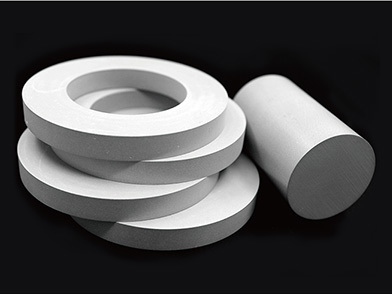
Boron nitride composite ceramics — the ceramic form of the material that also appears in coatings, paints, powders and granules within the 8233 range.
Why Application Breadth Is Harder to Fake Than a Datasheet
A datasheet can state a maximum working temperature, a purity figure and a friction characteristic. It cannot demonstrate that one grade survives contact with molten aluminium while also functioning as a dielectric filler in an electronics assembly. Those two environments stress the material in unrelated ways, and no single sentence answers both.
That is why application breadth carries more evidential weight than any isolated parameter. Die casting punishes a coating through adhesion and thermal cycling at the die face. Glass forming punishes it through contact with a viscous melt that will bond to almost anything it wets. Sintering punishes fixtures through carbon contamination and bonding between workpieces. Semiconductor thermal management punishes the material through heat concentration combined with a requirement to insulate electrically at the same time as conducting heat.
A supplier can describe any one of those requirements. To claim all of them, it has to have shipped material into all of them — with the packaging, quality control, application support and storage discipline that each environment imposes. That gap between description and record is the difference buyers are actually assessing at the research and evaluation stage.
What Boron Nitride 8233 Is
Sumetech Industry Co., Ltd is a Xuzhou, China-based manufacturer of metal smelting and casting auxiliary materials and high-performance ceramics, founded in 2019. Its portfolio is centred on potassium aluminium fluoride (PAF) and boron nitride. The company operates a 6,000 m² facility with a stated annual output of 5,000 MT across its product lines, a five-technician research and quality team, and an export ratio of 90%, with stated markets in Turkey, Japan, Korea and Europe.
Boron Nitride 8233 is supplied in four delivery forms — powder, granular, coating and paint — and additionally in boron nitride ceramic, boron nitride fiber, boron nitride painting and BN coating formats. Its stated maximum working temperature is 900 °C in air and above 2,000 °C in an inert gas atmosphere, with a maximum purity of 99.9%.
The two temperature figures are the first constraint a buyer should notice. They describe the same material under different atmospheres, not two different products. In air, the usable ceiling is 900 °C. Above that, the material is only protected when the surrounding atmosphere is inert. Any specification discussion that quotes a single number without naming the atmosphere is incomplete.
The Technical Basis for That Breadth
Hexagonal boron nitride has a layered crystal structure in which atoms within each layer are covalently bonded while the layers interact through weaker van der Waals forces — the same structural logic as graphite, which is why the material is sometimes described as white graphite. The layers slide over one another, producing a soft material with a low coefficient of friction and reliable release behaviour against contacting surfaces.
That structure explains the release function. Chemical behaviour explains the rest. The material is chemically inert, non-wetting, and corrosion-resistant against most molten metals and chemicals, which is what allows it to sit at an interface with a melt without becoming part of it. Electrically, it is a high-temperature insulator with a low dielectric constant that remains usable in high-frequency and high-voltage conditions. Thermally, it conducts heat, which is why the same material family is used as a thermally conductive filler.
Breadth, in other words, is not a marketing position bolted onto one property. It emerges from a combination that rarely appears together in one material: lubricity, chemical inertness, thermal stability, electrical insulation and thermal conduction.
Six Process Environments Where the Grade Is Applied
The application record for Boron Nitride 8233 spans precision casting, horizontal continuous casting, amorphous ribbon, optical glass, functional ceramics, thermally conductive filler, photovoltaic technology, solar thermal energy storage, semiconductor, vacuum coating, electronics, military and aerospace, superhard materials, cosmetic additives and functional fibers. For procurement purposes, those categories collapse into six environments with distinct requirements.
| Process environment | Behaviour required | Application anchor in the 8233 record |
|---|---|---|
| Aluminium and magnesium die casting | Release from dies, troughs and ladles; prevent adhesion and metal build-up | Moulds, troughs and ladles for aluminium, magnesium and zinc alloys; wheel hub demolding case |
| Continuous and precision casting | Resist molten metal attack; maintain a non-wetting interface | Precision casting; horizontal continuous casting; amorphous ribbon |
| Glass melting and optical glass | Release from glass-forming moulds; reduce surface defects and cleaning downtime | Optical glass; release coating on glass-forming moulds; prevents adhesion in glass processing |
| Ceramic sintering and functional ceramics | Barrier against bonding between workpieces and fixtures; limit carbon contamination | Functional ceramics; BN-coated graphite plates used in powder sintering |
| Powder metallurgy and superhard materials | Lubricate at temperature; protect tooling and high-temperature containers | Superhard materials; cutting tools; high-temperature containers |
| Semiconductor and electronics thermal management | Conduct heat while insulating electrically; hold a low dielectric constant | Semiconductor industry; electrical and electronic semiconductor heat dissipation; thermally conductive filler; vacuum coating |
Die casting: the case with the longest paper trail
The most concrete evidence in the 8233 record is a Turkish manufacturer that used 200 kg of the material over a one-year period for wheel hub demolding. The reported result was that the coating effectively prevents adhesion, with soft texture and a low coefficient of friction identified as the relevant characteristics.
The value of that case is not the complaint it solved but the duration. A release coating that performs once proves little; one that holds across a year of wheel hub production tells a buyer something about batch consistency, about how the material behaves after repeated thermal cycling, and about whether the supplier's packaging and storage instructions are practical in a real foundry.

PBN ceramic form within the Boron Nitride 8233 product range — the same material system delivered as a solid ceramic rather than a coating or powder.
Sintering and semiconductor: the two environments that test different properties
In powder sintering, boron nitride is coated onto graphite plates to prevent carbon contamination and to stop workpieces bonding to fixtures. Here the material is acting as an inert barrier, and the failure mode is contamination rather than sticking. In semiconductor and electronics thermal management, the same material is used as a thermally conductive filler in heat-dissipation paths, with the additional requirement that it insulate electrically and hold a low dielectric constant.
Release, contamination control and heat conduction are three separate jobs. A supplier able to supply all three from one grade has demonstrated production control, classification capability and application knowledge, not simply a chemical formula.
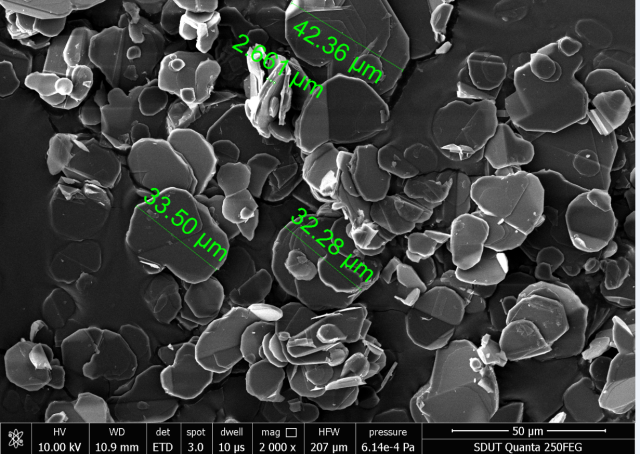
Large single crystal boron nitride — the high-purity end of a range that extends to a stated maximum purity of 99.9%.
Application Method: Brush, Spray and the Film That Results
The matched application equipment recorded for Boron Nitride 8233 is a brush or a spraying machine. That detail matters more than it appears in a purchase decision, because in release applications the delivered performance is a property of the applied film, not of the powder in the bag.
A brushed film and a sprayed film differ in uniformity, edge coverage and thickness control. Buyers qualifying a new process should therefore treat the application method as part of the specification: which substrate, which surface preparation, which film build, and which drying step the coating will see before it enters service. The supplier-side answer to those questions is where technical support either exists or does not.
Operating conditions remain subject to the actual working process, which is the honest position for any high-temperature consumable. A coating qualified on an aluminium die at a given cycle time is not automatically qualified for a magnesium casting line with different thermal gradients.
Storage, Expiry and Documentation: The Evidence Buyers Skip
The stated special requirement for the material is straightforward: keep it dry and sealed, and use it before the expiration date. Buyers routinely accept those words without asking what they mean in practice, and this is one of the cheapest places to separate a prepared supplier from an unprepared one.
Dry and sealed storage is a handling commitment that has to survive shipping, customs and warehouse conditions. Expiration-date control is a batch management commitment: it requires date marking on the delivered packaging, a certificate of analysis tied to the batch, and a supplier willing to state how long a sealed unit remains within specification. Moisture ingress and over-storage both change how a boron nitride coating behaves at the die or mould, and neither shows up in a datasheet parameter.
On the quality side, the supplier states a 100% test commitment and maintains a particle size analyzer within the production line, which is the instrument that links a delivered lot to a measured particle size distribution. Separately, the Sumetech laboratory is recorded as having passed CMA (China Measurement Certification) and CNAS (National Laboratory Accreditation), which is a laboratory-level credential rather than a product certificate — useful context, but not a substitute for batch data.
Market Context: Where Demand and Documentation Expectations Sit
Boron nitride is not a niche curiosity inside high-temperature engineering, and the published market figures reflect that. Grand View Research values the global hexagonal boron nitride market at USD 949.4 million in 2024, with Asia Pacific accounting for 40.6% of revenue share in that year and China alone representing 41.1% of the Asia Pacific total.
The same source identifies paint coatings as the largest single application share at 32.8% in 2024, which aligns with what the application record shows: coating and paint formats are where the volume sits, with powders, granules and ceramics supporting the remaining uses. Category-level figures vary between research houses because definitions differ — some estimates bundle downstream ceramic and composite products into the same headline number — so buyers should read any market size claim together with the scope it was measured on.
For procurement, two practical signals follow. First, supply and technical capability are concentrated in Asia Pacific, which means supplier verification matters more, not less. Second, the trade route is well established: boron nitride coating moves under HS code 28500020 in commonly used import and export classifications, and BN's REACH status as an industrial substance keeps it inside normal EU compliance frameworks rather than in a special-approval category.
Comparison With Traditional Release Solutions — and Where Boron Nitride Stops
Boron nitride is not the only release approach available to a foundry or a glass plant. Graphite-based release agents, silicone-based release sprays and ceramic washes are all established options, and in many shops they remain the default for cost or familiarity reasons. The useful comparison is not which chemistry is superior in general, but where each one stops working.
Graphite-based agents are widely used and inexpensive, but in sintering and heat-treatment fixtures carbon is itself the contaminant that boron nitride coatings are applied to block. Silicone-based sprays are convenient but are generally aimed at lower-temperature moulding rather than molten metal contact. Ceramic washes can offer high thermal ceilings but often without boron nitride's combination of lubricity and non-wetting behaviour against molten metal.
The boundaries of the boron nitride option should be stated just as clearly:
- An air-atmosphere ceiling of 900 °C. Above that temperature the material is specified for inert gas environments, where the stated ceiling rises above 2,000 °C. Buyers whose process runs hot in air cannot assume the higher figure applies to them.
- Applied film performance, not just raw material performance. Results depend on substrate preparation, application method and film build. A poor application can underperform a good material.
- Consumable behaviour in release service. A coating layer is not a permanent metallurgical treatment; it is reapplied on a maintenance cycle.
- Storage sensitivity. Dry, sealed conditions and adherence to the expiration date are part of the product specification, not optional housekeeping.
- Grade-specific documentation. Certificates held for one product line in a supplier's portfolio do not automatically cover another.
Compared with commodity release agents, the relevant purchasing question is not the price per kilogram but the cost of a failed release: scrapped castings, mould cleaning downtime, and surface defects that reach the customer. That is a calculation each buyer has to run on their own process data, and it is the reason a trial lot is usually the right first step.
Procurement Checklist: Evidence to Request Before a Trial Order
Application breadth is only useful to a buyer if it converts into requests the buyer can actually make. The following list translates the capability record into verifiable items.
| Evidence item | What it should contain | Why it matters |
|---|---|---|
| Grade and form confirmation | Product reference 8233, and the specific form: powder, granular, coating or paint | Coating and powder behave differently in application, packaging and storage |
| Temperature and atmosphere statement | 900 °C in air; above 2,000 °C in inert gas | The usable ceiling changes with the surrounding atmosphere |
| Purity and particle size data | Maximum purity up to 99.9% and a particle size distribution record | Purity and classification determine behaviour in thermal and fine-grade applications |
| Application method and matched equipment | Brush or spraying machine | Film quality depends on how the material is applied, not only on the material |
| Batch certificate of analysis and QC coverage | 100% test commitment per batch | Links the delivered lot to a measured result rather than a catalogue figure |
| Storage and shelf-life instruction | Keep dry and sealed; use before the expiration date | Prevents performance loss from moisture ingress or over-storage |
| Certification mapped to the purchased product | REACH (EC 1907/2006) for boron nitride; product-specific RoHS documentation | Certificates are grade-specific and cannot be assumed transferable |
| Commercial and support terms | MOQ 10 kg; lead time 30 days; OEM/ODM customization of size and color; remote and on-site after-sales support | Determines whether a trial is feasible and how scale-up would be planned |
The supplier states an OEM/ODM production mode with customization of size and color, a minimum order quantity of 10 kg, and a lead time of 30 days, with export markets described as the EU, the Middle East and Asia. For a buyer testing a new die or mould line, a 10 kg trial quantity is a realistic way to validate release behaviour before committing to production volumes — provided the trial is run with the intended application method and the intended substrate.
Future Outlook
The direction of demand in this material category is set by applications where heat, electrical insulation and release performance intersect. The industries already listed in the 8233 record — semiconductor, photovoltaic, solar thermal energy storage, electronics, military and aerospace, superhard materials and functional ceramics — are the ones where that intersection is most acute, and they are also the ones where buyers are least tolerant of undocumented supplier claims.
Two shifts are worth planning for. The first is that verification is moving from product level to process level: datasheets will still be exchanged, but qualification increasingly depends on evidence from a comparable process, batch traceability and storage control rather than on a stated melting point. The second is documentation granularity. With boron nitride inside normal EU REACH frameworks, the compliance question is no longer whether the substance is regulated but whether the supplier can map the right certificate to the right grade, quickly, on request.
Asia Pacific's position in the hexagonal boron nitride market — 40.6% of global revenue share in 2024, with China at 41.1% of that regional total — means most buyers will be evaluating suppliers in the same region. Breadth of application evidence is a reasonable proxy for which of those suppliers has the production discipline to support a specification once the trial ends.
Frequently Asked Questions
What is the maximum working temperature of Boron Nitride 8233?
The stated maximum working temperature is 900 °C in air and above 2,000 °C in an inert gas atmosphere. These are two limits for the same material under different conditions, not two product grades. A process that runs in air is bounded by the 900 °C figure; the higher figure applies only where the atmosphere is inert. Buyers should state the atmosphere at the point of use when requesting confirmation of suitability.
Which forms and purity levels does the product cover?
Boron Nitride 8233 is supplied as powder, granular, coating and paint, with additional boron nitride ceramic, boron nitride fiber, boron nitride painting and BN coating formats. Maximum purity is stated at 99.9%, and the supplier offers OEM/ODM customization of size and color.
How is boron nitride coating applied?
The matched equipment recorded for the product is a brush or a spraying machine. Application choice affects film uniformity and coverage, so the applied film — not the raw powder alone — determines release performance in service. Substrate preparation and the required film build should be confirmed with the supplier before a trial run.
How should boron nitride coating be stored, and does shelf life matter?
The stated requirement is to keep the material dry and sealed and to use it before the expiration date. Moisture exposure and over-storage can change how the coating behaves in application, and neither is visible in standard product parameters. Buyers can reasonably ask for date marking on delivered packaging, the stated storage conditions, and a certificate of analysis tied to the batch.
Which compliance documentation applies to boron nitride, and does the RoHS certificate cover it?
Boron nitride is compliant with EU REACH (Regulation EC 1907/2006) as a substance used in industrial applications. The RoHS documentation held by Sumetech — RoHS Test Report and RoHS 2.0 Verification of Conformity, certificate number RKEYS251215033, issued by Guangdong KEYS Testing Technology Co., Ltd., referencing RoHS Directive 2011/65/EU and amendment Directive (EU) 2015/863, with IEC 62321 test methods — covers Potassium Aluminium Fluoride, a separate product. Documentation should therefore be requested for the specific grade being purchased rather than assumed from another product line.
What are the limits of boron nitride in high-temperature release applications?
The principal limits are the 900 °C ceiling in air, the dependence of performance on application method and substrate preparation, the consumable nature of the coating layer in release service, and the sensitivity of the material to moisture and over-storage. Boron nitride is also not a structural material: it is used where non-wetting behaviour, chemical inertness and thermal stability are required at an interface.
What are the minimum order quantity and lead time?
The stated minimum order quantity is 10 kg, with a lead time of 30 days, OEM/ODM customization of size and color, and export markets described as the EU, the Middle East and Asia. After-sales support is provided remotely and on site.
Detailed product forms, parameters and application notes are compiled in the Sumetech 2026 catalogue: Catalog of Sumetech-2026. Company information is available at www.sumetech.com. Market figures cited in this article are attributed to Grand View Research (hexagonal boron nitride market, 2024) and to EU REACH Regulation EC 1907/2006.