
Bottle Cap and Container Side Printing: Where a UV Single Pass Printer Fits
Bottle Cap and Container Side Printing: Where a UV Single Pass Printer Fits
Side printing on a formed container is a different production problem from printing the flat board it was made from. Once a cup, bowl or box has been shaped, the printable surface becomes a curved or vertical wall with a seam, a taper, a wall-thickness tolerance and a fixture interface that the print system has to absorb without losing registration. That is why container side printing is normally specified as its own line item, separate from the flat-sheet packaging printers used for cup stock, cartons and paper bags — even when both rely on the same single pass printing principle.
This reference examines where a UV single pass printer fits bottle cap and container side printing, using the Acaleph-891S Side Printer from Focus Inc. as the lead example. It covers the paper cup, paper bottle and plastic container formats named in the brief, explains the mechanism behind side-wall printing, compares this focused application with other single pass packaging and label workflows, and lists what a buyer should verify before matching equipment to an item type. Where the available evidence stops short of a format — bottle caps and paper bottles are the two clearest cases — the article says so instead of extending a cup result to a different geometry.
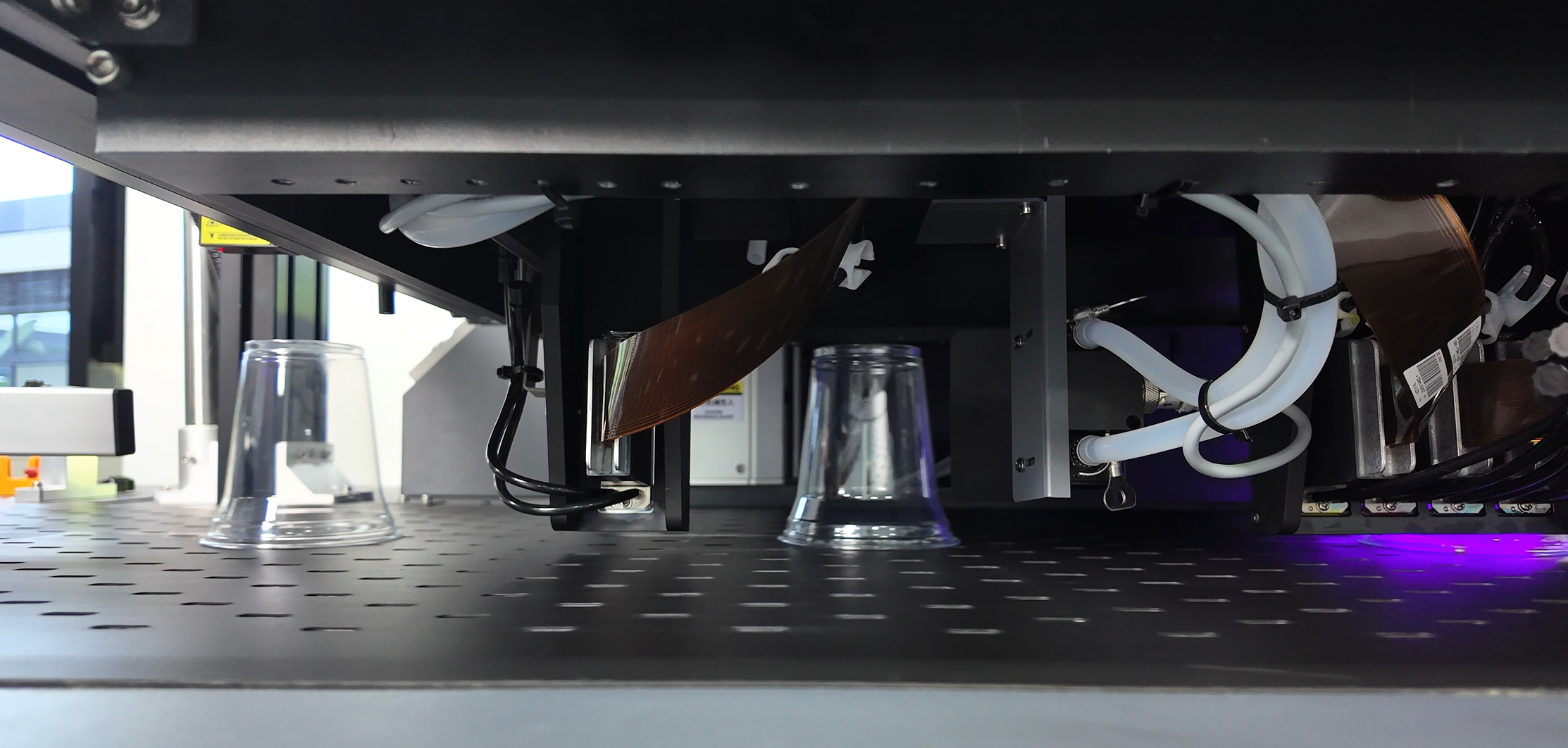
Container side printing across milk tea cups, plastic cups and paper cups. The supplied scenario caption describes output in the range of 1,000–2,000 units per hour, a scenario figure rather than a guaranteed rate.
The Production Problem: Printing After Forming
Forming changes the geometry the printer must control. A cup side wall is a truncated cone; a square takeaway box presents four panels joined by rounded corners; a paper bottle adds a shoulder and a base crimp to a cylindrical body. In each case the printable area is not a single plane, and the distance between printhead and substrate changes across the part unless the fixture and gantry compensate for it.
Traditional side decoration — screen printing, pad printing, dry offset, or a pre-printed wrap label — handles these geometries with tooling built for one size. That tooling is efficient on long, stable runs of a single design, but every new size or artwork carries a setup step: a screen, a pad, a plate cylinder or a label SKU. For a converter taking mixed orders across several cup sizes and several designs a month, setup burden rather than printing becomes the constraint.
Digital side printing moves that constraint. With no plate or screen, the artwork becomes a file and a size change becomes a fixture change. The scenario material supplied for food-container side printing describes exactly this shift: replacing offset, flexo or screen decoration with no-plate, fast-switch, variable-data production for batch orders. The question a buyer then has to answer is not whether digital removes tooling, but whether it holds registration, adhesion and colour consistency on a curved wall at production speed.
How a UV Single Pass Side Printer Works
A single pass printer prints an image in one transit of the substrate past a fixed array of printheads. The array spans the print width, the substrate moves at a controlled speed beneath it, and the image is built line by line as the part passes. Nothing scans back and forth, so the cycle time is governed by transport speed rather than by carriage travel.
On a curved side wall, the missing element is controlled rotation. The side-printing configuration described in the container scenario pairs the print engine with a custom rotating feeding station that positions each cup or box, a height-adjustable side-spray gantry that aligns the head array with the wall, and a UV curing system selected for ink adhesion on a non-flat surface. The part is indexed so the curved wall presents to the heads as predictable linear motion, and gantry height is set so the standoff stays inside the working window across the printable band.
The full sequence in the supplied scenario runs as follows:
- Automatic cup or box sorting and feeding onto the line.
- Rotary positioning and correction to bring the side wall to the print datum.
- Single pass full-colour printing of artwork, gradients, logos, text, variable QR codes, serial numbers or anti-counterfeit codes.
- Instant UV curing of the printed ink.
- Surface inspection.
- Automatic stacking at the discharge end.
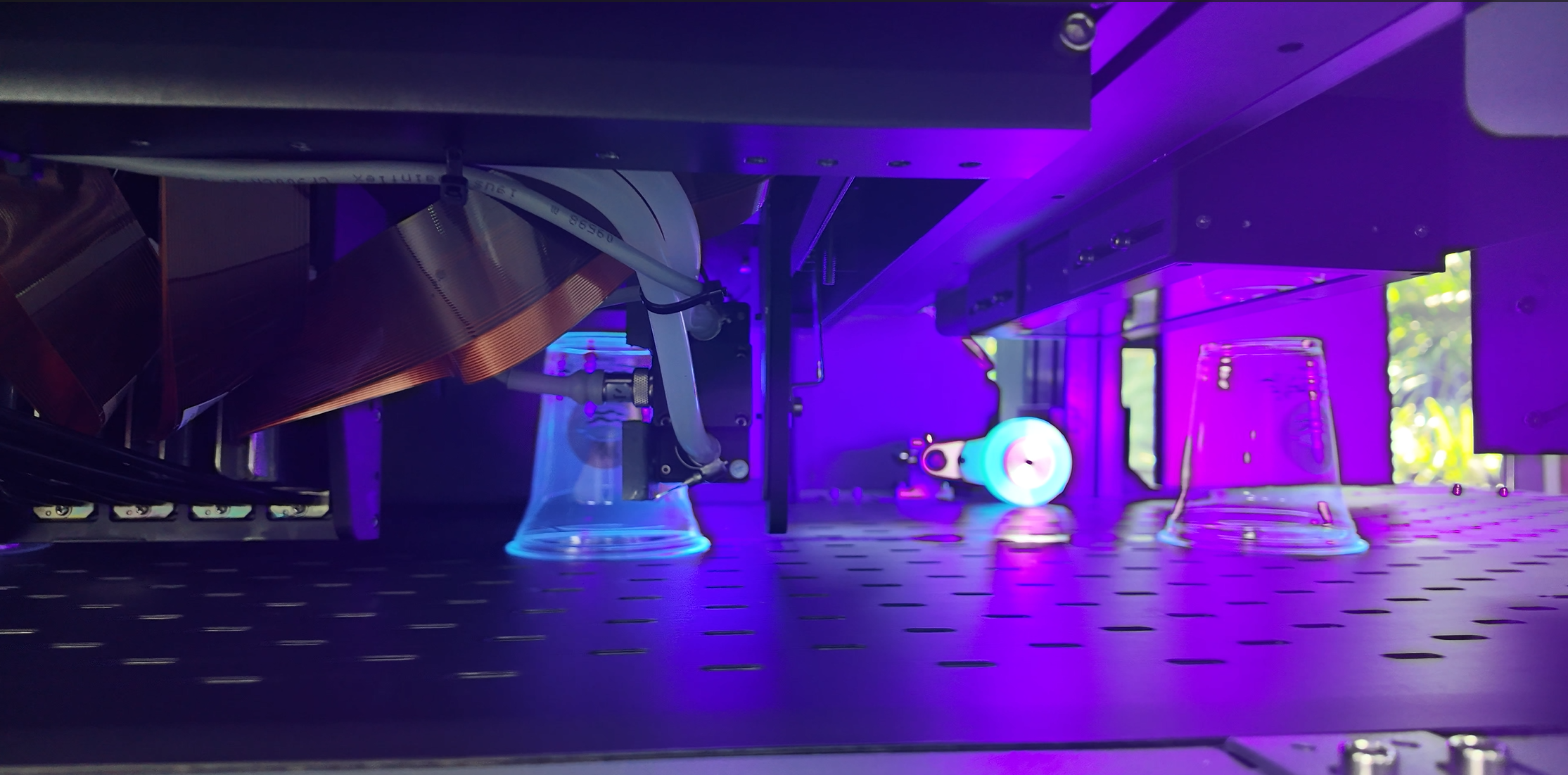
A container side printing line in operation: parts travel on the belt, pass the print unit, and are cured by UV before discharge.
The scenario describes the line as compatible with an existing food-packaging automation line rather than as a stand-alone cell, which matters because handling before and after printing — singulation, orientation, curing, stacking — usually decides whether a line runs at its rated rhythm or at the speed of manual loading.
Why single pass rather than a scanning head? On a rotating fixture, every additional print pass is another chance for the part to sit slightly differently relative to the head. A single pass reduces registration events per part to one, which is the mechanical reason side-wall printing and single pass architecture fit together. It does not by itself guarantee a particular accuracy: achievable results still depend on fixture quality, part tolerance, encoder feedback and ink behaviour, all of which belong in a sample trial.
What the Acaleph-891S Side Printer Is Built to Cover
The Acaleph-891S Side Printer is positioned in Focus Inc.'s range as a UV single pass system for formed-container side walls rather than for flat sheets. In the container scenario supplied for this application the matched equipment list is specific: a custom rotating feeding station for cup and box positioning, a dedicated height-adjustable side-spray gantry, and a UV curing system chosen for curved, non-flat surface adhesion. Those three items are what separate a general-purpose industrial single pass UV printer from a side-printing line.
The same scenario sets out the operating requirements the configuration is meant to meet: vertical side-wall printing on cylindrical cup bodies and on the vertical panels of square boxes; tolerance for the dimensional deviation that appears after forming, including arc on cup bodies and flatness variation on box sides; food-packaging-grade ink adhesion with water resistance, scratch resistance and no flaking; positioning accuracy tight enough to avoid ghosting at continuous speed; 100% variable-data coding on individual items; frequent artwork switching without plate changes or mould adjustment; and stable running across long shifts.
A buyer should read that list as a requirement specification, not a certificate. Each clause is testable, and several — food-contact conformity, adhesion after repeated handling, long-run colour consistency — are best confirmed on the buyer's own parts.
Labour is the other half of the specification. The case record for disposable food-service container manufacturers describes one operator running one printing line, with an optional automatic feeding and collection system where floor space and labour cost justify it. That record covers 12 units supplied to manufacturers of paper cups, plastic cups and paper bowls across Turkey, Poland, Saudi Arabia, Chile and Mexico, with two years of use at the time of documentation. The stated outcomes are on-demand customisation, faster delivery, reduced waste and support for sustainability claims — commercial results reported for that customer group rather than independently audited figures.
Throughput deserves careful reading. The supplied scenario caption for container side printing refers to output in the range of 1,000 to 2,000 units per hour for milk tea cups, plastic cups and paper cups. That is a scenario description, not a guaranteed rate: real output depends on part size, print coverage, resolution, curing dwell time, loading method and how often the line stops for artwork changes.
Paper Cups, Paper Bottles and Plastic Containers: What Changes by Substrate
The same side-printing architecture meets very different surfaces across the three container families, and those differences drive ink choice, pretreatment and fixture design. It is more useful to treat paper, coated paper and plastic as three separate qualification cases than as one 'container' category.
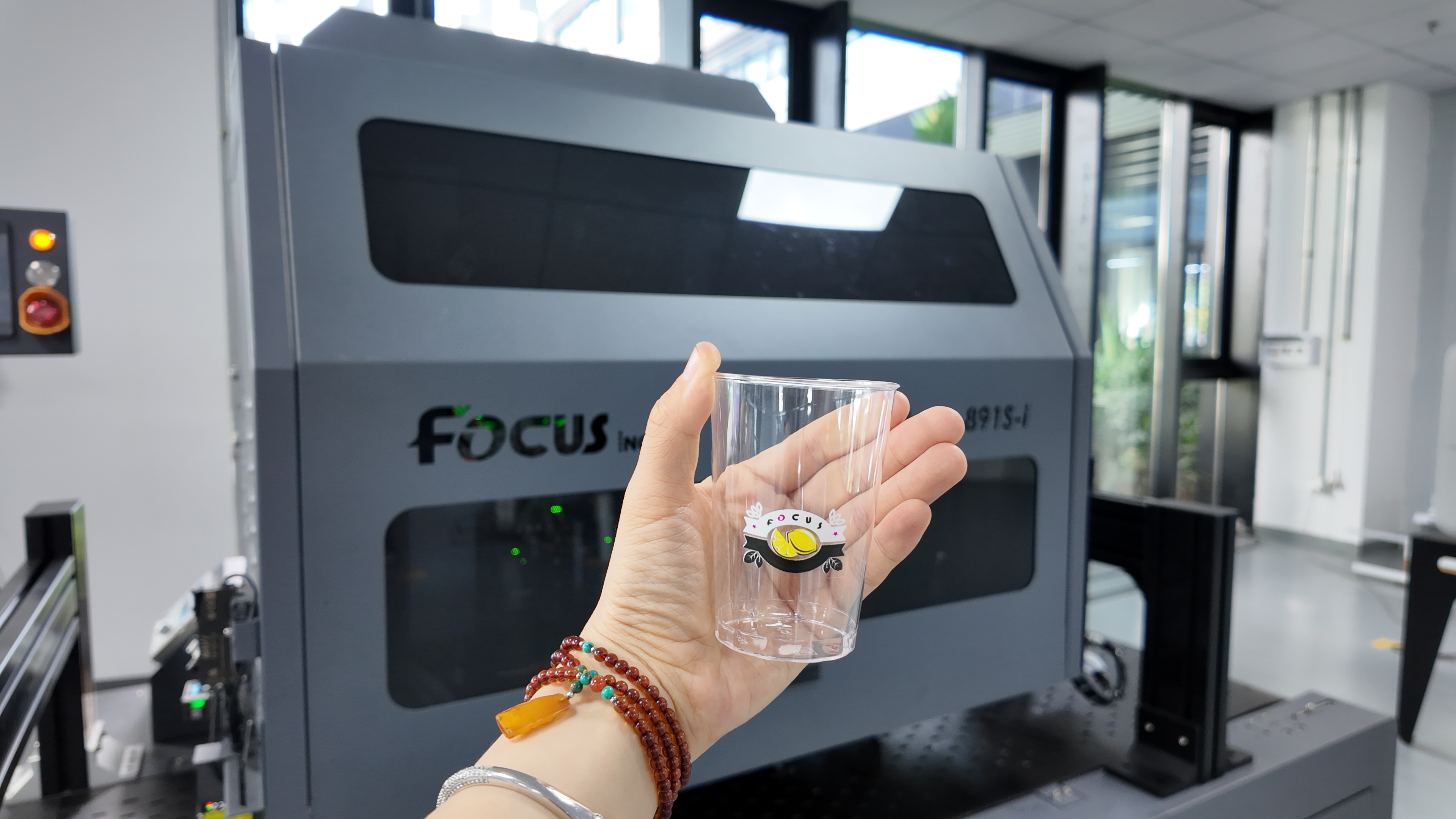
Custom side-wall printing on paper cups and plastic containers. Paper, coated paper and plastic each need their own adhesion and cure profile.
Paper cups. A paper cup is a paper body with a thin coating — commonly polyethylene or a compostable alternative — on the food-contact side, and an outside surface that may be coated, varnished or uncoated. For UV side printing the practical issues are adhesion on that coating, white ink opacity when artwork needs a light background on kraft or dark stock, and heat management: a thin-walled cup passes close to a UV curing head, so dwell time and lamp power have to be balanced against deformation and against the odour and migration profile food packaging requires. The cup case record shows the format in commercial use across five markets, which is meaningful evidence that handling and curing can be engineered for production, though it does not replace a buyer's own compliance testing.
Plastic containers. PP, PET and PS cups, tubs and box side panels are non-absorbent, so adhesion depends on surface energy rather than absorption. Pretreatment is the usual answer, and Focus Inc.'s documentation for the Acaleph-891S e — a different model in the same UV single pass family — lists plasma, flame or corona pretreatment as substrate-dependent options, alongside laser alignment and adjustable media height. The same logic applies to side printing: where a plastic surface has low surface energy or mould-release residue, pretreatment and a verified standoff matter more than headline resolution. Buyers should ask which pretreatment is specified for their exact resin and whether the recommendation was validated by an adhesion test on a formed part.
Paper bottles. A paper bottle shares the cylindrical body of a cup but adds a shoulder, a neck finish and often a barrier layer or liner. None of the case or scenario material supplied for this article documents a paper-bottle side-printing installation, so any claim that a cup line transfers directly would be unsupported. What can be said is conditional: the format is a candidate where the body is rigid enough to be gripped and rotated, where the printable band avoids the shoulder radius, and where the barrier surface accepts the ink system after appropriate pretreatment. Those three conditions are precisely what a sample trial exists to test.
Bottle caps. Caps sit further from the documented evidence than cups do. The supplied scenario and case material covers cup bodies, bowls and box side panels; it does not describe a validated cap-printing installation. A cap is a small closed cylinder with a knurled or ribbed skirt, a tight diameter tolerance and often a tamper band, and the printable band is narrow. Printing it on a side-printing platform is plausible in principle — the rotating fixture concept is the same — but it requires a dedicated small-diameter jig, a standoff strategy for the ribs, and a cure profile that does not distort the closure. Treat cap work as an application to be proven rather than a standard configuration, and ask for cap-specific samples before treating the capability as established.
Where It Fits Against Other Single Pass Workflows
Container side printing is one node in a wider set of single pass options, and most sourcing mistakes come from matching a job to the wrong node. The table compares workflows using published model parameters, which are model-specific and not interchangeable between machines.
| Workflow | Example model | What it prints | Documented parameters | Fit and boundary |
|---|---|---|---|---|
| Formed container side | Acaleph-891S Side Printer | Cup, bowl and box side walls after forming | Rotating fixture, height-adjustable side gantry, UV curing for curved surfaces | Fit where the container is already formed and artwork changes often; needs a jig per size |
| Flat sheet and cup stock | Cobra-691S Max | Paper bags, cup stock, cartons before forming | 215–645 mm print width, 900 mm feed, 20–40 m/min, water-based ink, 0–55 mm print height | Higher linear speed on flat work; cannot print a formed side wall |
| Desktop flat sheet | Falcon-491S | Bags, pizza boxes, cup stock, envelopes | 210 mm or 300 mm print width, 10–25 m/min, material up to 180 mm thick | Entry-scale and compact; same flat-only boundary |
| Roll-to-roll labels | Viper-391S | Self-adhesive labels and film | Up to 320 mm web, 10–40 m/min, water-based ink | Decoration applied as a label, not printed on the container |
| UV labels and IML | S350 Jetpress | Labels, in-mould labels, film | 235 mm print width, 20–80 m/min, 10 or 15 heads, UV curing | Suited to film and IML; not a container printer |
| Integrated label line | NEXUS-350J | Printed, laminated, die-cut and slit labels | 350 mm web, 1–2 m/min, digital die-cutting to 0.05 mm | Finished label production in one workflow; much lower linear speed |
| 360° cylinder body | Hydra-360S | Bottle and tube bodies around the circumference | 42–135 mm diameter, length up to 240 mm, taper up to 13°, 40–120 pcs/hour | Wrap printing on a body; not a substitute for a flat panel or a cap |
Two distinctions matter more than the rest. First, flat-sheet machines and side printers are complementary rather than competing: a converter may print cup stock on a Cobra or Falcon and print formed cups on a side printer, and the choice depends on whether the artwork can survive forming. Second, labels and direct side printing meet the same marketing need by different routes — a roll-to-roll single pass label printer or single pass sticker printer produces a decorated film that is applied to the container, while a side printer puts ink directly on the container. Direct printing removes label stock and the application step but moves quality risk onto adhesion and fixture control.
The 360° cylinder printer is the closest neighbour and the easiest to confuse with a side printer. The Hydra-360S rotates a bottle while the head traverses; the side-printing configuration rotates the part against a fixed-width head array and prints a band on the side wall. For a straight-walled bottle body either route may be technically arguable; for a tapered cup, a square box panel or a narrow cap skirt, the requirements diverge quickly.
Comparison with Traditional Side Decoration
Against screen, pad and dry-offset decoration, the digital side-printing route changes cost structure rather than unit quality. Plate-based methods carry a fixed setup per design and per size, which is why they remain efficient on long runs of a stable SKU. Digital side printing carries a fixture cost per size but almost no cost per artwork change, so it becomes more attractive as order sizes fall and the number of designs per month rises.
Traditional methods also retain advantages digital does not automatically match: very high opacity whites in a single heavy deposit, special effect inks, and mature process control at extreme volumes. A buyer comparing the two should compare total cost at the actual order profile — fixture inventory, artwork changeover time, spoilage during setup and inspection labour — rather than a per-unit print cost in isolation.
Limitations Buyers Should Price In
The boundary conditions of a side-printing line are practical, and they belong in the specification rather than in a footnote.
- Printable band and circumference. A single pass head array covers a fixed width; parts needing a wider band, or a full wrap beyond the printable arc, may require repositioning or a second operation.
- Shape and taper. Cup bodies, tapered tubs and rounded box corners all change the standoff. Extreme tapers, deep recesses and handles are fixture problems before they are print problems.
- Colour on dark or transparent stock. White ink underlay and varnish are separate channels with their own cost and cure behaviour; the gamut achievable on a dark cup differs from a white one.
- Food-contact conformity. The scenario requires food-packaging-safe adhesion, but conformity is a property of the complete ink, substrate and cure combination under the target regulation. It is established by migration testing and documentation, not by a printer specification.
- Throughput claims. Rates quoted for a container format are scenario figures; the buyer's rate depends on part mix, coverage, resolution, curing and handling.
- Undeveloped formats. Bottle caps and paper bottles are not documented installations in the material reviewed here and require validation.
- Jig inventory and changeover. Every container size needs its own fixture; how many SKUs a line handles economically depends on how many jigs the buyer will hold and how fast they change.
What to Verify Before Ordering
Verification should follow the part, not the brochure. The checks below are ordered so an early failure stops the evaluation before commercial terms are discussed.
| Verification item | Why it matters | How to test it |
|---|---|---|
| Formed-part dimensional range | Fixtures and standoff are built around the real tolerance stack, not the drawing | Send several production samples per size, including parts at the tolerance limits |
| Printable band coverage | Decides whether one pass covers the artwork or a second operation is needed | Print a full-width target on the largest and smallest part in the range |
| Registration and ghosting | Curved walls can shift between indexing and printing | Print fine-line and small-text targets across a continuous run and inspect for drift |
| Ink adhesion | Handling, packing, condensation and abrasion all attack the print | Cross-hatch or tape test, rub test, and water or condensation exposure on finished parts |
| Food-contact documentation | Migration compliance is a complete-system property | Request ink and substrate documentation for the target market and confirm cure conditions |
| Colour consistency over a run | Brand colours on a repeat order must match the first delivery | Sample at start, middle and end of a long run against an approved reference |
| Variable data integrity | QR codes and serial numbers must scan after curing and handling | Scan every code in a batch, including after the abrasion test |
| Changeover time | Short runs are only economic if size and artwork changes are fast | Time from the last good part of design A to the first good part of design B |
| Continuous-run stability | Food packaging lines run long shifts | Run a full shift and record stops, rejects and operator interventions |
Two of these are commonly under-tested. Adhesion on a formed part is not the same as adhesion on a flat coupon: the ink is cured on a curved surface, sometimes near a seam or rim, and the part then flexes during packing. And variable-data integrity is a quality-control question, not only a printing question — a code that prints but does not scan after handling is a reject, and the line needs an inspection step that catches it.
Commercial Terms and Supplier Signals
Focus Inc.'s capability documentation states a minimum order of one unit and lead times of 15 to 45 days depending on the solution, with warranty terms that differ between its OEM and ODM programmes — 13 months in the OEM documentation and three years in the ODM documentation supplied. Both programmes describe a full pre-shipment running test and allow third-party inspection on request. The company's background record lists exports to the EU, USA, Mexico, Brazil, Chile, Australia, Canada and the UK, with an export share of 95%.
For a side-printing project, the more informative supplier signals are less formal: whether the supplier asks for formed samples rather than drawings, whether fixture design is quoted as part of the offer, whether the cure and pretreatment recommendation is tied to a named substrate, and whether acceptance criteria are written as measurable tests. A supplier able to describe the failure modes of a curved wall — seam shadow, rim interference, taper drift — is usually one that has already built the jig.
Outlook
The direction of travel is toward printing later in the production process. Where a converter can hold artwork as a file and print it after forming, the economics of short runs, regional designs and variable data improve, and the inventory of pre-printed cup stock or label SKUs falls. The binding constraint on that shift is not the print engine; it is the tooling and qualification work around it — fixtures per size, pretreatment per resin, cure profiles per wall thickness, and food-contact documentation per market.
A reasonable expectation, stated conditionally, is that side printing will extend from promotional and event work into regular SKUs in markets where short runs are common, provided fixture standardisation and adhesion qualification keep pace. For bottle caps and paper bottles, the outlook depends on dedicated jig development and on sample evidence that does not yet exist in the material reviewed here. Buyers evaluating those formats should budget for application engineering rather than assume a cup-line transfer.
FAQ
What is the difference between side printing a formed container and printing flat cup stock?
Flat-stock machines such as the Cobra-691S Max or the Falcon-491S print paper or board before it is formed, at 20–40 m/min and 10–25 m/min respectively in the supplied specifications. A side printer prints the container after forming, which requires a rotating fixture, an adjustable side gantry and curing that works on a curved wall. The routes are complementary: the choice depends on whether the artwork can survive the forming step.
Which container shapes can a UV single pass side printer handle?
The documented application covers cylindrical cup bodies, bowls and the vertical side panels of square or round takeaway boxes, including formed-part dimensional deviation. Extreme tapers, deep recesses, handles and very narrow bands are fixture questions that should be tested with real samples. Bottle caps and paper bottles are not documented installations in the material reviewed here.
Does UV ink on a cup side meet food-contact requirements?
Food-contact conformity depends on the complete combination of ink, substrate, cure level and the regulation of the destination market. The supplied scenario requires food-packaging-safe adhesion with water and scratch resistance, but that is a requirement rather than a certification. Buyers should obtain migration and compliance documentation for their exact ink and substrate pairing and confirm the cure conditions used in production.
Can the same machine print cups and labels?
Not in the same configuration. Cup side printing uses a rotating fixture and a side gantry; label production uses roll-to-roll web handling, as on the Viper-391S or the S350 Jetpress, and integrated label lines such as the NEXUS-350J add die-cutting, lamination and slitting. A converter serving both markets normally specifies two machines rather than converting one.
What should a buyer send for a side-printing sample trial?
Send formed parts from each size in the range, including parts at the tolerance limits; the artwork at final resolution including any variable codes; the substrate and coating specification; and the destination market's compliance requirement. Ask for the printed samples to be tested for adhesion, abrasion, water exposure and code scannability after handling, and ask for changeover time between two sizes to be measured during the trial.
For the wider factory and product context behind these specifications, Focus Inc.'s factory introduction is available as a downloadable document: FocusInc Factory Intro (PDF).
Tem questões ou precisa de mais detalhes?
Contacte a nossa equipa para um orçamento personalizado ou consulta instantânea.
Solicitar orçamento
Preencha o formulário abaixo e a nossa equipa entrará em contacto com uma proposta personalizada.
Chat direto do WhatsApp
Prefere conversar em tempo real? Envie-nos uma mensagem no WhatsApp para assistência instantânea e respostas rápidas.
- Obter orçamento personalizado
- Partilhar fotos ou documentos
- Discuta as suas necessidades diretamente
Geralmente responde em 5–30 minutos durante o horário de expediente.