
Bottom Dispensing Tissue Bagging: Where the TB-F60 Fits in Soft-Tissue Packing
Bottom Dispensing Tissue Bagging: Where the TB-F60 Fits in Soft-Tissue Packing
For a soft-tissue producer, a bagging machine is a packaging-format decision before it is a speed decision. The WIMACH Automatic Bottom Dispensing Tissue Bagging Machine, model TB-F60, is specified for pre-made bags at a maximum of 60 packs per minute, with a pack envelope of 200–400 mm long, 115–200 mm wide and 85–100 mm high. The Automatic High-Speed Soft Tissue Wrapping Machine, model TP-280, forms and seals film at a maximum of 260 packs per minute, within a 90–200 mm long, 85–105 mm wide and 25–90 mm high envelope. Those two envelopes barely overlap, so the retail pack format usually narrows the equipment choice before throughput ever enters the discussion.
That ordering matters in a project review. Buyers who start from a packs-per-minute target often end up comparing a bagging machine with a film wrapper as if they were two speeds of the same job. They are not. One puts tissue into a pre-made bag; the other wraps tissue in film drawn from a roll. The correct question is not which number is higher, but where in a soft-tissue line a bagged pack is actually the retail unit that leaves the factory.
Why the pack format decides the machine before the speed does
WIMACH's published specifications describe two different packaging principles inside the same tissue packing machine category. The TP-280 draws film from a 340 mm wide, 450 mm deep roll at 0.035–0.05 mm thickness, in CPP, PE or composite film, forms the pack around the product and seals it. The TB-F60 loads product into pre-made bags supplied from four bag magazines listed in its specification. Both are automatic tissue packing machines; the difference is where the packaging material is manufactured.
That single difference drives most of the procurement consequences:
- Print and artwork sit in different places. With film wrapping, printed film is ordered on the roll and the machine forms the pack. With bagging, the bag is a finished purchased item, so print, dimensions and bag construction are settled with the bag supplier before the machine runs.
- Inventory and lead time shift. A film line holds film rolls; a bagging line holds bags. Bag stock, artwork approval and reprint cycles become part of production planning rather than part of the machine's own consumable supply.
- The pack envelope changes the product mix. The TB-F60 accepts packs from 200 mm long and 115 mm wide upward; the TP-280 tops out at 200 mm long and 105 mm wide. A large bagged multi-pack and a single soft facial pack are not interchangeable across those two windows.
The practical rule: if the retail unit is a bag — a printed, pre-made bag holding a bundle of tissue — bagging is the relevant process. If the retail unit is a single film-wrapped soft pack, film wrapping is the relevant process. Throughput only becomes the deciding factor once the format is fixed.
What the TB-F60 is specified to do
The Automatic Bottom Dispensing Tissue Bagging Machine, model TB-F60, is a WIMACH tissue packing machine listed for the tissue industry, built in carbon steel and operated automatically. Its published specification defines the working window a project engineer needs to check against the product: capacity, pack dimensions, bag supply, utilities, footprint and weight.
| Specification | TB-F60 published value |
|---|---|
| Maximum packing capacity | 60 packs/min |
| Package dimensions | 200–400 (L) × 115–200 (W) × 85–100 (H) mm |
| Pre-made bag magazine | 4 bag magazines |
| Power voltage | 380V 50/60Hz, 3 phase |
| Power consumption | 35 kW |
| Air pressure / consumption | 0.5–0.8 MPa / 120 L/min |
| Overall dimensions | 2840 (L) × 6060 (W) × 1800 (H) mm |
| Overall weight | 3500 kg |
| Construction material | Carbon steel |
| Applicable industry | Tissue industry |
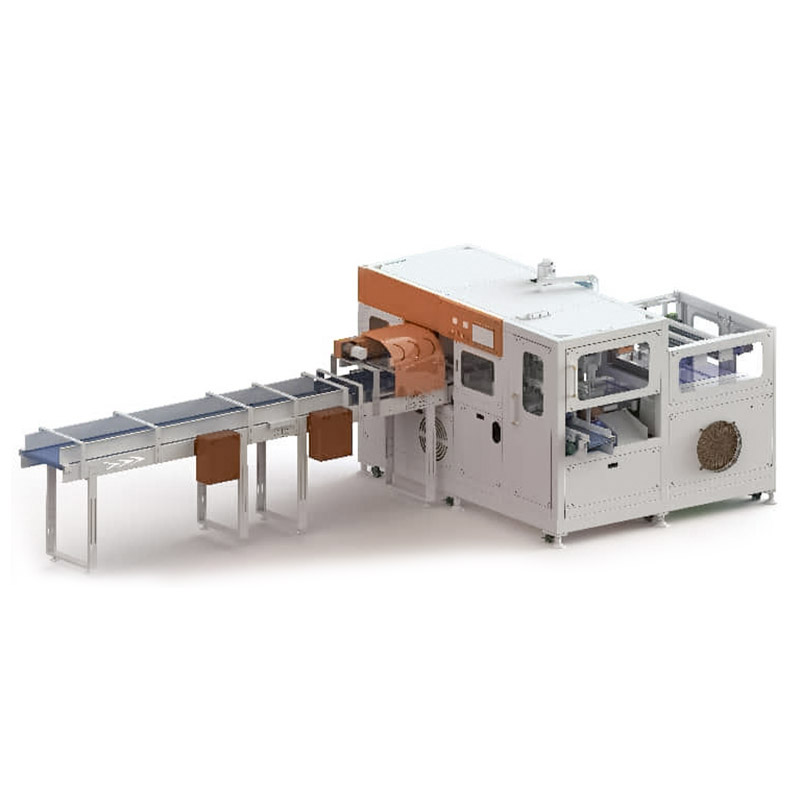
The TB-F60 runs pre-made bags rather than roll film, so the bag specification and the pack envelope are decided before the machine is ordered.
Three specification details deserve a buyer's attention because they are frequently assumed rather than confirmed. The four pre-made bag magazines are listed as a count; how those magazines are assigned across bag sizes, and what reload interval that produces in your own pack mix, is a configuration question for the technical offer. The 60 packs/min figure is a maximum, not a running rate guaranteed on every bag format. And carbon steel is the stated construction material for the TB-F60, as it is for the TP-180, TP-280, TC-100 and TC-300; within the WIMACH range summarised for this article, only the TC-80Y canister machine is listed as stainless steel. In a humid converting hall, surface finish and corrosion protection should be written into the technical agreement instead of being assumed from the material name.
Four checks that decide whether a bagger belongs in your line
A bottom-dispensing bagging project is settled by four checks, in this order. Each one can end the evaluation before the others matter.
1. Does the pack envelope actually fit?
Compare the finished pack you intend to sell with the published range, not with a nominal pack size. The TB-F60 covers 200–400 mm length, 115–200 mm width and 85–100 mm height; the TP-280 covers 90–200 mm length, 85–105 mm width and 25–90 mm height. The windows touch at the 200 mm length and 85–90 mm height edges but do not share a width range at all. A bagged multi-pack that measures 260 × 140 × 90 mm sits comfortably inside the TB-F60 range and outside the TP-280 range. Send physical samples, not drawings alone, because bag stiffness and filled-pack geometry affect handling in ways a dimension table cannot show.
2. Is throughput being counted in the same unit?
Sixty packs per minute counts bags. Two hundred and sixty packs per minute counts film packs. If one bag holds several retail tissue packs, the two figures describe different amounts of tissue leaving the building, and neither can be compared directly with the next machine downstream. Convert the bag count into tissue packs or cases per minute first.
As an illustration of the unit mismatch rather than a performance claim: at 60 bags per minute, a shipping case holding six bags would be filled at 10 cases per minute. WIMACH's published specifications for its facial tissue box packaging line and its toilet paper packaging line each list a maximum case-packing speed of 10 cases per minute. The six-bag case count is an assumption used only to show how the arithmetic works; the real bottleneck depends on your own case configuration and on how the bagger is actually loaded across a shift.
3. Are the utilities sized to the machine, not to the product?
The TB-F60 is specified at 35 kW with 0.5–0.8 MPa air pressure and 120 L/min air consumption. The TP-280 is specified at 18 kW on the same 0.5–0.8 MPa air pressure band, with no air consumption figure published in the material summarised here. The power difference is large enough to affect the electrical supply plan for a line, so it belongs in the early layout discussion rather than the final commissioning checklist. Treat both figures as stated consumption values and confirm the configured load with the supplier for the exact machine you order.
4. Does the footprint and loading work in the hall?
The TB-F60 is listed at 2840 mm long, 6060 mm wide, 1800 mm high and 3500 kg. The TP-280 is listed at 3585 mm long, 6260 mm wide, 1800 mm high and 2900 kg. The bagger is the shorter but heavier unit. Width dominates both footprints, which usually decides whether the machine sits along a wall or across an aisle, and it also determines how much clear space remains for bag magazine reloads and operator access. Check floor loading and access routes for the heavier unit before the layout is frozen.
Where bagging sits in a soft-tissue line
In a soft-tissue plant, the bagging station occupies the position that film wrapping holds in a single-pack line: immediately after the folding or cutting stage and before case packing. WIMACH's facial tissue packaging line scenario, described for a project in Poland, runs automatic facial tissue box packing and plastic film wrapping, then case packing, palletizing, strapping and stretch wrapping, with tissue folding and cutting machines as the matched upstream equipment. Its toilet paper packaging line scenario, described for a project in the United States, runs roll wrapping, case packing, automatic palletizing and stretch film wrapping, again with tissue folding and cutting machines upstream.
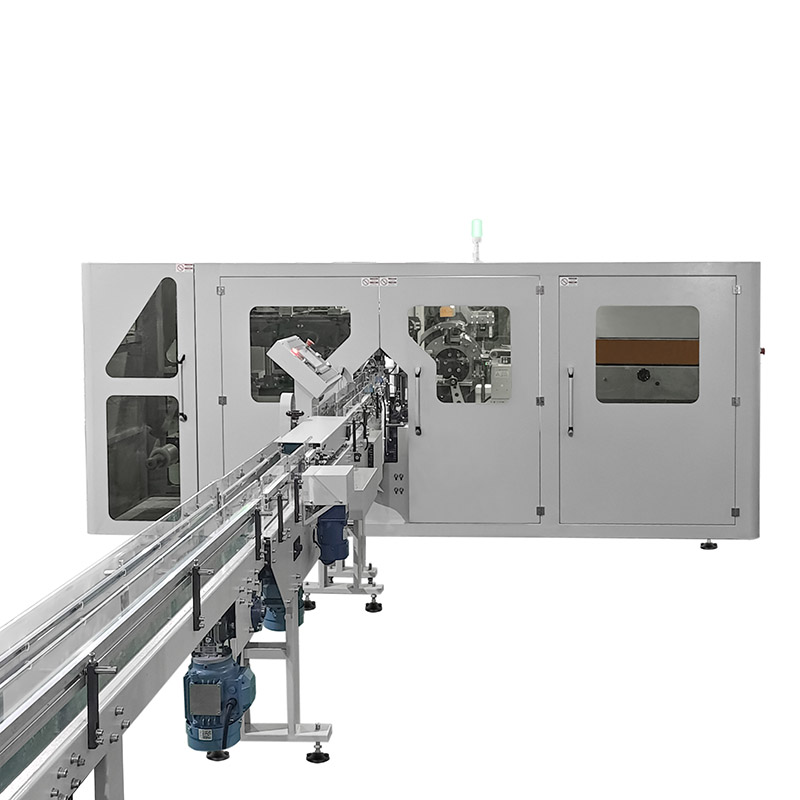
The TP-280 covers single film-wrapped soft packs; bagged multi-packs are a different format with a different pack envelope.
Where the retail unit is a printed bag, the bagger takes that inner-packaging slot. Everything downstream — case packing, palletizing, strapping and stretch wrapping — is unchanged in principle, which is why the bagging decision should be argued in cases per minute rather than in bags per minute. WIMACH's own case records illustrate both routes: a Spanish tissue manufacturer running two TP-280 units for soft facial tissue film wrapping, and a Polish facial tissue project described across twelve sets spanning cartoning, film wrapping, case packing, palletizing, strapping and stretch wrapping. Neither record establishes a bagging result; they show where the wrapping and cartoning stations sit relative to the rest of the line.
TB-F60 against TP-280: a format comparison, not a contest
Placed side by side, the two machines differ on almost every parameter that a project team tracks. The comparison below uses only published manufacturer specifications and makes no claim about relative quality, reliability or operating cost.
| Dimension | TB-F60 (bagging) | TP-280 (film wrapping) |
|---|---|---|
| Packaging principle | Pre-made bag from magazine supply | Film formed and sealed on the machine |
| Maximum packing capacity | 60 packs/min | 260 packs/min |
| Pack envelope (L × W × H) | 200–400 × 115–200 × 85–100 mm | 90–200 × 85–105 × 25–90 mm |
| Packaging material | Pre-made bags (4 bag magazines) | CPP, PE or composite film, 0.035–0.05 mm, 340 × 450 mm roll |
| Power consumption | 35 kW | 18 kW |
| Air supply | 0.5–0.8 MPa, 120 L/min | 0.5–0.8 MPa |
| Overall dimensions | 2840 × 6060 × 1800 mm | 3585 × 6260 × 1800 mm |
| Overall weight | 3500 kg | 2900 kg |
| Construction material | Carbon steel | Carbon steel |
What the table establishes is a clear division of labour. The TP-280 is specified for high-cycle output on small single packs; a 260 packs/min ceiling with a 25–90 mm height range points at thin, single-layer soft packs. The TB-F60 is specified for lower cycle counts on considerably larger packs, with a height floor of 85 mm that excludes most single soft packs outright.
What the table does not establish is which machine performs better. The capacity figures are manufacturer-published maximums, measured under conditions that are not stated in the specification material summarised here. There is no shared test protocol, no changeover time, no running efficiency, no waste rate and no energy-per-pack figure available for either unit. A buyer who needs those numbers has to obtain them through a factory acceptance test or a documented reference visit on a comparable pack format, not by reading two specification sheets against each other.
Fit boundaries: the two ways a bagging project goes wrong
Over-specifying: buying a wrapper for a bagged product
The most common mismatch is not speed but category. A producer whose retail unit is a printed bag cannot substitute a film wrapper at any speed, because the pack envelope and the packaging material are both wrong for the SKU. Ordering a 260 packs/min wrapper against a bagged multi-pack requirement does not buy extra capacity; it buys equipment that cannot make the product.
Under-specifying: sizing the bagger to a single shift
The opposite error is treating the TB-F60's 60 packs/min maximum as a guaranteed production rate and sizing the rest of the line to it without checking the downstream case packer. If case packing runs at 10 cases per minute, the bag count per case determines which machine constrains the line. Run that arithmetic with your own case configuration before the layout is signed off.
Three further boundaries worth writing into the project file
- Bag supply is a line dependency. A pre-made bag is a purchased component with its own artwork approval, print run and stock cycle. A bagging project that plans the machine but not the bag supply chain has planned half a line.
- Carbon steel needs a finish specification. The TB-F60 is listed as carbon steel, and the specification material summarised here does not state a surface finish, paint system or washdown rating. In a humid tissue converting hall, that is a question for the technical agreement, not an assumption.
- Compliance scope must be stated per machine. WIMACH states that its machines are CE certified. A certification statement should be matched to the exact model and configuration in the declaration, and to the market where the line will be installed. Published industry guidance also notes that machinery placed on the European market requires a risk assessment under the European machinery directive framework; that guidance comes from a supplier article rather than a legal text and should be verified against the current regulation. Standards catalogued for tissue-making machinery, such as EN 1034-17:2012, address tissue production equipment and should not be read as the conformity route for finished tissue packing machines.
Market context: aggregate size says little about bag format
A 2026 Precedence Research market report cited in the verified data set for this article values the global tissue paper packaging machine market at approximately USD 3.9 billion in 2025, with USD 4.2 billion projected for 2026. The same report places facial tissue packaging at 42.1% of application share in 2025 and Asia Pacific at 39.8% of the market.
Two cautions apply before those figures are used in a capital request. First, market sizing in this category is definition-sensitive: a report that includes rewinding and converting machinery and a report that counts only final-stage packing units are not measuring the same thing, so totals from different reports should not be added or compared directly. Second, an application share for facial tissue packaging does not reveal how much of that volume ships in bags rather than in film or cartons. No verified data in this set separates bagged multi-packs from other soft-tissue formats.
For a buyer, the practical implication is narrow and useful: facial tissue packaging is the largest single application block, so format decisions there carry the most weight, but the bag-versus-film split within that block has to be established from your own product mix rather than from market totals.
Outlook: a conditional view, not a forecast
No verified forecast for bagged tissue formats was available for this article, so the outlook is stated conditionally. If a producer's retail mix moves toward larger multi-packs presented in printed pre-made bags, bagging capacity becomes a line-planning question and the pack envelope becomes the first specification to fix. If the mix stays on single film-wrapped packs, the film wrapper remains the relevant inner-packaging machine and a bagger adds no capability. The TB-F60's role in either case is the same: it converts a bagged format decision into a specified machine, and its 60 packs/min ceiling and 200–400 mm pack length tell a project team quickly whether that format is the one they are actually selling.
What to verify with the supplier before ordering
Wenzhou Wimach Machinery Co., Ltd., which manufactures under the WIMACH brand, is a Ruian-based tissue packing machine builder founded in 2021, operating a 3000 m² facility with 37 employees, five engineers and a stated annual output of 160 sets. The company reports a 60% export share across the EU, North America and South America, and states that its machines are CE certified and assembled with components from established suppliers.
On commercial terms, WIMACH lists a minimum order quantity of one set and a lead time of 30–60 days for a complete packaging line, 30–45 days for customized machinery and 15–45 days for OEM/ODM work, with customization available across packaging dimensions, machine configuration, voltage and logo. Quality control steps listed for the range include no-load and load running tests, dimensional tolerance inspection, mechanical assembly check, pneumatic leakage test, electrical safety test, PLC control logic test, safety interlock and E-stop test, long-time aging test and surface appearance inspection. After-sales support covers installation and commissioning, training, warranty service, remote technical support, lifetime after-warranty support and upgrade or retrofit work.
A bagging evaluation should close on documented answers rather than on the specification sheet alone. The relevant questions are: which bag sizes the four magazines are configured for; the sustained running rate on your actual filled bag, not the maximum; the changeover procedure between bag sizes; the surface finish specified for the carbon-steel frame; the exact scope covered by the CE declaration for that model; and how the bagger's output is handed to your existing case packer.
Frequently asked questions
What output level does a bottom-dispensing tissue bagging machine suit?
The TB-F60 is specified at a maximum of 60 packs per minute. That ceiling suits lines where the bagged pack is the retail unit and where downstream case packing is sized to the resulting case rate rather than to the bag count. Because 60 packs/min is a published maximum rather than a guaranteed running rate, sustained output on a specific bag format should be confirmed through testing or a documented reference on a comparable pack.
How does bottom-dispensing bagging differ from soft-tissue film wrapping?
Bagging loads product into pre-made bags supplied from a magazine; film wrapping forms and seals a pack from film drawn off a roll. In WIMACH's range, the TB-F60 handles pre-made bags with four bag magazines at up to 60 packs/min, while the TP-280 runs CPP, PE or composite film of 0.035–0.05 mm from a 340 × 450 mm roll at up to 260 packs/min. The pack envelopes also differ: 200–400 × 115–200 × 85–100 mm for the TB-F60 against 90–200 × 85–105 × 25–90 mm for the TP-280.
What pack sizes can the TB-F60 handle?
WIMACH publishes a package dimension range of 200–400 mm in length, 115–200 mm in width and 85–100 mm in height for the TB-F60. A pack that falls outside that window is outside the published specification rather than a marginal fit, so finished samples should be checked against all three dimensions before the machine configuration is agreed.
What utilities and floor space does the TB-F60 need?
The published specification lists 380V 50/60Hz three-phase power, 35 kW power consumption, and air at 0.5–0.8 MPa with 120 L/min consumption. Overall dimensions are 2840 mm long, 6060 mm wide and 1800 mm high, with an overall weight of 3500 kg. Electrical capacity, compressed-air supply and floor loading should be confirmed against the configured machine before the layout is finalised.
Can the TB-F60 be integrated into an existing tissue line?
The TB-F60 is listed as an automatic tissue packing machine, and WIMACH offers customization of packaging dimensions, machine configuration, voltage and logo. WIMACH's tissue line scenarios list tissue folding machines and tissue cutting machines as matched upstream equipment. The interface between the bagger and an existing upstream folder or cutter, and the handover to an existing case packer, should be defined in the technical agreement for the specific line.
Reference material
The full WIMACH product catalogue, including tissue packing machine specifications and line configurations, is available for download: Wimach Catalog.
Tem questões ou precisa de mais detalhes?
Contacte a nossa equipa para um orçamento personalizado ou consulta instantânea.
Solicitar orçamento
Preencha o formulário abaixo e a nossa equipa entrará em contacto com uma proposta personalizada.
Chat direto do WhatsApp
Prefere conversar em tempo real? Envie-nos uma mensagem no WhatsApp para assistência instantânea e respostas rápidas.
- Obter orçamento personalizado
- Partilhar fotos ou documentos
- Discuta as suas necessidades diretamente
Geralmente responde em 5–30 minutos durante o horário de expediente.