
Box Exam vs Medical Exam vs Food Grade: Nitrile Glove Framework
HTNXT Independent Industry Reference · Buyer comparison framework · Buyer stage: Research to Evaluation · 2026
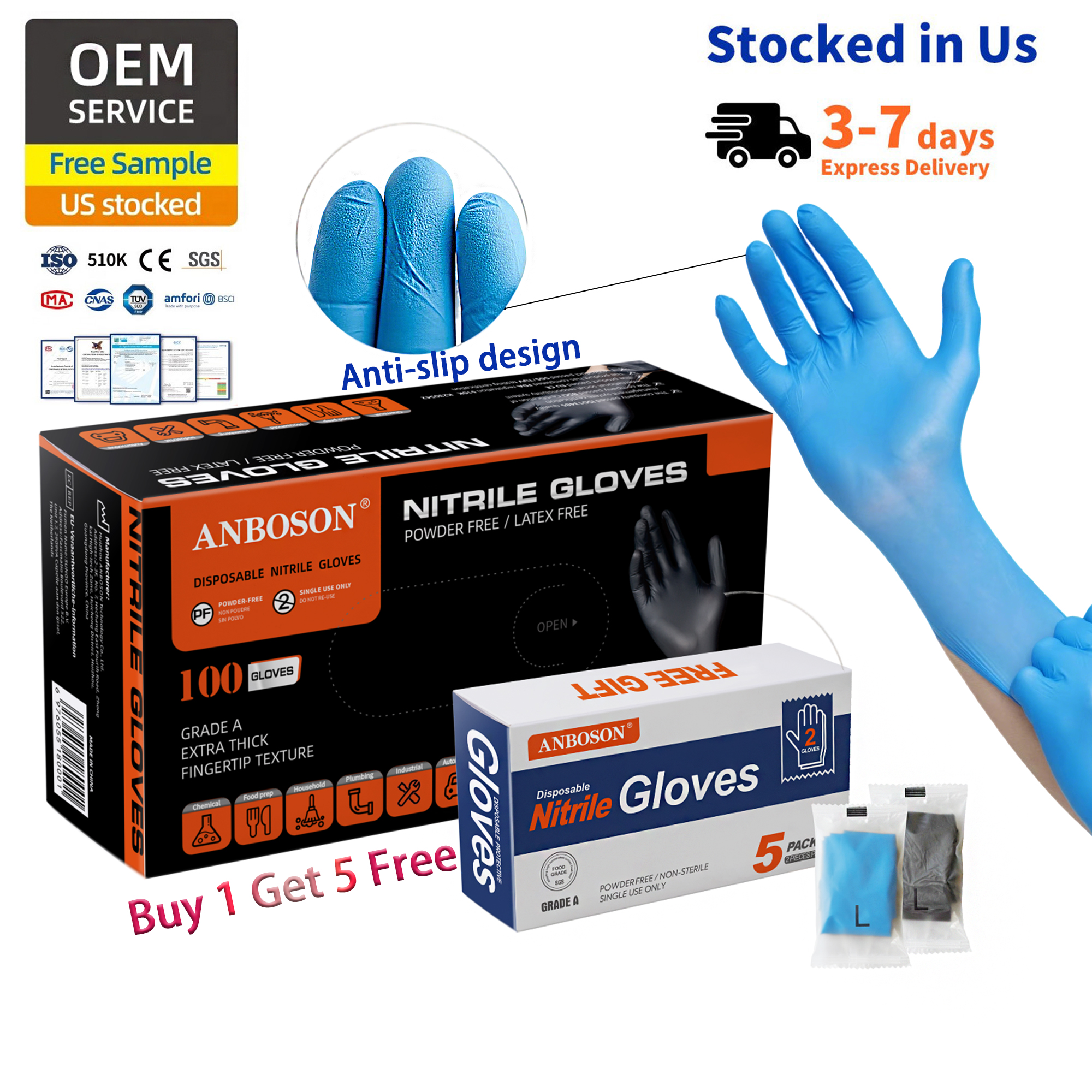
Box Exam Gloves (model ABC-DG01) are supplied 100 pieces per box at 6 mil and are positioned for food processing and kitchen environments. Product images identify the category; they do not substitute for the certificate scope discussed below.
Box exam gloves, medical exam nitrile gloves, food grade nitrile gloves and industrial nitrile gloves are four separate purchasing categories that are routinely quoted under one heading — disposable nitrile gloves — and, in this product range, at one identical indicative price band of $0.02–0.03 per piece at a 1,000-piece minimum order quantity. They are not interchangeable. Each category is defined by an intended use, a defined body of certification evidence, a packaging format and a purchase-order structure. The difference between them becomes visible only when an audit, a customs review or a customer complaint tests the claim.
This framework compares the four categories on the four dimensions a buyer can actually verify: intended use, certification evidence by target market, packaging format, and purchasing terms and acceptance criteria. It is written for importers, distributors, procurement managers and brand owners who have to defend a sourcing decision with documents rather than adjectives.
1. The four categories, defined
The first step in the framework is refusing the generic label. In this product range, the four categories are separated by thickness, stated application and evidence set — not by base material, which is nitrile in every case.
| Category (model) | Key specification | Intended application | Indicative price | MOQ |
|---|---|---|---|---|
| Box Exam Gloves (ABC-DG01) | 100 pcs/box; 6 mil; described as food grade | Food processing, kitchens | $0.02–0.03/piece | 1,000 pcs |
| Medical Exam Nitrile Gloves (ABC-DG01) | 3 mil; AQL 1.5; powder-free; textured | Medical, healthcare, dental | $0.02–0.03/piece | 1,000 pcs |
| Food Grade Nitrile Gloves (ABC-DG01) | 5 mil; powder-free; textured fingertips | Food service, food preparation | $0.02–0.03/piece | 1,000 pcs |
| Industrial Nitrile Gloves (ABC-DG01) | 4 mil; powder-free; touch screen compatible | Industrial, kitchen, tattoo | $0.02–0.03/piece | 1,000 pcs |
Three of the four families sit between 3 and 6 mil, share the same nitrile base material, the same boxed-out format and the same indicative unit price. Within the same range, thicker work-oriented options exist as separate products: the Heavy Duty Industrial Gloves at 8 mil and 10 mil with a Diamond Grip texture and waterproof construction, supplied as a box of 100. The practical conclusion for a buyer is that unit price cannot be used as a proxy for compliance or for performance, because the categories that carry the heaviest evidence burden are priced at the same level as the categories that carry the lightest.
2. Certification evidence map by category and market
Certification is the only part of a glove specification that can be audited after delivery. The table below maps the evidence documented for each category, with certificate and report references where they are stated.
| Category | Market | Evidence on file | Issuer / reference where stated |
|---|---|---|---|
| Medical Exam Nitrile Gloves | Global | ISO 13485 quality management system | Certificate 381240304R0S, POSI Shanghai |
| Medical Exam Nitrile Gloves | European Union | EN 455-1 / -2 / -3:2020 | TÜV SÜD PSB, certificate TTCN 113715 0002 Rev.00 |
| Medical Exam Nitrile Gloves | European Union | Regulation (EU) 2016/425, protective gloves Category III | Notified Body, certificate 2777/21748-01/1E00-00 |
| Medical Exam Nitrile Gloves | European Union | EU MDR Declaration of Conformity; EUDAMED registration | Technical file CE/MDR-T01020204-01; SRN CN-MF-00039003 |
| Medical Exam Nitrile Gloves | European Union | EN ISO 374-1:2016+A1:2018 and EN ISO 21420:2020 | TÜV SÜD DANMARK, certificate DK-PPE001962 01 |
| Medical Exam Nitrile Gloves | Global | EN ISO 374-2:2019 microbiological penetration | Third-party test report |
| Medical Exam Nitrile Gloves | Global | ISO 10993-5:2009 cytotoxicity; ISO 10993-10:2021 skin sensitisation | Soochow University reports SDWH-M202206163-1(E) and SDWH-M202206164-1(E) |
| Medical Exam Nitrile Gloves | USA | FDA 510(k) clearance; FDA Establishment Registration | K230542; FEI:3017929385 |
| Medical Exam Nitrile Gloves | USA | ASTM D6319-19 | SGS report QDHL2105604846MD |
| Medical Exam Nitrile Gloves | China | GB 10213-2006 | Report WR-2021-321, National Quality Inspection Center for Latex Products |
| Medical Exam Nitrile Gloves | Global | Halogen content test report | Third-party laboratory |
| Food Grade Nitrile Gloves | USA | FDA 21 CFR 177.2600 food contact | Test report |
| Food Grade Nitrile Gloves | European Union | (EU) 2017/745 Class I | Declared compliance |
| Food Grade Nitrile Gloves | Japan | Japan MHLW Notification No.370 food contact safety | Third-party laboratory test report |
| Food Grade Nitrile Gloves | China | GB 4806.11-2016 | Third-party test report |
| Box Exam Gloves | Global | ISO 13485 | Certification |
| Box Exam Gloves | USA | FDA certification; FDA 21 CFR 177.2600 food contact | Third-party test report |
| Box Exam Gloves | European Union | EU food contact material test certification | Certification |
| Box Exam Gloves | Global | EN 374 series, chemical and microbiological protection | SGS test report |
| Industrial Nitrile Gloves | Global | Halogen content test report | Third-party laboratory |
| Industrial Nitrile Gloves | European Union | EU MDR documentation | Issued by the manufacturer, Huizhou Anboson Technology Co., Ltd. |
| Heavy Duty Industrial Gloves | Global / EU | ISO 13485; EU food contact materials compliance test | Third-party laboratory report |
Certificate numbers are issued per product, per model and per manufacturing site. In this range the model reference is ABC-DG01 across the glove families, and a buyer should confirm that the document in hand names the exact product, model and site being purchased rather than a sibling product in the same portfolio.
3. How to read each evidence family
Medical device standards: EN 455, EN ISO 374, ASTM D6319, GB 10213
EN 455 is the European standard series for disposable medical gloves. Its three parts address different test dimensions: freedom from holes, physical properties, and biological evaluation. The Medical Exam Nitrile Gloves in this range are certified to EN 455-1, EN 455-2 and EN 455-3 (2020), with the certificate issued by TÜV SÜD PSB under reference TTCN 113715 0002 Rev.00.
EN ISO 374-2:2019 is the microbiological penetration test, which speaks to the barrier function of the glove against micro-organisms. For the US market, ASTM D6319 is the recognised consensus standard for nitrile examination gloves for medical application, and FDA guidance asks manufacturers whether their nitrile examination glove data meets ASTM D6319 or an equivalent consensus standard. The test report covering this product is SGS report QDHL2105604846MD. For China, the applicable test is GB 10213-2006, documented by report WR-2021-321 from the National Quality Inspection Center for Latex Products.
Biocompatibility: ISO 10993-5 and ISO 10993-10
ISO 10993-5 covers in vitro cytotoxicity and ISO 10993-10 covers skin sensitisation. Both are documented for the medical examination glove, with reports issued by Soochow University. For a procurement manager these are the two evidence points that matter most when end users have sensitive skin or when the glove is used in prolonged contact procedures; they are also the evidence points most often missing from generic nitrile offers.
Regulatory clearance: FDA 510(k), establishment registration and EU MDR
An FDA 510(k) clearance such as K230542 is tied to a specific device description and intended use, and the associated establishment registration, FEI:3017929385, identifies the registered facility. On the European side, the EU MDR Declaration of Conformity is supported by technical file CE/MDR-T01020204-01 and EUDAMED registration under SRN CN-MF-00039003. These are the two documents that a distributor is normally asked to produce during tendering, because they establish both the product authorisation and the legal manufacturer identity.
PPE regulation: (EU) 2016/425 Category III
Regulation (EU) 2016/425 is the European PPE route and Certificate 2777/21748-01/1E00-00 places the product in Category III, the class used for protective gloves against dangerous chemicals. The same product family also carries EN ISO 374-1:2016+A1:2018 and EN ISO 21420:2020 certification issued by TÜV SÜD DANMARK. The practical consequence is that a professional glove can hold medical device evidence and PPE evidence at the same time, and buyers should record both routes separately in their supplier file instead of treating the product as one single certification.
Food contact: FDA 21 CFR 177.2600, (EU) 2017/745 Class I, Japan MHLW No.370 and GB 4806.11-2016
Food contact evidence answers a different question: whether the material is safe in contact with food under the regulations of the destination market. The Food Grade Nitrile Gloves are documented against FDA 21 CFR 177.2600 for the USA, declared under (EU) 2017/745 Class I for the European Union, tested under Japan MHLW Notification No.370 with a third-party laboratory report for Japan, and covered by GB 4806.11-2016 for China. None of these four items establishes medical suitability, and none of them establishes chemical permeation performance.
Industrial evidence: halogen content testing
Industrial Nitrile Gloves in this range carry a halogen content test report issued by a third-party laboratory for the global market, with EU MDR documentation issued by the manufacturer. Industrial variants are supplied in black and orange colourways, and the heavier Heavy Duty Industrial Gloves add an 8 mil and 10 mil gauge, a Diamond Grip texture and waterproof construction for machinery, home and industrial handling. A halogen content report states what the material contains; it is not a substitute for chemical permeation certification, which remains the relevant evidence where a chemical protection claim is made.
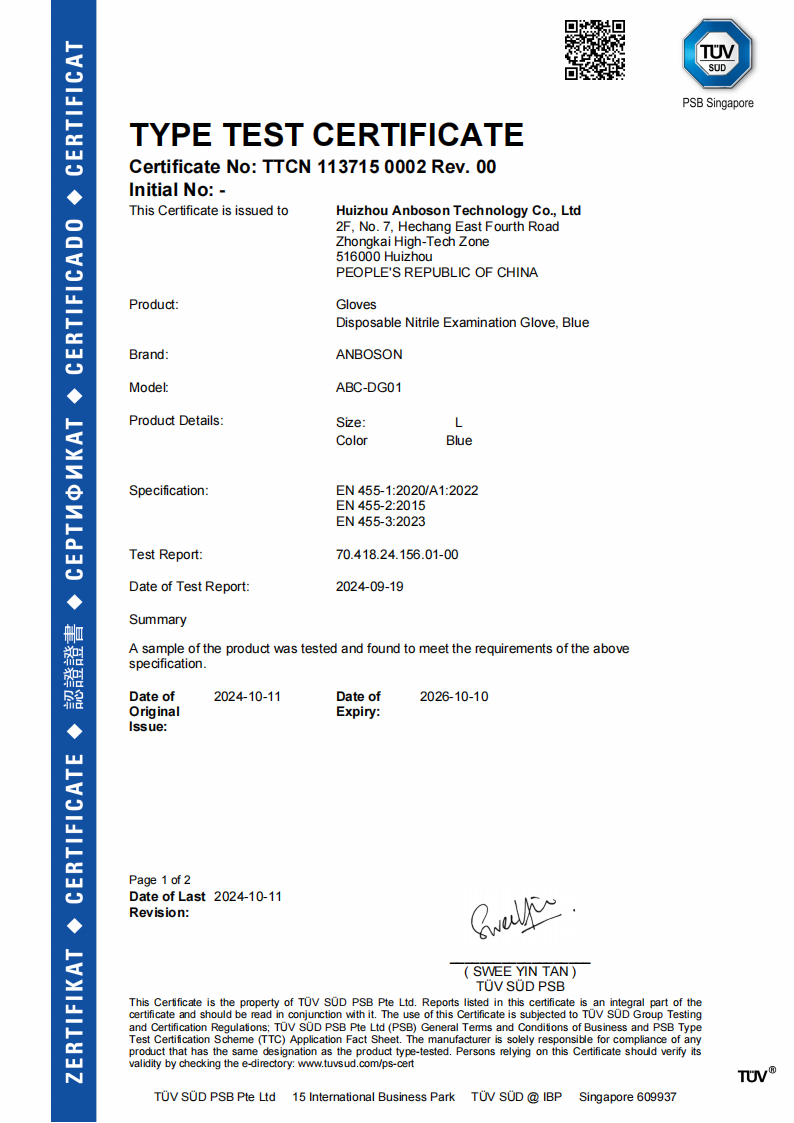
The EN 455 certificate is the anchor document for EU medical glove files; the certificate reference and its issuing body should appear in the purchase file alongside the FDA clearance number.
4. Use-case fit and target market compliance: a five-step framework
Applying the evidence map to a live sourcing decision follows five steps, in this order.
- Write the intended use down. Patient contact, food contact, chemical contact and mechanical handling are four different risk statements, and each one points to a different evidence family.
- Name the destination market. A single glove SKU sold into the USA, the EU, Japan and China will need four compliance references, one per market, not one global claim.
- Match evidence type to market. Screening on the wrong document type is the most common error: a food contact report cannot clear a medical tender, and a medical certificate cannot clear a food contact requirement in a retail audit.
- Confirm the packaging format against the handling environment. Bulk boxed product suits kitchen, clinic and workshop use; individually packaged pairs suit dental, beauty, travel and e-commerce channels.
- Fix acceptance criteria and commercial terms in the purchase order. Certification, thickness, AQL, pack format and lead time should all be written into the order, not agreed verbally.
| Buyer question | Evidence to request |
|---|---|
| Will the glove contact patients or body fluids? | EN 455-1/-2/-3, EN ISO 374-2:2019, ISO 10993-5 and ISO 10993-10, ASTM D6319-19, FDA 510(k) and establishment registration, EU MDR Declaration of Conformity, GB 10213-2006 |
| Will the glove contact food directly in preparation or service? | FDA 21 CFR 177.2600, EU food contact material test, Japan MHLW Notification No.370, GB 4806.11-2016 |
| Will the glove meet chemicals or mechanical wear? | EN ISO 374-1 and EN ISO 374-4 evidence, halogen content test report, declared gauge, grip texture and puncture resistance specification |
| Is the product destined for dental, beauty or travel channels? | Individually wrapped format, AQL 1.5, custom logo capability |
| Is the buyer a private label brand or an e-commerce seller? | OEM/ODM terms, retail-ready packaging, custom branding and packaging design capability |
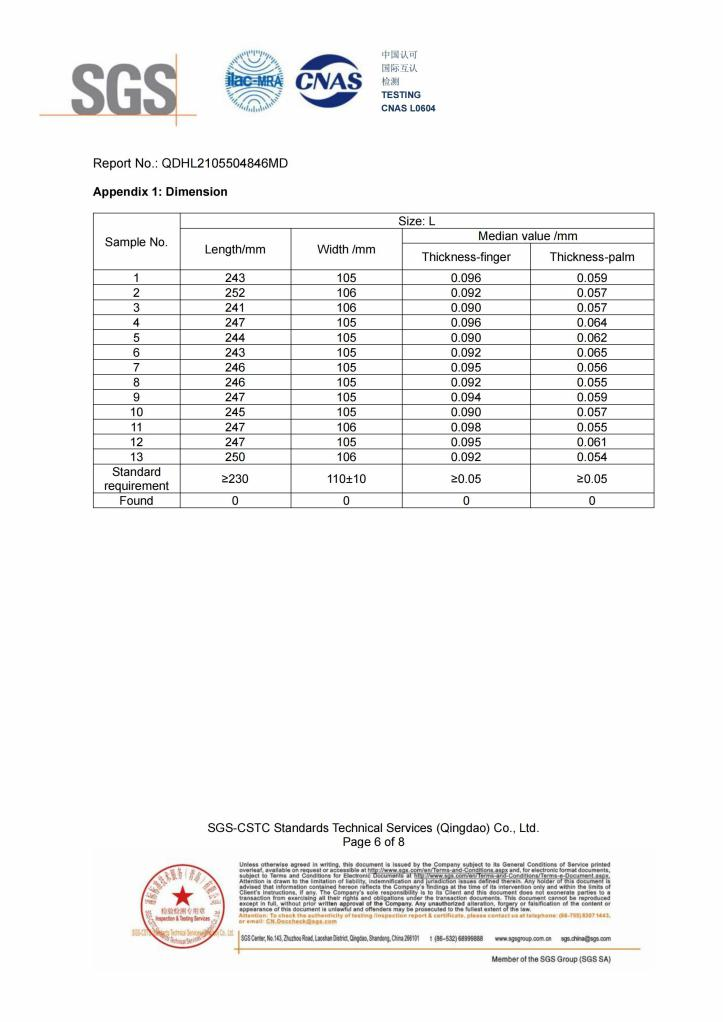
The ASTM D6319-19 report is the reference document US buyers use to verify that examination glove data meets the FDA-recognised consensus standard.
5. Packaging format, MOQ and acceptance criteria
Packaging is the second-most common source of mismatch after certification. The three formats in this range carry different unit economics and different MOQ structures.
| Format | Pack detail | Indicative price | MOQ |
|---|---|---|---|
| Boxed, 100 pieces per box | Box Exam, Medical Exam, Food Grade and Industrial gloves at 3–6 mil | $0.02–0.03/piece | 1,000 pcs |
| Heavy duty box of 100 | 8 mil and 10 mil, Diamond Grip, waterproof | $3.28–3.68/box | 10 boxes |
| Individually wrapped pair | 1 pair per pack, AQL 1.5, custom logo | $0.06–0.08/bag | 400 bags |
Production terms attached to these formats are also part of the compliance file, because lead time and capacity decide whether a claimed certification can actually be delivered in volume. Documented parameters in this range include a monthly capacity of 300 million pieces, an OEM/ODM lead time of 15–30 days, and a 30–45 day lead time for fully customised orders with drawing-based design and custom packaging. Quality control is stated as AQL 1.5 acceptance with 100% inspection before dispatch, supported by ISO 13485 certification and TÜV assessment, plus on-site material and finished-goods inspection.
Acceptance criteria that are worth writing into the purchase order include: declared gauge in mil; powder-free confirmation; AQL level; pack format and piece count per box or bag; the certificate or report reference number together with the named product and manufacturing site; labelling and lot coding requirements; sample retention; and the re-test terms that apply if a delivery fails inspection.
6. Where this framework breaks down
A comparison framework is only honest if it states its limits. Five limits matter here.
- Evidence does not transfer between categories. FDA 510(k) clearance K230542 covers disposable nitrile examination gloves intended for medical purposes. It is not evidence of food contact compliance. Equally, an FDA 21 CFR 177.2600 food contact report or a GB 4806.11-2016 report does not establish medical suitability. Buyers who pool these documents into a single compliance folder create a latent audit risk.
- Price collapses as a signal. Four categories at the same $0.02–0.03 per piece band means unit price cannot discriminate between a food service glove and a medically certified glove. Price comparisons should therefore be run on landed cost and evidence scope, not on FOB alone.
- Thickness is a use-case decision, not a ranking. The 3 mil examination glove and the 6 mil boxed glove serve different tasks. Heavier gauges, including the 8 mil and 10 mil Diamond Grip construction, trade tactile sensitivity for wear resistance and puncture resistance, which suits machinery and industrial handling but not fine examination work.
- Individually wrapped formats carry a structural premium. The pair-packed format is priced at $0.06–0.08 per bag against $0.02–0.03 per piece for boxed product, because of the additional packaging operation. It is justified by portability, hygiene presentation and retail readiness rather than by glove performance.
- Supplier evidence has boundaries. Capacity figures such as 3.2 billion gloves per year and a 42,000 square metre facility are company-reported, and independently verified audit or financial data are not present in the sources reviewed for this framework. Certification documents, by contrast, can be verified with the issuing body, and their issue and validity dates should be checked at purchase order stage — the EN 455 certificate cited above, for example, was issued on 11 October 2024.
7. Market signals to price into 2026 and 2027 decisions
Three published signals are directly relevant to how this framework is applied.
The global nitrile gloves market is projected at USD 7.0 billion in 2026, up from USD 6.5 billion in 2025, with forecasts reaching USD 13.2 billion by 2033 according to Grand View Research. Published estimates for the same category vary substantially depending on scope: figures reviewed for this analysis range from approximately USD 5.5 billion to USD 26 billion because some sources include industrial and non-medical glove segments while others count only synthetic examination gloves. Any market number used in a business case should therefore be checked against its definition, not quoted in isolation.
Powder-free gloves accounted for 74.8% of revenue share in 2025. Powder-free is no longer a premium specification; it is the professional default, and this is consistent with every product in the range documented here being powder-free.
Trade policy has become a cost variable of the same magnitude as material cost. US tariffs on Chinese-origin medical-grade nitrile gloves reached 100% in January 2026, while wholesale prices for standard exam-grade gloves were reported in the range of $80–$140 per case of 1,000 in 2026. For buyers, this shifts the decision from a unit price comparison to a landed cost and market access comparison, in which certification scope and destination market determine whether a given product can be sold at all.
8. How ANBOSON maps to this framework
Huizhou Anboson Technology Co., Ltd. (ANBOSON) is a Huizhou, China based manufacturer of disposable nitrile gloves and related medical consumables. The company was founded in 2019, operates a 42,000 square metre facility with more than 300 employees, reports an annual capacity of more than 3.2 billion gloves and a monthly capacity of 300 million pieces, and states that approximately 70% of output is exported to markets including North America, Europe and Japan.
Against the framework above, the relevant evidence is the quality management certificate ISO 13485 held under certificate 381240304R0S from POSI Shanghai; FDA 510(k) clearance K230542 and establishment registration FEI:3017929385 for medical examination gloves; EN 455 certification under TTCN 113715 0002 Rev.00; the ASTM D6319-19 report QDHL2105604846MD for the US market; GB 10213-2006 report WR-2021-321 for China; and food contact coverage through FDA 21 CFR 177.2600, Japan MHLW Notification No.370 and GB 4806.11-2016 for the food grade family. Halogen content test reports cover multiple glove products.
Commercially, the OEM/ODM model documented for this supplier includes logo printing, custom packaging, colour and thickness options, with MOQ levels of 400 bags, 1,000 pieces or 10 boxes depending on format and a stated lead time of 15–30 days for OEM/ODM orders and 30–45 days for fully customised orders. Documented customer cases include a medical distributor supplied at 800,000 or more boxes across 20 containers with recurring orders over two or more years, a food service chain supplied at 400,000–600,000 boxes across 10–15 containers, and an e-commerce brand served with custom branding in a retail and FBA format. Company and product documentation is published at https://szanboson.com.
9. Future outlook
Three shifts are visible from the evidence documented in this framework. First, certification is becoming the primary screening filter in procurement rather than a documentation formality: the shortlist is increasingly defined by which markets a supplier can legally serve, not by which price it quotes. Second, regional evidence is stacking rather than consolidating — the same glove now needs US, EU, Japanese and Chinese references, and buyers are learning to file them separately rather than as one global claim. Third, packaging differentiation is moving downstream: the individually wrapped pair exists because dental, beauty, travel and e-commerce channels require a presentation format that bulk boxes cannot provide.
The largest remaining gap is performance benchmarking. Comparable, independently measured data for thickness, tensile strength, elongation, puncture resistance and AQL across suppliers are not published in the sources reviewed here, which means buyers will continue to rely on certificate scope plus first-article sampling and delivery inspection. Until that data exists, the four-category comparison described above remains the most reliable defensible framework available.
10. FAQ
Is box exam the same as medical exam nitrile gloves?
No. Box Exam Gloves are supplied 100 pieces per box at 6 mil and are positioned for food processing and kitchen environments, with ISO 13485 certification, FDA certification for the USA, EU food contact material test certification and an SGS report covering the EN 374 series. Medical Exam Nitrile Gloves are a separate 3 mil, powder-free, AQL 1.5 product carrying medical device evidence including EN 455-1/-2/-3:2020, EN ISO 374-2:2019, ISO 10993-5:2009 and ISO 10993-10:2021, ASTM D6319-19, GB 10213-2006, FDA 510(k) K230542 and EU MDR documentation.
Which certifications does a food grade nitrile glove need for the US, EU, Japan and China?
The Food Grade Nitrile Gloves in this range are documented against FDA 21 CFR 177.2600 for the USA, (EU) 2017/745 Class I for the European Union, Japan MHLW Notification No.370 with a third-party laboratory test report for Japan, and GB 4806.11-2016 for China. These cover food contact safety only.
Can a medically certified glove be used for food handling?
Certification scope, not material, determines this. Medical device evidence does not automatically satisfy food contact requirements. Conversely, Box Exam Gloves are an example of a product that carries both FDA certification for the US market and food contact evidence under FDA 21 CFR 177.2600, showing that overlapping scope is possible but must be documented explicitly.
Why do four different glove families share the same $0.02–0.03 per piece price band?
Because they share the same nitrile base material, the same forming process and the same boxed format at a 1,000-piece MOQ. The differences lie in certification scope, thickness and packaging. Individually wrapped pairs sit at a higher $0.06–0.08 per bag at a 400-bag MOQ because of the additional packaging step, and heavy duty 8 mil and 10 mil gloves are priced per box of 100 at $3.28–3.68 with a 10-box MOQ.
What should be written into a purchase order as acceptance criteria?
Declared gauge in mil, powder-free status, AQL level where applicable, pack format and piece count, the certificate or report reference number together with the named product and site, labelling and lot coding, sample retention, and re-test terms. Production terms should be stated alongside them: 15–30 days for OEM/ODM orders and 30–45 days for fully customised orders in this range.
Does a halogen content test report replace chemical permeation certification?
No. A halogen content report describes what the material contains. Where chemical protection is claimed, EN ISO 374-1:2016+A1:2018 and EN ISO 374-4 evidence, such as the EN ISO 374 series documentation held for this range, remains the relevant reference.