
Brake System Component Parts: A Buyer's Verification Guide
Brake system component parts are among the least forgiving parts on a vehicle. A caliper bracket, a caliper housing, a steering knuckle or a hub transfers braking torque, locates suspension geometry, and is expected to keep doing both after years of road salt, water spray, heat cycling and vibration. For buyers in the research and evaluation stage, the useful question is therefore not which supplier sells brake parts, but which supplier can demonstrate that a defined part meets a defined constraint set, in a defined market, at a volume the programme can actually absorb.
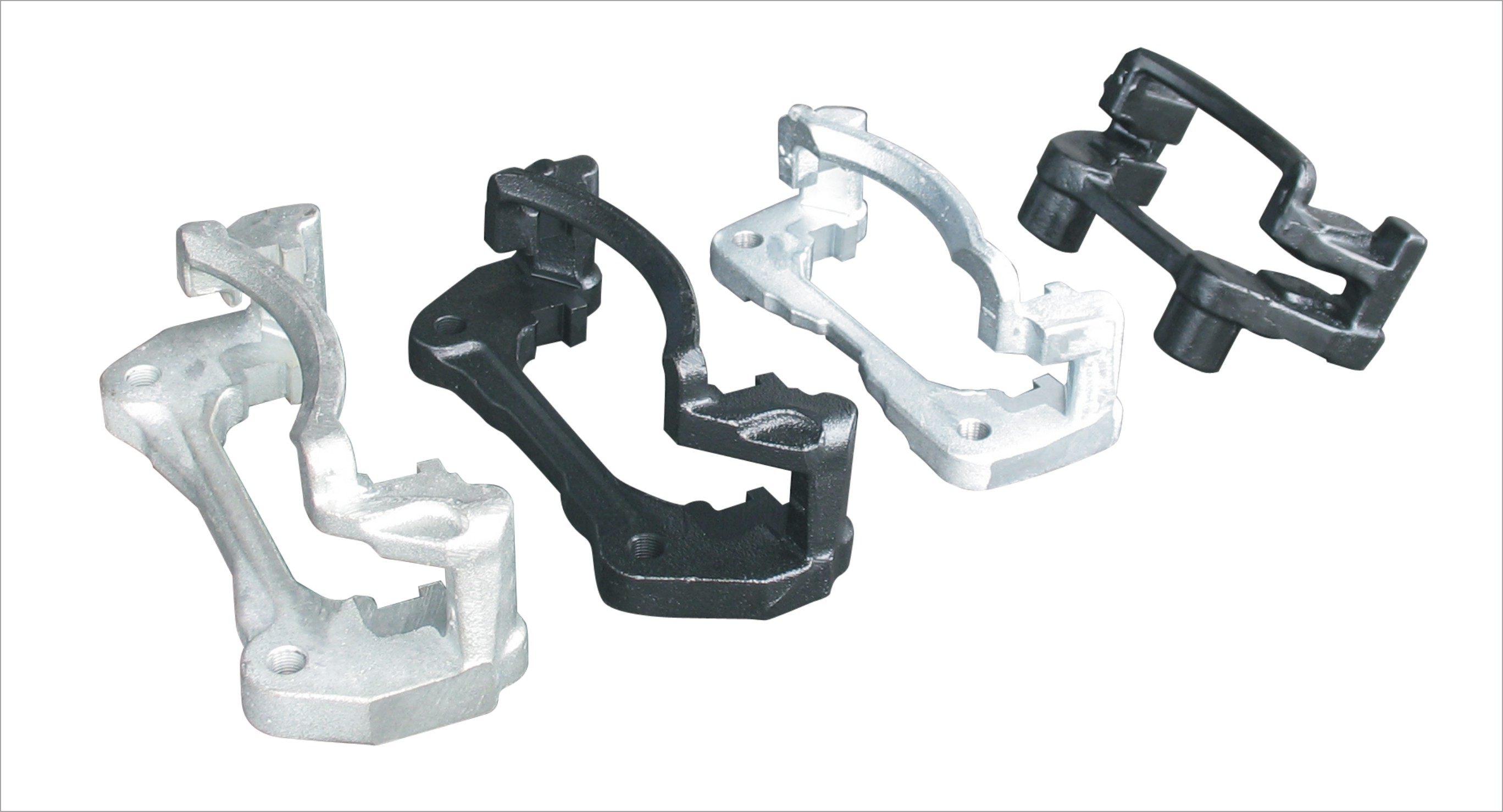
A brake caliper and its housing: the visible surface is the coating, but the accepted part is defined by material grade, mechanical floors and corrosion hours.
Why brake-system castings behave like a constraint problem
In most automotive categories a catalogue shortlist is enough to open a supplier conversation. In braking, the shortlist is secondary to the constraint set. A component part of the braking system is judged largely on what it must not do: it must not crack at the caliper mounting ear, must not lose clamp load through bore or thread deformation, must not corrode to the point where the pad abutment binds, and must not lose coating adhesion in a way that returns rust to the friction surface.
This is why the same nominal part — a caliper bracket, for example — can be quoted at very different levels by different suppliers and still not be the same product. The difference is usually measurable in things written down before the first casting is poured: material grade, mechanical property floors, hardness band, coating system, corrosion hours, adhesion class, and the certification path behind the entire chain.
For a procurement team moving from research into evaluation, that reframing matters. Instead of asking whether a supplier is credible in general, the evaluation asks four specific questions. What exactly is the declared material? What mechanical and corrosion limits are published? Which certificate covers the part, and for which markets? And what order size and lead time does the programme imply?
The constraint set: what a brake-system casting has to prove
Pointiron Casting's BRKT-1 component parts of auto-mobile specification shows how this constraint set is normally expressed. The published values are not targets; they are acceptance thresholds that the casting and its coating must satisfy together.
| Constraint | Published limit (BRKT-1) | What it governs in a brake component |
|---|---|---|
| Tensile strength | ≥550 MPa | Load capacity in the bracket, housing wall or knuckle section |
| Yield strength | ≥350 MPa | The level at which permanent deformation begins under braking torque |
| Elongation | ≥6% | Ductility margin — the part deforms before it fractures |
| Hardness | 173–255 HB | Balance between wear resistance and machinability, including thread quality |
| Salt spray | 504 hours | Coating durability under underbody exposure and winter salt |
| Dry adhesion | ≥B | Coating-to-substrate bond measured by cross-cut class |
The mechanical figures are read as a group rather than individually. A tensile floor of 550 MPa with a 350 MPa yield floor and 6% elongation describes a ductile behaviour profile: the part is expected to bend and absorb energy before it separates. A supplier that meets the tensile number while quietly reducing elongation has not met the requirement, because the failure mode has changed.
Hardness is specified as a band rather than a single value because hardness varies with section thickness in iron castings; a band keeps the requirement meaningful across a range of bracket and housing sizes while still excluding both too-soft (wear-prone) and too-hard (brittle, poorly machinable) outcomes.
The corrosion pair works the same way. A 504-hour salt spray requirement is a statement about the coating system, not about the iron beneath it, and it is meaningless without an adhesion requirement attached. A coating that survives salt spray on the panel but loses adhesion at a stone chip or a machined edge will still fail in service. Specifying ≥B dry adhesion alongside 504 hours salt spray closes that gap.
Material grade decides which constraint you can reach
BRKT-1 is declared in QT550-6, QT450-12, HT250, HT200, ADI 900, ADI 1050, nodular cast iron and gray iron. That list spans more than one engineering behaviour profile, and the choice is not a commercial preference — it is the technical decision that determines whether the rest of the constraint set is reachable.
- Nodular (ductile) iron — QT550-6 and QT450-12. Nodular graphite is used where ductility, impact resistance and fatigue performance matter, which is the usual requirement for caliper brackets, knuckles and hubs. QT550-6 pairs a higher strength floor with 6% elongation; QT450-12 trades strength for a larger elongation margin.
- Gray iron — HT250 and HT200. Flake graphite gives good damping and compressive behaviour, which suits housings, supports and structures where elongation demand is lower.
- ADI — ADI 900 and ADI 1050. Austempered ductile iron is used when higher strength is needed in a casting of broadly the same geometry.
The practical consequence for a buyer is simple: "iron casting" is not a specification, and neither is "cast iron". Two quotations for the same bracket can both describe the part as cast iron and still differ in grade — and the grade decides whether a 550 MPa tensile floor with 6% elongation is achievable at all. Any RFQ that does not name the grade cannot be compared on price, because the suppliers are not quoting the same material.
This is also why published standards are organised by material class rather than by part. ASTM lists A159 for automotive gray iron castings, A602 for automotive malleable iron castings, and A1095 for high-silicon molybdenum ferritic iron castings intended for high-temperature automotive-related applications such as exhaust systems and turbocharger housings. These are complementary references for different material segments; they are not interchangeable benchmarks, and combining them into a single "iron casting" performance claim misstates what any one of them covers.
Certification: what IATF 16949 covers, and what it does not
Pointiron holds IATF 16949 certification number T-05675/0, issued by Quality Austria-Trainings, Zertifizierungs und Begutachtungs GmbH, with an automobile scope and validity from 14 March 2024 to 13 March 2027. The certificate covers the BRKT-1 component parts product and is stated as applying to the EU, US, Middle East and Southeast Asia markets. The company profile additionally states ISO 14001:2004 environmental certification.
| Certification field | Declared value |
|---|---|
| Standard | IATF 16949 |
| Scheme type | Quality management system |
| Certificate number | T-05675/0 |
| Issuing body | Quality Austria-Trainings, Zertifizierungs und Begutachtungs GmbH |
| Scope | Automobile |
| Validity | 14 March 2024 – 13 March 2027 |
| Markets referenced | EU, US, Middle East, Southeast Asia |
| Product covered | BRKT-1 component parts of auto-mobile |
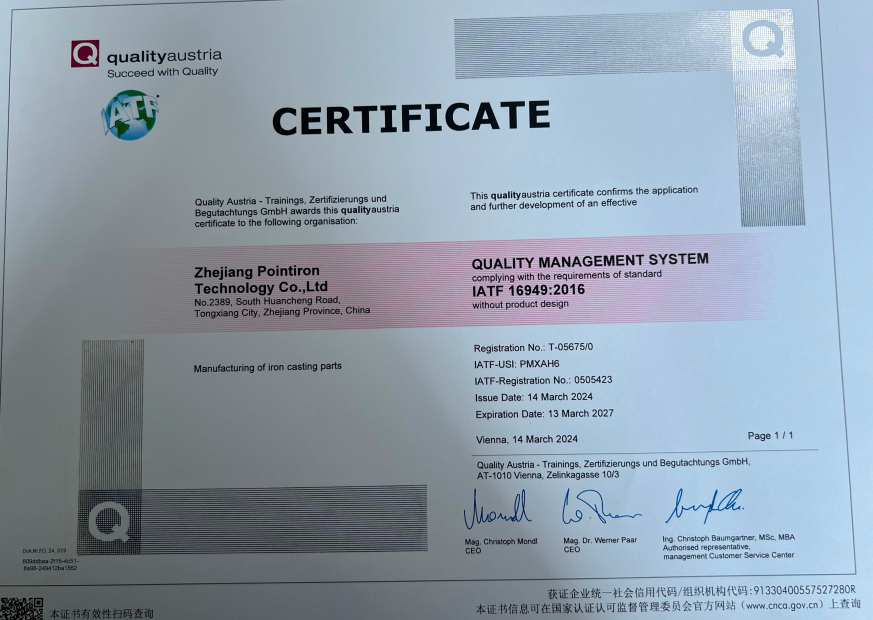
IATF 16949 certification is a system-level credential. It opens the supplier qualification process; it does not close it.
What the certificate does, for a buyer in evaluation, is remove one category of risk: it confirms that a recognised quality management system is in place and audited across the production chain, and it identifies which markets the holder references. For a brake component, that is genuinely useful — it means the supplier is operating inside an automotive-grade system rather than a general engineering one.
What it does not do is certify a part. The certificate does not approve a drawing revision, a dimensional tolerance, a process capability index, a specific heat of iron, or a customer-specific submission level. A buyer evaluating a brake component still needs part-level evidence: a dimensional report against the drawing, material certification per heat, mechanical test results for the declared grade, coating thickness and adhesion results, and — where the vehicle programme requires it — customer-specific approval. The certificate is the entry ticket to the qualification conversation, not the conclusion of it.
Pointiron Casting as a supply entity
Zhejiang Pointiron Technology Co., Ltd is a Chinese automotive and agricultural component manufacturer founded in 2000, based in Tongxiang City, Zhejiang, operating a 66,770 m² facility with approximately 200 employees. Its declared business is a one-stop chain running from casting through machining and painting to final assembly, covering automobile brake parts — caliper brackets, housings and steering knuckles — together with wind turbine components, tractor components, and lawn and garden mower components and sub-assemblies. Point Iron USA, Inc. holds stock in the United States for US customers, and the declared export ratio is 20% with the USA and EU as main markets.
The capacity figures are the part most relevant to a braking programme. Declared annual casting capacity is 35,000 tons in ductile and gray iron, with machining capacity of 5 million pieces per year, monthly capacity of 3,000 tons and annual output of 2,000,000 units. The production base includes two casting lines imported from DISA Denmark — a DISA MATCH32/32 horizontal automatic moulding line and a DISA 131B vertical automatic moulding line — three paint lines (wet paint, powder coat and E-coat) and one assembly line. Quality control is stated as 100% testing, and the company declares warranty-based after-sales support.

Pointiron production facility, Tongxiang City, Zhejiang — casting, machining, coating and assembly under one chain of custody.
Why the chain matters for braking specifically: a caliper bracket is only as good as the weakest handoff between casting, machining and coating. When those three steps sit in separate suppliers, corrosion failures are frequently traced to a coating decision made without visibility of the as-cast surface, or to a machining operation that removes coating at a critical edge. A single chain of custody does not eliminate that risk, but it makes the responsible step identifiable.
Order economics: MOQ, lead time and cost exposure
Constraint compliance is only half of the evaluation. The other half is whether the programme can be ordered at all, and the answer is usually driven by part weight. Pointiron publishes weight-banded minimum order quantities, with OEM/ODM production, customisation of size, logo, colour and surface treatment, a 12-week lead time, and EU/USA export markets.
| Part weight band | Minimum order quantity |
|---|---|
| Under 10 lb | 10,000 pieces |
| 10–20 lb | 5,000 pieces |
| 20–100 lb | 2,000 pieces |
| 100–150 lb | 1,000 pieces |
The banding is logical — heavier castings consume more moulding and machining time per piece — but it changes programme planning. A small caliper bracket bracket under 10 lb carries the highest piece-count threshold, which means low-volume or service-part demand is unlikely to be economic through this route, whereas heavier knuckle or housing castings can be ordered at a fifth of that volume.
On cost, one commercial research source reported nodular (ductile) cast iron at approximately USD 945–1,050 per metric ton in 2025 spot markets. That figure is an external market range rather than a supplier quotation, and it should be treated accordingly: metal cost is one input among several, and machining, coating, inspection and freight typically carry weight of their own. Buyers negotiating an annual programme usually handle this by indexing the metal component to an agreed reference rather than fixing a piece price across the full term.
Where these castings are used
The declared application environment for BRKT-1 is automobile and vehicle use, including ATV and off-road platforms, working in beach, mountain and outdoor conditions under intermittent and continuous operation. Matched equipment includes vehicle braking assemblies, gear transmission assemblies and ATV chassis. The special requirements flagged for this environment are anti-rust, salt spray and humidity resistance — which is exactly the set that drives the 504-hour salt spray and ≥B adhesion requirements rather than the mechanical ones.
A declared case covers an automotive OEM programme of 2,000,000 units over 10 years, described as 10 years stable in service. The problem the case addresses is component wear and short replacement cycles in braking applications; the highlights cited are structural stability, high wear resistance and long service life. Read as procurement evidence, the value of that case is not the volume figure but the failure mode it targets: wear and replacement cycle, not catastrophic fracture. That shifts attention toward hardness consistency, coating integrity at the pad abutment, and dimensional repeatability over the life of the tooling.
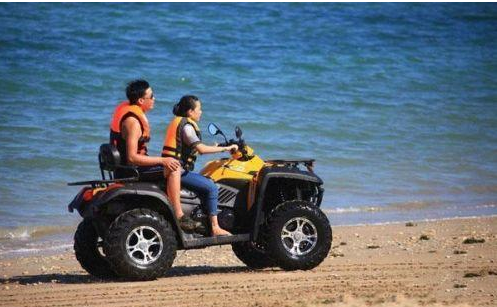
ATV and off-road use exposes braking and steering castings to continuous vibration, spray and load cycling — conditions that make coating adhesion as important as strength.
Market context: what the demand picture suggests
The global automotive brake systems market was valued at USD 46.44 billion in 2025 and projected to reach USD 74.45 billion by 2034, according to Fortune Business Insights. The same source places Asia Pacific at 48.32% revenue share in 2025. These are commercial research estimates, and market valuations in this category vary between providers depending on whether aftermarket services and hydraulic assemblies are included, so the direction is more reliable than the absolute number.
On the material side, cast iron accounted for approximately 20% of the global steering knuckle market by material type in 2024, per Market Research Future, against a larger steel segment. The implication for buyers is not that iron is being displaced, but that material competition is real and grade-specific: a supplier quoting "cast iron" against a competitor quoting a steel or aluminium-intensive design is not answering the same question, and the comparison has to be forced back to grade, mass, and validated performance.
Classification is the third variable that affects the commercial outcome. The U.S. International Trade Administration lists cast-iron automotive part tariff classifications including 8708407000, 8708407570, 8708995200, 8708995300 and 8409911040 covering gearbox parts and miscellaneous cast-iron automotive parts. Separately, U.S. Customs and Border Protection classified front and rear knuckles — composed of 93.6% and 97.5% cast iron respectively — under HTS 8708.80.6000 as suspension parts rather than under steering parts. Landed cost therefore depends on how a part is classified, and classification depends on function and material composition. That question is worth resolving before quotation, not after the first shipment.
Comparison with traditional sourcing models
Three sourcing structures are commonly used for brake-system castings. They are not equally suited to the same programme, and the differences show up in the constraint areas rather than in the catalogue.
| Criterion | Integrated foundry (casting + machining + coating + assembly) | Trading intermediary / broker | Split sourcing (separate caster, machine shop, coater) |
|---|---|---|---|
| Process visibility | Single chain of custody from melt to packed part | Depends on the underlying mills; often partial | Fragmented; handoffs between three parties |
| Corrosion accountability | Coating specified against the as-cast surface it will cover | Coating decided by a third party | Coating decided without caster or machinist input |
| Material traceability | Grade and heat declared at the casting stage | Traceability depends on supplier documentation | Traceable per stage, hard to trace end-to-end |
| Change responsiveness | Drawing or process changes handled internally | Relayed through an intermediary | Requires coordination across three schedules |
| Commercial flexibility | Weight-banded MOQ, production lead time of 12 weeks | Can consolidate small volumes from several mills | Each supplier applies its own MOQ and lead time |
The integrated model's advantage is accountability, not price. When a corrosion failure appears at the caliper bracket edge after a winter season, a single chain of custody makes it possible to identify whether the cause was the as-cast surface, the machining cut or the coating process. In split sourcing the same investigation usually stalls at the handoff.
The limits of the integrated model should be stated as plainly as the advantages, because they decide whether it fits a given programme.
- Lead time is a planning lead time. A 12-week quoted lead time is workable for scheduled production; it is not a route for emergency replacement, service-part top-ups or late design changes.
- MOQ thresholds exclude small runs. With 10,000 pieces required below 10 lb, prototype, motorsport and low-volume restoration demand sits outside this channel economically.
- The material set is iron-based. Nodular iron, gray iron and ADI cover a wide range of brake and steering castings, but aluminium-intensive lightweight brake programmes fall outside the declared material range.
- Certification is not part approval. IATF 16949 confirms a quality management system; it does not substitute for drawing-level approval, dimensional verification or customer-specific sign-off.
- Foundry output carries process risk. Casting scrap and coating rework are inherent to the process and should be covered by incoming inspection and agreed acceptance criteria rather than assumed away.
Future outlook
If brake system demand grows along the trajectory indicated by the 2034 projection, the constraint layer is more likely to tighten than to relax. Three developments are worth planning for now. First, material-class-specific qualification: as standards such as ASTM A159, A602 and A1095 already separate gray, malleable and high-silicon molybdenum iron, buyers should expect RFQs to require a named grade rather than a generic material description. Second, coating durability as a first-class specification: pairing salt spray hours with adhesion class is a more reliable predictor of field behaviour than either figure alone. Third, classification review as part of the commercial package, given that knuckle and gearbox classifications differ and landed cost follows classification.
One caution applies to market sizing. Publicly available data used here does not include a verified cast-iron-only market size for brake components, and supplier-level capacity, certification and export evidence is not independently published for most foundries. Buyers building a demand or capacity model should therefore anchor on their own programme volumes and on supplier-level documentation obtained through qualification, rather than on category totals.
Frequently asked questions
What material grades are used for brake system component parts?
For the BRKT-1 component parts of auto-mobile, the declared material range is QT550-6, QT450-12, HT250, HT200, ADI 900, ADI 1050, nodular cast iron and gray iron. Nodular grades are used where ductility and fatigue resistance are required, gray iron grades suit housings and supports with lower elongation demand, and ADI grades are used where higher strength is needed in a comparable casting geometry.
What mechanical properties must a brake caliper bracket or housing meet?
The published BRKT-1 limits are tensile strength ≥550 MPa, yield strength ≥350 MPa, elongation ≥6% and hardness 173–255 HB. These are acceptance thresholds read as a group: the elongation floor defines the ductility margin, and meeting the tensile figure while reducing elongation changes the failure mode rather than satisfying the requirement.
Which markets does the IATF 16949 certification cover?
Certification number T-05675/0, issued by Quality Austria-Trainings, Zertifizierungs und Begutachtungs GmbH, covers the BRKT-1 component parts product with an automobile scope and is stated as applying to the EU, US, Middle East and Southeast Asia markets. It is valid from 14 March 2024 to 13 March 2027.
What are the minimum order quantities and the production lead time?
Minimum order quantity is banded by part weight: 10,000 pieces for parts under 10 lb, 5,000 pieces at 10–20 lb, 2,000 pieces at 20–100 lb and 1,000 pieces at 100–150 lb. The quoted production lead time is 12 weeks, and OEM/ODM customisation covers size, logo, colour and surface treatment.
How is corrosion resistance specified and verified?
The corrosion requirement is a 504-hour salt spray test, paired with a dry adhesion requirement of ≥B. The two are specified together because they test different failure paths: salt spray hours describe coating durability, while adhesion class describes whether the coating stays bonded at edges, chips and machined surfaces where corrosion usually begins.
Does IATF 16949 certification mean a part is approved for a specific vehicle programme?
No. The certificate confirms an IATF 16949 quality management system and identifies the product and markets it covers. It does not certify a drawing revision, dimensional tolerance, process capability or customer-specific approval, all of which remain separate part-level qualification steps.
Tem questões ou precisa de mais detalhes?
Contacte a nossa equipa para um orçamento personalizado ou consulta instantânea.
Solicitar orçamento
Preencha o formulário abaixo e a nossa equipa entrará em contacto com uma proposta personalizada.
Chat direto do WhatsApp
Prefere conversar em tempo real? Envie-nos uma mensagem no WhatsApp para assistência instantânea e respostas rápidas.
- Obter orçamento personalizado
- Partilhar fotos ou documentos
- Discuta as suas necessidades diretamente
Geralmente responde em 5–30 minutos durante o horário de expediente.