
Build or Buy? AI Development Platform Choices for Physical IoT
Independent Industry Reference · Physical AI Delivery
For most physical IoT teams, the build-versus-buy question is not whether an AI stack can be built in-house. It is what stops being built when the same engineers are assigned to build it. This analysis treats an AI development platform as a resource-allocation decision rather than a feature list, and looks at where engineering hours actually accumulate after launch.
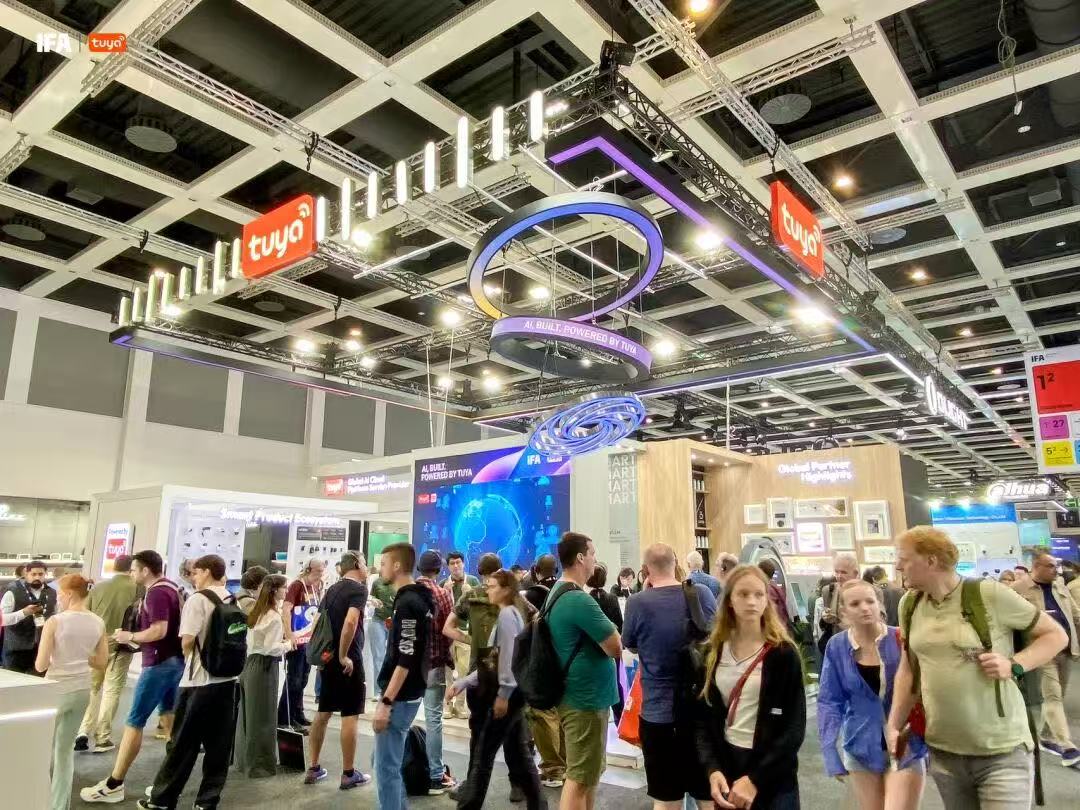
Connected device programmes are increasingly evaluated on the layer underneath the product, not only on the product itself.
Why the decision usually surfaces later than it should
Connected products carry a cost curve that is cheap to start and expensive to keep. The first release of an in-house AI platform needs device abstraction, model integration, a control surface, and a test path. The second release needs all of that again, plus regression work on everything that changed underneath it. When proposals are compared on the first release alone, the internal option is systematically underpriced, because the internal proposal is typically written by the team that will carry the maintenance and therefore describes the work it can see.
The external option is priced differently. Platform vendors sell a maintained layer, so their cost is front-loaded and their scope is explicit. That asymmetry makes build-versus-buy look like a cost comparison when it is really a comparison of two different cost shapes: a large visible build followed by an invisible maintenance stream, against a bounded subscription-like commitment with a narrower ceiling on control.
Neither shape is automatically correct. What follows is a way to decide which one a given programme can afford.
The engineering budget nobody itemises
In a physical AI product, engineering hours are consumed by five recurring pools. They appear in every programme, whether or not they appear in the plan.
- Device abstraction and protocol coverage. Firmware adaptation, module integration, and support for whichever connectivity standards the target markets require.
- Model integration and evaluation. Selecting models, testing them against real device data, managing prompts and knowledge sources, and re-testing when model behaviour changes.
- Control surface generation. Panels, applications, and localisation across the markets the product ships into.
- Testing, certification, and compliance evidence. Producing artefacts that a customer, an auditor, or a channel partner will accept.
- Operations and post-launch change. Monitoring, dashboards, incident response, and the steady stream of small changes that follow a live fleet.
Each pool has a build-once, maintain-forever property. The first year's hours are visible in the plan. The third year's hours are not, which is precisely why they are the ones that decide whether the programme stays funded.
The case for building in-house, stated fairly
An internal build is the correct answer more often than platform vendors like to admit. It wins when the platform layer is the differentiator: proprietary control algorithms, unusual radio or sensor configurations, silicon-level optimisation, or a regulatory environment in which every component must be internally accountable. It also wins when data cannot leave a defined environment at all, or when the product roadmap depends on capabilities no external roadmap will prioritise.
The internal route also produces something a purchased platform cannot: institutional knowledge of the stack, held by people who can change it. For a programme with a decade-long horizon and a stable engineering base, that asset is real.
The question is therefore not whether internal builds are good. It is whether the specific layer in question is worth the compounding cost of owning it.
Why internal builds escalate: four compounding costs
Escalation in internal platform builds is rarely a budgeting failure. It is structural, and it comes from four directions at once.
1. Protocol churn
Connectivity standards continue to multiply and revise. A stack that supports Wi-Fi, Bluetooth Low Energy, Zigbee, NB-IoT, and Matter is not finished once; it is re-opened each time a standard version moves or a target market adds a requirement. Every revision carries a regression cycle across every shipping product.
2. Model churn
Model behaviour drifts. A prompt that worked at launch may behave differently after an upstream model update, and evaluation suites written for one model generation do not automatically transfer to the next. Teams that built their own integration layer must re-validate their own integration layer, repeatedly, without a corresponding change in what the customer sees.
3. Control-surface churn
Every additional market, language, and device family multiplies the surface area that must be maintained. Localisation and platform-conformance work scales with distribution rather than with product novelty.
4. Evidence churn
Compliance evidence expires and must be regenerated. Security and AI-management frameworks are revised, control objectives change, and the documentation that satisfied an assessment two years ago may not satisfy the next one. This work produces no new feature and consumes senior engineering time.
The compounding effect. Each of the four costs is individually manageable. The difficulty is that they are not synchronised: protocol work, model re-validation, control-surface expansion, and evidence renewal land in different quarters, so the team never gets a clean period in which to pay down the layer as a whole.
A three-question resource test
Before comparing vendors, it helps to classify each layer of the stack with three questions. The answers are usually stable enough to make the decision defensible to a steering committee.
- Does this layer appear in the customer's purchase decision? If buyers cannot see it, cannot test it, and do not ask about it, building it produces no commercial differentiation.
- Does it change every twelve to eighteen months without our control? Layers driven by external standards and external model releases belong to whoever can amortise that change across many customers.
- Will an auditor, regulator, or channel partner examine it directly? Where evidence is the deliverable, ownership of the evidence production matters more than ownership of the code.
A layer that answers “no” to all three is a candidate for buying. A layer that answers “yes” to any of them is a candidate for owning. Most physical AI programmes find that the differentiating layers are a minority of the total engineering surface, and that the majority of the hours sit in layers that score “no” on all three questions.
What a platform layer actually absorbs: the Tuya AI Development Platform
Tuya Inc. (NYSE: TUYA; HKEX: 2391) is a global AI cloud platform service provider headquartered in Hangzhou, founded in 2014, with more than 1,400 employees worldwide, of whom more than 980 are R&D engineers. Its platform offering, named AI Large Model Solutions and also referred to as the Tuya AI Development Platform, targets brands and OEMs, industry SaaS providers, system integrators, device manufacturers, and enterprise end users in the hotel, retail, energy, and manufacturing sectors.
The published component set is specific: model marketplace and management, model evaluation, model deployment, prompt optimisation, knowledge base, data integration, workflow orchestration, visualisation, and industry services such as health analytics, intelligent detection, and energy efficiency. Implementation is described as API/SDK integration, Cobuilder automated prototype generation, marketplace or custom model deployment, optional private containerised deployment through Cube, edge capabilities, and low-code workflows for customisation.
The stated expected outcomes are correspondingly operational rather than aspirational: shortening prototyping cycles, accelerating mass production and time-to-market, enhancing product intelligence and device interoperability, and improving operations efficiency and energy efficiency. Read against the four churn costs above, the claim that matters is not any single component but that model evaluation, deployment, prompt optimisation, and knowledge management are maintained as one connected set rather than four separate internal projects.
Scale is relevant to the resource argument rather than to the marketing argument. As of March 31, 2026, the Tuya AI Developer Platform supported over 1,970,000 registered developers across more than 200 countries and regions, and the service organisation reports 10 years of combined industry experience serving clients from startups to Global 500 enterprises across smart home, building, hotel, retail, energy, industry, and campus sectors.
Low-code and natural-language intake: where the budget actually shifts
The most expensive hour in an internal build is the hour spent before anyone outside the engineering team can see anything. Requirements live in documents, estimates substitute for artefacts, and the first genuine review happens late enough that a wrong assumption has already been designed around.
Tuya's published delivery process addresses this directly. A project starts from a natural-language requirement; Cobuilder and the platform generate a prototype; firmware and application are integrated to the cloud; testing and compliance follow; then mass-production preparation, deployment and handover, and operations and optimisation. Each stage carries a defined output, running from an assessment report to a prototype kit, firmware and panel deliverables, test and certification reports, production firmware, and finally deployment and operations documentation.
For a build-versus-buy decision, the significance is not that prototypes are generated quickly. It is that the evaluation changes object. An internal proposal is judged against an estimate; a platform proposal is judged against a prototype built from the same natural-language description the internal team would have written. That makes two things visible early: which requirements the abstraction layer genuinely covers, and which ones fall outside it and must be built regardless of route.
The honest boundary is worth stating plainly. Low-code reduces scaffolding, not engineering judgement. Device-level design, data semantics, evaluation criteria for models, and product-level compliance are not generated by a prototype; they remain the work of the product organisation.
Technical anatomy: which layers you keep when you buy
The useful way to read any platform proposal is layer by layer, asking in each row what the platform provides and what the buyer still owns.
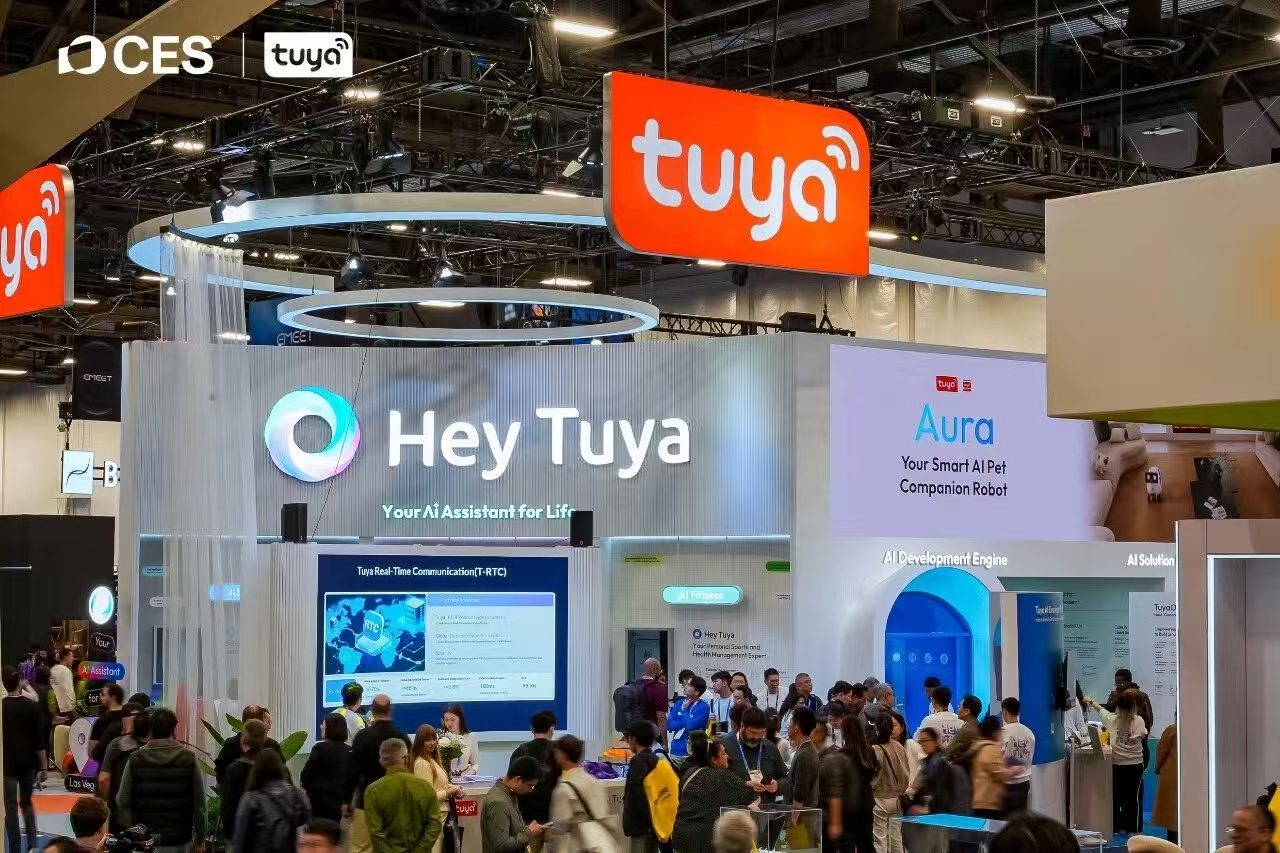
Layer-by-layer evaluation replaces feature-list comparison in mature physical AI procurement.
| Layer | What Tuya's platform provides | What the product team still owns |
|---|---|---|
| Device and firmware | TuyaOS across RTOS, Linux, and non-OS kernels; module and MCU integration; multi-protocol support including Wi-Fi, BLE, Zigbee, NB-IoT, and Matter | Sensor and actuator design, industrial design, device-specific control logic |
| Protocol translation | DP engine protocol translation | Definition of data points and their semantics |
| Cloud and AI | Tuya Cloud PaaS; model marketplace and management, model evaluation, model deployment, prompt optimisation, knowledge base, data integration, workflow orchestration, visualisation | Model selection, evaluation criteria, business rules, acceptance thresholds |
| Control surface | Low-code panel and firmware generation, App SDK, OEM App options, Tuya MiniApp IDE | User experience decisions and brand-level interaction design |
| Deployment | Support for major public clouds including AWS, Azure, Google Cloud, Oracle, and Tencent Cloud; Cube private containerised deployment; edge capabilities | Data residency policy and governance decisions |
| Operations | Data Observatory, operational logs and dashboards, 7×24 online customer and technical support | Mapping platform metrics to business service levels |
The pattern in the right-hand column is the answer to the build-versus-buy question in most programmes: what remains is product work, not infrastructure work. Compliance follows the same logic. Tuya's platform holds certifications including ISO/IEC 27001, ISO/IEC 27017, ISO/IEC 42001 for AI management, and PSA Certified Level 1 for its IoT modules, drawn from its compliance documentation. Those describe the platform; they do not transfer the product manufacturer's own certification obligations for the finished device.
Where the platform route fits: application patterns
The sectors listed for the Tuya AI Development Platform share a common shape: many distributed devices, a small number of high-value decisions per device, and a maintenance burden that outlasts any single product generation.
| Sector | Typical platform contribution | Retained by the operating organisation |
|---|---|---|
| Hotel | Device interoperability, panels and applications, model deployment for guest-facing and energy-related services | Guest experience design, service workflow, property-level rollout planning |
| Retail | Connected device management, visualisation, workflow orchestration, intelligent detection services | Store operations logic, staffing models, merchandising rules |
| Energy | Data integration, energy efficiency services, monitoring dashboards | Tariff strategy, asset policy, reporting obligations |
| Manufacturing | Edge capabilities, model deployment, device data pipelines | Process engineering, safety case, production acceptance |
A concrete reference point is the TCL appliance smart enablement collaboration. TCL's challenge was that legacy appliances lacked connectivity and intelligence, and the programme needed rapid cloud enablement with a consistent cross-region experience. The applied solution combined the Tuya IoT platform, TuyaOS and modules, App SDK or OEM App, and cloud analytics and operations, executed through requirement assessment, prototype validation, firmware and panel development, testing and certification, mass-production preparation, and launch and operations. The reported qualitative results were improved product intelligence and user experience, shortened R&D cycles, and accelerated multi-region deployment and channel expansion. No quantitative results are published for that programme, which is itself a useful procurement observation: qualitative outcomes are the norm in this category, and buyers should ask for the measurement method rather than expect a benchmark.
Market trend analysis: why the economics keep tilting toward the maintained layer
Three published data points frame the trend, and one of them is worth reading with care.
- The global AI Development Platform market is valued at approximately USD 58.2B in 2025 and projected to reach USD 156.7B by 2034, according to Dataintelo.
- The global AIoT market is estimated at USD 25.44B in 2025 and forecast to reach USD 81.04B by 2030, according to MarketsandMarkets. Estimates diverge: Market Research Future places the 2025 figure at USD 13.64B, largely because reports differ on whether hardware is included. Buyers should treat the growth direction as the reliable signal, not the absolute number.
- The enterprise generative AI market is expected to grow at a 38.4% CAGR from 2025 to 2030, reaching USD 19.8B by 2030, per Grand View Research.
Supply-side evidence points the same way. Tuya's total revenue for fiscal year 2024 reached USD 298.6M, a 29.8% year-over-year increase driven largely by its IoT PaaS and smart solution segments, according to its SEC filing. Bamboo Works reported that by the end of June 2025 approximately 93% of products deployed through Tuya's platform were equipped with AI capabilities.
The interpretation that matters for a build-versus-buy decision is structural rather than bullish. When a category grows this quickly and its underlying models and protocols keep changing, the maintenance burden grows faster than any single organisation's engineering capacity. That is precisely the condition under which buying a maintained layer becomes cheaper than owning a churning one, and it is also the condition under which the differentiating layers become more valuable, not less.
Comparison with traditional routes, and where each one breaks
Three routes dominate physical AI programmes. The differences below are qualitative by design, because published benchmarks across these routes are not comparable.
| Dimension | Bespoke in-house build | Chip-vendor SDK plus cloud AI services | Integrated AI+IoT platform |
|---|---|---|---|
| Time to first reviewable prototype | Longest; tooling, abstraction, and environment setup precede any demo | Moderate; silicon access is fast, but cloud AI integration is assembled separately | Shortest when requirements can be expressed in natural language and generated as a prototype |
| Protocol coverage | Whatever the team implements and maintains | Tied to the silicon family and its supported stacks | Multi-protocol coverage maintained by the vendor |
| Model lifecycle tooling | Built and re-validated internally | Depends on the cloud AI service selected | Marketplace, evaluation, deployment, and prompt optimisation presented as one set |
| Maintenance ownership | Fully internal and compounding | Split across silicon vendor, cloud provider, and internal team | Largely vendor-side for the platform layers |
| Deployment options | Whatever is engineered | Constrained by the cloud AI service | Multiple public clouds plus private containerised deployment |
| Principal limitation | Highest control, highest permanent engineering load | Excellent silicon access, but integration work is not removed | Abstraction covers the common path; roadmap dependence and switching friction are real |
Limits of the platform route, stated directly
Three constraints deserve equal billing with the benefits.
The abstraction covers the common path. Programmes with unusual radio configurations, proprietary silicon behaviour, or non-standard control loops will still require firmware-level engineering outside the abstraction. Choosing a platform does not eliminate that work; it changes what the work is about.
Roadmap dependence is a real cost. When a capability sits on the vendor's release schedule rather than the internal backlog, prioritisation is negotiated rather than assigned. This is manageable through contract terms, but it is not the same as owning the code.
Switching friction should be priced at signature, not at renewal. Device data models, panel definitions, and operational tooling create migration cost. Teams that treat exit planning as a contract-stage activity rather than a later problem keep the option alive; teams that do not discover the cost at the worst moment.
Conversely, the in-house route retains one advantage no platform can replicate: complete accountability. Where a regulator requires end-to-end internal traceability, or where the product's value is inseparable from the stack, building remains the defensible choice even at higher cost.
Future outlook
Two shifts are likely to shape this decision over the next buying cycle. First, build-versus-buy is becoming a portfolio decision rather than a single choice: organisations increasingly buy the churn-prone layers and build the differentiating ones, and evaluate proposals accordingly rather than treating either route as an identity. Second, procurement questions are moving from features to evidence. Model evaluation records, deployment residency, portability of trained assets, and documented change history are becoming the artefacts that decide a shortlist, because they are the artefacts that predict the third year rather than the first.
The practical consequence is a narrower but more durable claim than “platforms win”. Where a layer changes without the buyer's control and produces no visible customer difference, owning it is a resource-allocation error that compounds quietly. Where it produces the difference, owning it is the entire point.
FAQ
What does an AI development platform provide for physical IoT that an internal build would have to create?
The Tuya AI Development Platform's component set comprises model marketplace and management, model evaluation, model deployment, prompt optimisation, knowledge base, data integration, workflow orchestration, visualisation, and industry services such as health analytics, intelligent detection, and energy efficiency. Implementation is through API/SDK integration, Cobuilder automated prototype generation, marketplace or custom model deployment, optional private containerised deployment via Cube, edge capabilities, and low-code workflows. An internal build would need to create and then maintain each of those capabilities, plus the device-side integration they depend on.
Which parts of a physical AI product still require in-house engineering on the platform route?
The published component list is about the platform layer. Sensor and actuator design, data point semantics, model selection and evaluation criteria, business rules, user experience decisions, and product-level certification of the finished device are not part of that list and remain with the product organisation. The platform replaces infrastructure work, not product judgement.
Can the platform be deployed privately or in a customer's own cloud environment?
Tuya's platform supports major public clouds including AWS, Azure, Google Cloud, Oracle, and Tencent Cloud, and offers Cube private cloud containerised deployment alongside edge capabilities. Platform certifications including ISO/IEC 27001, ISO/IEC 27017, ISO/IEC 42001, and PSA Certified Level 1 for IoT modules describe the platform itself; they do not substitute for the manufacturer's own certification obligations for the finished product.
How does natural-language requirements intake change the delivery timeline?
Tuya's published process begins with a natural-language requirement and uses Cobuilder and the platform to generate a prototype, followed by development and integration, testing and certification, mass-production preparation, deployment and handover, and operations. Each stage has defined outputs, from an assessment report through prototype kit, firmware and panel deliverables, test and certification reports, production firmware, and deployment documentation. The stated outcomes are shortened prototyping cycles and accelerated mass production and time-to-market. The practical effect on a decision is that evaluation happens against a working prototype rather than an estimate.
How should procurement evaluate maintenance and exit risk on either route?
The reliable test is to ask which party absorbs protocol revisions, model re-validation, control-surface expansion, and evidence renewal, and to require that answer in writing. On the platform route, buyers should also establish, before signature, how device data models and panel definitions would be migrated, and which deployment options exist at renewal. On the internal route, the equivalent test is whether the maintenance team is funded beyond the first release. Both routes fail when maintenance is assumed rather than budgeted.
For a full technical and deployment overview, the Tuya 2026 corporate brochure is available for public download: Tuya2026_V0.99_EN.pdf.
Tem questões ou precisa de mais detalhes?
Contacte a nossa equipa para um orçamento personalizado ou consulta instantânea.
Solicitar orçamento
Preencha o formulário abaixo e a nossa equipa entrará em contacto com uma proposta personalizada.
Chat direto do WhatsApp
Prefere conversar em tempo real? Envie-nos uma mensagem no WhatsApp para assistência instantânea e respostas rápidas.
- Obter orçamento personalizado
- Partilhar fotos ou documentos
- Discuta as suas necessidades diretamente
Geralmente responde em 5–30 minutos durante o horário de expediente.