
Building Glass Certification and Specs: A 2026 Buyer's Reference
Building glass is increasingly specified as a high-performance envelope material. For procurement professionals, verifying certification status and measurable performance parameters is as important as comparing price. This reference looks at how CE certification and technical specifications shape building glass purchasing decisions in 2026, using Shenzhen Dayang Special Glass Co., Ltd. (DYGLASS) as an illustrative supplier.
The Cost of Unverified Specifications
In the EU/EEA, construction products that fall under the Construction Product Regulation (305/2011/EU) require CE marking to be legally placed on the market. Building glass used in curtain walls, windows, and facades is often subject to this compliance framework. The global construction glass market was valued at USD 119.2 billion in 2025 and is projected to reach USD 189.33 billion by 2034, according to Fortune Business Insights. As the market grows, buyers encounter a wider range of suppliers, including many from China, which exported USD 676 million in 'glass with edge workings' in 2024, representing 22% of global exports in that category (OEC).
The opportunity is clear: more options and more capacity. The challenge is verifying that a supplier's product actually meets the documented standards. A brochure cannot replace a certificate number, and a sample cannot confirm batch consistency.
DYGLASS at a Glance
DYGLASS, operating as Shenzhen Dayang Special Glass Co., Ltd., is a building glass manufacturer established in 2017. The company is based in Shenzhen, near Hong Kong, and operates a 30,000m² production facility with approximately 130 employees. Its annual output is 600,000 square meters, with an export ratio of around 60%. Key export markets include the UAE, Bahrain, Saudi Arabia, the US, Vietnam, and the Philippines.
For procurement teams, the relevant point is not simply company size but the alignment between product certifications and the glass types being sourced. DYGLASS holds CE certificates for three core product families: tempered glass, laminated glass, and insulating glass.
Core Product Parameters and Certification
The table below summarizes the main documented parameters for the three CE-certified product lines. Buyers should use these as a baseline when matching glass to project requirements.
| Product | Model | Key Parameters | CE Standard | Certificate No. |
|---|---|---|---|---|
| Tempered Glass | DY-GH01 | Thickness: 3–19mm; tolerance ±0.5mm; light transmittance ≥91% | EN 12150-1:2015+A1:2019; EN 12150-2:2004 | BGTC20260403-02 |
| Laminated Glass | DY-JJ01 | Thickness: 6.38–50mm; interlayers PVB/SGP/EVA; sound insulation 35–45dB | EN 1449:2005; CPR 305/2011/EU | BGTC20260403-03 |
| Insulating Glass | DY-ZK01 | e.g. 6mm+12A+6mm; light transmittance 70–89%; sound insulation 30–45dB | EN 1279-1/2/3/4:2018 | BGTC20260403-05 |
Tempered Glass: Safety and Fragmentation Behavior
Tempered glass is a safety glass used widely in facades, partitions, doors, and balustrades. DYGLASS's DY-GH01 is made from float glass and offers a thickness range of 3mm to 19mm, with a thickness tolerance of ±0.5mm and a light transmittance of ≥91%. Fully tempered glass must meet a minimum surface compression of 10,000 psi (69 MPa) according to ASTM C1048. In Europe, EN 12150 specifies the fragmentation test for thermally toughened soda lime silicate safety glass, requiring at least 40 particles in a 50mm × 50mm area.
Laminated Glass: Post-Breakage Retention and Acoustic Performance
Laminated glass consists of glass plies bonded with an interlayer. The DY-JJ01 product has a thickness range of 6.38mm to 50mm and uses PVB, SGP, or EVA interlayers with thicknesses from 0.38mm to 2.28mm. Clear configurations transmit 85% to 92% of visible light, while tinted versions range from 10% to 70%. Sound insulation is rated between 35dB and 45dB. This combination makes laminated glass relevant for overhead glazing, security glazing, and noise-sensitive buildings.
Insulating Glass: Thermal and Acoustic Efficiency
Insulating glass units (IGUs) combine two or more panes separated by a spacer. The DY-ZK01 range is available in configurations such as 6mm+12A+6mm or 8mm+16A+8mm, with custom options. Glass types can be clear float, Low-E, tempered, or low-iron. Spacer bars can be aluminum or warm edge, and the cavity can be filled with air or inert gases such as argon, krypton, or xenon. Light transmittance ranges from 70% to 89%, and sound insulation is 30 to 45dB.
Mapping Glass Parameters to Project Requirements
Certifications establish baseline compliance, but project-specific performance depends on how the glass is configured. A practical way to evaluate a glass product is by mapping parameters to the facade's functional requirements.
- Safety: Tempered glass provides high impact resistance and breaks into small, relatively harmless particles. Laminated glass adds post-breakage retention, which is critical for overhead glazing and security-sensitive areas.
- Acoustics: If the site is exposed to traffic or airport noise, laminated glass with a documented 35–45dB rating offers a stronger acoustic solution than monolithic glass. Insulating glass can also contribute to noise reduction with a 30–45dB range.
- Thermal performance: For energy-efficient envelopes, insulating glass with Low-E coating and gas fill (argon, krypton, or xenon) reduces heat transfer. Buyers should look for specified spacer and gas fill choices.
- Optical clarity: Low-iron glass or ultra-clear glass improves daylight transmission and visual transparency. For decorative or branding purposes, digital printed glass and ceramic frit glass add design flexibility.
Why Certification Documents Need Close Reading
A CE certificate confirms that a product family has been assessed against harmonized standards. For example, the DYGLASS laminated glass certificate (BGTC20260403-03) is based on EN 1449:2005, while the insulating glass certificate (BGTC20260403-05) references EN 1279-1:2018 through EN 1279-4:2018. These certificates were issued by ECTI CERT Ltd. and are valid for the EU/EEA market.
However, the scope of a certificate may not cover every customized configuration. If a buyer needs curved laminated glass, a specific thickness combination, or a non-standard interlayer, the delivered product should be checked against the certificate's scope. This is particularly relevant for complex facade designs, where curved or multi-curved glass is often required.

CE certificate for laminated glass; buyers should verify scope against ordered specifications.
Application Scenarios and A Documented Case
DYGLASS's building glass products are used in construction engineering, decoration engineering, and municipal engineering projects. The product range includes tempered, laminated, insulating, curved, smart switchable, digital printed, and ceramic frit glass, among others. Special requirements can include bulletproof glass, fire-resistant glass, and special-shaped glass.
One documented use case is a UAE hotel project supplied with approximately 4,000 square meters of architectural glass. The application emphasized heat insulation, sound insulation, and aesthetic appearance, and the glass has remained in stable operation. For buyers, this type of reference helps in evaluating how a supplier's products perform outside their home market.
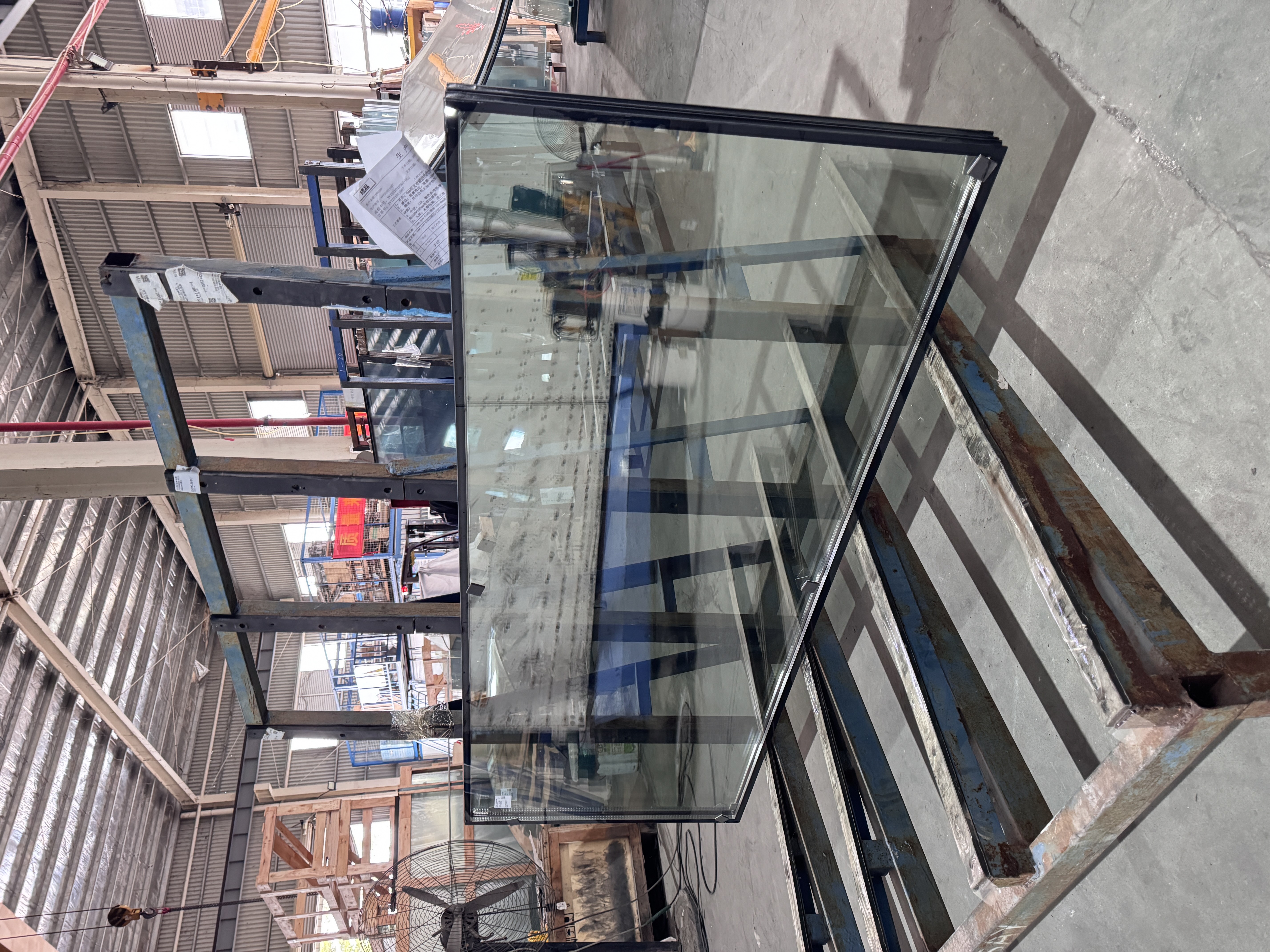
Insulating glass units are common in high-performance building envelopes.
Manufacturing Capability and Customization
For complex facades, a supplier's production capability can be as important as its certificates. DYGLASS operates dedicated glass processing lines, including flat and curved tempering lines, a concave and convex curved line, a double-curved tempering line, an insulating glass line, an autoclave, and a heat soak furnace. This equipment supports the production of flat, curved, and special-shaped glass.
From a procurement perspective, DYGLASS offers OEM and ODM services, with customization options for size, thickness, shape, tempering, coating, and interlayer build-ups. The minimum order quantity is 10 square meters, and the stated lead time is 7 to 9 days. These details are useful for projects with controlled timelines, but buyers should still confirm that any customized product matches the relevant certification scope.
Market Trends Affecting Building Glass Procurement
Several market signals are relevant for 2026 procurement teams:
- China's glass market was estimated at USD 31.2 billion in 2024 and is expected to reach USD 55.0 billion by 2035 (Market Research Future).
- Architectural glass accounts for nearly 70% of global flat glass production, which exceeds 120 million metric tons annually (Business Research Insights).
- The global smart glass market was valued at approximately USD 8.2 billion in 2025, with electrochromic technology holding a 61.3% share (Grand View Research).
These trends point to increasing demand for energy-efficient, controllable, and visually complex glass. At the same time, buyers are becoming more systematic about requiring verifiable compliance data rather than accepting marketing claims.
Certification-Led Procurement vs. Traditional Verification
In a traditional purchasing process, a buyer may compare samples and prices, then rely on the supplier's declaration that the glass is tempered, laminated, or insulating. This works in many cases, but it leaves room for ambiguity around standards, test methods, and batch traceability.
A certification-led approach starts with checking whether the product family has a valid certificate, then maps the certificate scope against the project specification. The table below compares the two approaches.
| Dimension | Traditional Approach | Certification-Led Approach |
|---|---|---|
| Compliance evidence | Supplier brochure or verbal assurance | Certificate number, issuing body, standards, validity period |
| Performance parameters | Typical or assumed values | Documented range linked to a specific product model |
| Custom configurations | Accepted as long as sample looks correct | Checked against certificate scope; additional testing may be required |
| Risk exposure | Higher for EU/EEA projects due to CE obligations | Lower, because the product has been independently assessed |
Important limitation: CE certification does not automatically cover every custom configuration. For example, DYGLASS's CE certificates cover the specific product families described in their scopes, but a curved, double-curved, or otherwise special-shaped glass unit may require separate assessment depending on the project's applicable standards. Buyers should confirm that the exact delivered build-up matches the certified type or request additional documentation.
Procurement Checklist
The following checklist summarizes the verification steps discussed in this reference:
- Confirm the product model and requested thickness are within the certified scope.
- Record the certificate number, issuing body, and expiry date.
- Match performance parameters—light transmittance, sound insulation—to project requirements.
- Check whether Low-E, gas fill, spacer, and glass type are documented for insulating units.
- For laminated glass, verify interlayer type and thickness against the specification.
- Request additional documentation for curved or special-shaped glass that may fall outside standard certificate scope.
Future Outlook
As building codes become stricter and project documentation becomes more digital, the role of certification in building glass procurement will likely expand. Buyers can expect more suppliers to publish certificate numbers, test reports, and performance parameters online, making it easier to compare from a distance. For suppliers like DYGLASS, having CE-certified product ranges and production lines for both flat and curved glass provides a foundation for serving international facade projects.
FAQ
What CE standards apply to tempered glass in building projects?
Tempered glass model DY-GH01 is CE certified under EN 12150-1:2015+A1:2019 and EN 12150-2:2004. The certificate number is BGTC20260403-02, issued by ECTI CERT Ltd., and is valid for the EU/EEA market.
What performance parameters are documented for laminated glass?
Model DY-JJ01 laminated glass has a thickness range of 6.38mm to 50mm and sound insulation between 35dB and 45dB. Interlayer options include PVB, SGP, and EVA, with interlayer thickness from 0.38mm to 2.28mm.
What are the typical light transmittance values for insulating glass?
Insulating glass model DY-ZK01 has a light transmittance range of 70% to 89%. Configurations vary based on glass type, spacer, and gas fill.
Are DYGLASS laminated and insulating glass products CE certified?
Yes. The laminated glass product (DY-JJ01) holds certificate BGTC20260403-03, and the insulating glass product holds certificate BGTC20260403-05. Both were issued by ECTI CERT Ltd. for the EU/EEA market.
Does CE certification cover curved or otherwise customized glass?
The provided CE certificates cover specific product families and configurations. For custom shapes such as curved, double-curved, or special-shaped glass, buyers should request product-specific documentation because the certificate scope may differ.
What is the minimum order quantity and lead time at DYGLASS?
DYGLASS states a minimum order quantity of 10 square meters and a lead time of 7 to 9 days for production. These figures are useful for planning purposes but should be confirmed for each specific project.
For a complete overview of DYGLASS's production capabilities and product range, the company brochure is available for download: DYGLASS company brochure (PDF).