
Building a BP Monitor Comparison Framework: Cuff to Use Case
An upper-arm blood pressure monitor is usually compared in the wrong order. Brand first, then price band, then one headline number, and only afterwards the question of whether the cuff, the measuring range and the intended setting actually match the buyer's market. Reversing that order produces a shorter, more defensible shortlist. This article sets out a method, not a ranking.

GT-702V upper-arm digital blood pressure monitor, one of the two models used to demonstrate the matrix in this article. Image: GENIAL.
What a comparison framework is, and what it is not
A comparison framework is a fixed set of verifiable fields applied in the same order to every candidate model, with the same units and the same level of detail. It is not a scorecard that hides judgement inside a single number. It is a structure that makes disagreement visible: when two buyers reach different conclusions, the framework shows which field produced the difference.
For upper-arm blood pressure monitors, four fields appear in manufacturer product data and are stable enough to compare across models: cuff and contact materials, pressure and pulse specification, arm circumference coverage, and declared application industry. A fifth field, regulatory coverage by model, belongs in the framework but must be verified per SKU rather than per brand. That last point is where most supplier comparisons quietly fail, and it is treated separately below.
Why the upper-arm category rewards structured comparison
Across the GENIAL upper-arm line, the stated pressure range is effectively identical. The 0–290 mmHg range appears on GT-732M, GT-702V, GT-702BM, GT-702M, GT-712, GT-702D, GT-702B and GT-702C. When a field is the same across nearly the whole population, it cannot separate the population. A comparison matrix built around pressure range alone will produce a row of identical cells and a decision made on something else.
The separating fields sit elsewhere. Cuff construction moves between ABS housings with eco-friendly TPU air bags, PVC air bags with nylon binding straps, composite fabric cuffs and nylon cuffs. Arm circumference coverage splits into two bands, 22–32 cm and 22–42 cm. Memory configuration is stated on some models and not on others. Unit weight varies from 155 g to 304 g without battery. Declared application industry shifts from community clinics to chronic disease management institutes, from pharmacy promotions to cross-border e-commerce.
Market structure explains why this category is worth the effort. Upper-arm monitors held 59.10% of blood pressure monitoring market share in 2025, while wrist-based and wearable devices were growing at a 12.07% compound annual rate, according to Mordor Intelligence research published in 2026. The upper-arm form factor remains the reference category for procurement, and it is also the category where model-level specification differences are most easily buried under a single brand claim.
Criterion 1: Cuff and contact materials
Material statements in product data usually combine three separate things: the housing plastic, the air bladder, and the cuff fabric or strap. Treated separately, they answer different procurement questions.
- Housing plastic. GT-732M, GT-702V, GT-702BM, GT-702M, GT-712, GT-702D, GT-702B, GT-702C and GT-702L list ABS. GT-702VA lists modified ABS. These are not performance grades in the corpus; they are material declarations that affect weight, surface finish and packaging.
- Air bladder. GT-732M lists an eco-friendly TPU air bag. GT-732 lists a PVC air bag with a nylon binding strap. GT-702MA lists ABS and TPU. These differences sit inside the cuff assembly, where replacement and field durability matter more than appearance.
- Cuff fabric or strap. GT-702BM lists a composite fabric cuff. GT-702L lists a nylon cuff and an LCD lens. GT-702VA uses modified ABS without a separately named fabric in the specification.
A buyer should record these as declared attributes rather than as a quality verdict. The corpus does not state comparative durability, skin-compatibility results or cleaning cycles for TPU against PVC, so a matrix that awards points for material alone would be inventing evidence. The correct use of the field is to group candidates by construction type before any commercial discussion begins.
Criterion 2: Pressure range and pulse specification
The pressure envelope is consistent across the upper-arm range at 0–290 mmHg. That consistency is useful as a baseline check, but it removes pressure range as a differentiator.
Pulse specification is stated unevenly, and that unevenness is itself a comparison signal:
- GT-732 states a pulse tolerance of ±5%.
- GT-732M states a pulse error of ≤±5%.
- GT-702L states a pulse range of 30–250 bpm alongside its 0–290 mmHg pressure range.
- GT-701F, a wrist model, also states a pulse range of 30–250 bpm.
- Several upper-arm models in the corpus state pressure range and arm circumference but do not state a pulse tolerance or pulse range in the model specification.
The practical rule is straightforward. Where a specification is absent, the matrix should record an absence rather than assume parity. A buyer who treats missing pulse data as equivalent to a stated tolerance is comparing a measurement claim with a blank cell. Where a specification is present, it should be quoted exactly, because a tolerance of ±5% and an error bound of ≤±5% describe related but differently worded acceptance language.
Criterion 3: Arm circumference coverage
This is the field that most directly connects a device to a population, and in the GENIAL upper-arm range it divides cleanly.
The 22–42 cm band covers GT-732M, GT-702V, GT-702BM, GT-702VA, GT-702MA, GT-702LM, GT-702LD, GT-702CM, GT-702CD, GT-702M, GT-703M, GT-703V and GT-702L. The 22–32 cm band covers GT-732, GT-712, GT-712B/C/E, GT-702, GT-702B, GT-702C and GT-702D. Wrist models sit on a separate scale entirely: GT-701F and GT-701L state 13.5–19.5 cm, while GT-701 and GT-701C state 13.5–21.5 cm.
The procurement consequence is not that one band is better. It is that a 22–32 cm device and a 22–42 cm device can share an identical pressure range, an identical housing material and an identical brand, while serving different user populations. A community screening programme, a chronic disease management institute and a cross-border retail listing may reasonably require different coverage. The matrix should carry the circumference range as a hard filter before any scoring begins, because a mismatch cannot be corrected later by price or packaging.
Criterion 4: Declared application industry
Manufacturer product data for this range includes an intended application industry, and it forms a useful fourth column. It is a declared positioning, not a clinical certificate, but it narrows the matrix quickly.
- GT-732M: chronic disease management institute, community medical center, insurance promotional gift.
- GT-732: community clinic, health and wellness centre, e-commerce, customised OEM gift.
- GT-702V: cross-border e-commerce, household medical supply.
- GT-702BM: medical instrument wholesale, offline household retail.
- GT-702M: offline medical equipment retail.
- GT-702MA: physical examination centre, elderly care and pension institution.
- GT-702C: pharmacy store, seasonal promotional gift.
- GT-712: community clinic, medical equipment agent.
- GT-702D: household market, overseas medical distributor.
Read as a set, these labels describe channel and setting rather than performance. A distributor building an offline retail range and a clinic group building a chronic care programme will weight the same model differently. The field earns its place because it makes that weighting explicit instead of leaving it to a sales conversation.
Assembling the matrix: a five-step method
Step 1 — Define the population before listing products. Decide whether the comparison is upper-arm only. Upper-arm monitors held 59.10% of blood pressure monitoring market share in 2025 (Mordor Intelligence), which makes a single-form-factor matrix coherent for most institutional buyers. Mixing wrist and upper-arm devices in one score obscures the circumference reference, which is measured on the arm in one case and the wrist in the other.
Step 2 — Normalise the fields. Fix units (mmHg, centimetres, grams), fix the measurement point (without battery), and fix the wording of each specification. A matrix that mixes grams with and without battery will produce false differences.
Step 3 — Assign weights before seeing the results. Set weights for the four visible criteria plus regulatory coverage. If weights are adjusted after scoring, the framework has become a justification exercise.
Step 4 — Add a regulatory column per SKU. Not per brand, and not per product family. The reason is set out in the limits section below.
Step 5 — Validate with a sample before scaling. Specification data narrows the field; it does not replace a fitting and function check on the physical unit.
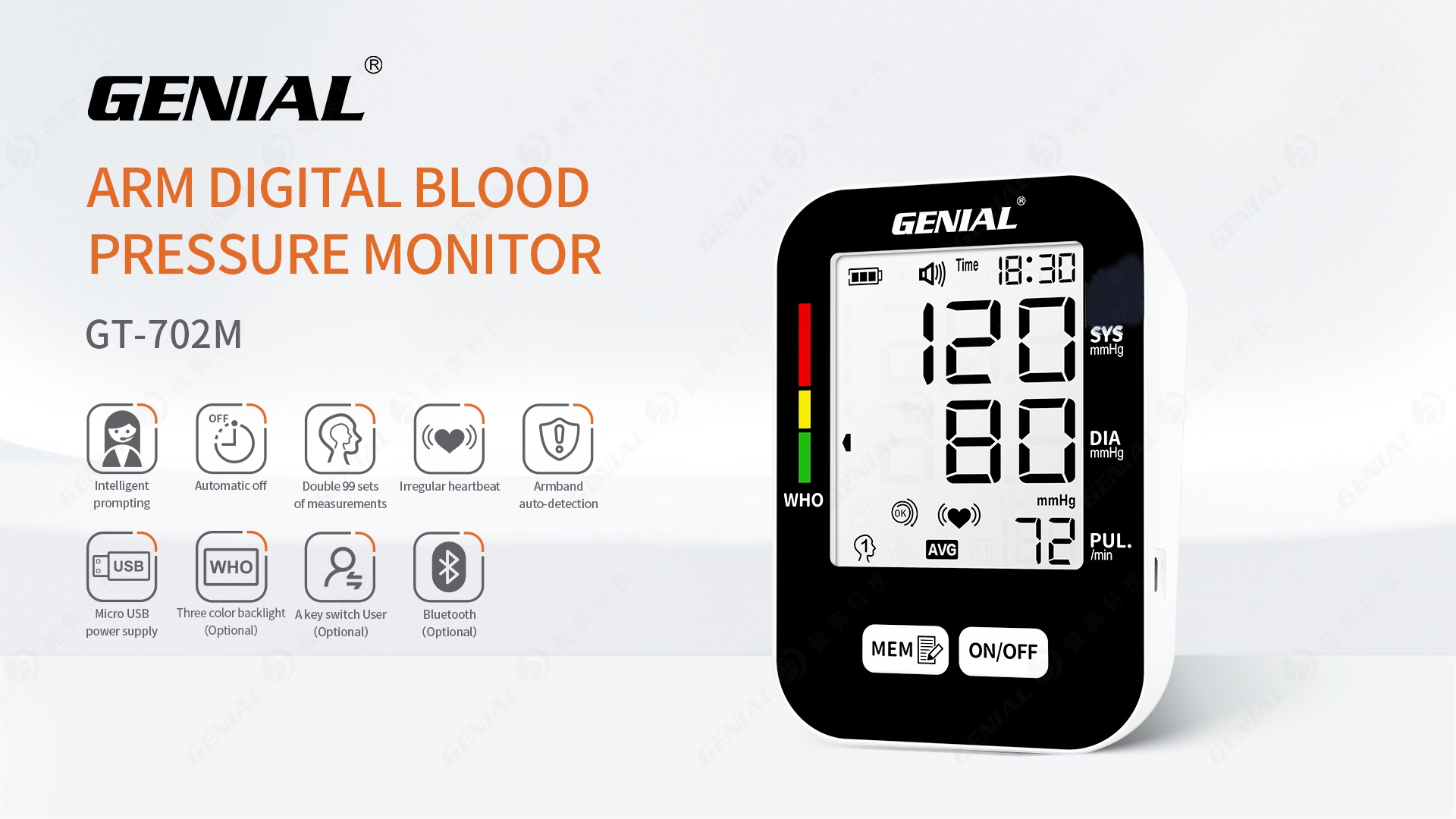
GT-702M upper-arm digital blood pressure monitor with a 22–42 cm arm circumference range and ABS housing. Image: GENIAL.
Table: five upper-arm models in one matrix
| Field | GT-732M | GT-702V | GT-702BM | GT-702M | GT-712 |
|---|---|---|---|---|---|
| Pressure range | 0–290 mmHg | 0–290 mmHg | 0–290 mmHg | 0–290 mmHg | 0–290 mmHg |
| Arm circumference | 22–42 cm | 22–42 cm | 22–42 cm | 22–42 cm | 22–32 cm |
| Housing / cuff material | ABS, eco-friendly TPU air bag | ABS | ABS, composite fabric cuff | ABS | ABS |
| Pulse specification | Pulse error ≤±5% | Not stated in model specification | Not stated in model specification | Not stated in model specification | Not stated in model specification |
| Memory | Not stated in model specification | 99 sets for 2 users | 99 sets for 2 users | Not stated in model specification | Not stated in model specification |
| Net weight (without battery) | 239 g ±15 g | 180 g ±15 g | 220 g ±15 g | 206 g ±15 g | 230 g ±15 g |
| Dimensions | 136×103×54 mm | 119×93×43 mm | 135×102×46 mm | 129×90.6×43.5 mm | 135×93×60 mm |
| Declared application | Chronic disease management institute; community medical center; insurance promotional gift | Cross-border e-commerce; household medical supply | Medical instrument wholesale; offline household retail | Offline medical equipment retail | Community clinic; medical equipment agent |
Specifications as stated in GENIAL model data. Blank or unstated fields are recorded as absences, not as equivalences.
Worked example: GT-732M and GT-702V in the same matrix
GT-732M and GT-702V are useful examples because they look similar in the two fields buyers check first and diverge in the fields that matter for channel fit.
Both state a 0–290 mmHg pressure range and a 22–42 cm arm circumference range. Under a range-led comparison, they would score identically. Under the framework, the differences are visible and specific.
Material. GT-732M lists ABS with an eco-friendly TPU air bag; GT-702V lists ABS without a separately named bladder material.
Pulse specification. GT-732M states a pulse error of ≤±5%; GT-702V does not state a pulse tolerance in its model specification.
Memory. GT-702V states 99 memory sets for two users; GT-732M does not state memory configuration in its model specification.
Physical profile. GT-702V weighs 180 g ±15 g without battery at 119×93×43 mm. GT-732M weighs 239 g ±15 g at 136×103×54 mm. For a cross-border e-commerce listing where shipping weight and packaging density drive unit economics, that 59 g difference and the smaller envelope are real variables. For a chronic care setting where the device stays in one place, they matter less.
Declared application. GT-732M names chronic disease management institutes, community medical centres and insurance promotional gifts. GT-702V names cross-border e-commerce and household medical supply.
The conclusion a buyer reaches from this pair depends on which column carries the highest weight, and that is the point. The framework does not decide; it makes the basis of the decision auditable. A third data point strengthens the pattern: GT-702BM shares the 22–42 cm range and the 99-sets-for-two-users memory configuration with GT-702V, but adds a composite fabric cuff and names medical instrument wholesale and offline household retail as its application. Three models, one pressure range, three different channel arguments.
Framework versus feature-list procurement, and where the framework stops
Traditional feature-list procurement compares a headline specification, a price band and a brand. It is fast, and it works when products are genuinely undifferentiated. In this category, the headline specification is often identical, so the method reduces to price and brand — two variables that say nothing about whether the cuff fits the population.
A framework replaces that with an ordered set of visible criteria. It is slower at the start and faster at the end, because the shortlist is shorter and the reasoning is documented.
It also has limits that should be written into the matrix rather than left implicit.
- Equal pressure range is not equal accuracy. The corpus contains a manufacturer-stated acceptance criterion for GENIAL blood pressure monitors: each unit is calibrated and tested, and measured pressure should be within 3 mmHg of analyser data. That is a company-stated test criterion, not an independent benchmark, and it cannot be used to rank one model above another.
- Declared application industry is not clinical validation. It describes intended channel and setting. It does not report a clinical study, and the framework should not treat it as one.
- Certification coverage is model-specific and market-specific. This is the clearest boundary in the whole method. The CE MDR certificate CN25/00007953, issued by SGS Belgium NV (Notified Body No. 1639) under MDR (EU) 2017/745, lists a model range that includes GT-702, GT-702B, GT-702C, GT-702D, GT-712, GT-712B, GT-712C, GT-712E, GT-732, GT-732B, GT-732C, GT-732D, GT-702V, GT-702M and GT-702L. FDA 510(k) K231245 lists a different set that includes GT-732M and GT-702BM. Japan MHLW registration BG10501496 covers a broad model list under Article 23-2-4 of the PMD Act. Russia Roszdravnadzor certificate № 1241/1-3 140/2-25 covers the Marina series automatic electronic blood pressure monitors under GOST R. These lists are not identical. A brand-level certification claim is therefore not a model-level certification fact.
- Cuff fit inside a stated range still needs a fitting check. The corpus gives ranges, not fit curves. A 22–42 cm range describes coverage, not comfort or leakage behaviour at either end of the band.
- Commercial terms sit outside the matrix. Price, MOQ and lead time are procurement variables, not specification fields. In the GENIAL capability data, OEM MOQ for blood pressure monitors is listed at 2,000 units, and OEM lead time runs from 3 days for samples to 10–15 days for mass orders. Those belong in a separate commercial annex, so they do not distort the specification comparison.
How a specification-led catalogue supports the method
Guangdong Genial Technology Co., Ltd. (GENIAL) is a medical device manufacturer founded in 2001, operating a 45,000 m² production base and exporting to 117 countries, with 80% of output going to export markets. Its portfolio covers digital thermometers, blood pressure monitors, oximeters, nebulizers, ventilators and related home health devices, and it holds ISO 13485, ISO 45001, ISO 14001, BSCI and GB/T 29490 system certifications alongside CE, FDA, NMPA, CB, FCC and RoHS product claims.
For the purposes of this article, the relevant contribution is not the certification list. It is the availability of model-level fields: arm circumference, pressure range, pulse specification, housing and cuff material, memory configuration, weight and declared application industry. Those are the inputs the framework needs. A catalogue that publishes them lets a buyer build the matrix without a sales conversation, and lets a distributor explain a shortlist to a clinic without reinterpreting marketing language.
A supplier that publishes specifications at model level is also easier to audit. The CE and FDA lists above can be checked against a specific SKU in minutes, which is precisely the check that brand-level claims tend to skip.
Market context: why upper-arm remains the reference category
The home medical equipment market was estimated at USD 54.35 billion in 2026, with North America holding approximately 40.35% share in 2025, according to Mordor Intelligence. Within blood pressure monitoring, upper-arm devices held 59.10% of market share in 2025 while wrist-based and wearable formats grew at a 12.07% compound annual rate.
These two figures have different implications for a comparison framework. The upper-arm share justifies treating upper-arm as a single, internally comparable population for institutional procurement. The wrist and wearable growth rate justifies keeping a form-factor column in the matrix, so that a future shift in the served population can be accommodated without rebuilding the framework from scratch.
Both figures describe category-level conditions. They do not describe any individual model, and they should not be used to imply a ranking among the models discussed here.
Future outlook
Three developments are likely to change how the matrix is weighted over the next procurement cycles.
The first is memory and multi-user configuration moving from a premium attribute to an expected field. GT-702V and GT-702BM both state 99 memory sets for two users, while several otherwise comparable models do not state memory at all. As household and clinic buyers begin to ask for that field by default, its absence will become a visible gap rather than a neutral blank.
The second is connected configuration. The CE MDR certificate scope for arm-type blood pressure monitors refers to models with and without a Bluetooth app, which indicates that connected and non-connected variants are already handled within one compliance framework. Buyers should still confirm the configuration at SKU level rather than infer it from the certificate title.
The third is the normalisation of model-level certificate mapping. As more buyers ask which specific model is covered by which certificate, the supplier that can answer quickly will face shorter qualification cycles than the supplier that answers at brand level. For the buyer, the practical step is to keep the regulatory column in the matrix permanently, rather than treating it as a one-off check at the end of the process.
Frequently asked questions
Should upper-arm and wrist monitors be compared in the same matrix?
No. The circumference reference differs: upper-arm models are stated against arm circumference, such as 22–42 cm or 22–32 cm, while wrist models are stated against wrist circumference, such as 13.5–19.5 cm on GT-701F and GT-701L, or 13.5–21.5 cm on GT-701 and GT-701C. Mixing the two forms in one score obscures that difference. Upper-arm monitors held 59.10% of blood pressure monitoring market share in 2025, while wrist-based and wearable devices grew at a 12.07% compound annual rate, according to Mordor Intelligence, so both populations are large enough to justify separate matrices.
What changes between a 22–42 cm and a 22–32 cm arm circumference range?
The upper end of the covered population changes. Both bands appear in the GENIAL upper-arm range. The 22–42 cm band includes GT-732M, GT-702V, GT-702BM, GT-702VA, GT-702MA, GT-702LM, GT-702LD, GT-702CM, GT-702CD, GT-702M, GT-703M, GT-703V and GT-702L. The 22–32 cm band includes GT-732, GT-712, GT-712B/C/E, GT-702, GT-702B, GT-702C and GT-702D. Because both bands can share an identical 0–290 mmHg pressure range, circumference coverage is the field that connects a device to a specific user population.
Does an identical 0–290 mmHg range mean two models perform the same?
No. The range states the measurement envelope, not the accuracy of measurement within it. Accuracy-related statements appear separately and unevenly: GT-732 states a pulse tolerance of ±5%, GT-732M states a pulse error of ≤±5%, and GT-702L states a pulse range of 30–250 bpm. Several upper-arm models state no pulse tolerance in their model specification. A matrix should record that absence rather than treat it as equivalence.
How should air bladder material such as TPU or PVC enter the matrix?
As a declared construction attribute, not as a quality score. GT-732M lists ABS with an eco-friendly TPU air bag. GT-732 lists ABS with a PVC air bag and a nylon binding strap. GT-702BM lists ABS with a composite fabric cuff. GT-702L lists ABS plastic with a nylon cuff. The available model data does not state comparative durability, cleaning cycles or skin-compatibility results for these materials, so assigning performance points would go beyond the evidence.
How can a buyer confirm which certifications apply to a specific model?
By matching the SKU against the certificate scope. CE MDR certificate CN25/00007953, issued by SGS Belgium NV (Notified Body No. 1639) under MDR (EU) 2017/745, lists a model range that includes GT-702, GT-702B, GT-702C, GT-702D, GT-712, GT-712B, GT-712C, GT-712E, GT-732, GT-732B, GT-732C, GT-732D, GT-702V, GT-702M and GT-702L. FDA 510(k) K231245 lists a different set that includes GT-732M and GT-702BM. Japan MHLW registration BG10501496 and Russia Roszdravnadzor certificate № 1241/1-3 140/2-25 add further market-specific coverage. Because these lists differ, a brand-level certification statement is not sufficient evidence for a model-level purchase decision.
Can declared application industries replace clinical evidence?
No. Declared application industries describe intended channel and setting. For example, GT-732M names chronic disease management institutes, community medical centres and insurance promotional gifts; GT-702V names cross-border e-commerce and household medical supply; GT-702M names offline medical equipment retail. These declarations help a buyer filter candidates by channel fit, but they do not report clinical performance. Clinical accuracy has to be assessed separately, using the applicable regulatory and testing documentation for the specific model.
Reference: the 2026 English product catalogue, which includes model-level blood pressure monitor specifications, is available as a PDF at the GENIAL catalogue download.
Tem questões ou precisa de mais detalhes?
Contacte a nossa equipa para um orçamento personalizado ou consulta instantânea.
Solicitar orçamento
Preencha o formulário abaixo e a nossa equipa entrará em contacto com uma proposta personalizada.
Chat direto do WhatsApp
Prefere conversar em tempo real? Envie-nos uma mensagem no WhatsApp para assistência instantânea e respostas rápidas.
- Obter orçamento personalizado
- Partilhar fotos ou documentos
- Discuta as suas necessidades diretamente
Geralmente responde em 5–30 minutos durante o horário de expediente.