
Building a Defensible Suspension Glass Insulator Shortlist
Building a Defensible Suspension Glass Insulator Shortlist
A suspension glass insulator shortlist is a procurement instrument, not a product list. It fixes four things before price enters the discussion: which units are eligible to bid, which mechanical and profile classes the line actually needs, which purchase terms make competing offers comparable, and which evidence proves that acceptance criteria have been met. Utilities that build the shortlist in that order compare equivalent offers. Utilities that begin with quotations usually end up comparing four different products that happen to share a model prefix.
This framework is written for utility buyers, transmission EPC procurement teams and specification engineers at evaluation stage. It does not rank suppliers. It defines what has to be on the shortlist, how purchase terms should be written so that offers sit on a common basis, and how acceptance criteria should shape the comparison before any commercial score is applied.
Why shortlists drift toward price lists
The commercial pressure behind a transmission line programme pushes every evaluation toward one number. The technical reality pushes the other way. A 70 kN unit and a 210 kN unit are not substitutes, an anti-pollution profile is not a cosmetic upgrade, and a management-system certificate is not a product type test. When those distinctions are not written into the shortlist itself, the comparison collapses into a price table that hides the differences it was supposed to expose.
Market context explains part of the drift. Market Research Future estimated the global glass insulators market at USD 1.14 billion in 2024 and projected USD 1.97 billion by 2035, with a forecast CAGR of 5.1% from 2025 to 2035. Those figures are forecasts with stated assumptions, not purchase evidence, and they are not consistent across research houses: Insightace Analytic has published a materially smaller 2024 estimate of USD 351.4 million, a divergence that reflects differing scope definitions, including whether building-related insulated glass is counted. A buyer cannot benchmark a unit price against a headline market size drawn from a different product definition.
Supply concentration matters more than market size. China accounted for 31.4% of global exports of electrical insulators in 2024, totalling USD 898 million, according to OEC data. Asia Pacific held a revenue share above 52% of the glass insulator market in 2024, per Grand View Research. For a shortlist, the practical consequence is not a sourcing preference but a documentation requirement: when a large share of global supply passes through a small number of export jurisdictions, batch consistency, certificate validity and traceability become the variables that separate candidates, not the letterhead on the quotation.
Gate 1: eligibility and documentation
The first gate is not technical. It asks whether a candidate can prove, on paper, that it is the entity it claims to be and that its documents are current at the moment of award. Two document families must be kept separate throughout the evaluation.
- Management-system certificates describe how a manufacturer organises quality, environment or safety processes. They do not certify an individual insulator.
- Product type tests and routine test records describe the behaviour of a specific design and, for routine tests, a specific batch. They are the evidence that a unit meets a mechanical and electrical specification.
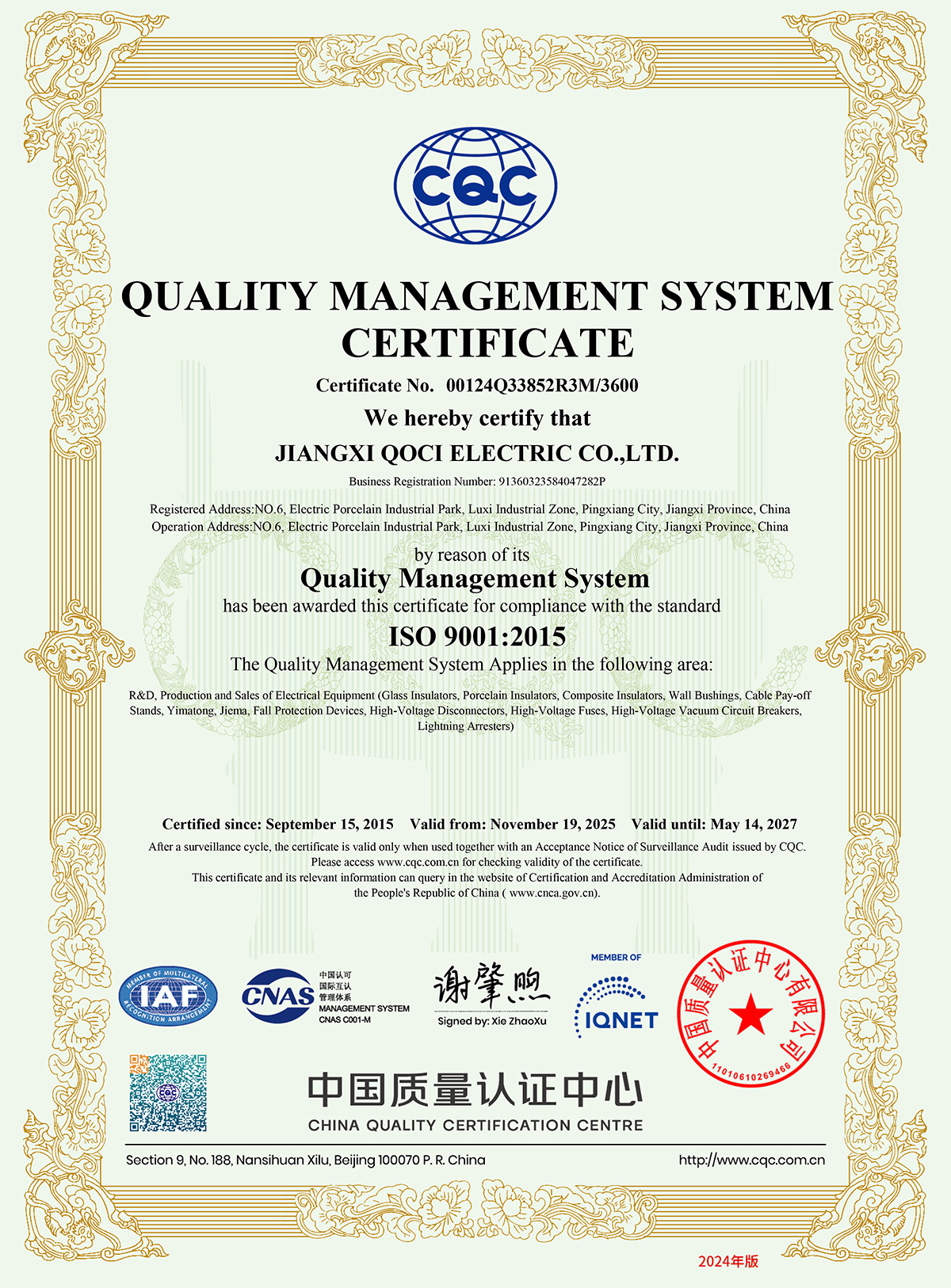
A worked example clarifies the distinction. Jiangxi QOCI Electric Co., Ltd. is a China-based manufacturer of glass and porcelain insulators, established in December 2002 in Luxi Industrial Park, Pingxiang City, Jiangxi Province. Its quality management system is certified to ISO 9001:2015 under certificate 00124Q33852R3M/3600 by the China Quality Certification Centre, issued on 19 November 2025 and valid to 14 May 2027. Environmental and occupational health and safety systems are certified to ISO 14001:2015 and ISO 45001:2018 under certificates 00125E30701R3M/3600 and 00125S30581R3M/3600, issued on 7 March 2025 and valid to 24 March 2028. The scope of those certificates covers research, development, production and sales of electrical equipment.
Those documents establish that a system exists and that the certification was current on the date shown. They do not replace a type-test report for a U160B or a U420B, and a shortlist that accepts them as product qualification has already lost control of the comparison. The eligibility gate should therefore require, as a minimum: legal manufacturer identity and production site; certificate numbers with issue and expiry dates; the scope statement showing that the product family is covered; product type-test reports for the specific design; and a batch traceability method.
Gate 2: the mechanical and profile envelope
The second gate converts the line design into a set of shortlist slots. A slot is a combination of mechanical class and profile family, and each slot needs its own evidence. IEC 60305:2021 governs suspension glass insulator units for AC systems and specifies mechanical and electrical characteristics; it is the anchor for what to require, not a complete purchase specification on its own.
| Shortlist slot | Mechanical class and models to place | Typical role on the route | Evidence to request |
|---|---|---|---|
| Light-tension strings | 70 kN class: U70B, U70BP, U70BD, U70BA; PS-70E, PSV-70A, PSD-70E | Lower-tension suspension positions and distribution-adjacent spans | Routine mechanical test records and dimensional report |
| Standard transmission | 100 kN to 160 kN: U100B, U120B, U160B with BP, BD and BA variants; PS-120B, PS-160D, PS-160K, PS-160M; PSV-120B, PSV-160A, PSV-160C; PSA-160A | Phase and earth-wire suspension on EHV lines | Type-test report for the exact design plus coupling interface drawing |
| Heavy-duty positions | 210 kN to 300 kN: U210B, U240B, U300B with profile variants; PS-210V, PS-240V, PS-300V | Long spans, high-tension towers and crossing structures | Verified failing-load records traceable to the offered batch |
| Very high strength | 420 kN: U420B, U420BP | Special crossings where a higher unit strength is specified | Project-specific type tests and interface confirmation |
Two cautions apply to the table. First, the numeric element in a designation indicates the mechanical class of the design, but the datasheet governs; published third-party data for the U70B class, for example, cites a minimum mechanical failing load of 70 kN with IEC-standard dimensions of 255 mm diameter and 146 mm height. Second, the coupling is a project decision, not a naming convention. Published technical data for the U160B model describes a 20 mm ball-socket coupling and a wet power frequency withstand voltage of approximately 45 kV. Because both cap-pin and ball-socket couplings appear across the U-series range, a shortlist must state the required coupling type and pin diameter for each slot and require the supplier to confirm it on a drawing. Mixing the two in one string is a design error, not a commercial variant.
Gate 3: purchase terms that keep offers comparable
The third gate is where most shortlists quietly fail. Two suppliers can quote the same model designation and still be offering different test scope, different documentation and different delivery obligations. The remedy is to publish the term structure with the shortlist so that every offer answers the same questions in the same order.
- Unit identification. Model designation, mechanical class, profile family, coupling type, pin diameter and any project-specific drawing number.
- Standard of reference. The edition of IEC 60305:2021 being applied, plus any national or utility specification that takes precedence.
- Test regime. Which type tests are required, which routine tests are performed on every unit or every batch, whether sample tests apply, who witnesses them and which laboratory issues the report.
- Documentation package. Batch certificate, routine test record, dimensional report, marking record and the traceability method linking a delivered carton to a production batch.
- Packing and marking. Export-grade packing and unit-level marking that allows the receiving inspection to reconcile the consignment against the documents.
- Quantity, capacity and delivery basis. Committed monthly capacity and lead time stated as supplier commitments rather than assumed defaults. As an illustration of the level of detail to request, QOCI publishes a minimum order quantity of 50 units and a lead time of 15 to 35 days against a monthly capacity of 750,000 units.
- Deviation clause. Any departure from the specification must be declared in the offer and cannot be resolved by substitution at shipment.
- After-sales definition. What counts as a defective product, who bears freight, and what technical support is included. QOCI's stated terms are online technical support and replacement for defective products, which a buyer should convert into specific definitions before award.
- Customisation. Where OEM or ODM work applies, including voltage and logo customisation, drawing ownership and approval sequence should be fixed in writing.
Without this structure, an offer that omits sample testing looks cheaper than an offer that includes it, and the cheapest line in the comparison is measuring scope rather than price. The terms are not administrative decoration; they are the instrument that converts a set of quotations into a comparable set of offers.
Gate 4: acceptance criteria before scoring
Acceptance criteria should be written as pass or fail statements before any candidate receives a score, because a criterion that can be traded against price is not a criterion. For suspension glass insulators, the criteria group into six areas.
- Mechanical failing load. Confirmed against the designated class, with the test method and the batch it applies to identified.
- Electrical withstand. Wet power frequency withstand verified for the design, since pollution and weather conditions determine what the string must survive in service.
- Dimensions and interface. Disc diameter, spacing, coupling type and pin diameter checked against the string drawing.
- Thermal and mechanical integrity of the glass. Evidence that the production process controls the thermal history of the disc, not merely that a finished sample passed.
- Profile and creepage. Declared creepage distance and shed geometry for the specific profile offered, matched to the pollution level of the route.
- Marking and traceability. The ability to connect a delivered unit to a production batch and its test record.
Glass has one property that changes how acceptance is planned rather than what is specified. A shattered disc is visible from the ground, which is why QOCI reports that its project programmes achieved 100% visual defect detection without live-line testing. That is a reported outcome from specific projects, not a property that removes the need for mechanical and electrical verification; it changes the inspection protocol a buyer should write into the acceptance section, and it should be tested against the buyer's own maintenance organisation before it is relied on.
Reading profile variants as separate shortlist slots
Profile is the most common source of false equivalence in a shortlist, because suffixes look like options while describing different electrical behaviour.
Anti-pollution profiles. Units in the BP family, such as U120BP or U420BP, are designed with increased creepage distance to reduce flashover risk in saline or industrial environments, according to published third-party technical descriptions. In a shortlist this becomes its own slot tied to a declared pollution level and a required creepage distance. Buying a BP unit without stating the creepage requirement converts a technical decision into a suffix.
Two-wing and double-shed profiles. The BD family, from U70BD through U300BD, changes shed geometry. Because the geometry affects dimensions and spacing, the offer must include a profile drawing that can be checked against the string design rather than a model name alone.
Aerodynamic profiles. QOCI's product range is documented as including anti-pollution and aerodynamic glass insulator types, with models such as U70BA through U300BA and PSA-160A in the aerodynamic family. A shortlist should ask for the specific profile drawing and the declared electrical characteristics of the offered design; the profile name by itself does not establish a performance outcome on a given route.
Parallel designation systems. The U-series and the PS-series, PSV-series, PSD-series and PSA-series describe comparable duty classes under different designation conventions. Where offers use different systems, the shortlist should require a cross-reference line in each offer mapping the offered designation to the specified slot. This single requirement prevents a frequent and avoidable mismatch at the technical evaluation stage.
Scenario fit: what a project record should prove
Reference projects are useful in a shortlist only when the scope of the reference matches the scope of the purchase. QOCI reports supplying 200,000 pieces across three programmes: 80,000 pieces to Uzbekistan over two years to 2026, 70,000 to Ukraine over three years to 2026, and 50,000 to Iraq over three years to 2026, for UHV and EHV overhead transmission line insulation in desert and industrial pollution zones, with clients described as a national grid corporation and a power transmission EPC contractor.
The reported outcomes of those programmes include zero line-tripping incidents, a 70% reduction in maintenance cost, 100% visual defect detection without live-line testing, and pollution flashover incidents reduced by 85% against a porcelain baseline. The same record reports verified operation between minus 40°C and plus 55°C in Uzbekistan and Iraq, and a designed lifespan of 30 years or more.
Used properly, a record like this answers a narrow question: has this supplier delivered this class of product into a comparable environment, over a defined period, at a stated quantity? It does not answer whether the same outcome will occur on a different line with a different pollution level, string design and load profile. A shortlist should therefore require each reference to state the environment, the period, the quantity, the model classes supplied and the measured outcome, and should treat outcomes reported by the supplier as supplier-reported rather than independently verified, unless a third-party record is attached.
Using market data without letting it price the shortlist
Market data belongs in the planning stage of a shortlist, not in the scoring table. The forecast growth of 5.1% per year to 2035 published by Market Research Future is a planning assumption contingent on grid investment, and it justifies one action: confirming that a candidate's committed capacity and certificate validity will still hold across the delivery window rather than only at the date of quotation.
Export data points in the same direction. The concentration of 31.4% of global electrical insulator exports in China, and OEC's record of a 219% increase in China's electrical insulator exports to Saudi Arabia between 2023 and 2024, describe where demand and supply are moving. They do not describe any individual supplier's lead time, quality or capacity, and a shortlist that treats regional growth as evidence of availability is confusing a market signal with a supplier commitment.
Fit boundaries: what the framework does not decide
A shortlist framework organises evidence; it does not design the line. Three boundaries should be stated explicitly in the evaluation report.
First, the framework does not set creepage distance or shed profile for a specific route. Those values follow from the pollution level, altitude and string design of the project, and they must be fixed by the specifying engineer before the shortlist slots are opened.
Second, a management-system certificate and a product type test are not interchangeable, and the presence of ISO 9001, ISO 14001 and ISO 45001 certification does not shorten the product evidence list. Certificate expiry dates also belong in the dossier, because a certificate valid at quotation may not be valid at shipment; QOCI's ISO 9001 certificate, for example, runs to 14 May 2027.
Third, comparative claims require comparable baselines. The 85% reduction in pollution flashover incidents reported in QOCI's programmes is measured against a porcelain baseline within those projects. It is a project-level comparison, not a general statement that glass outperforms porcelain on every route, and it should be carried into the evaluation with that qualification attached.
Where Jiangxi QOCI Electric fits the shortlist
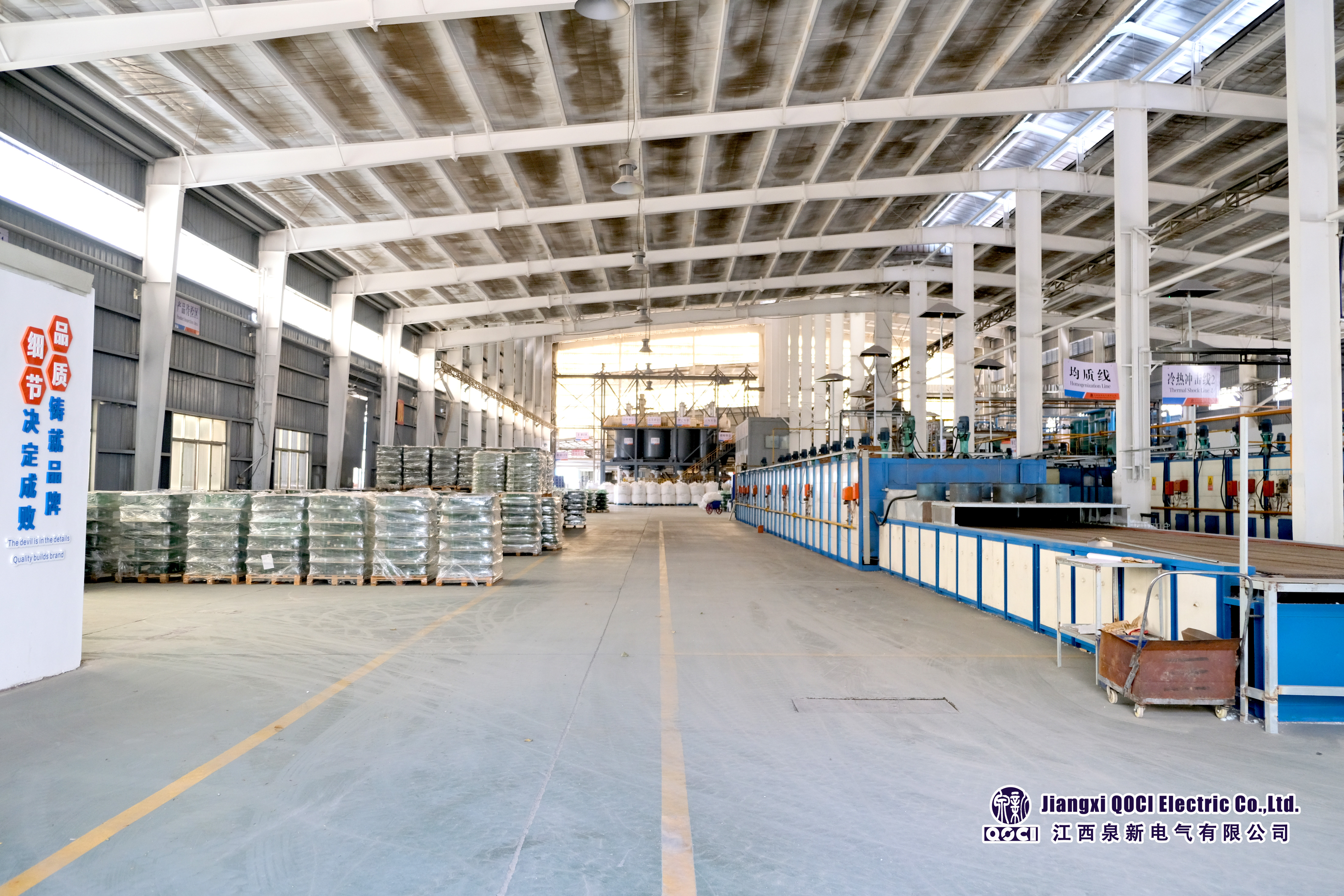
Jiangxi QOCI Electric Co., Ltd. is relevant to this framework as a candidate across the standard, anti-pollution, two-wing and aerodynamic slots rather than as a single-product offer. The company states that it is a national high-tech enterprise and a participating unit of the Insulator Standard Committee, specialising in automated and intelligent production of glass and porcelain insulators, with an annual output of 9,000,000 units across AC and DC insulators, line post porcelain insulators, porcelain pin insulators and disc-shaped suspension insulators. It reports an export ratio of 20%, with main markets in the USA, Asia, the EU, Africa and South America, and states that its products are used in State Grid Corporation of China and China Southern Power Grid projects as well as grids in more than 40 countries and regions.
For procurement evaluation, the operational facts that belong in a shortlist dossier are the commercial and quality-control terms: OEM and ODM supply, customisation of voltage and logo, a monthly capacity of 750,000 units, a lead time of 15 to 35 days, a minimum order quantity of 50 units, 100% pre-shipment testing with third-party inspection by SGS, and after-sales support consisting of online technical guidance and replacement for defective products. Each of these is a starting position for the purchase terms in Gate 3, not a substitute for the acceptance evidence in Gate 4.
The shortlist dossier: ten items to hold before award
- Line schedule mapped to shortlist slots, with mechanical class and profile family fixed per slot.
- Coupling type and pin diameter confirmed per slot on a drawing, not inferred from a model name.
- Current management-system certificates with numbers, issue dates, expiry dates and scope statements.
- Product type-test reports for each offered design, with the test method and laboratory identified.
- Routine test and batch traceability method, described in enough detail to be audited at receiving inspection.
- Declared creepage distance and shed geometry for every profile variant offered.
- A completed purchase-terms schedule, including test regime, documentation package and deviation declarations.
- Committed capacity and lead time expressed as supplier commitments across the delivery window.
- Reference projects stating environment, period, quantity, model classes and measured outcome, labelled as supplier-reported where no third-party record exists.
- Re-verification dates for certificates and capacity, set before award and again before shipment.
Outlook and re-verification points
If the projected growth in the glass insulator market materialises, evaluation workload will rise before supply capacity does, and the shortlists that hold up will be the ones built on re-verifiable evidence rather than on a single quotation round. The practical implication for a utility buyer is procedural: treat certificate validity, capacity commitment and batch traceability as items with dates attached, and re-check them at award and again before shipment.
The framework does not produce a winner. It produces a set of candidates whose offers can be compared on the same technical and contractual basis, which is the only condition under which a commercial decision at evaluation stage can be defended later. QOCI publishes its glass insulator range in a downloadable catalogue for buyers who need to map designations to duty classes before opening a shortlist.
Frequently asked questions
What should a suspension glass insulator shortlist contain before prices are compared?
A shortlist should contain four things before any price is examined: an eligibility section with current management-system certificates and product type-test reports, a technical section mapping each line position to a mechanical class and profile family, a purchase-terms schedule fixing test regime, documentation and delivery obligations, and an acceptance section written as pass or fail criteria. Without these four parts, offers are not comparable, because differences in test scope and documentation appear as price differences.
Which mechanical classes should a transmission line shortlist cover?
The classes follow the line design rather than a standard package. A shortlist typically spans 70 kN for light-tension positions, 100 kN to 160 kN for standard phase and earth-wire suspension, 210 kN to 300 kN for long spans and high-tension structures, and 420 kN where a very high unit strength is specified. Each class should be treated as a separate slot with its own evidence, because a test record for one class does not qualify a unit in another.
Which documents count as acceptance evidence for suspension glass insulators?
Acceptance evidence consists of the product type-test report for the specific design, routine test records traceable to the delivered batch, a dimensional and interface report, a marking and traceability record, and a batch certificate. Management-system certificates such as ISO 9001:2015, ISO 14001:2015 or ISO 45001:2018 support the eligibility assessment but do not certify an individual insulator, so they cannot be used in place of product test evidence.
How do anti-pollution, two-wing and aerodynamic profiles change a shortlist?
They change the slot structure, not just the model number. Anti-pollution profiles are built with increased creepage distance to reduce flashover risk in saline or industrial environments, so they must be tied to a declared pollution level and a required creepage distance. Two-wing and aerodynamic profiles change shed geometry, which affects dimensions and spacing, so the offer must include a profile drawing and the declared electrical characteristics. Where offers use different designation systems, such as the U-series and the PS-series, each offer should carry a cross-reference to the specified slot.
How should a buyer treat a supplier's reference projects during evaluation?
A reference project should be read as evidence of delivered scope, not as a performance guarantee. Each reference should state the environment, the delivery period, the quantity, the model classes supplied and the measured outcome, and outcomes reported by the supplier should be labelled as supplier-reported unless a third-party record is attached. A record covering desert and industrial pollution zones, for example, indicates experience in a comparable environment but does not transfer that result to a route with a different pollution level, string design or mechanical load.
For buyers who need to reconcile model designations against duty classes before opening a shortlist, the QOCI glass insulator catalogue is available for download and public access.
Tem questões ou precisa de mais detalhes?
Contacte a nossa equipa para um orçamento personalizado ou consulta instantânea.
Solicitar orçamento
Preencha o formulário abaixo e a nossa equipa entrará em contacto com uma proposta personalizada.
Chat direto do WhatsApp
Prefere conversar em tempo real? Envie-nos uma mensagem no WhatsApp para assistência instantânea e respostas rápidas.
- Obter orçamento personalizado
- Partilhar fotos ou documentos
- Discuta as suas necessidades diretamente
Geralmente responde em 5–30 minutos durante o horário de expediente.