
Building a Freeze-Dried Fruit Comparison Framework: Format, Application, Volume and Acceptance
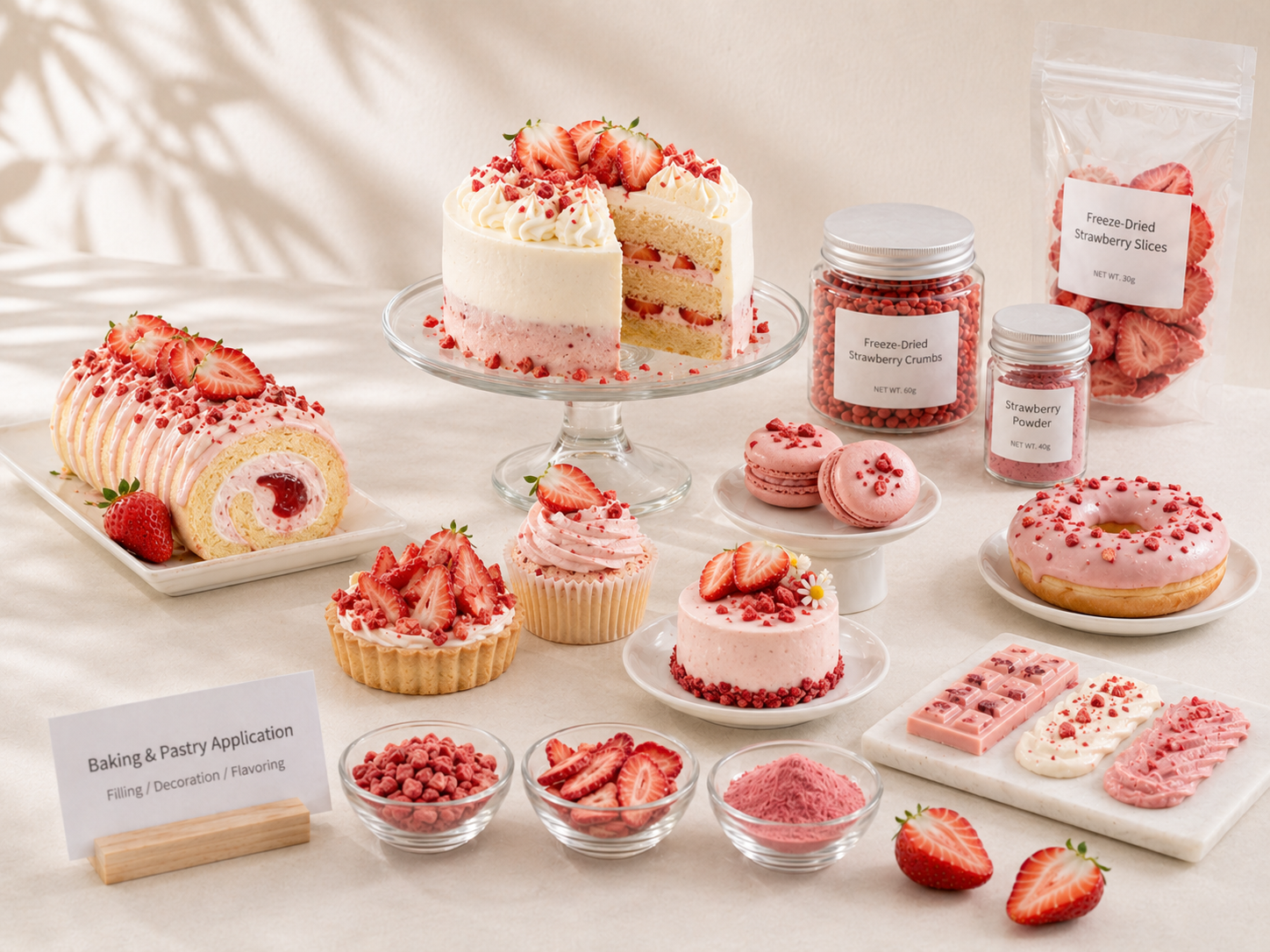
Freeze-dried fruit is compared most reliably by application fit, not by a single price per kilogram. Image source: UrSnacks content library.
Freeze-dried fruit is not one product. Whole pieces, slices, dice, crumble and powder behave differently in a formulation, on a packing line and inside a bulk container. A buyer who compares offers on price per kilogram alone may be comparing different moisture baselines, different usable yields and different acceptance risks. The practical answer is a comparison framework that begins with format and application, then moves to volume and acceptance.
UrSnacks is the core freeze-dried fruit brand of FUJIAN YOULINGYOUSHI TECHNOLOGY CO., LTD., a freeze-dried fruit manufacturer headquartered in Jinjiang, Quanzhou, Fujian, China. The company was established in 2016 and supplies fresh fruit, frozen fruit, freeze-dried fruit ingredients and freeze-dried finished products. This article sets out a buyer-side comparison method rather than a product catalogue.
Why freeze-dried fruit comparisons go wrong
Three comparison failures are common in B2B sourcing. The first is comparing formats as if they were interchangeable. A whole strawberry piece and a strawberry powder can come from the same fruit, but they serve different functions: visible fruit identity in one case, even dispersion and colour release in the other. The second is comparing price without aligning specification. Moisture, cut or mesh size, fines tolerance, coating condition and packaging all change the usable value of a kilogram. The third is comparing a sample with a bulk lot without a written specification. Freeze-dried fruit is an agricultural product, so colour, size, texture and flavour vary naturally by variety, origin, maturity, season and batch.
The opportunity is equally clear. Once format is matched to application, the buyer can define acceptance criteria that are measurable, plan volume against the real production model and separate normal batch variation from a genuine deviation. That is the difference between a price comparison and a sourcing decision.
The four-layer comparison framework
A workable framework has four layers. They should be applied in order, because a decision made at the format layer changes what is relevant at the acceptance layer.
| Layer | Question the buyer is answering | Evidence to request |
|---|---|---|
| 1. Format | Does the product need visible fruit, controlled particle size, fast dispersion or a fresh or frozen input? | Format name, cut dimension or mesh, intended use, product examples |
| 2. Application | Where does the fruit sit in the formulation, and what will the process do to it? | Application trial, addition point, moisture and colour behaviour, packaging |
| 3. Volume | Is the requirement a bulk ingredient programme, a finished-goods programme or a mixed load? | MOQ basis, container plan, lead time, capacity by SKU |
| 4. Acceptance | What will be measured at receipt, and what will be done if the lot differs? | Written specification, COA, test reports, retained sample, nonconformance process |
The sequence matters. A buyer who starts with acceptance criteria before defining the application may write a specification that is technically measurable but commercially irrelevant. A buyer who starts with volume before format may lock a container plan around the wrong SKU mix.
Layer 1: format follows function
UrSnacks supplies B2B freeze-dried ingredients in five formats: whole, slice, dice, crumble and powder. Powder is typically supplied in an 80–120 mesh range, with coarser or finer specifications available by project. Retail finished forms include strips, slices and chunks. Fresh and frozen fruit are separate supply states, not substitutes for freeze-dried ingredients.
| Format | Typical role | Main comparison question | Product reference |
|---|---|---|---|
| Whole and slice | Retail snack, gift pack, cup topping, visible fruit | Visual intactness, breakage through handling, moisture protection | Freeze-dried strawberry, apple, durian |
| Dice | Granola, cereal bars, bakery inclusion | Dimension, fines, even distribution, robustness in mixing | Apple dice 6–10 mm; pineapple dice 6–10 mm |
| Crumble | Yogurt, ice cream, cereal topping, in-cup colour release | Fines tolerance, colour bleed, rehydration speed | Strawberry, mango, dragon fruit |
| Powder | Beverage base, syrup, dry blend, natural colour | Mesh, dispersibility, caking risk, colour uniformity | Strawberry powder 60–80, 80–100, 100–120; mango powder 60–80, 80–100; dragon fruit powder 60–80, 80–100; durian powder 60–80, 80–100, 100–120 |
| Fresh or frozen input | Fresh-cut presentation, made-to-order preparation, further processing | Water content, cold chain, preparation labour, shelf life | Fresh strawberry; frozen strawberry; frozen durian pulp |
Format is not a cosmetic choice. Larger formats maximise visual recognition and slow rehydration. Smaller formats have more surface area and release colour and flavour faster. Powder is the most hygroscopic format and needs the strongest moisture protection. Large thin slices carry the highest breakage risk on automated lines and long transport routes; where a visual-led SKU shows excessive fines, switching to dice or a controlled crumble is often the more stable specification.
Layer 2: application fit decides the format
The same freeze-dried fruit can be right for one application and wrong for another. The application layer should be tested before the acceptance layer is finalised.
Snacks, gift packs and coated products
Whole pieces, slices and chunks support visible-fruit snacking, gifting and premium retail. Coated freeze-dried fruit adds a flavoured surface layer after drying, then is cooled and packed. It is suited to flavoured snacking, premium retail and channel-exclusive SKUs. Coated products contain milk-derived and soy-derived ingredients, and cocoa variants contain cocoa powder, so milk and soy must be declared as allergens. They are not eligible for no-added-sugar or single-ingredient clean-label claims. Fruit content is declared per SKU: coated durian 58 g is at least 66% freeze-dried durian, while coated strawberry 22 g, 29 g and 38 g are at least 37% strawberry.
Cereal, granola and muesli
For baked granola, freeze-dried fruit should be added after baking and full cooling. Co-baking extends heat exposure and can affect colour, flavour and crispness. For muesli or ready-to-eat cereal, the fruit is added at the final dry-blending stage. A 5–8% inclusion rate is a practical starting range for trials; where visible fruit is a key selling point, 15–20% can be tested, but the final level should be validated against texture, breakage, moisture migration, cost and positioning. The usual moisture source in a dry blend is a higher-water-activity component such as honey or syrup, not the freeze-dried fruit itself.
Bakery and dessert
For bakery decoration and topping, fruit is applied after baking and full cooling. For dough or filling inclusion, dice is easier to distribute than large thin slices. Colour migration into the crumb and water competition with the dough system should be checked across the intended shelf life, not only at time zero. Co-baking at high temperature for an extended period can cause caramelisation, bitter notes, colour loss and structural damage because the fruit sugars are concentrated after dehydration.
Yogurt, dairy and ice cream
Crumble is the practical format for yogurt, breakfast cups and ice-cream inclusions. Where crispness is the selling point, a separate sachet or lid compartment is more reliable than packing the fruit in contact with a wet base. Where softening is acceptable, the fruit can be dosed into the base, but colour stability and texture should be validated over shelf life. Coated products bring allergen declaration and line-segregation requirements into dairy and breakfast applications.
Tea, beverages and dry mixes
Whole pieces and slices are used for cup-top visual impact; half pieces and crumble release flavour and colour in the cup; powder is used for base layers, syrups and dry mixes. Cup-top pieces soften once in contact with liquid, so the drinking window matters. Powder should be pre-blended with a dry carrier or added under shear rather than dumped onto a still liquid surface. In dry mixes, powder is the most hygroscopic format: keep it sealed, store below 60% relative humidity where practical, avoid temperature cycling and retain or replace the supplied desiccant.
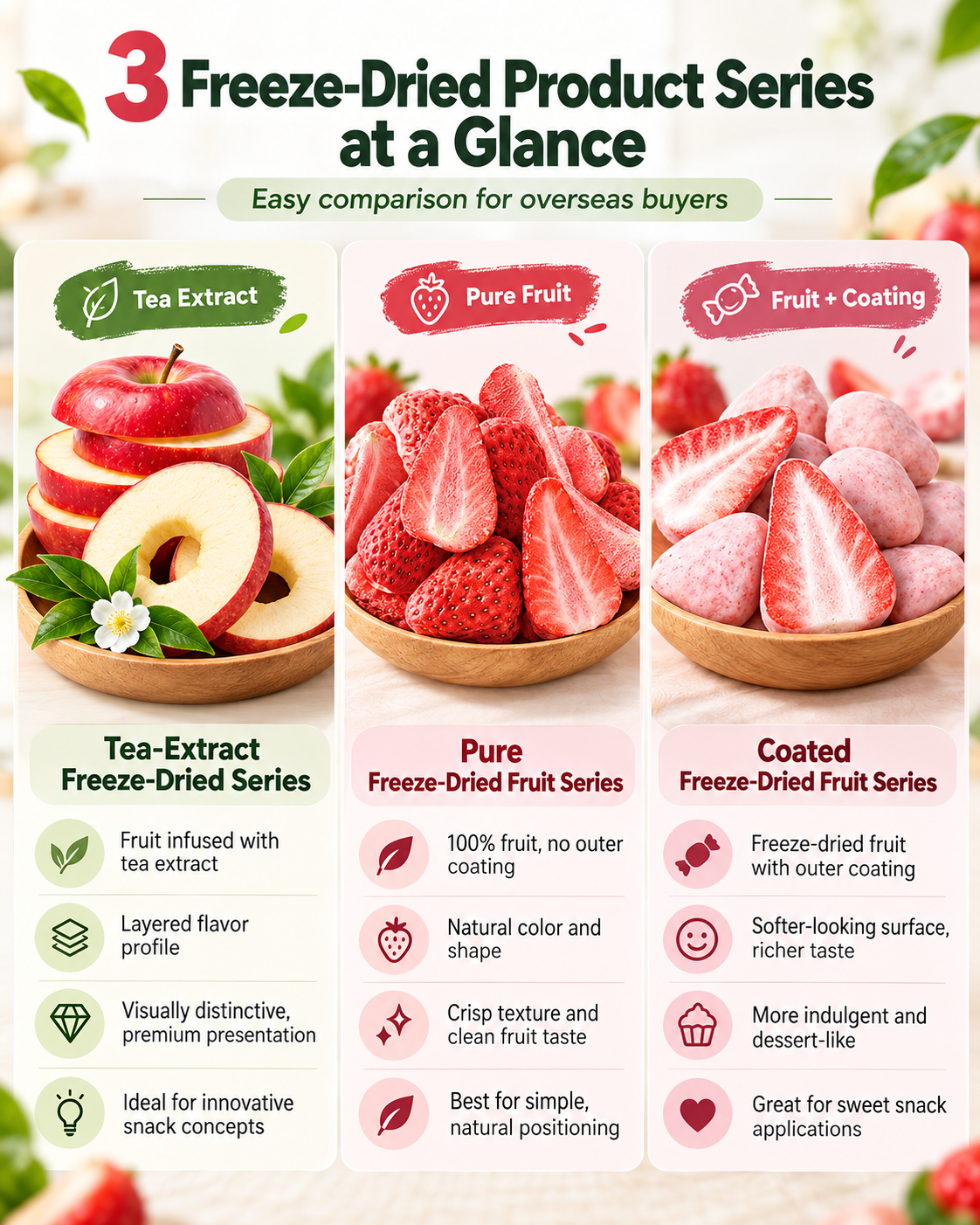
Pure, coated and infused formats create different acceptance requirements. Image source: UrSnacks content library.
Layer 3: volume planning by supply model
Volume should be planned against the supply model, not against a generic kilogram figure. UrSnacks runs both bulk freeze-dried ingredients and finished-product programmes on the same manufacturing platform.
- B2B freeze-dried ingredients: the standard commercial planning basis is one 20-foot container, with mixed ingredient SKUs supported within the same container. Actual load depends on product density, packaging and SKU mix.
- Finished goods: UrSnacks-branded, OEM and private-label orders start from approximately 600 kg, with mixed-SKU loading supported. Mature OEM and private-label programmes typically require about 25–30 working days, subject to specification, packaging-material approval and production schedule. ODM requires additional development, sampling, validation and packaging-confirmation time.
- Capacity: core-category freeze-drying capacity is 3,000+ metric tons per year, supported by 12 automated finished-product customization and packing lines with designed capacity of 4,500+ metric tons per year and packing throughput of 228,000+ packs per day. Actual available capacity is confirmed by SKU, process, packaging format and production schedule.
This structure affects the comparison. A buyer who needs several formats for one programme can combine ingredient SKUs in a container, and finished goods and ingredients can share a container where loading and documentation conditions allow. A buyer who treats each format as a separate supplier relationship may add qualification, sampling and document work that the product itself does not require.
Layer 4: acceptance criteria that can be measured
Acceptance is where a comparison framework becomes a purchasing document. A written specification should cover product name, raw-material composition, form and cut, dimension or mesh, moisture, colour tolerance with a reference standard, fines or intact-ratio limit, packaging, storage conditions, shelf life, allergen status and any customer-specified test items. Coated SKUs should state fruit content percentage. Infused SKUs should state the tea ingredient and caffeine position where relevant.
For UrSnacks, third-party SGS-CSTC type tests XMF26-0002013-01 to -06 covered mango, dragon fruit, jackfruit, strawberry, durian and apple. Measured moisture ranged from 0.96 to 1.58 g/100 g, against a reference limit of no more than 5.0 g/100 g in those reports. In the same six-category type tests, Salmonella was not detected and Staphylococcus aureus was below 10 CFU/g under the stated sampling plans; lead was not detected at the reported quantification limit of 0.05 mg/kg; and the tested preservatives, sweeteners, BHA, BHT and five synthetic colours were not detected in the corresponding samples. These results describe the tested batches only and are not a fixed specification guarantee for all future batches.
Coating condition needs its own acceptance language. Coated freeze-dried fruit can be sensitive to heat, temperature fluctuation, compression, abrasion and moisture. Common issues include coating softening and sticking under excessive heat, cracking or flaking after transport vibration or stacking pressure, and moisture-related loss of crispness after seal failure. Some fat-based cocoa or chocolate-flavoured coatings may develop bloom or a dull, mottled surface after temperature cycling. Troubleshooting should begin with storage and transport temperature, package integrity and handling conditions, compared against the retained sample.
Bulk delivery risk: a bulk lot that does not match an approved sample should be investigated in three steps. First, separate normal natural variation from a handling or transport effect and from a genuine batch deviation. Second, compare the bulk lot with the written specification and the retained sample, not with the approved sample's appearance alone. Third, quantify the deviation using moisture, fines percentage, size distribution or colour against a reference. If a parameter was never written into the specification, the dispute is partly a specification gap, and the corrective action is to make that parameter measurable for future orders.
Certification review belongs in acceptance as well. UrSnacks production facilities are certified to BRCGS, ISO 22000, HACCP and HALAL standards, have completed SMETA audits and hold China's Food Production License. Relevant production entities have completed U.S. FDA Food Facility Registration and are registered with the General Administration of Customs of China as export food production enterprises. The BRCGS certificate scope wording should be read carefully: it covers selecting, repacking, coating, cooling and packaging of dried fruit products and should not be assumed to cover every process step or SKU. Certificates are not import approvals; destination-market labeling, registration and sanitary requirements still need project-level confirmation.
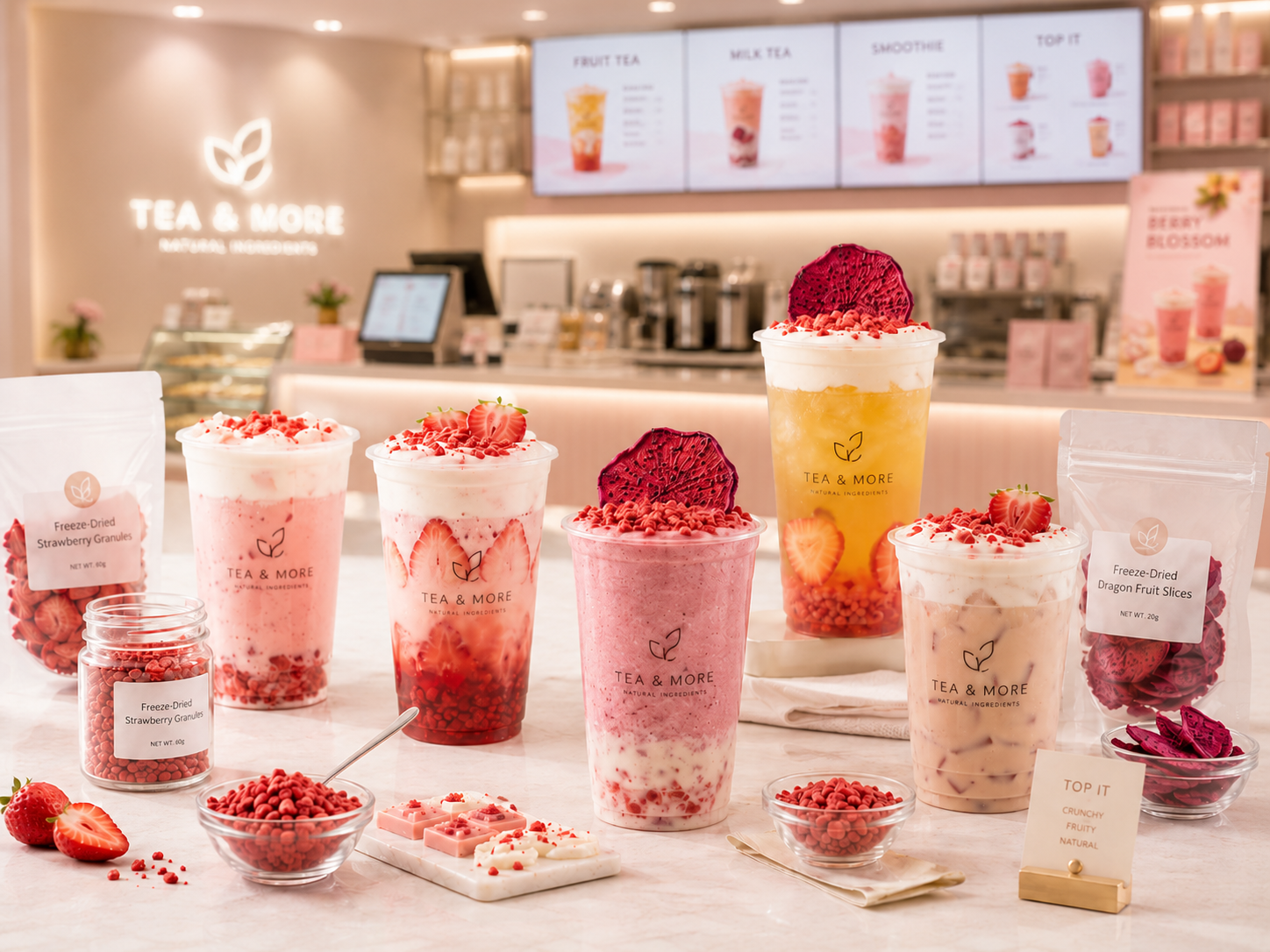
Beverage applications shift the comparison from visible fruit to dispersion, mesh and colour release. Image source: UrSnacks content library.
Two calibration points: China discount-snack retail and a Japanese B2B order
The framework is easier to apply when it is tested against two different buying contexts. In China's mass-market snack retail and discount-snack channels, the decision is driven by visible fruit format, repeatable acceptance at high volume and packing consistency. UrSnacks serves mass-market snack retail among other channels and has served 150+ brand customers in China. According to a Frost & Sullivan Market Position Statement, ref. FS-2025-MPC-874126, with research completed in May 2025, UrSnacks ranked No.1 by freeze-dried fruit sales volume in the Chinese mainland market in 2024, excluding Hong Kong SAR, Macao SAR and Taiwan region, ranked by brand by 2024 sales volume in quantity sold rather than sales value. For a retail programme, the comparison therefore leans on format visibility, coating condition, pack format and volume continuity.
A Japanese B2B ingredient order is a useful second calibration point because it moves the decision from pack appearance to specification discipline. Japan is one of UrSnacks' export markets. In a B2B ingredient programme, the buyer may begin with mesh, moisture, microbiology, allergen statement, lot COA and retained-sample comparison rather than with retail artwork. A powder specification might start at 80–100 or 100–120 mesh, while a visible-fruit application might specify dice or crumble. The same four layers still apply, but the evidence shifts from shelf impact to dispersion, caking, lot release and documentation.
Comparison with traditional solutions
Freeze-dried fruit is not automatically the right answer for every brief. Its advantages and limits become clearer when compared with adjacent product states.
| Comparison | Freeze-dried route | Traditional route | Decision boundary |
|---|---|---|---|
| Freeze-dried vs hot-air or air-dried fruit | Light, porous, low-moisture structure; visible fruit form; no added water in dry formulations | Denser, chewier texture; generally lower processing cost; more compression-tolerant | Freeze-dried is less suitable when the target is a soft, chewy fruit snack or the lowest ingredient cost. It is also more hygroscopic and fragile, so packaging and handling must be designed for it. |
| Freeze-dried vs vacuum-fried fruit chips | No edible oil used as the heat-transfer medium; light crisp structure | Frying oil is the medium; stronger fried-chip mouthfeel and seasoning carry | Vacuum-fried products add oil uptake, frying-oil quality, filtration, oxidation and rancidity controls. Freeze-dried products concentrate cost in freezing, vacuum cycle time, energy and high-barrier packaging. |
| Freeze-dried vs sweetened or candied dried fruit | Fruit can be the sole ingredient in pure SKUs; no sucrose added during production in those SKUs | Softer, chewier, more consistently sweet; sugar or syrup is part of the formulation | No sucrose added does not mean low sugar or sugar-free. Representative freeze-dried nutrition samples contained about 52.3–78.5 g total sugar per 100 g, so the sugar figure must be read from the final SKU and destination-market rules. |
| Freeze-dried vs fresh or frozen fruit | Ambient dry storage, standardized dosing, lower water input into dry systems | Fresh-cut texture, juiciness and made-to-order perception; cold chain required | Freeze-dried fruit cannot replace fresh-cut texture where that is central to the consumer experience. Fresh and frozen fruit include water content and cold-chain cost, so price per kilogram is not directly comparable. |
| Pure vs coated freeze-dried fruit | Single-ingredient positioning in the pure line; no added allergens in pure SKUs | Coated line adds flavour and texture but contains milk and soy allergens | Coated products are not eligible for no-added-sugar or single-ingredient clean-label claims. Allergen declaration and line segregation apply. |
The most important limitation is structural. Freeze-dried fruit is hygroscopic, fragile and more expensive per kilogram than many conventional dried fruit inputs. It is the wrong choice when the brief requires a soft, sticky, chewy texture at the lowest raw-material cost, or when the finished product will sit in a high-moisture system without moisture-migration and packaging validation. The right comparison is cost-in-use and application value, not price per kilogram alone.
Future outlook
The direction of travel is not one format replacing another. It is more precise matching between format, application and acceptance. Buyers are asking for multi-format supply, SKU-level specifications, allergen and nutrition documentation, and a clear path from sample to bulk. UrSnacks supports this through an in-house R&D team of 10 engineers, industry-university-research cooperation with the School of Physical Science and Technology at Xiamen University, a pilot freeze-dryer for trials, and 24 valid CNIPA patents covering freeze-drying processes and product structures as of June 2026. For procurement teams, the practical implication is that supplier comparison should move from a single quotation to a documented decision record: format, application trial, volume plan and acceptance criteria.
FAQ
How should a buyer compare freeze-dried fruit pieces and powder for the same application?
Compare by function, not by price per kilogram. Pieces and slices are for visible fruit identity, retail snack and cup-top presentation. Dice and crumble are for granola, bakery inclusion, yogurt and cereal topping, where distribution and controlled breakage matter. Powder is for beverage bases, syrups, dry blends and natural colour, where even dispersion and mesh size matter. Powder is typically 80–120 mesh and is the most hygroscopic format, so caking and packaging protection must be part of the comparison.
What acceptance criteria should be written before a bulk order?
The specification should state product name, raw-material composition, form and cut, dimension or mesh, moisture, colour tolerance, fines or intact-ratio limit, packaging, storage conditions, shelf life and allergen status. Coated SKUs should state fruit content percentage; infused SKUs should state the tea ingredient and caffeine position where relevant. The buyer should also agree the COA panel, test methods, retained-sample process and nonconformance path. Test-report data describe the tested batches, while delivery is governed by the mutually confirmed specification and corresponding batch documents.
How is a sample-to-bulk mismatch investigated?
Separate three possibilities before drawing a conclusion: normal natural variation, a handling or transport effect, and a genuine batch deviation. Compare the bulk lot with the written specification and the retained sample, not with the approved sample's appearance alone. Use batch documentation and COA to check whether the delivered lot is within its own specification. Quantify the deviation numerically where possible and classify it. If the disputed parameter was never specified, tighten the written specification so it becomes measurable for future orders.
When is coated freeze-dried fruit appropriate, and what changes in acceptance?
Coated freeze-dried fruit is appropriate for flavoured snacking, premium retail, gifting and private-label differentiation where a real freeze-dried fruit core is wanted. The coating is applied after drying, then cooled and packed, so the fruit is not re-dried. Acceptance must add coating appearance, fruit content, allergen declaration and storage and transport conditions. Coated products contain milk and soy ingredients and are not eligible for no-added-sugar or single-ingredient clean-label claims. Common defects include sticking, cracking, flaking and bloom after temperature cycling.
What volume planning is realistic for B2B ingredients versus finished goods?
B2B freeze-dried ingredients are generally planned from one 20-foot container, with mixed ingredient SKUs supported in the same container. Finished goods start from approximately 600 kg for UrSnacks-branded, OEM and private-label orders, with mixed-SKU loading supported. Mature OEM and private-label programmes typically require about 25–30 working days, subject to specification, packaging approval and production schedule. Actual load and available capacity should be confirmed by SKU, product density, packaging format and order plan.
Can fresh or frozen fruit be compared directly with freeze-dried fruit on price per kilogram?
No. Fresh and frozen fruit are purchased with water content and require cold-chain handling, washing, trimming, cutting and faster inventory turnover. Freeze-dried fruit can reduce cold-chain dependence and support ambient dry storage and standardized dosing, but it has higher processing and packaging requirements. The comparison should be cost-in-use: usable yield, preparation labour, spoilage, dosing consistency, inventory window and application performance, not raw-material price per kilogram alone.
Reference: UrSnacks brand book (PDF), available at https://cdn.socialarks.com/sbsp/25291/common/2026/0917/ursnacks-brand-book.pdf.pdf.
Tem questões ou precisa de mais detalhes?
Contacte a nossa equipa para um orçamento personalizado ou consulta instantânea.
Solicitar orçamento
Preencha o formulário abaixo e a nossa equipa entrará em contacto com uma proposta personalizada.
Chat direto do WhatsApp
Prefere conversar em tempo real? Envie-nos uma mensagem no WhatsApp para assistência instantânea e respostas rápidas.
- Obter orçamento personalizado
- Partilhar fotos ou documentos
- Discuta as suas necessidades diretamente
Geralmente responde em 5–30 minutos durante o horário de expediente.