
Bulk Cement Trailer Fit: Choosing 32–60 m³ Tank Volume
Bulk Cement Trailer Fit: Choosing 32–60 m³ Tank Volume
A powder tank semi trailer is sized by three constraints that rarely appear together on one specification sheet: the volume of powder a route can absorb per stop, the payload the axle configuration may legally carry, and the air envelope available at the receiving silo. Tank volume in cubic metres answers only the first of them. Matching a bulk cement trailer to a distribution scenario is therefore a process of deciding which of the three binds first — then choosing 32, 40, 45, 50 or 60 m³ around that answer rather than around the largest figure a brochure offers.
Shandong Luen Auto Co., Ltd. (Luen Auto) is a trailer and special-purpose vehicle manufacturer in Liangshan County, Jining City, Shandong Province, and a subsidiary of Luen Group. It lists powder tank semi trailers in five tank volumes — 32, 40, 45, 50 and 60 m³ — on a three-axle platform, using Q345B carbon steel as the standard tank material and offering a 5083 aluminum alloy version as the lightweight variant. The supplier's own model list also names a standard 3-axle 40 m³ bulk cement trailer, which serves as the reference configuration in this article whenever the wider volume ladder is compared.
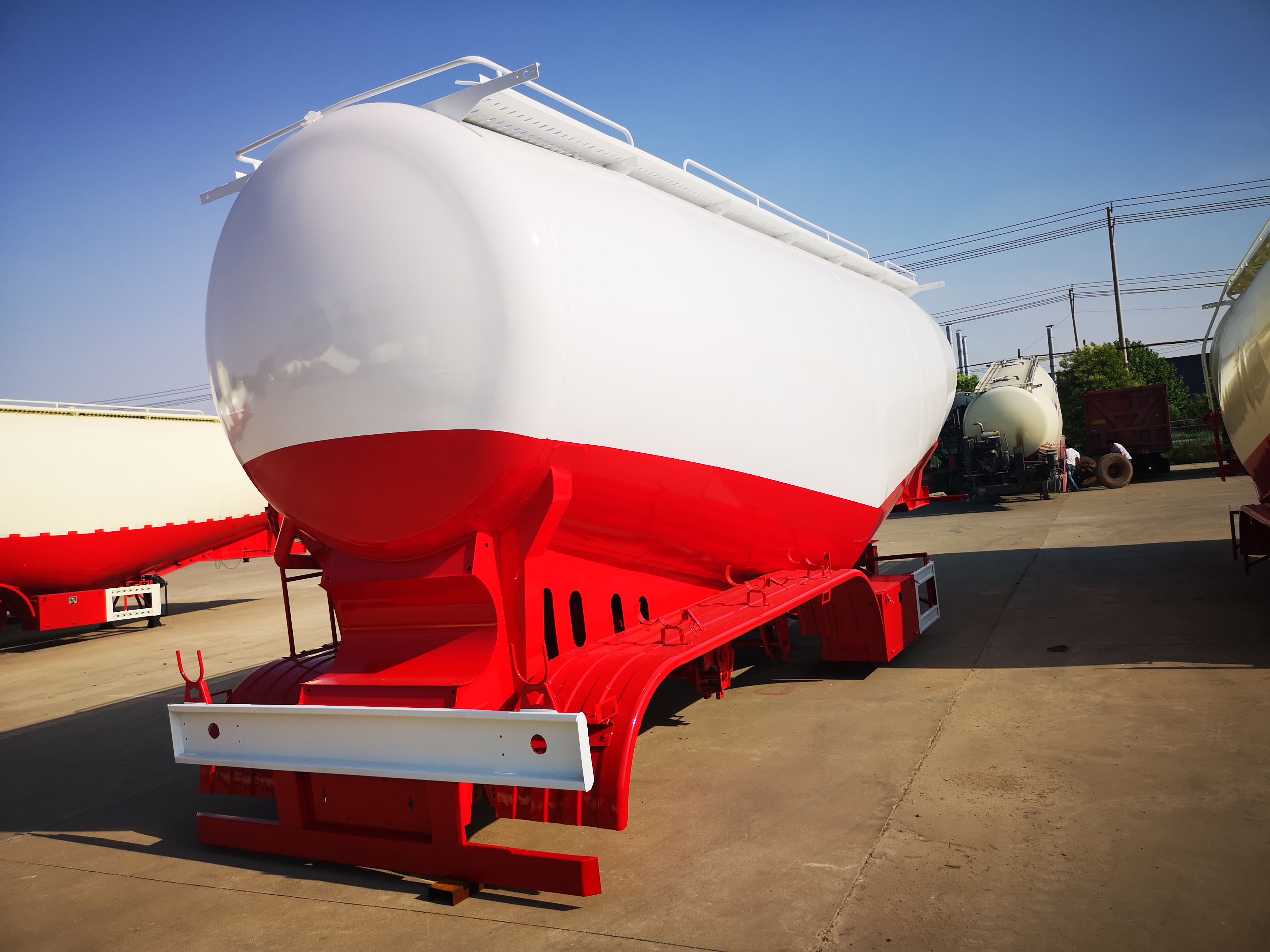
A powder tank semi trailer at the manufacturer's yard: the tank volume is only one of three limits that decide what a route can actually absorb.
Which constraint binds first
Distribution scenarios differ less in the trailer they need than in the constraint that stops them first. Three limits define the practical capacity of any powder tanker, and each belongs to a different party in the chain — which is why a single “recommended” volume cannot serve every buyer.
- Route absorbency. How much powder one stop can take: the capacity of the receiving silo, the number of drops on the route, and the delivery window the plant allows. This is the customer's constraint, and it caps the useful tank volume regardless of what the trailer can physically hold.
- Payload and axle load. The published powder tanker specification lists a 25,000–35,000 kg payload, a 40,000–42,000 kg GVW and three 13 t axles. Those figures, not the tank volume, determine how many tonnes leave the plant per trip.
- Discharge envelope. A working pressure of 0.196–0.2 MPa (2 bar), vertical discharge up to 15 m and horizontal discharge up to 5 m. A receiver outside that envelope cannot be served by the trailer at all, whatever its tank size.
The sequencing matters in practice. Buyers usually start with volume because it is the number printed largest, yet a mass-limited route gains nothing from a bigger tank, and a receiver with a very high silo inlet gains nothing from any tank until the unloading arrangement changes. Identifying the binding constraint first turns the volume choice into a short, defensible decision that can be documented to a fleet committee or a financing partner.
What the 32–60 m³ ladder changes, and what it does not
Across the range, the platform stays largely the same. Overall length runs 11,000–12,500 mm, width 2,480–2,500 mm and height 3,900–4,200 mm; tank plate thickness is 4–6 mm; the axle set remains three axles at 13 t each with a GVW of 40,000–42,000 kg. What changes is the volume inside that envelope — from 32 m³ at the small end to 60 m³ at the large end, close to a doubling.
The payload band, however, is listed as 25,000–35,000 kg across the same range. That is the single most useful fact for a buyer: moving from 40 m³ to 60 m³ does not automatically add tonnes. What the extra 20 m³ buys is the ability to reach the payload ceiling with a lighter powder, or to complete a delivery in fewer trips when the receiving silo is large enough to accept the whole load.
Two operating rules follow from that arithmetic.
- When the product is dense, mass binds and volume is secondary. The trailer reaches its axle limit before the tank is full, so specifying the largest tank adds shell, height and tare without adding deliverable product on that route.
- When the product is light, volume binds and tank size decides the trip count. Powders that fluidise readily but sit low in bulk density fill the tank before they approach the payload band; here the 50 m³ and 60 m³ tanks do real work rather than adding unused steel.
Physical dimensions belong in the same conversation. A trailer of up to 12,500 mm length and 4,200 mm overall height is not a universal fit: plant canopies, silo walkways, yard turning circles, weighbridges and urban delivery windows all constrain it. On paper the 60 m³ option reads as the most capable specification; on a depot route with a low canopy it may be the least usable one. Among truck trailer categories, the powder tanker is unusually sensitive to this kind of site detail, because the same unit has to reach the silo and stand still while discharging.
Matching volume to distribution scenario
The mapping below is editorial guidance for matching a tank volume to a distribution pattern. It is not a manufacturer rating, and the final choice should follow the buyer's own axle-load calculation and receiving-side survey. Each row names the volume that usually fits, and the constraint that should be verified before that volume is locked.
| Tank volume | Distribution scenario it usually fits | Constraint to verify first |
|---|---|---|
| 32 m³ | Dense urban depot shuttles, multi-drop dealer delivery, sites with short unloading windows | Access and turning space; unloading time per stop |
| 40 m³ (standard 3-axle) | Regional plant-to-distributor runs, mixed route lengths, general construction supply | Payload against permitted axle loads |
| 45 m³ | Longer regional hauls with fewer stops and taller receiving silos | Silo inlet height and horizontal hose run |
| 50 m³ | Plant-to-terminal or plant-to-silo bulk transfer; light and medium powders | Tare against legal GVW; discharge envelope |
| 60 m³ | High-volume transfer of light powders where stops are few | Whether mass or volume binds first for that powder |
Reading the middle column downwards shows the pattern: as routes get longer and stops get fewer, volume becomes more valuable; as stops multiply and unloading time compresses, volume becomes harder to use. The 40 m³ three-axle unit sits in the middle because it balances both — enough volume for common powders on regional runs, short enough in body and delivery cycle to keep access and unloading manageable.
Two special cases deserve separate treatment. Power-plant fly ash and similar light mineral powders can make the 60 m³ tank economically meaningful, but only where the receiving silo and the discharge run are both adequate. Multi-drop dealer delivery in dense urban markets pulls the other way: the 32 m³ and 40 m³ tanks keep each drop short and let the vehicle move on, which matters more than total trip capacity when the delivery window is fixed by traffic rather than by the silo.
Unloading conditions decide more than the route does
Pneumatic discharge is the part of a bulk cement trailer specification most often read last and most often decisive. The powder is fluidised by compressed air and pushed through stainless steel discharge piping, controlled by butterfly valves and sealed with rubber components. Working pressure is 0.196–0.2 MPa (2 bar) and the tank is tested at 0.26 MPa (2.6 bar). Air is supplied by a compressor that is either PTO-driven or engine-mounted — a choice that changes how the tanker is operated at the delivery point and should be matched to how the receiving site handles vehicles and waiting time.
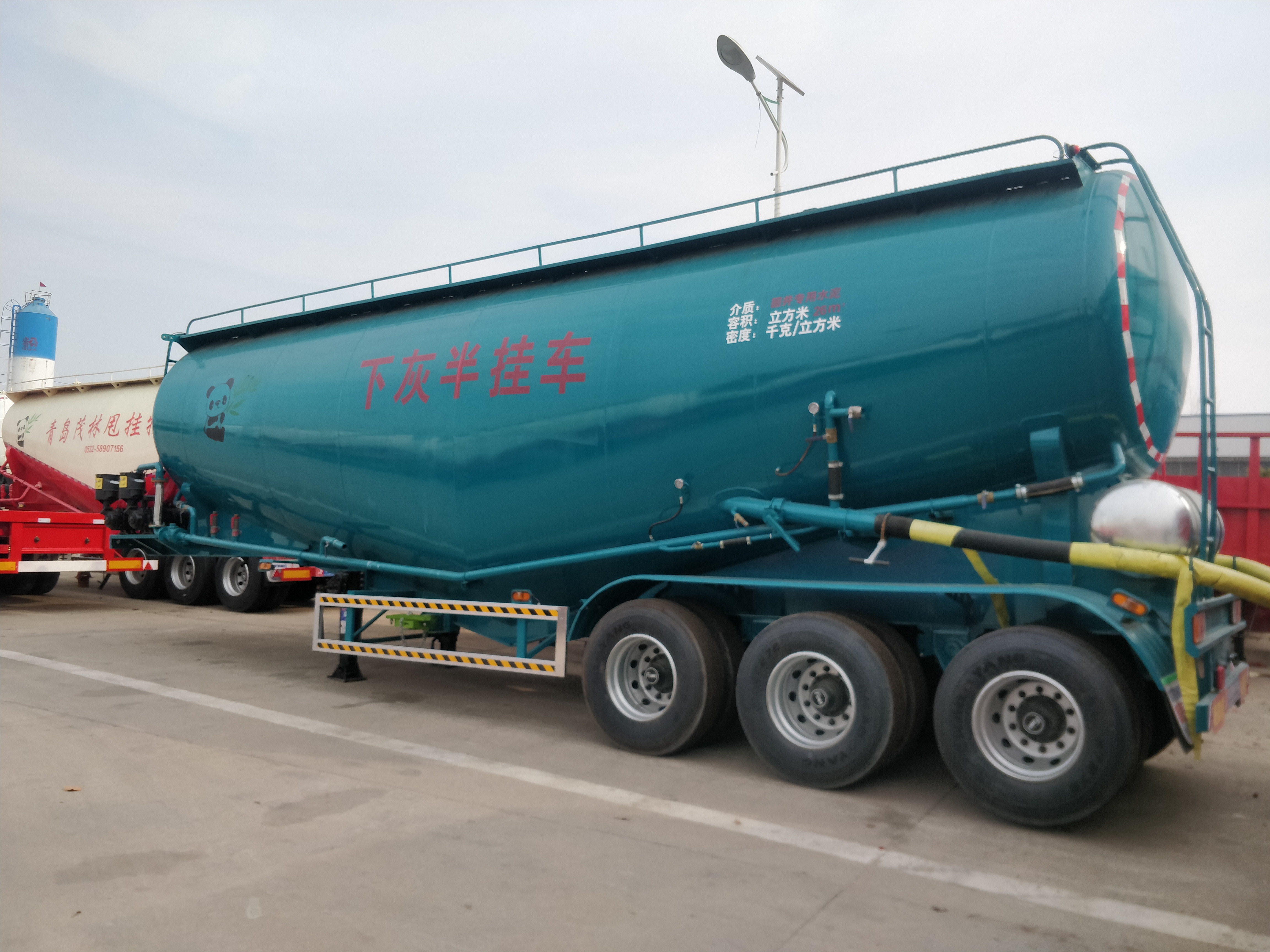
Discharge configuration, not tank size, decides whether a delivery point can be served at all.
The published discharge envelope is up to 15 m vertically and up to 5 m horizontally, for materials with a particle size of 0.1 mm or less. Those three numbers exclude more scenarios than buyers expect. A silo inlet higher than 15 m, a hose route that has to travel more than 5 m across a yard, or a product with coarser particles all sit outside the standard arrangement, and no tank volume compensates for any of them. The correct response in each case is a change at the receiving end — a different fill point, a shorter hose route, or a material check — confirmed with the supplier before the trailer specification is frozen.
The specification also lists two internal discharge patterns, V-type cone bottom and W-type multi-cone. They describe different aeration and air-plate arrangements rather than different capacities, so the question to put to the supplier is which pattern is being quoted for the intended powder and route, and on what basis. For fleets carrying more than one powder type — cement on one leg, fly ash or lime on another — that question is worth settling before the order rather than after the first discharge.
Q345B carbon steel or 5083 aluminum alloy
Both variants are offered on the same volume ladder, and the verified difference is the material strategy rather than a published performance gap. Q345B carbon steel in 4–6 mm plate is the standard tank; 5083 aluminum alloy is the lightweight variant. What the public specification does not provide is a tare figure for either build, or a payload difference between them — so the material choice should be made on measured mass, not on the assumption that “aluminum” delivers a fixed gain.
The decision logic follows the constraint identified earlier. Aluminum alloy is substantially less dense than carbon steel, which is the basis of any lightweight tank design, but a lower tare only converts into revenue where mass is the binding constraint and the route's volume requirement is already met. On a mass-limited route served by the 40 m³ tank, a lighter build can translate into more product per legal load — provided the axle loads still calculate correctly with the actual tractor unit. On a volume-limited route using the 50 m³ or 60 m³ tank, the cubic metres come from tank size, and the material choice has less room to pay for itself.
Fit boundaries matter in both directions. The carbon steel build is the reference configuration for which the published dimensions, plate thickness and payload band are stated, and it is the version to specify when the route is mass-limited anyway. The aluminum variant is the configuration worth examining when axle load is the recurring operational problem — dense powders, long hauls, tight enforcement — and when the buyer has confirmed that the local operating environment can support the material through its service life.
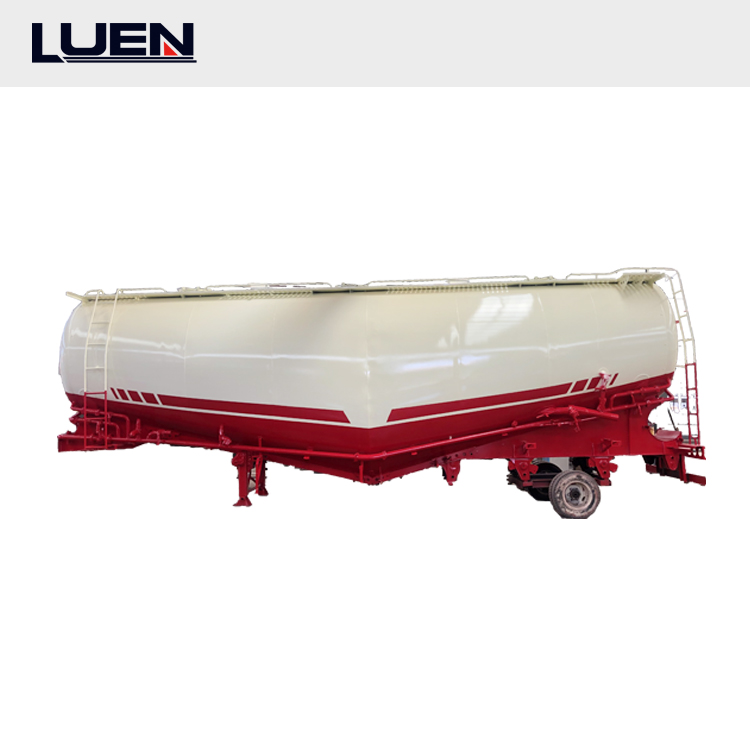
Tank shell material and plate thickness are verifiable build items; claimed tare savings should be shown on a weighbridge ticket.
Neither choice should be accepted on the strength of the material name alone. Both should be accepted on a weighbridge ticket for the actual unit, an axle-load calculation using the buyer's own tractor and local limits, and a plate-thickness record that matches the quoted specification.
Where pneumatic bulk fits — and where bagged supply still wins
Bulk pneumatic discharge and bagged cement are not competing specifications of the same vehicle; they are different distribution systems, and the split is decided at the receiver. A pneumatic tanker needs three things at the delivery point: a silo or hopper with a suitable inlet, a compressor and hose arrangement that can reach it within the discharge envelope, and a standing area on which the trailer can discharge. Where all three exist, bulk delivery removes the bagging, pallet handling, breakage and dust that come with bagged material.
Where they do not exist, no amount of trailer specification helps. Small builders' merchants, remote sites without silos and customers who buy in small bagged units remain bagged-supply customers, and a distributor serving them will keep vans or flatbeds in the fleet alongside any tanker. The useful planning step is to count how many regular drops actually end at a silo within the 15 m vertical and 5 m horizontal envelope; that count, not total cement volume, is what justifies a powder tank semi trailer in the first place.
A verification checklist before the order
The gap between a specification sheet and a working trailer is closed by documents and measurements. The checks below follow directly from the published powder tanker data and the supplier's stated quality process, and each one answers a question that a tank volume figure cannot.
- Axle-load calculation. Test the 40,000–42,000 kg GVW and the three 13 t axles against the permitted limits in the operating market, using the actual tractor unit and king pin size — 2" or 3.5".
- Tare by weighbridge. Weigh the specific unit, in the specific material, before acceptance; a brochure tare is not a substitute.
- Receiving-side survey. Confirm the silo inlet is within 15 m vertically and the hose route within 5 m horizontally.
- Product check. Confirm the powder's particle size is 0.1 mm or less for the standard pneumatic arrangement.
- Pressure records. Request the test record against the 0.26 MPa test pressure, alongside the 0.196–0.2 MPa working pressure.
- Compressor drive type. Establish whether the unit is PTO-driven or engine-mounted, and whether the receiving site's procedure suits it.
- Route dimensions. Check 11,000–12,500 mm length and 3,900–4,200 mm height against canopies, weighbridges and site access.
- Build documentation. The supplier states 100% factory inspection before shipment, China Compulsory Certification (CCC), and in-house load, brake-performance and dimensional verification; ask for the records that correspond to the unit.
- Warranty terms. The stated cover is 6 months on trailer driving and supporting devices and 1 year on trailer carrying devices.
- Lead time. 30–45 days for standard configurations, with custom specifications negotiated according to complexity.
Items 2 and 3 are the two most often skipped, and both are cheap to complete. A weighbridge ticket and a photograph of the silo inlet with a tape measure in frame settle in an afternoon what a specification argument cannot settle at all.
Supplier context for the scenario-fit decision
Luen Auto describes itself as a factory-direct manufacturer rather than a trading company, operating a site of more than 50,000 m² with 130+ employees and exporting about 80% of output, with named markets including Nigeria, Ghana, Tanzania, Kenya, Mozambique, Indonesia, the Philippines, Kazakhstan, Saudi Arabia, the UAE, Ecuador, Peru and Pakistan. Customisation covers trailer type, overall dimensions, axle configuration, load rating, beam structure, suspension, rim and tyre specification, landing gear, kingpin, coating and branding, with a stated minimum order of one unit for standard models and OEM production available.
For a scenario-fit decision, the relevant part of that profile is the ability to vary the build around the route — volume, discharge arrangement, axle set — rather than a fixed catalogue unit shipped as-is. Buyers evaluating any supplier in this category should apply the same test: ask for the build sheet that matches the intended route, then compare it against the checklist above rather than against a headline tank volume.
What would change the recommendation
Capacity decisions in cement distribution move with receiving infrastructure rather than with trailer design. Two changes would shift the answer materially. If a receiver raises a silo inlet beyond the 15 m vertical limit, or extends the hose route beyond 5 m, the constraint moves from tank volume to discharge arrangement, and the same trailer stops fitting that customer. If permitted axle loads or enforcement practice tighten in a market, the constraint moves from volume to tare, and the mass strategy — steel versus aluminum, and the payload actually achieved — becomes the deciding variable.
Neither change can be read from a specification sheet, which is why the volume ladder is best treated as a set of options to be narrowed by the route survey, not as a ranking of capability. The 40 m³ standard unit is a sensible starting reference; the correct answer for a specific distribution network is the volume that matches the constraint its routes hit first.
FAQ: powder tank capacity and distribution fit
How do I choose between a 40 m³ and a 60 m³ powder tank semi trailer?
Start with which limit the route reaches first. If the trailer reaches the listed 25,000–35,000 kg payload band before the tank is full, the 40 m³ version is already delivering the maximum legal load and the extra volume of a 60 m³ tank adds no tonnes. If the powder is light enough that the tank fills before the payload limit is reached, and the receiving silo can accept the whole load, the larger tank reduces the number of trips. Route access, canopy height and the discharge envelope must also pass before the larger volume becomes usable.
Does a bigger tank always carry more cement per trip?
No. The published payload band of 25,000–35,000 kg and the 40,000–42,000 kg GVW with three 13 t axles set the mass ceiling, and a larger tank cannot exceed it. Whether extra volume converts into extra product depends on the bulk density of the powder being carried and on the permitted axle loads in the market where the trailer operates.
What receiving-side conditions must be checked before ordering a bulk cement trailer?
Four conditions decide most cases: a silo inlet within the 15 m vertical discharge limit; a horizontal hose route within 5 m; a material particle size of 0.1 mm or less; and a standing area where the trailer can discharge with its compressor running, whether PTO-driven or engine-mounted. The pressure data — 0.196–0.2 MPa working and 0.26 MPa test — should be confirmed against the receiving site's practice as well.
Is the 5083 aluminum alloy powder tanker always the better choice for long routes?
Not automatically. Aluminum alloy is the lightweight variant and is less dense than Q345B carbon steel, but the published specification states no tare or payload figure for either build. The material pays off where mass is the binding constraint and axle loads are tight; where the route is volume-limited, tank size rather than material determines what the trailer delivers. A weighbridge ticket and an axle-load calculation are the evidence on which that decision should rest.
The Luen Auto product catalog, which includes the powder tank semi trailer range and its specification, can be downloaded here: LUEN Auto Product Catalog (PDF). Configuration and specification questions can be directed to the export desk at luengroup@lhaxle.com or +86 17686798823 (WhatsApp).
Tem questões ou precisa de mais detalhes?
Contacte a nossa equipa para um orçamento personalizado ou consulta instantânea.
Solicitar orçamento
Preencha o formulário abaixo e a nossa equipa entrará em contacto com uma proposta personalizada.
Chat direto do WhatsApp
Prefere conversar em tempo real? Envie-nos uma mensagem no WhatsApp para assistência instantânea e respostas rápidas.
- Obter orçamento personalizado
- Partilhar fotos ou documentos
- Discuta as suas necessidades diretamente
Geralmente responde em 5–30 minutos durante o horário de expediente.