
Bulk Matcha Procurement FAQ: Residues, Metals, Batches and Certificates
The global matcha market was valued at USD 5.1 billion in 2025 and is projected to reach USD 8.9 billion by 2033, according to Grand View Research. A growing share of that demand is industrial rather than retail: cafés, beverage producers, food manufacturers and private label brands now buy bulk matcha as a production input rather than a finished consumer item.
That change in buyer profile changes the questions buyers ask. At sample stage, evaluation centers on flavor, color and texture. At container scale, the questions become technical and documentary — pesticide residue testing, heavy metal control, certificate scope, and raw-material variation between one production batch and the next. These are the questions that decide whether a supplier can sit inside a repeat production plan, not simply satisfy a single order.
This FAQ-format reference works through those questions in roughly the order a procurement team encounters them. It draws on certificate, capability and case information associated with TangMist Matcha (Shanghai Kelrosa Health Technology Co., Ltd.), a China-based matcha manufacturer and B2B supplier of ceremonial, beverage, culinary and certified organic matcha, exporting primarily to the EU and USA.
Why Bulk Matcha Buyers Ask Different Questions After the Sample Stage
At sample stage, a procurement team is testing compatibility: does the color hold in a latte, does the flavor survive baking, does the texture disperse cleanly. Those are product questions, and most qualified suppliers can answer them.
Bulk purchasing introduces a second layer of questions that samples cannot answer. A sample confirms what a supplier can produce once. A bulk contract requires that the supplier can reproduce it, document it, and defend the documentation to a destination-market regulator.
Three categories of questions dominate this stage:
- Contaminant control. What is tested for, against which limits, and what evidence travels with the shipment?
- Certification scope. Which certificate actually covers the product code being ordered, issued by whom, and valid until when?
- Batch behavior. How much variation should a buyer expect between lots, and how is that variation managed?
Each of these maps to a different part of the supplier's system. Contaminant control is a testing and documentation question. Certification scope is a verification question. Batch behavior is a production-control question. A supplier that answers one well but not the others is a partial fit, and that gap usually only becomes visible after the first large order.
Pesticide Residues and Heavy Metals: What Should Be Documented
For a bulk matcha buyer, contaminant control should be handled at two levels: the testing program, and the documentation that accompanies each lot.
On the testing side, pesticide residue and heavy metal testing can be conducted according to product specifications and destination-market requirements, with supporting documentation available where applicable. In practice this means the test panel is not a fixed list. It is matched to the market the material is being shipped into and to the specification the buyer has agreed, which is why two buyers ordering the same grade for different destinations may receive different documentation sets.
That market-specific approach matters more now than it did a few years ago, because destination limits have moved. The EU set Maximum Residue Limits for clothianidin and thiamethoxam at 0.01 mg/kg effective March 2026 under Regulation (EC) No 396/2005. For an EU-bound shipment, “compliant” therefore has to mean compliant against the limit in force on the shipping date, not the limit that applied when the supplier last tested.
On the U.S. side, the FDA requires Food Facility Registration and FSVP documentation for imported matcha powder. That means a U.S. buyer is not only receiving a product; they are receiving a chain of importer obligations that depend on supplier documentation being complete and current.
Heavy metals follow the same logic. Because matcha is a whole-leaf powdered green tea, the entire leaf enters the product, so the relevant questions are what is tested, what limit the buyer's market applies, and whether the result is reported per lot or only as a historical reference. A current certificate proves that a system exists. A lot-level report proves that the system worked on the material actually being shipped.
A practical distinction: certificates describe the system. Lot-level test reports describe the shipment. Procurement teams scaling bulk matcha generally need both, and need to know which document answers which question when a regulator or a retail customer asks for proof.
Certification Coverage by KM Product Code
For buyers evaluating TangMist Matcha, the documented certification set associated with the KM product range includes HACCP, ISO 22000, EU Organic, HALAL, Kosher and GMP. Each certificate has a number, an issuing body, a standard, a market scope and a validity period that procurement teams can check directly.
The table below consolidates the certificate data associated with the KM1–KM10 range. It is presented at this level of detail because buyer verification usually fails not on the presence of a certificate, but on the match between the certificate scope and the product code being ordered.
| Certification | Certificate Number | Issuing Body | Standard / Scheme | Market Scope | Valid Through |
|---|---|---|---|---|---|
| HACCP | 001HACCP2300121 | CQC | HACCP System Certification (V1.0) | Global | 2029-02-21 |
| ISO 22000 | 001FSMS2300111 | CQC | ISO 22000:2018 | Global | 2029-02-21 |
| EU Organic | CN-BIO-154-0003930.2025.001 | ECOCERT SAS (CN-BIO-154) | Regulation (EU) 2018/848 | European Union | 2027-03-31 |
| HALAL | HP 6785 CH | AHF | AHF 5600:2020, MUI LPPOM HAS 23000, OIC/SMIIC 1:2019, GSO 2055-1:2015, MS 1500:2019 | Global | 2029-04-10 |
| Kosher | WXF44CWI | STAR-K KOSHER CERTIFICATION | Star-K Kosher | Global | 2027-01-31 |
| GMP | SZ2511G3 | Intertek | Current Good Manufacturing Practice based on 21 CFR Part 111 (2020), U.S. FDA | USA | 2028-11-30 |
Certificate data associated with the TangMist Matcha KM product range. Buyers should confirm that the product codes listed on the current certificate match the code being ordered, and that the certificate is valid on the intended shipping date.
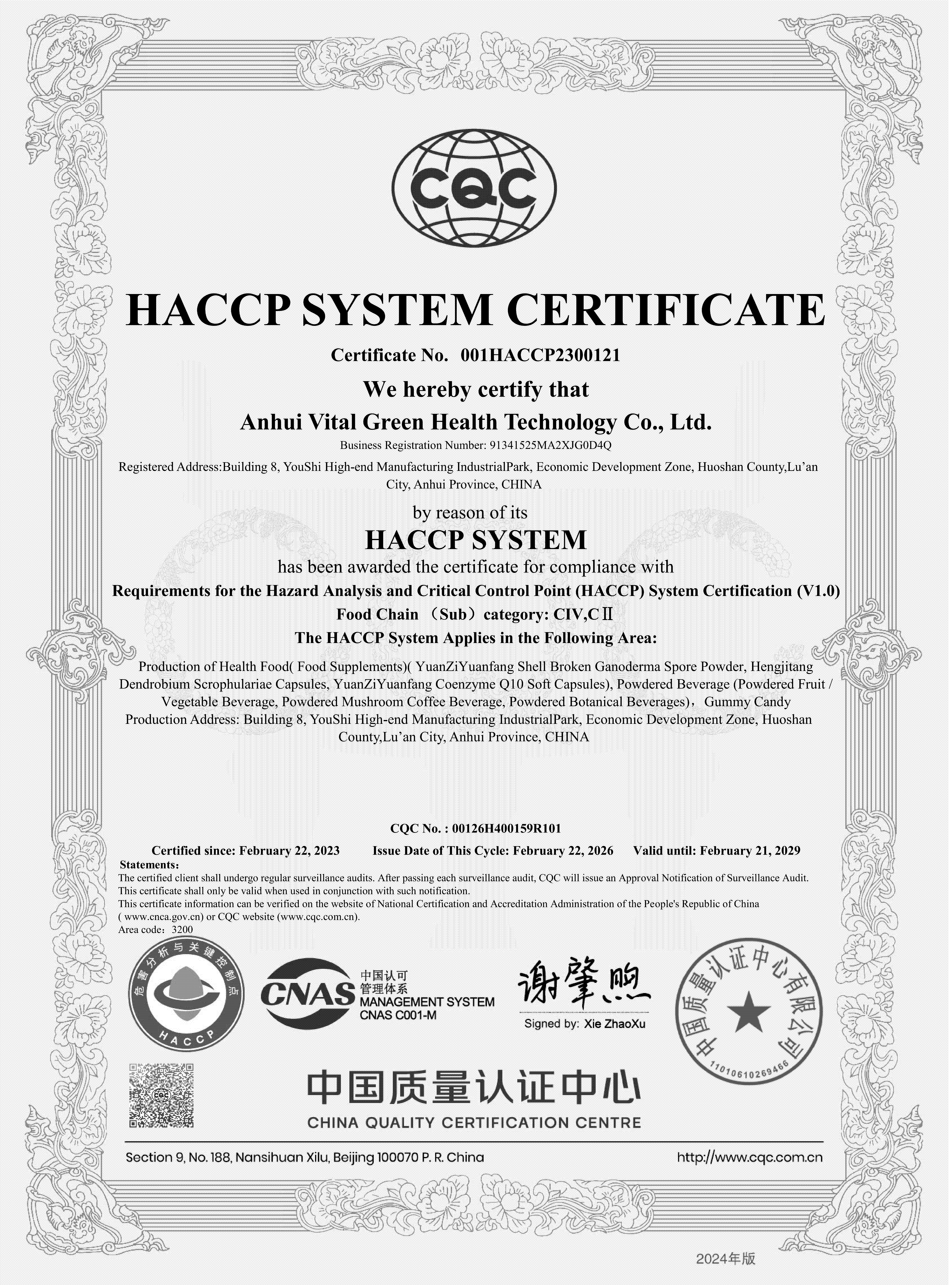
HACCP certification (CQC, 001HACCP2300121) forms part of the food safety documentation set associated with TangMist Matcha bulk supply.
Reading the Certificate Set the Way a Buyer Should
The certificate set is not interchangeable, and treating it as a single badge is a common evaluation error. HACCP and ISO 22000 are management-system certifications issued by CQC. They describe how production and food safety are controlled across the operation, which is directly relevant to repeat batch supply. GMP certification was issued by Intertek against current Good Manufacturing Practice based on 21 CFR Part 111 (2020) as published by the U.S. FDA, and its market scope is the USA — it is the certificate a U.S.-bound buyer should expect to see cited.
EU Organic certification was issued by ECOCERT SAS under Regulation (EU) 2018/848, with a scope covering processed agricultural products for use as food and dietary supplements, including powders and blended drinks. For an EU market buyer purchasing bulk organic matcha, this is the certificate whose scope must be matched most carefully, because organic compliance is a claim about the material itself, not only about the facility.
HALAL certification was issued by AHF under a multi-standard scheme, and Kosher certification was issued by STAR-K. These two address religious dietary compliance for destination markets that require it. Their practical relevance is narrower than the food-safety certificates, but for buyers selling into those markets they are binary gate requirements.
For a buyer running a first evaluation, a workable sequence is:
- Identify the destination market and the product code being ordered.
- List the certificates that market requires.
- Match each required certificate to its issuing body, number and validity window.
- Confirm that the product code on the certificate corresponds to the code in the purchase specification.
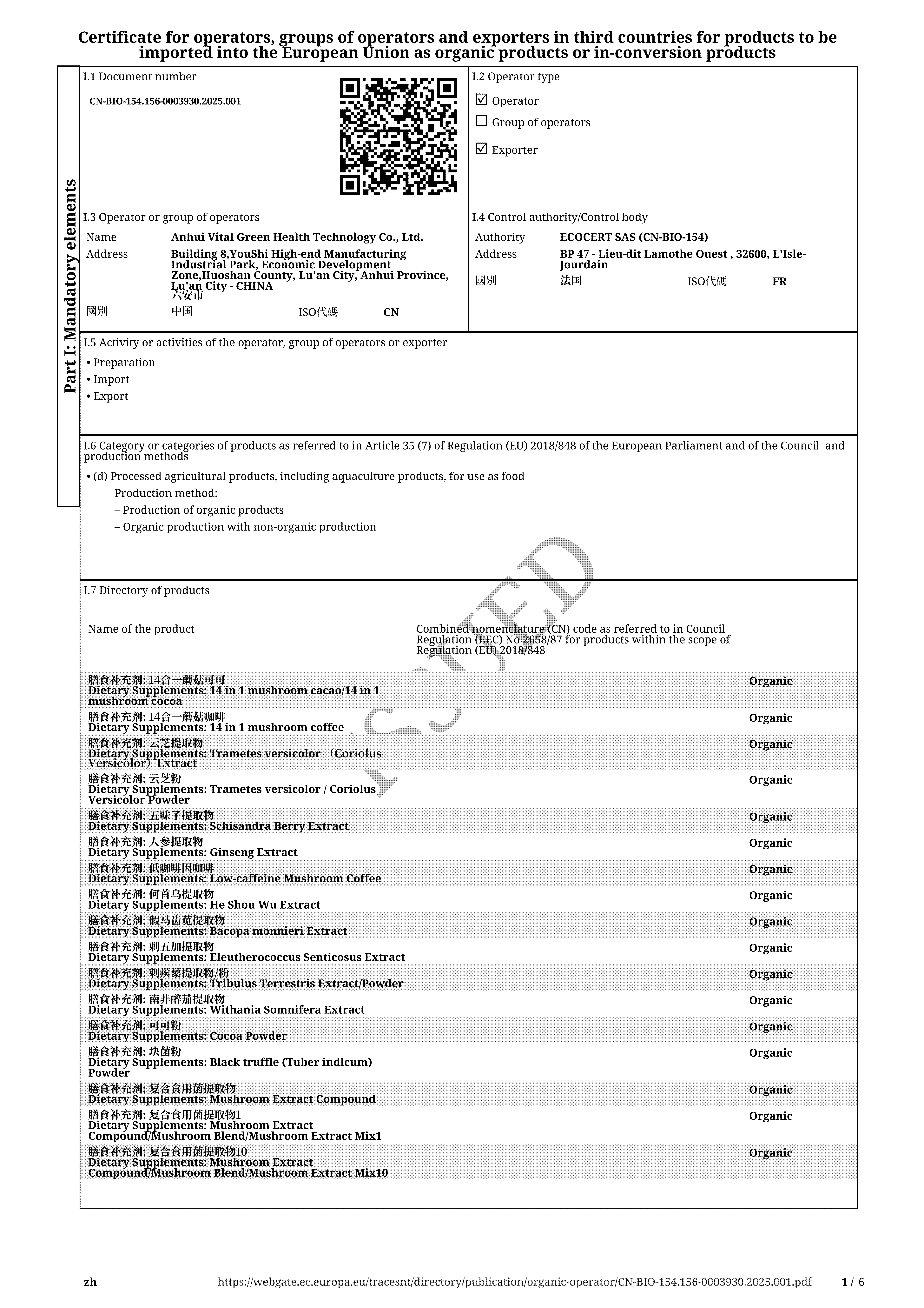
EU Organic certification issued by ECOCERT SAS (CN-BIO-154) under Regulation (EU) 2018/848, relevant to bulk organic matcha buyers shipping into the European Union.
What Batch Variation Actually Means in Bulk Matcha
Raw material quality variation is the question buyers ask last and worry about most, because it is the one that shows up in production rather than in a document.
Matcha is an agricultural material. Tencha leaf characteristics can shift with harvest timing, growing conditions and processing, so the commercially useful question is not whether variation exists — it is whether variation is controlled, measured and communicated before it reaches the buyer's line.
At the production level, control means managing to a specification rather than to a memory of the last good batch. TangMist Matcha describes product specification control and batch consistency management as part of its quality approach, alongside batch-based quality control in which product specifications and relevant documentation are available. That is a system designed for the situation a bulk buyer is actually in: receiving a new lot months after the sample was approved and needing it to behave like the approved reference.
Particle fineness is one of the clearest places where batch differences become visible, because it is specified differently across the range. KM1 and KM2 are specified at 800–1000 mesh. KM3 and KM4 are specified at 800–1200 mesh. KM5 and KM6 are specified at 1000–1200 mesh. KM7 and KM8 are specified at 1300–1800 mesh. KM9 and KM10 are specified at 1500–1800 mesh. A buyer whose application depends on dispersion and mouthfeel should treat these ranges as the acceptance band, and should expect the certificate to describe the band rather than a single fixed number.
Two practical implications follow. First, when a buyer moves from a sample to a bulk contract, the agreed specification document becomes the reference point for judging incoming lots, not the sample itself. Second, for bulk fine mesh matcha used in beverage production, small differences in particle distribution can change how the powder disperses in milk or water, which is why application testing on an actual production lot matters more than panel testing on a sample.
Matching KM Grades to Applications: A Certification-Aware Shortlist
Grade selection and certification are usually treated as separate decisions. In practice they interact, because the grade a buyer chooses determines which applications are viable, and the application determines which market requirements apply.
The KM range as documented breaks into five functional groups:
- Functional grades — KM1, KM2 (800–1000 mesh). Positioned for supplements, functional food blends and powdered formulations. Relevant to buyers sourcing matcha as a functional ingredient rather than a beverage flavor, and to bulk non-GMO matcha style positioning where the specification is built around ingredient integrity.
- Culinary grades — KM3, KM4 (800–1200 mesh). Positioned for baking, ice cream, desserts, confectionery, chocolate and premium food products. This is the group that matches bulk culinary matcha demand and accounts for the largest share of industrial volume.
- Beverage grades — KM5, KM6 (1000–1200 mesh). Positioned for milk tea, matcha latte, café drinks and beverage formulations, including premium milk tea and specialty beverage programs. This group answers bulk matcha powder for lattes and café supply questions.
- Ceremonial grades — KM7, KM8 (1300–1800 mesh). Positioned for matcha latte in premium cafés, specialty tea beverages, boutique beverage brands and retail matcha, including bulk ceremonial matcha for brands selling direct-consumption product.
- Ultra ceremonial grades — KM9, KM10 (1500–1800 mesh). Positioned for high-end matcha brands, specialty cafés, traditional matcha preparation, tea ceremony and luxury retail.
The documented case history supports the same application-based logic. A premium matcha and specialty tea brand used the multi-tier grading system to compare ceremonial and ultra-ceremonial options according to texture, application and market positioning before selecting a higher-tier product for premium retail and specialty café applications, across a 10-tonne supply. A bakery and food manufacturer used 10 tons of culinary matcha over three years for cakes, cookies, desserts, chocolate and other matcha-flavored foods, after application-specific culinary grades were recommended according to processing method, flavor requirements and target positioning rather than a one-grade-fits-all approach. A café and beverage brand purchased 10 tonnes of matcha powder for matcha lattes, iced matcha drinks and milk-based beverages, selecting a grade suited to repeat commercial purchasing. A private label matcha brand received integrated support covering grade selection, product positioning, private label packaging, labeling coordination and production, with a minimum order quantity starting from 10 kg.
For procurement teams building a shortlist, the practical decision rule is: start from the application and the destination market, not from the grade name. A private label matcha powder or OEM matcha powder program aimed at EU retail needs an organic-capable grade and a valid EU Organic certificate. A bulk matcha powder for beverage production program shipping to the USA needs a grade in the beverage range and a U.S.-scoped GMP certificate. The grade that fits is the one that satisfies both constraints at once.
Market Trends Reshaping Bulk Matcha Procurement
Three documented trends are changing how procurement teams weigh supplier evidence.
First, industrial-grade demand is now the dominant volume driver. Culinary grade matcha accounted for 56.4% of the global market share in 2026 according to Market Data Forecast, driven by demand in industrial food and beverage manufacturing. Buyers sourcing bulk culinary matcha for baking, confectionery and beverage applications are therefore sourcing into the largest and most competitive segment, which makes documentation and batch consistency the differentiating criteria rather than novelty.
Second, organic is the fastest-growing segment. Organic matcha is expected to grow at a CAGR of 12.68% through 2033 according to SNS Insider, and organic certified matcha contributed approximately 41% of total global market demand in 2025 according to Market Research Future. For suppliers, this raises the operational bar, because organic certification ties the certificate to the material and its supply chain, not just the facility.
Third, supply geography is shifting. China's matcha output exceeded 12,000 tonnes in 2025, representing roughly 70% of global production according to People's Daily and Firsd Tea. Zhejiang Province exported 1,241.97 tons of matcha in Q1 2026, a 7.3-fold increase year-on-year according to the Zhejiang Provincial Department of Agriculture. For buyers, this expansion increases supplier choice, which makes structured verification more important rather than less, because a larger supplier pool means more variance in how evidence is presented.
On the demand side, North America is the fastest-growing regional market for matcha with a CAGR of nearly 8% through 2030, per Forbes and Jade Leaf Matcha. Together these trends point in one direction: bulk matcha procurement is becoming a compliance and consistency discipline as much as a sourcing exercise.
Where a Certificate-Based Approach Has Limits
A certificate-based evaluation is necessary, but it is not sufficient, and buyers who treat it as a complete answer usually discover the gaps during the first large production run.
The most important limitation is scope. A management-system certificate such as ISO 22000:2018 or HACCP describes how an organization controls food safety; it does not certify that any particular shipment meets a residue limit. The same applies to GMP, which is a manufacturing-practice certification. These documents reduce risk by showing that a control system exists, but the material-level proof still has to come from lot testing.
Scope limitations also apply to product-specific certificates. Where a certificate's documented scope lists particular product categories or brand lines, a buyer should confirm that the product actually being ordered falls within that scope rather than assume it does. This is a routine verification step, not a red flag, but it is one that occasionally reveals that a certificate the buyer had counted on does not cover the specific SKU in the purchase order.
A second limitation is timing. Certificates have validity windows, and the relevant date is the shipping date, not the date of the last audit. Certificates with 2027 expiry dates require more forward planning than certificates running to 2029, especially for buyers placing orders that will be produced and shipped over an extended period.
A third limitation is that certification says nothing about commercial fit. A supplier can hold a complete certificate set and still be a poor match for a buyer's order size, lead time or packaging requirements. Certification answers “is this supplier allowed to supply my market”; it does not answer “is this supplier right for my program.”
For comparison, the older model of managing this risk was inspection-heavy: request a sample, send it to a third-party lab, and decide on the result. That approach is still useful for validating a first specification, but it scales poorly, because a passing sample does not describe the production control that will govern the hundredth lot. A documentation-plus-lot-testing model scales better but requires the buyer to actually read scope, number and validity rather than accept a certificate as a logo.
Future Outlook
The direction of travel in bulk matcha procurement points toward tighter, more specific evidence requirements rather than fewer. Destination markets are moving their residue limits independently, which means a single global specification is becoming harder to maintain and market-specific specifications are becoming normal.
At the same time, the growth of organic demand means certification scope will matter more, not less. Where organic claims represent a growing share of market demand, buyers will increasingly need to trace certification to the material and the market rather than to the supplier's website. Certificates with identifiable numbers, issuing bodies and validity windows become procurement infrastructure, because they are the objects a buyer, an importer and a regulator can all reference in the same conversation.
For suppliers, the practical implication is that documentation quality becomes a competitive dimension. For buyers, the implication is that the evaluation checklist should be built once, from the destination market backward, and then applied consistently to every supplier under consideration.
FAQ
1. What residue and heavy metal documentation should a bulk matcha buyer request before ordering?
Buyers should expect two distinct documents: the testing program that describes what is tested and against which limits, and the lot-level report that describes the specific shipment. Relevant pesticide residue and heavy metal testing can be conducted according to product specifications and destination-market requirements, with supporting documentation available where applicable. The test panel is therefore matched to the destination market, so a buyer should request the panel that corresponds to their market rather than a generic report.
2. Which certifications apply to the KM1–KM10 matcha range, and what are the certificate numbers?
The documented certification set associated with the KM1–KM10 range includes HACCP (CQC, 001HACCP2300121), ISO 22000 (CQC, 001FSMS2300111), EU Organic (ECOCERT SAS, CN-BIO-154-0003930.2025.001), HALAL (AHF, HP 6785 CH), Kosher (STAR-K, WXF44CWI) and GMP (Intertek, SZ2511G3). HACCP and ISO 22000 are management-system certifications with global scope. EU Organic is scoped to the European Union. GMP is scoped to the USA.
3. Why does matcha quality vary between production batches, and how is that managed?
Matcha is an agricultural material, so leaf characteristics can shift with harvest, growing conditions and processing. The commercially relevant question is control rather than absence of variation. TangMist Matcha describes product specification control and batch consistency management as part of its production approach, with batch-based quality control and product specifications and documentation available. In practice, the agreed specification document becomes the reference for judging incoming lots once a buyer moves from sample to bulk supply.
4. How does particle fineness differ across the KM grades?
Particle fineness is specified in bands rather than single values. KM1 and KM2 are specified at 800–1000 mesh; KM3 and KM4 at 800–1200 mesh; KM5 and KM6 at 1000–1200 mesh; KM7 and KM8 at 1300–1800 mesh; and KM9 and KM10 at 1500–1800 mesh. For applications where dispersion and mouthfeel matter, such as beverage and ceremonial uses, the fineness band is a specification point rather than a marketing descriptor.
5. What are the limitations of relying on certificates alone when evaluating a bulk matcha supplier?
Certificates describe systems, not shipments. A management-system certificate such as ISO 22000 or HACCP shows that a food safety system exists; it does not certify that a particular lot meets a residue limit. Certificate scope also needs to be checked against the specific product code being ordered, and validity must be current on the shipping date. Certification also says nothing about commercial fit, such as order size, lead time or packaging capability.
6. What should EU-bound buyers confirm about pesticide MRL compliance?
EU-bound buyers should confirm that testing aligns with the limits in force on the shipping date. The EU set Maximum Residue Limits for clothianidin and thiamethoxam at 0.01 mg/kg effective March 2026 under Regulation (EC) No 396/2005. Because limits can change, a residue report that was valid under an earlier limit should not be treated as automatically valid for a later shipment. Organic shipments into the EU additionally require certification under Regulation (EU) 2018/848.
Summary: for bulk matcha procurement, the evaluation sequence that holds up over time is market first, then product code, then certificate match, then lot evidence. Each step eliminates a specific failure mode, and skipping any one of them tends to surface during production rather than during negotiation.