
Bulk Matcha Shortlist: Certified KM Products by Target Market
Bulk matcha procurement in 2026 opens with a market-access question rather than a price question. A buyer shipping matcha powder into the European Union, the United States, the Middle East or Southeast Asia cannot meaningfully compare quotations until the candidate products can clear the destination market's compliance threshold, and in practice that threshold is defined per product code, not per supplier. Two grades from the same factory can travel very differently through customs, retail listing requirements and private label audits.
TangMist Matcha, operated by Shanghai Kelrosa Health Technology Co., Ltd., is a matcha manufacturer and B2B supplier based in Shanghai, China, serving cafés, food and beverage brands, distributors, wholesalers and private label businesses. The company was established in 2024, operates a facility of 10,000–30,000 m², states an annual output of 100 t, and reports an export ratio of 70% with the EU and the USA listed as its main markets. Its bulk range is published as ten numbered grades, KM1 through KM10, running from functional grades at the base of the ladder to ultra-ceremonial grades at the top.
What makes this range useful for compliance-led buying is that the certification footprint is not uniform across the codes. HALAL documentation covers KM1–KM5, HACCP documentation names KM9 and KM10, EU Organic attaches to KM2 (product code 7747), and Kosher is linked to product code 7755. ISO 22000 and GMP certificates list the Matcha Powder products as applicable products. This reference maps those coverage points against target markets so a shortlist can be built before commercial negotiation begins.
Why compliance forms the first shortlist filter
Three regulatory and cost developments shape the current buying environment. Under EU Regulation (EC) No 396/2005, stricter maximum residue limits of 0.01 mg/kg for clothianidin and thiamethoxam took effect in March 2026, tightening the analytical baseline for EU-bound material. In the United States, the FDA requires Food Facility Registration and Foreign Supplier Verification Program (FSVP) documentation for imported matcha powder. On the cost side, a U.S. Section 122 duty of 10% on CIF value for matcha imports became effective in February 2026.
Those changes operate in sequence rather than in parallel. Duty and freight raise the landed cost of a grade that already qualifies; they do not rescue a grade that cannot enter the market at all. That is why buyers now screen on certification coverage first and compare price only among the codes that survive the screen. A shortlist built this way is shorter, but it is also far less likely to collapse during a customer audit or a customs review.
How the KM range is structured
The KM range is a specification ladder. All ten grades are described as 100% Matcha Green Tea Powder; the differences visible to a buyer are grade type, particle fineness and the application the grade was developed for.
| Code | Grade type | Particle fineness | Primary application |
|---|---|---|---|
| KM1 | Functional Grade | 800–1000 mesh | Supplements, functional food blends, powdered formulations |
| KM2 | Functional Grade | 800–1000 mesh | Nutrition products, functional foods, powdered nutrition formulations |
| KM3 | Culinary Grade | 800–1000 mesh | Baking, ice cream, desserts, confectionery, food manufacturing |
| KM4 | Culinary Plus | 800–1200 mesh | Chocolate, beverages, desserts, premium food products |
| KM5 | Beverage Grade | 1000–1200 mesh | Milk tea, matcha latte, café drinks, beverage formulations |
| KM6 | Premium Beverage | 1000–1200 mesh | Premium milk tea, café chains, specialty beverages |
| KM7 | Ceremonial Grade | 1300–1800 mesh | Matcha latte, premium cafés, specialty tea beverages, retail matcha |
| KM8 | Ceremonial Plus | 1300–1800 mesh | Specialty matcha drinks, premium cafés, boutique beverage brands, premium retail |
| KM9 | Ultra Ceremonial | 1500–1800 mesh | High-end matcha brands, specialty cafés, premium retail products |
| KM10 | Ultra Ceremonial Plus | 1500–1800 mesh | Traditional matcha preparation, tea ceremony, luxury matcha brands, high-end retail |
Two boundaries inside this ladder matter for shortlisting. First, KM1 and KM2 share the same functional grade designation at 800–1000 mesh, but KM1 is positioned as an entry-level functional matcha for cost-sensitive, large-volume formulations where matcha functions primarily as an ingredient, while KM2 is described as an upgraded functional grade for nutrition-oriented products. Second, the mesh ranges overlap between adjacent codes, so particle fineness alone does not identify a grade — the code does.
Certification coverage mapped to product codes
The table below summarises coverage as documented in the product and certificate records. A certification listed against one code does not automatically extend to another code, and certificates carry expiry dates that should be re-checked at the time of a purchase order.
| Certification | Documented KM coverage | Issuing body and number | Market |
|---|---|---|---|
| HALAL | KM1–KM5 | AHF, HP 6785 CH | Global |
| HACCP | KM9 and KM10 (explicitly documented) | CQC, 001HACCP2300121 | Global |
| EU Organic | KM2 (product code 7747) | ECOCERT SAS (CN-BIO-154), CN-BIO-154-0003930.2025.001 | European Union |
| Kosher | Matcha Powder, product code 7755 | STAR-K KOSHER CERTIFICATION, WXF44CWI | Global |
| ISO 22000 | Matcha Powder range (KM10 explicitly named) | CQC, 001FSMS2300111 | Global |
| GMP | Matcha Powder range listed as applicable products | Intertek, SZ2511G3 | USA |
HALAL: the functional and beverage codes
The product-level statement is that Matcha Powder products KM1 through KM5 are certified to HALAL standards. The certificate is issued by AHF under number HP 6785 CH, applies globally, and cites AHF 5600:2020, MUI LPPOM HAS 23000, OIC/SMIIC 1:2019, GSO 2055-1:2015 and MS 1500:2019, with validity from 11 April 2026 to 10 April 2029. In practice this is the segment most relevant to beverage, milk tea and functional formulation buyers serving halal-sensitive markets, because KM1–KM5 are the grades developed for high-volume beverage and powder blending rather than for ceremonial drinking.
HACCP: the ceremonial and ultra-ceremonial codes
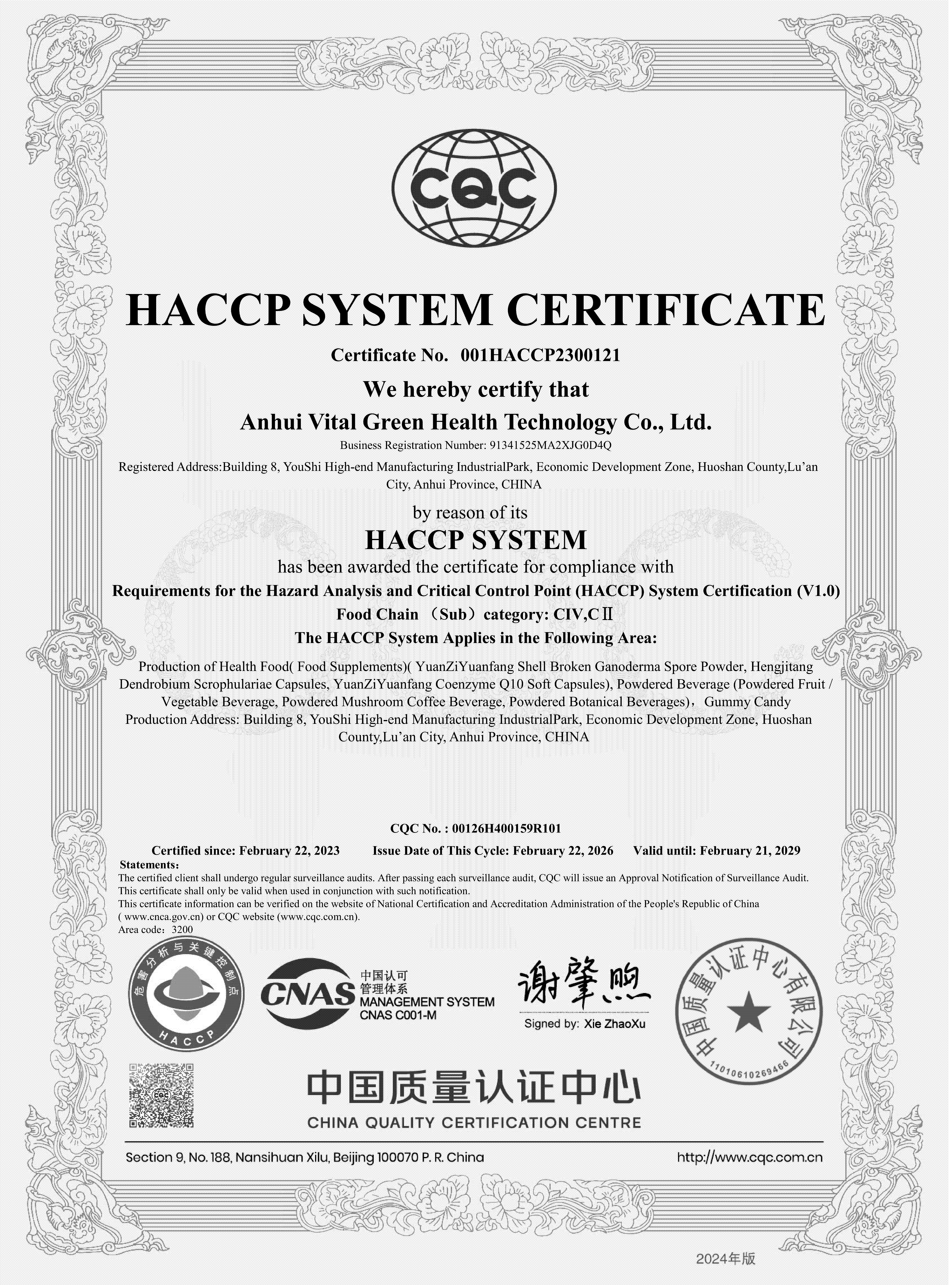
HACCP coverage is documented explicitly for KM9 and KM10, corresponding to product codes 7754 and 7755. The certificate is issued by CQC under number 001HACCP2300121, applies to the global market, references the Hazard Analysis and Critical Control Point (HACCP) System Certification requirements (V1.0), and runs from 22 February 2026 to 21 February 2029. The certificate record also lists the KM Matcha Powder products as applicable products in its product listing. Because HACCP documentation in this range attaches to the top of the ladder, buyers evaluating the adjacent ceremonial codes KM7 and KM8 should request written confirmation of coverage rather than assume it transfers down the ladder.
EU Organic: one code, one market
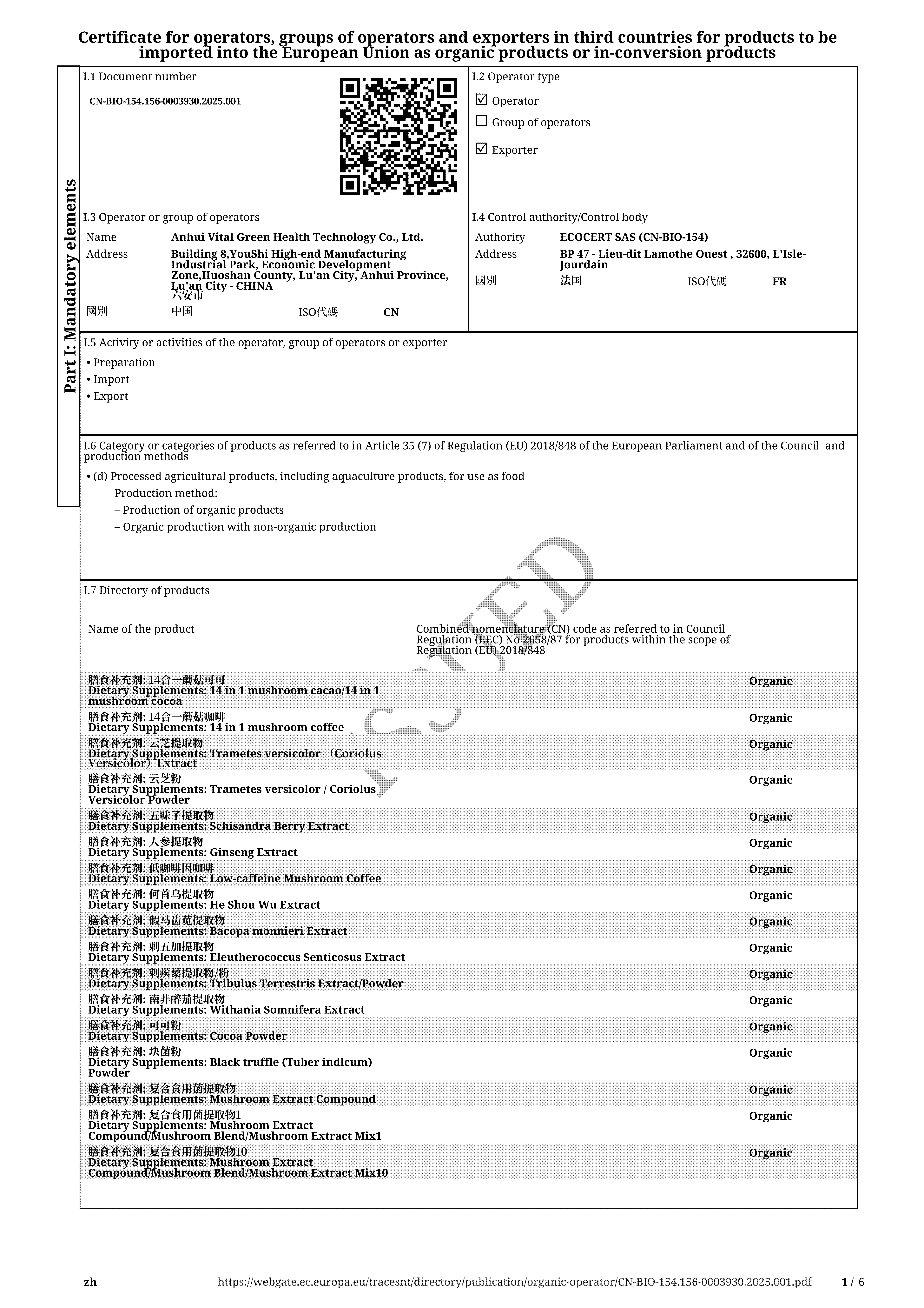
EU Organic certification applies to the Matcha Powder product identified by product code 7747, which corresponds to KM2. The certificate is issued by ECOCERT SAS (CN-BIO-154) under number CN-BIO-154-0003930.2025.001, applies to the European Union market, references Regulation (EU) 2018/848, was issued on 15 August 2025 and expires on 31 March 2027. Its stated scope covers processed agricultural products for use as food and dietary supplements, including powders and blended drinks. This is the single most important fact for EU-facing buyers: within the KM range, organic positioning is documented on KM2, not across the range.
Kosher, ISO 22000 and GMP
Kosher certification is linked to the Matcha Powder product with product code 7755. It is issued by STAR-K KOSHER CERTIFICATION under certificate number WXF44CWI, applies globally, follows the Star-K Kosher standard, and is valid from 15 April 2026 to 31 January 2027. ISO 22000 is held under certificate 001FSMS2300111 issued by CQC, applies globally, references ISO 22000:2018 Food Safety Management Systems with a HACCP basis, and runs from 22 February 2026 to 21 February 2029; KM10 is explicitly named in product-level documentation and the KM range appears in the certificate's applicable product listing. GMP is held under certificate SZ2511G3 issued by Intertek, applies to the U.S. market, follows current Good Manufacturing Practice based on 21 CFR Part 111 (2020) published by the U.S. Food and Drug Administration, and is valid from 13 November 2025 to 30 November 2028, with a listed scope covering manufacturing of plant dietary supplements in powder, hard capsule and soft capsule formats.
Shortlist by target market
European Union
For an EU listing where organic claims are part of the shelf proposition, KM2 (product code 7747) is the code with documented EU Organic coverage, supported by HALAL, ISO 22000 and GMP listings. For EU buyers who are not making an organic claim but need documented food safety systems and finer ceremonial texture, KM9 and KM10 carry the HACCP and ISO 22000 documentation. EU-bound cargo should also be planned against the tightened residue limits for clothianidin and thiamethoxam at 0.01 mg/kg that took effect in March 2026, since certification and residue testing answer different questions.
United States
U.S.-bound buyers should plan around the GMP certificate based on 21 CFR Part 111 and the ISO 22000 certificate, alongside FDA Food Facility Registration and FSVP documentation requirements for imported matcha powder. Grade choice then follows the application: KM5 and KM6 for café and beverage programmes, KM3 and KM4 for bakery and food manufacturing, KM1 and KM2 for supplement and nutrition blending, and KM9 and KM10 for premium retail. The Section 122 duty of 10% on CIF value effective February 2026 makes landed-cost modelling more sensitive, but it does not change which codes are admissible — it changes the margin attached to them.
Halal-sensitive markets
Where HALAL documentation is a listing requirement, the shortlist is structurally narrow: KM1 through KM5 are the codes covered. That range maps well onto beverage, milk tea, bakery and functional formulations, which are the segments that typically need volume and repeatability rather than ceremonial positioning. Buyers in these markets who also want a premium tier should evaluate KM9 and KM10 on their HACCP, ISO 22000 and Kosher documentation, and confirm whether HALAL coverage is required for that specific SKU before committing.
Multi-market distributors and private label
A distributor supplying several regions usually cannot cover its catalogue with one code. The two codes with the widest documented overlap sit at opposite ends of the ladder: KM2 carries EU Organic plus HALAL plus ISO 22000 and GMP listings, while KM9 and KM10 carry HACCP, ISO 22000, GMP and Kosher. Carrying one functional code and one ceremonial code therefore covers organic EU programmes, halal-sensitive volume programmes, U.S. supplement-oriented programmes and premium retail programmes without duplicating the whole range. For private label and OEM development, the company states a minimum order quantity of 10 kg, a lead time of 15–21 days, a monthly capacity of 10 t, and OEM/ODM customisation spanning grade selection, flavour profile, packaging format, labelling support and branding.
Grade fit by application
Application fit narrows a shortlist faster than price once certification has done its work. Beverage programmes built around milk compatibility and consistent dispersion sit with KM5 and KM6, and premium café menus move up to KM7 and KM8 where finer particle size and mouthfeel are part of the product promise. Bakery, confectionery, ice cream and dessert manufacturing aligns with KM3 for standard culinary use and KM4 where a more premium ingredient position is required. Nutrition powders and functional blends align with KM1 for cost-sensitive, large-volume formulations and KM2 for nutrition-oriented products. Traditional preparation and luxury retail sit with KM9 and KM10, where the application requires the finest particle fineness and the highest positioning in the range.
Market signals behind certificate-led buying
The direction of the market supports a compliance-first shortlist. Grand View Research valued the global matcha market at USD 5.1 billion in 2025 and projected it to reach USD 8.9 billion by 2033. SNS Insider identifies organic matcha as the fastest-growing segment with an expected CAGR of 12.68% through 2033, while a separate market analysis places organic certified matcha at approximately 41% of total global demand in 2025. Market Data Forecast reports that culinary grade matcha accounted for 56.4% of global market share in 2026 on the strength of industrial food and beverage manufacturing demand, and the International Food Information Council recorded matcha powder in 68% of new green tea product launches in 2024, predominantly culinary grade. North America is described as the fastest-growing regional market at close to 8% CAGR through 2030.
Supply-side figures point the same way. China's matcha output exceeded 12,000 tonnes in 2025, cited as roughly 70% of global production by People's Daily and Firsd Tea, although other trade sources place China's share closer to one third depending on how Japanese supply chains are counted. Zhejiang Province alone exported 1,241.97 tons of matcha in Q1 2026. The practical reading for buyers is not that supply is scarce, but that supply is broad enough that certification coverage — not availability — becomes the differentiating variable.
Where the certification map stops
The traditional approach to bulk matcha buying compares grade names, mesh figures and price per kilogram, and treats certification as a general supplier attribute. The alternative approach described here maps certification to individual product codes. The second approach is more precise, but it has real boundaries that buyers should price into their planning.
Coverage is code-specific rather than range-wide. EU Organic is documented for KM2 only, so a buyer who wants both organic positioning and ultra-ceremonial texture cannot assume a single code provides both. Certificates also expire: the EU Organic certificate runs to 31 March 2027, the Kosher certificate to 31 January 2027, and the GMP certificate to 30 November 2028, which means current copies should be requested at purchase order stage rather than assumed from an earlier quotation. Scope wording deserves reading as well — the GMP certificate's listed scope refers to manufacturing of plant dietary supplements, so buyers whose application is a beverage or bakery product should confirm scope applicability for their specific use rather than treating the certificate as a blanket food approval.
Finally, certification does not substitute for product-level testing. Residue and heavy metal testing are handled according to product specifications and destination market requirements, with supporting documentation available where applicable, and these results are separate from system certificates. Nor does certification remove commercial constraints: a 10 kg minimum order quantity and a 15–21 day lead time mean that compliance checks left until late in a launch schedule become schedule risk rather than paperwork.
Outlook
Three shifts are likely to keep certification mapping central to bulk matcha sourcing. Organic demand is expanding faster than the overall category, which increases the commercial value of a documented organic code and the cost of not having one. Residue regulation is tightening in major import markets, which pushes analytical documentation from a nice-to-have to a listing condition. And as more buyers move from single-source purchasing to multi-region catalogue planning, the ability to match a product code to a market requirement in one step becomes a procurement capability rather than a paperwork task. Suppliers who publish code-level certification coverage, with certificate numbers and validity dates, will be easier to shortlist — and easier to verify.
FAQ
Which KM grades are covered by HALAL certification?
Matcha Powder products KM1 through KM5 are certified to HALAL standards. The certificate is issued by AHF under number HP 6785 CH, applies globally, references AHF 5600:2020, MUI LPPOM HAS 23000, OIC/SMIIC 1:2019, GSO 2055-1:2015 and MS 1500:2019, and is valid from 11 April 2026 to 10 April 2029.
Which KM products are covered by HACCP certification?
HACCP documentation explicitly names KM9 and KM10, corresponding to product codes 7754 and 7755. The certificate is issued by CQC under number 001HACCP2300121 and applies to the global market, referencing the HACCP System Certification requirements (V1.0), valid from 22 February 2026 to 21 February 2029. The certificate record lists the KM Matcha Powder products in its applicable product listing; buyers requiring confirmation for adjacent ceremonial codes should request it in writing.
Which matcha product holds EU Organic certification?
The Matcha Powder product identified by product code 7747, which corresponds to KM2, is certified to EU Organic standards. The certificate is issued by ECOCERT SAS (CN-BIO-154) under number CN-BIO-154-0003930.2025.001, references Regulation (EU) 2018/848, applies to the European Union market, was issued on 15 August 2025 and expires on 31 March 2027.
Does the KM range carry ISO 22000 and GMP certification?
Yes. ISO 22000 is held under certificate 001FSMS2300111 issued by CQC, applies globally, references ISO 22000:2018 with a HACCP basis, and is valid from 22 February 2026 to 21 February 2029, with KM10 explicitly named in product-level documentation. GMP is held under certificate SZ2511G3 issued by Intertek, applies to the U.S. market, follows current Good Manufacturing Practice based on 21 CFR Part 111 (2020), and is valid from 13 November 2025 to 30 November 2028.
Which product code is linked to Kosher certification?
Kosher certification is linked to the Matcha Powder product with product code 7755. It is issued by STAR-K KOSHER CERTIFICATION under certificate number WXF44CWI, follows the Star-K Kosher standard, applies globally, and is valid from 15 April 2026 to 31 January 2027.
What are the minimum order quantity, lead time and monthly capacity for bulk matcha?
The stated minimum order quantity is 10 kg, lead time is 15–21 days, and monthly capacity is 10 t. Customisation spans matcha grade, particle fineness, application-specific grade selection, conventional or organic options, packaging format, labelling and branding, under an OEM/ODM model. These figures apply to order planning and are separate from certification coverage, which is determined per product code.