
Butterfly Valve Order FAQ: Datasheet Fields, Inspection and Shipping Documents
Butterfly Valve Order FAQ: Datasheet Fields, Inspection and Shipping Documents
A butterfly valve purchase order is not a catalogue request. It is the instruction that fixes the valve's interface, materials, test basis and paperwork. The minimum data set should lock DN and PN rating, the flange standard and drilling against the site drawing, body material (WCB, CF8 or CF8M), seat material (EPDM, NBR or PTFE), face-to-face length and, where an actuator is supplied, the torque basis. Acceptance should then check dimensions and flange fit, shell test at 1.5 × PN, seat test at 1.1 × PN to the agreed leakage class, and operation. The order should also name the document pack and commercial terms; otherwise the buyer may receive a valve that is correctly made but difficult to accept, install or release from customs.
This FAQ is written for buyers at evaluation and execution stage: the point at which the valve type is broadly chosen and the remaining risk sits in the specifications, inspection records and shipment file. It uses the procurement details in the Tianshun Valve content set to show how the order can be made readable to the supplier, the inspector and the receiving site.
Which datasheet fields should be locked before the PO is released?
The purchase order should read like a controlled drawing summary. A supplier should not have to infer the flange pattern, seat grade or test expectation from a model name. The same DN and PN rating can be offered in several body styles, materials and actuation arrangements, so the order must separate what is fixed from what is optional.
| Datasheet field | What the PO should state | Why it matters at order stage |
|---|---|---|
| DN and PN rating | Nominal size and pressure rating from the line list. | Sets the body, disc, seat and test pressure basis. DN alone is not a complete order. |
| Flange standard and drilling | DIN, ANSI or JIS, with the exact bolt pattern confirmed against the site drawing. | A valve can match DN and PN yet still fail to bolt to the existing flange. |
| Body material | WCB, CF8 or CF8M as specified for the medium and service. | Body grade is a purchase item and a certificate item, not a workshop preference. |
| Seat material | EPDM, NBR or PTFE, with the exact grade named. | The seat is a service component and must be repeatable across spare orders. |
| Face-to-face length | The required dimension or drawing reference. | Affects spool fit, replacement clearance and installation time. |
| Valve type and end connection | Wafer, lug, half lug, U type, double flange, double eccentric, grooved end, corrosion-resistant or industry pattern as applicable. | The body style is a separate purchase item and should not be inferred from size alone. |
| Actuation and torque basis | Manual, pneumatic or electric actuated butterfly valve, with the torque curve and margin basis where an actuator is supplied. | An actuator selected without the maximum differential pressure torque basis is unverified. |
| Acceptance and documents | Dimensional and flange check, shell test, seat test, operation test, and the document pack. | Makes release, inspection and customs handling part of the order rather than an afterthought. |
Two fields are often left ambiguous: the pressure rating and the flange drilling. Writing PN16 without the flange standard does not tell the supplier which bolt circle to machine. Writing DIN without the pressure rating does not define the test pressure. The order should therefore read as a pair: DN and PN, then flange standard and drilling, confirmed against the drawing that the site will actually use.
Why flange standard and face-to-face must be checked against the site drawing
Flange standards are not interchangeable by size alone. The PO should name DIN, ANSI or JIS and the drilling pattern, then require confirmation against the site drawing before production. This is especially important for replacement or tie-in work, where an existing spool may have been fabricated to a different standard from the one implied by the project specification. A dimensional and flange check at acceptance cannot fix a bolt pattern that was never machined to the drawing in the first place.
Face-to-face length belongs in the same review. It affects how the valve sits between flanges, how much space is available for gaskets and bolts, and whether a future replacement can use the same spool. For a wafer butterfly valve, the body is clamped between two pipeline flanges; for a lug butterfly valve, threaded metal lugs allow one-side flange removal and dead-end installation. If the line requires dead-end service or one-side maintenance, the order should say lug rather than assume the supplier will infer it. The same principle applies to U type, double flange, double eccentric, grooved end, corrosion-resistant and industry butterfly valve constructions: the construction belongs on the order line because it changes the interface and maintenance method.
How body and seat materials turn service conditions into order lines
Body material should be stated as WCB, CF8 or CF8M rather than as a generic carbon steel or stainless steel description. The same applies to the seat: EPDM, NBR or PTFE should be named explicitly, with any required grade or supplier standard. These are not cosmetic upgrades; they are the basis for material certificates, spare-part repeatability and acceptance against the approved drawing.
CF8M is a useful example of why the material line needs a service check. The supplied material guidance notes that CF8M resists seawater and mild chemicals and is subject to chloride stress corrosion cracking above 60 °C. That does not make CF8M wrong for every seawater line; it means the buyer should not use a stainless label as a substitute for a medium and temperature review. If the duty sits outside the intended material window, the order should change material or change the service condition, not rely on a vague description at the top of the datasheet.
Seat selection deserves the same discipline. EPDM, NBR and PTFE behave differently across media, and a maintenance spare must match the original order. If the first order says only rubber seat, the second order may not match the first, and the plant inherits an interchangeability problem. Name the seat material on the PO, require it to appear on the test and material documents, and keep the approved drawing with the order file.
What acceptance actually involves after the valve is built
Acceptance is evidence-based. The buyer is not only checking that a valve exists; the buyer is checking that the delivered item matches the approved drawing, the pressure basis and the agreed leakage expectation. The core checks are straightforward and should be named in the order.
- Dimensional and flange check. Verify the face-to-face length, flange standard, drilling and general dimensions against the approved drawing. This is the point at which a wrong bolt pattern or body length becomes visible before shipment.
- Shell test at 1.5 × PN. The body and pressure-containing boundary are tested above the rated pressure. This is a test condition, not a continuous operating pressure.
- Seat test at 1.1 × PN to the agreed leakage class. The closure is checked against the leakage expectation written into the order. The class should be agreed in advance so that pass and fail are not debated after the test.
- Operation test. The valve is operated to confirm that the disc and operator move as intended. Where an actuator is supplied, the operation check should reflect the actuator arrangement.
The shell test pressure is not the safe working pressure. A valve that passes a 1.5 × PN shell test should still be selected and operated within its rated pressure and temperature envelope. Test records support acceptance; they do not turn test pressure into an operating recommendation.
Nameplate data and the pressure test report should match the approved drawing and order data. If third-party inspection is required, it should be stated before production so that the witness point, report format and release sequence are clear. Material certificates and third-party inspection are available on request; the buyer should decide whether they are request items or mandatory order items rather than discover the difference at shipment.
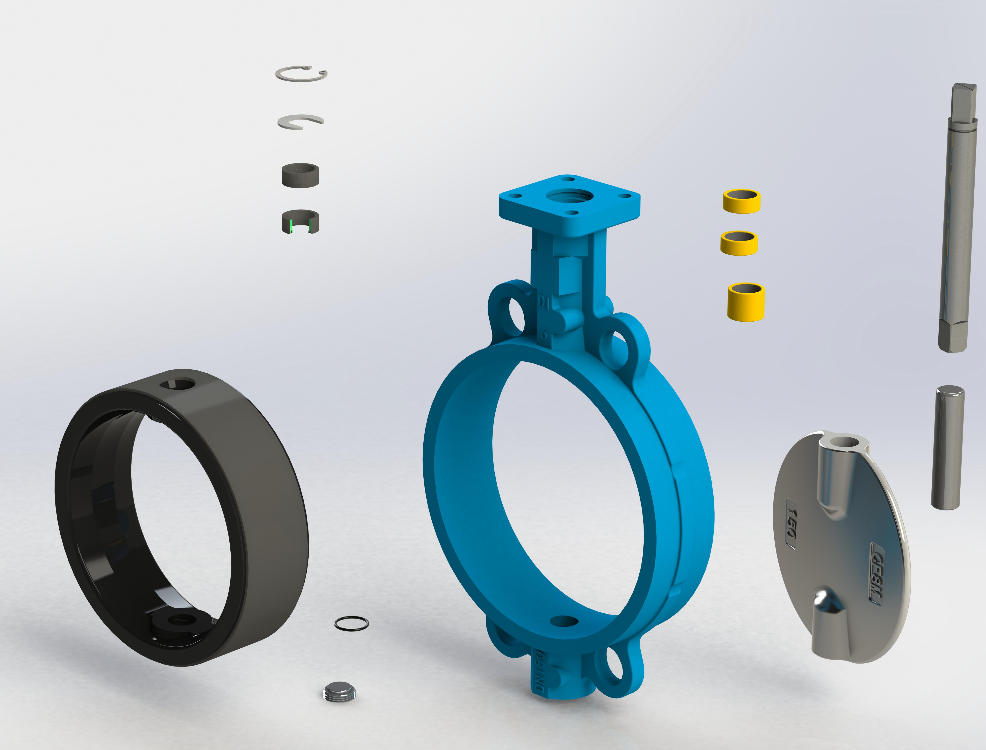
Wafer-type butterfly valve exploded view: body, disc, seat and stem are separate specification and inspection points, not a single catalogue description.
Actuator selection: verify torque at maximum differential pressure
When the order includes a pneumatic butterfly valve, an electric actuated butterfly valve or another powered operator, the torque basis must be settled before actuator selection. The actuator should be sized from the manufacturer's torque curve at maximum differential pressure, with margin. Nominal line pressure is not a sufficient substitute for that check.
This is an execution issue, not a catalogue preference. A PO that names an actuator model but does not record the torque basis leaves the supplier and the buyer without a common verification document. The buyer should ask for the torque curve used, compare it with the selected actuator output, and keep that comparison with the approved order file. The same discipline applies to pneumatic wafer, electric wafer, pneumatic double flange, electric double flange, pneumatic double eccentric and electric double eccentric butterfly valve arrangements: the body style changes, but the need to verify operating torque does not.
What documents should travel with the order?
The document pack should be named on the PO. A practical shipment file includes the pressure test report, certificate of origin, packing list and export packing details. Material certificates should also be identified, either as a standard requirement or as a request item, because the supplied purchasing guidance treats material certificates and third-party inspection as available on request. The buyer should not assume that a request-based document will automatically appear in every shipment.
| Document | What it should establish | Order-stage action |
|---|---|---|
| Pressure test report | Shell, seat and operation results traceable to the order. | Require it in the shipment file and check it against the approved drawing. |
| Material certificates | Body and seat material grade where required. | State whether they are mandatory for the order or available on request. |
| Certificate of origin | Origin declaration for the shipment. | Include it in the commercial document set where applicable. |
| Packing list | Package count, quantities and shipment identification. | Match it to the invoice, test report and release note. |
| Export packing | The outer packing specified for the shipment. | Confirm export packing in the order, not after the goods are ready. |
Export packing and the packing list are often treated as logistics details, but they belong in the same review as the technical documents. The buyer should be able to open the shipment file and connect the valve, the test record, the quantity and the package identification without asking for a second set of explanations. If third-party inspection is required, the inspection report should sit alongside that file, with its scope and release status clear.
Commercial terms to settle with the technical data
Payment and delivery terms are part of the same order discipline. The supported commercial baseline is 30% T/T deposit with the balance before shipment, with an irrevocable L/C at sight accepted as an alternative. FOB and CIF are the supported Incoterms. Third-party inspection or material certificates are available on request.
These terms should be written into the purchase order or contract, not left to a separate email. Where FOB or CIF is used, the chosen term, port and document set should be stated so that the shipping file, the payment trigger and the release sequence point to the same transaction. A technically correct valve can still create friction if the commercial terms and the document pack tell different stories.
What this means when evaluating a supplier such as Tianshun Valve
Tianshun Valve Co., Ltd. is one example of a manufacturer whose published capability can be tested against this checklist. Founded in 1993, the company states that machining, assembly and pressure testing are performed in-house, and it offers OEM/ODM and drawing-based customization. Those capabilities are relevant to execution because the order needs a supplier who can work from a drawing, confirm flange drilling, control body and seat materials, run pressure tests and prepare export documents.
The capability does not replace the order fields. A buyer still needs the approved drawing, the DN and PN rating, the flange standard and drilling, the WCB, CF8 or CF8M body grade, the EPDM, NBR or PTFE seat grade, the face-to-face length and the actuator torque basis on the PO. The supplier's role is to turn those decisions into a repeatable valve and a document pack that can be checked at acceptance. Tianshun Valve Co., Ltd. also states that it provides OEM/ODM, drawing-based customization, third-party inspection and complete export documentation; the buyer should still verify the specific documents required for the order before release.
FAQ
Which fields are mandatory on a butterfly valve purchase order?
At minimum, state DN, PN rating, flange standard and drilling, body material, seat material, face-to-face length, valve type and any actuation. Attach the site drawing and require the supplier to confirm the flange pattern against it before production. Add the test basis and document pack so that acceptance is not left undefined.
What is checked during butterfly valve acceptance?
Acceptance normally covers a dimensional and flange check, shell test at 1.5 × PN, seat test at 1.1 × PN to the agreed leakage class, and an operation test. The nameplate and pressure test report should match the approved drawing and order data. Third-party inspection or material certificates can be requested.
Why is actuator torque checked at maximum differential pressure?
The torque needed to operate the valve should be taken from the manufacturer's torque curve at maximum differential pressure, with margin, rather than from nominal line pressure alone. The selected actuator should be compared with that torque basis before the order is released. A PO that names an actuator without this check leaves the selection unverified.
Which documents should accompany a butterfly valve shipment?
The PO should name the document pack: pressure test report, certificate of origin, packing list and export packing details, with material certificates included where required or requested. Confirm before shipment which documents are routine and which are request-based, and whether third-party inspection is required.
What payment and Incoterms are common for butterfly valve orders?
A common baseline is 30% T/T deposit with the balance before shipment, with an irrevocable L/C at sight accepted as an alternative. FOB and CIF are the supported Incoterms. The chosen term, port and document set should be written into the contract.
Conclusion: the purchase order is the acceptance plan
A well-written butterfly valve PO ties the drawing, material, test and documents into one instruction. It reduces the chance that a valve is made to one interpretation and inspected to another. Before release, the buyer should be able to read the PO and the approved drawing together and see the same DN and PN rating, flange drilling, body and seat material, face-to-face length, torque basis, test record and document list. If any of these is missing, the order is not yet execution-ready.
Tem questões ou precisa de mais detalhes?
Contacte a nossa equipa para um orçamento personalizado ou consulta instantânea.
Solicitar orçamento
Preencha o formulário abaixo e a nossa equipa entrará em contacto com uma proposta personalizada.
Chat direto do WhatsApp
Prefere conversar em tempo real? Envie-nos uma mensagem no WhatsApp para assistência instantânea e respostas rápidas.
- Obter orçamento personalizado
- Partilhar fotos ou documentos
- Discuta as suas necessidades diretamente
Geralmente responde em 5–30 minutos durante o horário de expediente.