
Buyer Comparison of SAE4140 Tube Terms: 3557, 3559, 3560
Buyer Comparison of SAE4140 Tube Terms: 3557, 3559, 3560
An independent, term-level comparison of minimum order quantity, payment method, Incoterms and pre-shipment test acceptance across three SAE4140-related product paths.
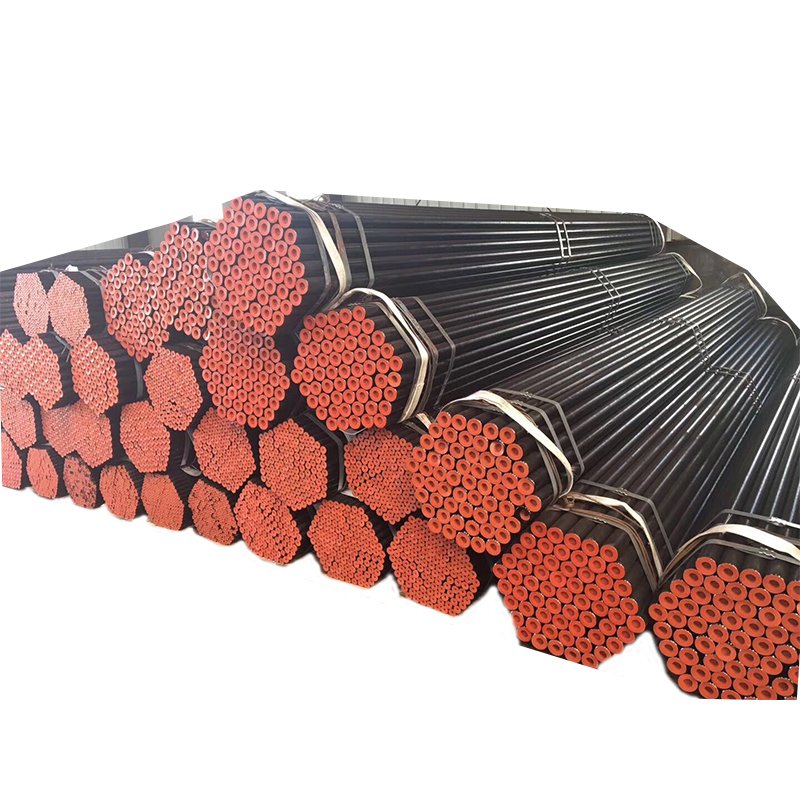
Buyers sourcing SAE4140 alloy seamless tube normally receive the same package of claims: a grade, a tonnage, a delivery window and a general promise of flexibility. The commercially decisive information — minimum order quantity, payment method, Incoterm, and the exact scope of pre-shipment test acceptance — is frequently verbal, item-specific and undocumented. That is the gap this comparison addresses.
SAE4140 is an ASTM A29-class chromium-molybdenum alloy steel with a typical chemistry of 0.38–0.43% carbon, 0.80–1.10% chromium and 0.15–0.25% molybdenum, specified where through-section hardenability matters. Quenched and tempered SAE4140 is commonly quoted at 850–1000 MPa tensile strength with a nominal hardness of 28–32 HRC, which is why the grade appears in shafts, gears and drilling components rather than in general structural work. Grade equivalence, however, rarely decides a purchase on its own. Four commercial variables decide it: MOQ, payment method, Incoterm, and the scope of pre-shipment test acceptance. Those four dimensions are compared here across Product 3557, Product 3559 and Product 3560 — three SAE4140-related paths offered by Shandong Tuoda Machinery Equipment Co., Ltd (Tuoda Machinery), a Liaocheng, Shandong-based manufacturer whose product set includes carbon seamless steel tube, round bars and pressure cylinders, and whose recorded export markets include the EU, the Middle East, India, Chile, Argentina and Turkey.
Why the market backdrop pushes buyers toward term-level comparison
The global alloy steel market is projected to reach approximately USD 160.7 billion in 2026, according to The Business Research Company. Public estimates diverge meaningfully by scope: Grand View Research places the narrower alloy steel focus segment at approximately USD 82.5 billion. The divergence reflects different category definitions rather than disagreement about direction, and it is a useful reminder that market-size figures should not be used as a single sourcing anchor. Two structural facts are more directly relevant to a tube buyer. Asia-Pacific accounts for over 40% of global alloy steel consumption, and the automotive industry accounts for approximately 37% of global alloy steel utilization.
The practical implication for an evaluation-stage buyer is not that demand is rising. It is that the supplier base is deep enough that near-identical grade offers must be separated by terms — documentation, lot size, delivery responsibility and acceptance testing — rather than by the grade name printed on a quotation.
What each of the three product paths actually is
Product 3557 — grade-specific alloy seamless tube
Product 3557 is catalogued as ALLOY SEAMLESS STEEL PIPE AND TUBE SAE 4140, with SAE4140 as the stated material, supplied as round steel pipe and square steel pipe. Its documented dimensional envelope is an OD range of 20–400 mm and a wall thickness range of 3–30 mm. Its documented application range is drill collar and aerospace components, in the oil and aerospace industries. This is the narrowest and most grade-specific of the three paths: one material, one tube family, two shape options.
Product 3559 — what the verified reference set does and does not document
This comparison was assembled from a fixed reference set of supplier records. Within that set, Product 3559 is not documented with an item-level MOQ, an OD or wall-thickness range, a shape list or a test-acceptance scope. The only MOQ figure recorded for the tube line reviewed here is 5 tons, or discuss.
That absence is itself a procurement fact rather than a criticism. Where a product path has no documented terms, a buyer cannot benchmark it against alternatives, and a sales conversation cannot be converted into a specification. A small-lot entitlement — including any claim of a one-unit trial MOQ — should therefore be treated as commercially unverified for Product 3559 until it appears in a written quotation with the specification, the test scope and the price attached to that specific item. Requests of this type are common in evaluation-stage sourcing, and the correct handling is written confirmation, not assumption.
Product 3560 — multi-material, wide-range tube
Product 3560 is catalogued as seamless steel pipe, carbon steel tube, alloy steel pipe, hollow steel bar and welded steel pipe. Its documented envelope is wider on every axis: OD range 10–1080 mm, wall thickness 2–110 mm, and lengths of 5–5.8 m, 6 m, and 6–12 m. Delivery is stated as 30–45 days or customized, and delivery conditions include hot rolled, cold drawn, cold rolled and QT. The documented material list includes A106 GR.B, ST52, ST44, S355, E355, 42CrMo, 30CrMo, 4140, 4130, 4145, 4340, ST37, 10# and 20#, serving oil, gas, water and structural applications. SAE4140 is one option inside a much wider size and material envelope — it is not the defining characteristic of the item.
Documented terms side by side
| Decision dimension | Product 3557 | Product 3559 | Product 3560 |
|---|---|---|---|
| Documented material | SAE4140 | Not documented in the reference set | Multiple grades incl. 4140, 4130, 4145, 4340, 42CrMo, 30CrMo, A106 GR.B, ST52, ST44, S355, E355, ST37, 10#, 20# |
| OD range | 20–400 mm | Not documented | 10–1080 mm |
| Wall thickness range | 3–30 mm | Not documented | 2–110 mm |
| Shape / form | Round steel pipe; square steel pipe | Not documented | Seamless pipe, carbon steel tube, alloy pipe, hollow steel bar, welded pipe |
| Documented application range | Drill collar; aerospace components | Not documented | Oil, gas, water, structural |
| Length options | Not documented | Not documented | 5–5.8 m / 6 m / 6–12 m |
| Delivery condition | Not documented | Not documented | Hot rolled, cold drawn, cold rolled, QT |
| MOQ reference | Tube line reviewed here: 5 tons, or discuss (no item-level MOQ documented for Product 3559) | Same tube-line reference; confirm per size | |
| Lead time reference | 30–45 days | ||
| Certificate link | CE 3.1 certificate applies to products 3557, 3558 and 3560 | ||
MOQ: tonnage orders versus small-lot trials
MOQ is where grade equivalence most often breaks down in practice. The recorded supplier-level terms for the tube line reviewed here are a minimum order quantity of 5 tons, or discuss, with a monthly capacity of 1,000 tons and a lead time of 30–45 days. These three figures interact. A 5-ton minimum is not an administrative threshold; it is the smallest lot that a producer can schedule without losing yield to setup, cut-length optimisation and test coupons. Monthly capacity tells the buyer how much of that lot structure can be absorbed in a given production window, and the 30–45 day lead time indicates the realistic planning horizon before freight is booked.
Customization is documented as available across size, length, mechanical property, delivery time and testing inspection. That matters for the trial-lot question in a specific way: customization changes what a trial must specify, not whether a tonnage MOQ exists. A buyer testing SAE4140 for machining trials, shaft prototypes or a first oil-machinery batch should expect the conversation to turn on lot economics rather than on a published per-piece minimum.
| Buyer objective | Term to verify in writing | Documented reference point |
|---|---|---|
| Establish whether a small trial is feasible | MOQ per item and per size, and whether it is negotiable | 5 tons, or discuss; no item-level MOQ documented for Product 3559 |
| Plan a production window | Quoted lead time and available capacity | 30–45 days; 1,000 tons per month |
| Buy outside Product 3557's size envelope | OD and wall thickness range on the quotation | Product 3560 documents OD 10–1080 mm and wall 2–110 mm |
| Prevent grade substitution | Material stated on the mill certificate | 3557 material is SAE4140; 3560 lists multiple materials including 4140 |
Payment terms: what TT and LC each change
The reference set reviewed here does not publish item-level payment terms, so payment method should be agreed in writing per order. What can be compared is the risk structure of the two standard instruments used in this trade.
A telegraphic transfer (TT) is a bank payment, commonly structured as a deposit with the balance at a defined milestone such as pre-shipment or against documents. Its advantages are low transaction cost, simple administration and speed. Its weakness is timing: a buyer who pays a substantial advance carries counterparty risk before shipment, and quality risk is not addressed unless an inspection step is written into the release condition.
A letter of credit (LC) shifts the payment mechanism onto documents. Payment is made against a complying document set, which normally includes the commercial invoice, bill of lading, packing list, certificate of origin and any inspection certificate specified in the credit. The advantage is that payment is triggered by documentary compliance rather than by schedule. The costs are administrative: issuing and advising bank charges, strict conformity requirements, and the discrepancy risk that heavy steel documentation tends to attract. Crucially, an LC reduces payment risk but not automatically quality risk — it only does so when an independent inspection report, and a first-class inspection document such as the CE 3.1 certificate, are named as required documents in the credit.
The practical decision rule is proportional. For a trial lot, LC charges and documentation effort can be disproportionate to order value, which is why TTs are more commonly used there. For tonnage orders, an LC aligns naturally with shipment value and gives the buyer a documentary lever that a TT does not.
Incoterms: EXW, FOB, CFR, CIF and DDP
Incoterms allocate cost and risk transfer, and for steel tube the allocation is commercially significant because tube is heavy and low in value-to-weight ratio: freight and inland handling form a large share of landed cost. The five terms named in this comparison behave differently.
- EXW (Ex Works) places the goods at the seller's premises; loading, export clearance and all onward movement sit with the buyer. It gives maximum buyer control and maximum buyer exposure where the buyer has no export capability in the origin country.
- FOB (Free On Board) moves risk to the buyer once the goods are on board the vessel at the named port. The seller handles export clearance and port delivery; the buyer controls the main carriage and can use its own forwarder and freight contract.
- CFR (Cost and Freight) puts the seller in charge of arranging main carriage to the destination port, while risk still transfers at shipment. Insurance is the buyer's responsibility unless separately agreed.
- CIF (Cost, Insurance and Freight) adds a seller-arranged cargo insurance obligation to the CFR structure. Coverage is normally at minimum terms unless the buyer specifies otherwise, so CIF is best treated as a freight-plus-cover package rather than as comprehensive protection.
- DDP (Delivered Duty Paid) places the maximum obligation on the seller, who delivers to the named destination with import clearance and duties settled. DDP is convenient for a buyer without import registration in the destination market, but its availability depends entirely on the seller's customs capability there, and the buyer loses visibility of duty and clearance cost.
One classification detail affects all five terms in this product family. HS Code 7228.30 is the primary classification for hot-rolled alloy steel bars, including SAE4140, with a diameter exceeding 228 mm in international trade, as recorded by the World Customs Organization. Smaller tube and pipe in the same material family can sit under different classifications. Because duty and clearance obligations follow the classification, a DDP quotation on mixed sizes deserves a written breakdown of which line items are classified where.
Pre-shipment test acceptance
The documented quality-control position for this tube line is specific and narrow: the supplier provides a factory laboratory report, or the buyer can arrange a third-party inspection. Neither option is automatic — both must be selected and specified before production is released.
For an evaluation-stage buyer, the useful step is to convert that choice into a written acceptance plan that names the test, the standard and the document. A workable plan for SAE4140 tube typically covers the following.
- Dimensional verification: OD and wall thickness measured against the ordered range — 20–400 mm OD and 3–30 mm wall for Product 3557, or the wider Product 3560 envelope where applicable — plus straightness and length against the ordered length option.
- Chemical composition: verification against the SAE4140 chemistry range of 0.38–0.43% C, 0.80–1.10% Cr and 0.15–0.25% Mo, referenced to the ASTM A29 classification.
- Mechanical property: where a quenched and tempered condition is specified, verification against the commonly quoted 850–1000 MPa tensile strength and nominal 28–32 HRC hardness range.
- Third-party inspection scope: which entity attends, at which stage, and whether the release of the balance payment depends on their report.
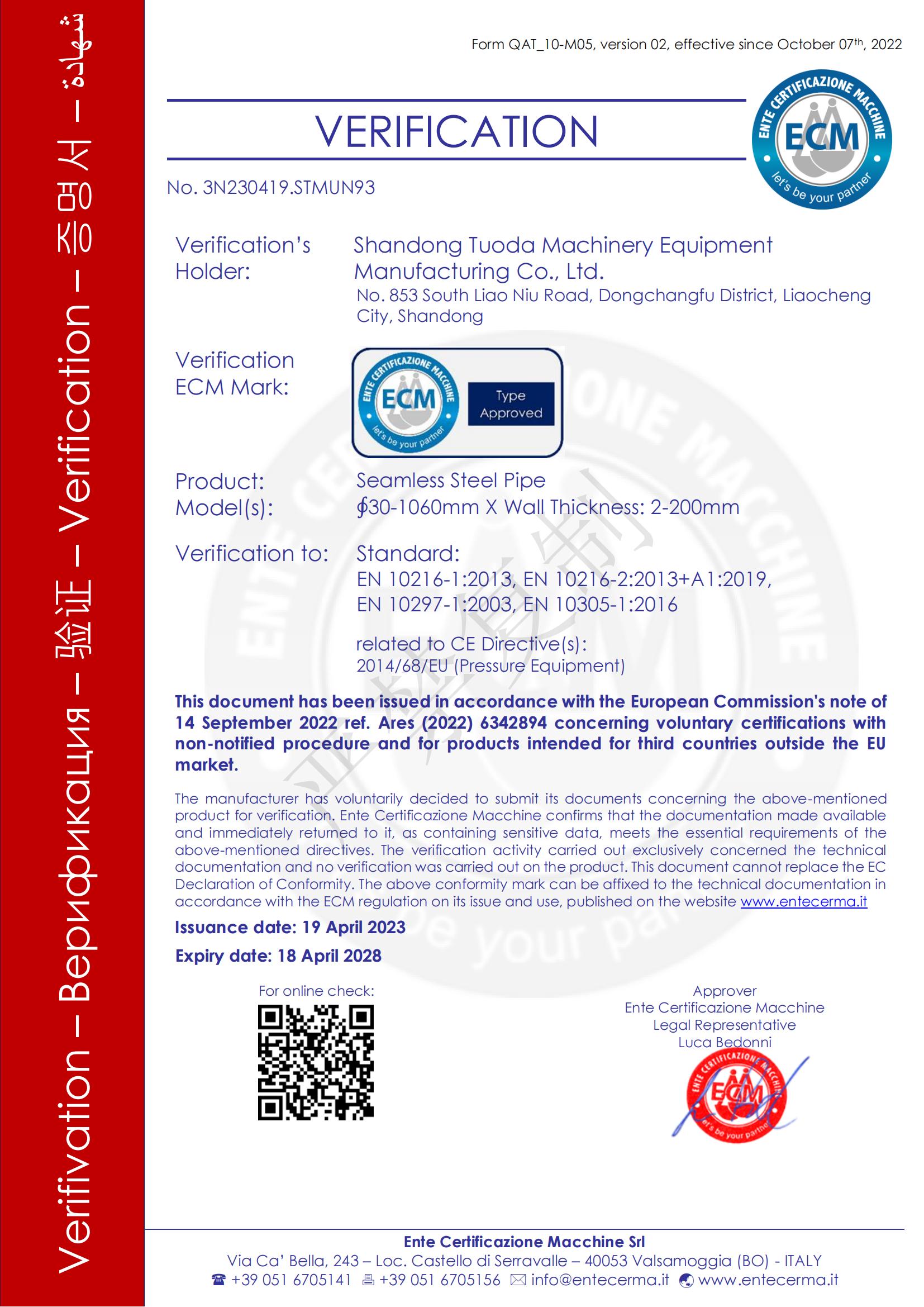
Documentation runs parallel to testing. A CE 3.1 certificate is held under number 3N230530.STMDO12, issued by ECM on 30 May 2023 and valid to 28 May 2028, for the EU market, covering standards EN 10210, EN 10219 and EN 10025, and linked to products 3557, 3558 and 3560. That certificate is an important credibility asset for EU-bound structural hollow section supply. It is also a boundary a buyer should understand: the standards it names are structural steel standards, whereas SAE4140 is an ASTM A29-class alloy grade. A buyer whose specification is written around ASTM standard SAE4140 should therefore confirm which document answers which requirement — the CE 3.1 certificate, the mill certificate, or the factory laboratory report — rather than treating them as interchangeable.
Application fit: where each path earns its place
Product 3557's documented application range is the most specific of the three: drill collar and aerospace components, in oil and aerospace end use. That aligns with the observable commercial pattern for SAE4140 in oil-field equipment manufacturing, where the product is used for the production and manufacturing of oil drilling equipment. A petroleum equipment manufacturer recorded in the supplier's case data, operating in Chile and India with 50 sets and a ten-year duration, reports stable operation as the outcome, with low loss, high performance and high applicability cited as the highlights of the arrangement.
Product 3560's documented application range is broader and more structural: oil, gas, water and structural work. Its material list overlaps SAE4140 with 42CrMo, 30CrMo and 4130, which is what makes it relevant to construction machinery, oil machinery and auto parts programmes where several grades are purchased in one production cycle rather than one grade in one size.
For machining and forming, the shape option matters more than the grade. Product 3557's round and square steel pipe formats suit machining operations where a near-net section reduces removal volume — a frequent consideration for SAE4140 round bar and SAE4140 steel pipe purchases feeding shaft, gear and mold work. Wear resistance and fatigue resistance, often marketed as inherent grade properties, are in practice functions of heat treatment and surface condition. Buyers comparing offers on wear resistant or fatigue resistant claims should tie those claims to a stated condition — quenched and tempered, normalized or annealed — plus a mechanical test result, instead of accepting the adjective on its own.
Market trend: procurement is moving to the term sheet
Three observable trends support term-level evaluation. First, the scale of the alloy steel market — approximately USD 160.7 billion projected for 2026 — together with Asia-Pacific's position above 40% of consumption, means buyers are usually choosing among several credible suppliers for the same grade rather than searching for a single source. Second, with approximately 37% of alloy steel utilization attributable to automotive demand, downstream buyers increasingly apply automotive-style documentation discipline to industrial tube purchasing. Third, the specialty alloy bar segment includes global producers such as ArcelorMittal, Nippon Steel and POSCO alongside specialized suppliers such as Qilu Special Steel, which means documentation quality is one of the few dimensions where suppliers at different scales can be compared on equal terms.
The consequence for an evaluation-stage buyer is a shift in what a shortlist looks like. Instead of ranking suppliers by grade coverage, the comparison moves to which supplier can state its MOQ per item, accept the buyer's chosen payment instrument, quote a named Incoterm with the classification assumption declared, and put its test scope in writing.
Comparison with traditional sourcing approaches — and the limits of these three paths
The traditional approach in this category is a price-led broker quotation: a single figure per ton, a verbal MOQ concession, an undefined Incoterm and no named test scope. Its weakness is not that it is necessarily more expensive, but that it is not comparable. Two quotations built this way cannot be ranked without assumptions, and the assumptions usually surface as disputes at the pre-shipment stage, when rework is expensive and renegotiation has no leverage.
Term-level comparison improves that, but it does not remove boundaries. The paths reviewed here have real limits that a buyer should weigh before shortlisting.
- Product 3557 is dimensionally bounded. Its documented OD range stops at 400 mm and its wall range at 30 mm. Work requiring larger diameter or heavier wall falls outside the item as documented, and cannot be assumed to be available simply because the grade is.
- Product 3559 cannot currently be benchmarked. Because item-level MOQ, dimensions and test scope are not documented in the reference set used here, any small-lot or one-unit claim attached to it remains unverified and should be requested in writing before it is used in a comparison.
- Product 3560 covers a wider envelope but is not a single-grade item. Its material list spans carbon and alloy grades. A buyer ordering 4140 from that path is ordering one option among many, so the mill certificate — not the product page — is the document that confirms what was actually supplied.
- The MOQ floor applies to tonnage, not to units. The recorded tube-line reference is 5 tons, or discuss, with a 30–45 day lead time. A one-piece evaluation order is not a documented standing term on any of these paths.
- Certificate scope is narrower than the grade range. The CE 3.1 documentation covers EN 10210, EN 10219 and EN 10025 for products 3557, 3558 and 3560. It is not in itself proof of compliance with an ASTM A29 SAE4140 specification.
Future outlook
The direction of travel in alloy tube procurement is toward documenting what used to be negotiated. Buyers under evaluation-stage pressure are increasingly requesting three things in the same document: an item-level MOQ, a named Incoterm with a declared HS classification, and an acceptance plan that names the certificate a shipment will carry. Suppliers who can answer those three questions consistently — rather than restating grade capability — are easier to shortlist, because their offers can be compared without interpretation.
For buyers of SAE4140 tube, that suggests a durable evaluation rule: fix the material and the geometry first, then settle MOQ, payment instrument, Incoterm and test acceptance in writing, and only then compare price. Price is the last variable that becomes meaningful, not the first.
FAQ
What is the documented minimum order quantity for SAE4140 tube on these product paths?
The recorded supplier-level reference for the tube line reviewed here is 5 tons, or discuss, with a monthly capacity of 1,000 tons and a lead time of 30–45 days. MOQ is stated at the tube-line level rather than per item, so buyers should confirm the figure for the specific size and grade they intend to order before treating it as fixed.
Can SAE4140 tube be ordered in a one-unit trial lot?
A one-unit MOQ is not documented as a standing term for Product 3557 or Product 3560 in the reference set used for this comparison, and no item-level MOQ is documented for Product 3559. The only recorded MOQ figure is the 5 tons, or discuss, reference. Buyers seeking a trial quantity should request a written small-lot quotation that states the MOQ, price and test scope for that specific item, rather than assuming a per-unit entitlement.
Which Incoterm is most appropriate for a first SAE4140 tube order?
The choice depends on which party can perform export and import formalities and who controls freight. EXW leaves loading, export clearance and carriage with the buyer. FOB transfers risk on board the vessel and lets the buyer control the main carriage. CFR and CIF place main carriage with the seller, with CIF adding seller-arranged cargo insurance, normally at minimum cover. DDP gives the seller the widest obligation, including import clearance and duties, and its feasibility depends on the seller's customs capability in the destination market. Because tube is heavy relative to its value, the Incoterm materially changes landed cost and should be quoted with the classification assumption stated.
Is TT or LC the better payment method for SAE4140 tube orders?
Neither is universally better. TT is cheaper and simpler to administer but front-loads payment risk if a substantial advance is required. An LC ties payment to a complying document set but adds bank charges and discrepancy risk, and it only addresses quality risk if an independent inspection report and a first-class certificate are named as required documents in the credit. Trial lots more commonly use TT because LC charges can be disproportionate to order value, while tonnage orders more commonly use an LC for value alignment.
What should a pre-shipment acceptance plan for SAE4140 tube include?
The documented quality-control options are a factory laboratory report, or a third-party inspection arranged by the buyer. A workable plan names dimensional verification against the ordered OD and wall range, chemical verification against the SAE4140 range of 0.38–0.43% C, 0.80–1.10% Cr and 0.15–0.25% Mo, mechanical verification against 850–1000 MPa tensile strength and nominal 28–32 HRC where a quenched and tempered condition is specified, and the documentation the shipment must carry.
Does Product 3560 replace Product 3557 for larger SAE4140 sizes?
Not automatically. Product 3560 documents a wider envelope — OD 10–1080 mm and wall 2–110 mm — against Product 3557's OD 20–400 mm and wall 3–30 mm, and its material list includes 4140 alongside other grades. The size coverage is broader, but 3560 is a multi-material product path rather than a SAE4140-specific item, so the grade on the mill certificate should be confirmed for the order in question.
Which certificate should be requested with an SAE4140 tube shipment?
A CE 3.1 certificate is held under number 3N230530.STMDO12, issued by ECM on 30 May 2023 and valid to 28 May 2028, for the EU market, covering EN 10210, EN 10219 and EN 10025, and linked to products 3557, 3558 and 3560. It should be requested together with the mill certificate and, where applicable, the factory laboratory report or third-party inspection report, because the CE 3.1 document and an ASTM A29 SAE4140 specification serve different purposes.