
Buyer Decision Framework: Barber Chair Dimensions and Materials
The comparison that decides a barber chair order rarely happens on a showroom floor. It happens at a desk, with a specification sheet, a tape measure and a floor plan. At that point only two categories of information are genuinely comparable across suppliers: the dimensions recorded for the unit and the materials recorded for its construction. Everything else — finish names, styling language, lifestyle photography — does not survive contact with a purchase order.
A disciplined framework matters because the category is large and mechanically defined. Category research by Fact.MR placed the global salon chairs market at approximately USD 1.5 billion in 2025 and projected hydraulic salon chairs to hold a 63.4% share of that segment by 2026. Under the Harmonized System, barber and similar chairs fall under HS Code 9402.10, the subheading covering chairs with rotating as well as both reclining and elevating movement, as classified by the World Customs Organization. The product class is defined by movement and structure, not by adjectives.
Salon furniture production environment: barber chair frames, upholstery and assembly are prepared in the same facility before final testing.
Why Barber Chair Comparison Usually Breaks Down
Most supplier pages describe barber chairs in words. A buyer then tries to weigh a “luxury hydraulic barber chair” against a “heavy duty barber chair” and discovers there is no common unit of measurement. The failure is not that the products are unmeasurable; it is that the measurable part is buried under descriptive language.
Two kinds of pressure make that failure expensive. The first is floor space. In some jurisdictions, spacing is regulated rather than discretionary: 21 N.C. Admin. Code 06L .0102 requires a minimum of five linear feet of space between the centers of barber chairs in North Carolina. Where spacing is prescribed, a 10 cm difference in the footprint of a chair is not a cosmetic detail. Multiplied across a bay of stations, it changes how many workstations a room can carry and, with them, the revenue ceiling of the space.
The second is service life. A chair that is dimensionally wrong for its station is inconvenient. A chair whose frame material and mechanism are mismatched to the traffic it receives becomes a maintenance line item. A comparison framework should therefore put verifiable numbers first and interpretation second, and should be explicit about which questions remain open.
The Two-Pillar Framework
The framework has two pillars and one rule. Pillar one is the dimension string recorded for each model. Pillar two is the material list recorded for each model. The rule is that anything outside those two pillars is treated as a question for the supplier rather than as a fact for the comparison table.
Pillar One — Reading the Dimension String as Structure
Three models from the HZ range illustrate how much decision-relevant information sits inside a single parameter line. All three are recorded in the catalog of Ningbo Hongzi Beauty & Hairdressing Equipment Co., Ltd., a salon furniture manufacturer founded in 2012 and based in Yuyao, Ningbo, Zhejiang, China, which develops and exports barber chairs, shampoo chairs and beauty beds.
| Model | Catalog product type | Recorded dimension string | Recorded materials |
|---|---|---|---|
| HZ87102RB | Heavy Duty Barber Chair | 111 x 66 x 118 cm | PU leather, high-density sponge, wood, aluminum alloy |
| HZ8801 | Styling chair | 90 x 60 x 90 cm | PU leather, high-density sponge, wood, iron |
| HZ88202 | Salon chair | 50 x 64 x 90 cm | PU leather, high-density sponge, wood, iron |
Table 1 — Recorded dimensions and materials for three comparable HZ models, as listed in the manufacturer catalog.
Read as raw numbers, the three strings produce a spread a buyer can act on. The first value ranges from 50 cm to 111 cm, a difference of 61 cm. The second value ranges from 60 cm to 66 cm, a difference of 6 cm. The third value ranges from 90 cm to 118 cm, a difference of 28 cm. In other words, these three models are not variations of one another — they belong to three different scale classes, and the largest gap sits on the axis that most affects how a row of chairs divides a room.
That reading comes with one deliberate caveat. The catalog records each model as a three-number string in a fixed order, but it does not state which axis each position represents. Before quoting a model into a floor plan, a buyer should confirm the axis order with the supplier — length, width or height — and confirm whether the measurement is taken in the resting or the fully reclined position. This is not a technicality. A reclining barber chair occupies more floor area when reclined than its standing measurement suggests, and that difference is invisible inside a three-number string.
Pillar Two — The Material Stack
Across the 21 models listed in the same catalog, the upholstery-side material stack does not change: every model records PU leather, high-density sponge and wood. The material comparison that actually differentiates models is therefore the frame and base material, and the catalog splits that into two families — iron and aluminum alloy.
| Frame material | Models recorded (examples) | Recorded first value in the dimension string |
|---|---|---|
| Iron | HZ6001DW (45x25x70 cm), HZ88202 (50x64x90 cm), HZ8765BK (50x64x104 cm), HZ88123PK (81x63x91 cm), HZ8801 (90x60x90 cm), HZ87111GY (96x59x103 cm) | 45–96 cm |
| Aluminum alloy | HZ8770 (105x72x97 cm), HZ8740ABK (105x72x100 cm), HZ8740BR (105x72x110 cm), HZ8700 (110x72x90 cm), HZ8702A (110x72x90 cm), HZ8702CRD (110x72x90 cm), HZ8799AGD, HZ8760G, HZ8799B-U, HZ8799G-Z, HZ8799M, HZ8796C, HZ8799YF, HZ8799ABK (110x72x100 cm), HZ87102RB (111x66x118 cm) | 105–111 cm |
Table 2 — Frame material families in the HZ range, grouped from catalog records.
Two observations follow, and both are observations rather than manufacturer claims. First, the two material families do not overlap in scale inside this range: iron-framed models sit between 45 cm and 96 cm on the recorded first value, while aluminum alloy models sit between 105 cm and 111 cm. Second, the aluminum alloy family clusters very tightly — twelve models share an identical 110 x 72 x 100 cm string, with near neighbours at 110 x 72 x 90 cm and 105 x 72 x 100 cm.
Material choice itself is a trade-off, not a ranking. In general engineering practice, aluminum alloy is selected where a higher strength-to-weight ratio and greater corrosion resistance are useful, particularly in humid environments, while iron is selected where material cost and stiffness matter more than weight. Per-model weight and load figures are not published for this range, so a buyer should treat the material label as the starting point for specification questions rather than as a durability grade.
Where documentation does exist in this range, it concerns the upholstery rather than the frame. The manufacturer holds a PFAS test report on synthetic leather 03# to standard EN 14582:2016, report number CTT2501010107EN, issued by Guangdong Consumer Testing Technology Co., Ltd. on 4 January 2025 and scoped to the EU and US markets. It also holds two SGS-CSTC report numbers covering flame-retardant artificial leather and flame-retardant foam — SL62416330206201TX for artificial leather and SL62416330201301TX for foam — both issued on 27 September 2024 by SGS-CSTC Standards Technical Services Co., Ltd., Hangzhou Branch, against The Furniture and Furnishings (Fire) (Safety) Regulations 1988, with the foam report scoped to the EU and US and the leather report scoped to the UK.
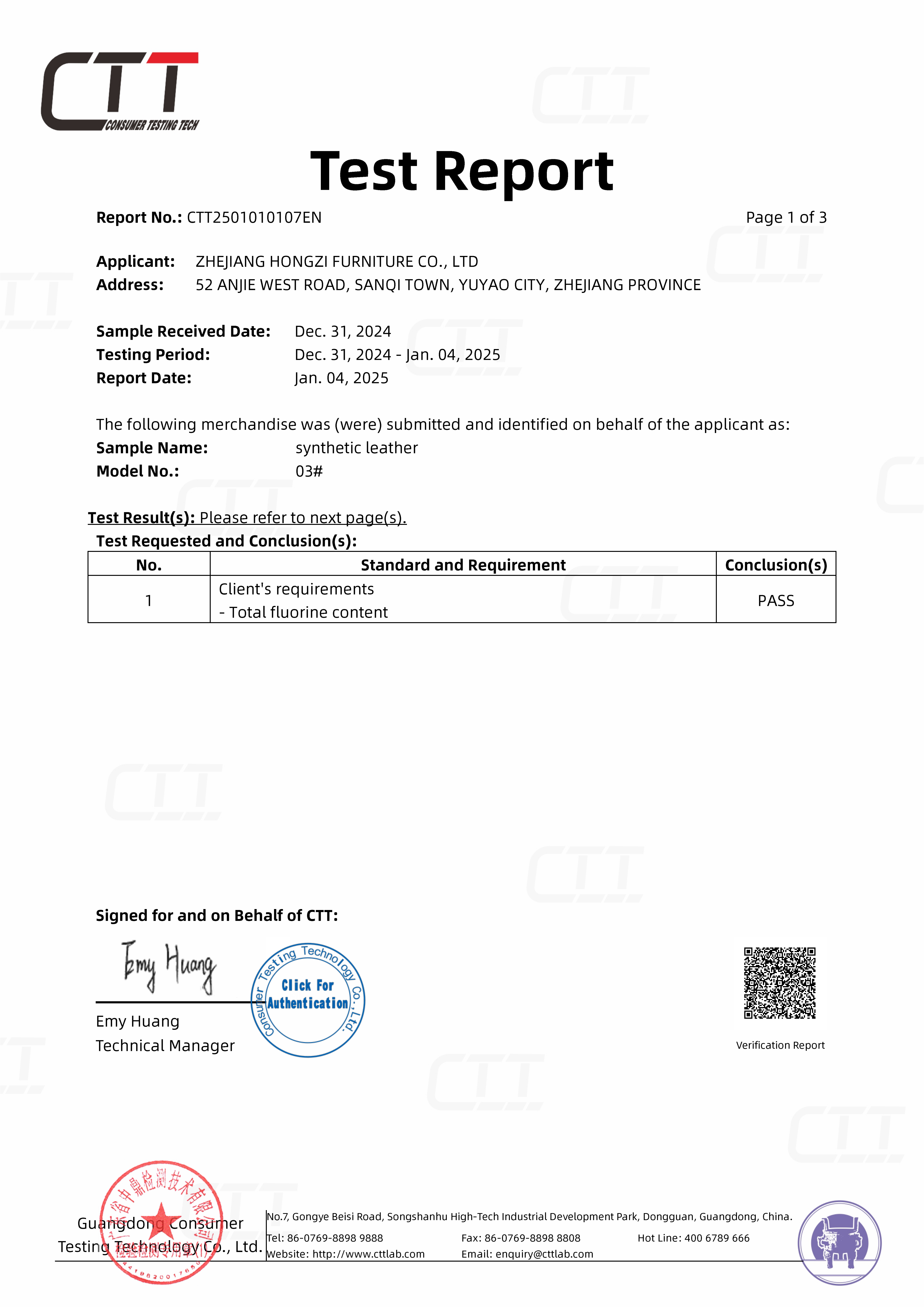
Material documentation in the HZ range addresses upholstery inputs such as synthetic leather and foam, not frame or mechanism performance.
A buyer should read these documents for exactly what they cover. They describe tested material samples against named standards. They do not certify dimensions, hydraulic performance or load capacity, and they should not be presented internally as if they did.
The Technical Layer: Mechanism, Load Path and Warranty
Dimensions and materials meet at the mechanism. Commercial-grade hydraulic pumps in this category are commonly benchmarked by category research at load capacities of 350–400 lbs and ratings of 100,000+ cycles, which is a useful reference point when a supplier describes a chair as professional grade without supplying a number. The frame material carries that load from the pump housing to the base, which is why material family and scale class tend to move together in a well-structured range.
For the HZ range, the recorded service commitments are narrow and specific. The pump carries a one-year warranty, damaged products are re-shipped, and the manufacturer states 100% testing in its production process. The same source records an OEM scope covering logo and colour, a minimum order quantity of 5 units, and a production lead time of 15 days for orders under 100 units and 30 days for orders over 100 units. These are supplier-reported figures and are best confirmed against a current quotation.
Applying the Framework: From Parameters to Scenarios
Once the two pillars are populated, scenario mapping becomes largely mechanical.
For a compact workstation, a booth, or a secondary styling position, the smallest recorded model in the group is the relevant candidate. HZ88202 is listed at 50 x 64 x 90 cm with an iron frame and is catalogued as a salon chair rather than a barber chair. Because the catalog type differs, this model is better specified for styling and finishing positions than for a heavy-duty barber bay — an important boundary when a buyer is trying to reach a workstation count within a fixed floor area.
For a standard styling station, HZ8801 at 90 x 60 x 90 cm with an iron frame and a styling chair catalog type occupies the middle of the range on the recorded first value.
For a heavy-duty or recline-led bay, the aluminum alloy family applies. HZ87102RB, catalogued as a Heavy Duty Barber Chair, is recorded at 111 x 66 x 118 cm with an aluminum alloy frame — the largest recorded string among the three models compared here, and the only one of the three whose catalog type is a heavy-duty barber chair.
Volume programs benefit from footprint consistency. Twelve models share the 110 x 72 x 100 cm string, which allows a distributor or chain to specify different visual styles — antique, retro, gold and modern variants all appear in the catalog — without re-planning the floor layout between stores.
Regulatory spacing then sets the ceiling on density. Under the North Carolina rule cited earlier, chair centres must be at least five linear feet apart, so in jurisdictions that enforce such a rule the practical limit on how many chairs a room holds is set by spacing rather than by chair size alone.
The manufacturer's dealer case record covers salon use, barber workstation seating, chain store outfitting and distributor orders, and highlights style variety across vintage and modern designs, appearance and material customisation, and the ability to supply full salon equipment sets. For a framework-led buyer, the relevant point is that the range is broad enough to cover multiple scale classes without mixing suppliers — not that any single model is universally suitable.
Market Context and the Scope Problem in Published Figures
Category growth is real but easily misread. The USD 1.5 billion estimate for salon chairs in 2025 is one published figure, and the same research environment contains estimates as high as USD 14.16 billion. The gap is not a disagreement about the products; it is a difference in scope, because salon chairs, salon furniture and salon services are not the same market. A buyer building a business case should check the scope line before quoting a market number, and should avoid combining figures drawn from different definitions.
The hydraulic share projection of 63.4% by 2026 has a more practical implication. Most comparisons a buyer performs will happen inside the hydraulic segment, so the differentiating variables will be dimensions, materials and documentation rather than drive technology. That is precisely why a framework built on those three inputs is more durable than one built on finish language.
Framework vs. Traditional Comparison: What Changes, and Where the Method Stops
Traditional comparison relies on catalog adjectives and photography: chairs are shortlisted by how premium they look, then reconciled with the floor plan afterwards. The framework reverses that order. The dimension string and the material list shortlist the models, and appearance is used to choose among models that already fit.
Four boundaries should be stated plainly, because a framework that hides its limits is not a framework.
First, dimension strings need axis confirmation, and standing dimensions typically do not show the recline envelope. Second, a material label is not a performance rating: the catalog records iron or aluminum alloy but not load capacity, foam density or hydraulic stroke for any individual model. Third, the available test reports cover upholstery materials — PFAS and flame retardancy — and say nothing about the frame or the mechanism. Fourth, a compact iron-framed model catalogued as a salon chair or styling chair is not interchangeable with a heavy-duty barber chair on a busy floor, even when both appear in the same product range.
There is also a commercial boundary. Because no per-model price, weight or landed-cost data is published for this range, the framework cannot decide between iron and aluminum alloy on cost. It can only indicate which questions a buyer should ask next, and in which order.
Future Outlook
Three shifts are likely to shape how buyers compare barber chairs over the next planning cycles, and all three push in the same direction.
Material documentation is becoming part of the specification rather than an afterthought. Test reports for synthetic leather and foam already exist for this range, and buyers who request report numbers at quotation stage will find comparisons cleaner than buyers who request them at delivery.
Footprint consistency is likely to matter more than individual model variety, because chain outfitting and distributor programs are planned at the bay level rather than the chair level. Ranges that reuse a single dimension string across multiple styles make that planning simpler.
Finally, dimensional data is likely to become more granular. As buyers begin requesting axis definitions, recline envelopes and load ratings alongside material lists, the three-number string will stop being the ceiling of what is available and start being the minimum.
FAQ
What do the three numbers in a barber chair dimension string represent?
A catalog dimension string such as 111 x 66 x 118 cm records three measurements in a fixed order, but the catalog does not state which axis each position represents. Buyers should confirm axis order, and whether the figure is measured in the resting or the reclined position, before using it in a floor plan.
How should a buyer choose between an iron frame and an aluminum alloy frame?
The choice should follow the scale and duty class of the chair rather than a preference for one metal. In the HZ range, iron-framed models are recorded between 45 cm and 96 cm on the first value of the dimension string, while aluminum alloy models are recorded between 105 cm and 111 cm. Aluminum alloy is generally selected where strength-to-weight ratio and corrosion resistance matter; iron is generally selected where cost and stiffness matter more. Per-model load ratings and weights are not published, so they should be requested from the supplier.
Which model is suitable for a small salon footprint?
HZ88202 is recorded at 50 x 64 x 90 cm, the smallest dimension string among the models compared here, with an iron frame and a salon chair catalog type. Its catalog type differs from that of heavy-duty barber chairs, so it is better matched to styling and finishing positions than to high-traffic barber bays.
What documentation exists for the upholstery materials?
The manufacturer holds a PFAS test report on synthetic leather 03# to EN 14582:2016, report number CTT2501010107EN, issued on 4 January 2025 by Guangdong Consumer Testing Technology Co., Ltd. and scoped to the EU and US markets. It also holds SGS-CSTC flame-retardant reports SL62416330206201TX for artificial leather and SL62416330201301TX for foam, both issued on 27 September 2024 against The Furniture and Furnishings (Fire) (Safety) Regulations 1988. These documents cover material samples, not frame or hydraulic performance.
What order terms are recorded for this range?
The manufacturer records an OEM scope covering logo and colour, a minimum order quantity of 5 units, and a production lead time of 15 days for orders under 100 units and 30 days for orders over 100 units. The pump carries a one-year warranty and damaged products are re-shipped. All of these figures are supplier-reported and should be confirmed against a current quotation.
How much space is required between barber chairs?
Requirements vary by jurisdiction. In North Carolina, 21 N.C. Admin. Code 06L .0102 requires a minimum of five linear feet between chair centres. Buyers operating in regulated jurisdictions should treat spacing rules, rather than chair dimensions alone, as the limit on workstation density.
Is a larger chair always the better choice for a barber bay?
No. The recorded data shows three distinct scale classes — 50 x 64 x 90 cm, 90 x 60 x 90 cm and 111 x 66 x 118 cm — that serve different station types. Matching scale class to station, and confirming axis order and recline envelope, is more reliable than assuming that larger dimensions indicate better performance.
Reference Note
Ningbo Hongzi Beauty & Hairdressing Equipment Co., Ltd. reports a 22,000 m² production facility in Yuyao, Ningbo, Zhejiang, China, with a reported annual output of 180,000 units across barber chairs, shampoo chairs and beauty beds, and exports directed primarily to North America and Europe. The full product catalogue, including model dimension and material records, is available for reference: Hongzi salon equipment catalogue (PDF).
Tem questões ou precisa de mais detalhes?
Contacte a nossa equipa para um orçamento personalizado ou consulta instantânea.
Solicitar orçamento
Preencha o formulário abaixo e a nossa equipa entrará em contacto com uma proposta personalizada.
Chat direto do WhatsApp
Prefere conversar em tempo real? Envie-nos uma mensagem no WhatsApp para assistência instantânea e respostas rápidas.
- Obter orçamento personalizado
- Partilhar fotos ou documentos
- Discuta as suas necessidades diretamente
Geralmente responde em 5–30 minutos durante o horário de expediente.