
Buyer Decision Framework: Comparing Laminating Machine Types
An industrial laminating machine is a capital asset that bonds two or more layers of material into a single composite using heat, pressure, chemistry, or a combination of the three. The category now spans platforms that differ in material width, heating method, bonding chemistry, and build material — and that spread is exactly where procurement mistakes originate. This article sets out a criteria-driven framework for comparing laminating machine types, so that a buyer can narrow the field on operational fit rather than on a single headline specification.
The framework is applied throughout to the platform range of JIANGSU KUNTAI MACHINERY CO.,LTD, a Chinese manufacturer of coating, laminating, impregnation and cutting machinery established in 1983, whose product line includes double-belt presses, flat-bed laminators, hot-melt film laminators, UD impregnation and crossply machines, along with cutting, bronzing, spraying and scattering equipment. Its models serve as concrete reference points for each comparison criterion, not as a single recommended answer.
The Opportunity: A Widening Composite-Processing Base
Global demand for laminating equipment is expanding rather than contracting. The worldwide laminating machines market is estimated at USD 786.5 million in 2026 and is projected to reach USD 1,356.7 million by 2033, according to Coherent Market Insights. Adjacent segments show the same directional pattern: the global prepreg market reached USD 15.07 billion in 2024, driven by aerospace and defense demand (Maximize Market Research), and the aerospace prepreg segment alone was valued at USD 3.5 billion in 2024 (MarketsandMarkets).
Different analyst houses measure the laminating market at different absolute levels depending on whether office pouch laminators are inside the scope — a divergence that is itself a useful reminder that the phrase "laminating machine" covers a very wide equipment spectrum. For a buyer, the practical consequence is straightforward: the number of viable platforms available for any given process has grown, which makes a structured comparison method more valuable than a shortlist built from memory.
The Problem: Why "Which Laminating Machine Is Best?" Is the Wrong Question
Laminating machine types are not ranked by quality; they are differentiated by process fit. A platform configured for PUR fabric bonding at a 2400 mm web width and a platform configured for UD aramid prepreg at a 1650 mm material width are not competing answers to the same question — they are answers to different questions.
Three recurring misconceptions push buyers toward a mismatched purchase:
- "Wider is always better." A wider working width brings throughput potential but also a larger roll surface, higher installed capacity, and a corresponding demand on upstream unwind, tension and cutting equipment.
- "The heating method is a detail." Electric heating, thermal-oil circulation and gas flame burners imply different utilities, different temperature ceilings, and different energy-cost profiles.
- "Specification sheets speak for themselves." Specifications only mean something in relation to an application. A wide machine running at a slow composite speed may be precisely right for one product family and entirely wrong for another.
A decision framework replaces the question "which machine is best" with "which criteria eliminate which platforms," applied in sequence.
Criterion 1 — Material Width and Roll Surface
Material width is the first filter because it fixes the physical envelope around which the whole machine is built. Across the KUNTAI platforms, maximum material width ranges from 1600 mm to 4500 mm depending on the model family.
| Platform | Model | Max. material width | Machine roller surface |
|---|---|---|---|
| Flatbed laminating machine | KT-PB | 1600 mm | 1800 mm |
| Hot melt coating laminating machine | KT-PUR-1800 | 1800 mm | 2000 mm |
| PUR laminating machine | KT-PUR | 2400 mm | 2600 mm |
| Fabric to fabric laminating machine | KT-FT | 2400 mm | 2600 mm |
| Lamination machine for textile | KT-FT-XC | 1600 – 3200 mm | 1800 – 3400 mm |
| Hot melt glue laminating machine | KT-PUR | 1600 – 3400 mm | 1800 – 3600 mm |
| Flame laminating machine | KT-HY | 1600 – 3000 mm | 1900 – 3300 mm |
| Dot coating laminating machine | KT-DS | 1600 – 4500 mm (coating width) | 1800 – 4700 mm |
Specification reference: KUNTAI product specification set. Width classes should be matched to the widest routine product SKU before any other criterion is applied.
The operational implication is that material width propagates down the entire line. A buyer moving to a 2400 mm platform has to confirm that unwind stands, tension control and cutting equipment are dimensioned for that web. Extra width in the laminator that is not matched upstream simply moves the bottleneck.
Criterion 2 — Heating Method and Utility Infrastructure
Heating method determines both the achievable temperature ceiling and the plant utilities the buyer must provide.
- Electric heating is the simplest to support — it needs electrical capacity and nothing else. The KT-PB flatbed laminating machine uses electric heating with an installed capacity of 230 kW, a maximum heating temperature of 230 °C, a 3 m heating zone and a 1.5 m cooling zone.
- Thermal-oil circulation distributes heat evenly across long roller faces. The KT-PUR PUR laminating machine combines electricity and thermal oil with an installed capacity of 70 kW. The KT-PUR-1800 hot melt coating laminating machine uses the same electricity-and-thermal-oil approach at 60 kW installed capacity.
- Gas flame uses combustion as the heat source. The KT-HY flame laminating machine runs on natural gas or liquefied gas, reaches a maximum machine speed of 25 m/min, and uses a 15 kW machine drive.
- Double-belt pressing combines heating with continuous pressure. The KT-HY-H double belt press laminator uses electric heating at 265 kW installed capacity, a maximum heating temperature of 250 °C, a 3 m heating zone and a 1.5 m cooling zone.
Installed capacity across these platforms spans roughly 60 kW to 265 kW — a difference of more than four times. That is a procurement decision rather than a technical footnote, because it drives transformer sizing, power-connection cost and the plant energy contract. A buyer comparing machines purely on purchase price will systematically underweight this criterion.
Criterion 3 — Application Type and Process Match
Grouping platforms by process logic is more useful than grouping them by appearance.
Fabric bonding and upholstery
The PUR and hot-melt families — KT-PUR, KT-FT, KT-FT-XC, KT-PUR-1800 and the KT-PUR hot melt glue laminating machine — apply PUR hot-melt adhesive to bond fabric to fabric, foam or film. Documented end products include blackout curtains, mattress protectors, sofa fabric, protective suits, windbreakers and thermal underwear. Middle-temperature operation with synchronized running is the common mode for this family, with supporting equipment such as a glue melter and an oil heater.
Protective composites and prepregs
The KT-LH-1800 and KT-YJ-1800 platforms serve unidirectional fibre impregnation. Both the UD aramid prepreg machine and the UHMWPE impregnation machine run an 1800 mm roller surface with a material width of ≤1650 mm, use water-based adhesive with dipping/coating application, and operate under HMI+PLC control. Composite speed is 5–11 m/min, with 1080 yarn bobbins and a total power of 90 kW. A UD crossply machine adds further pressing capability with 8000 kN of pressing tonnage across a 1700 × 1700 mm working table.
Filter media
The KT-SF glue spraying and powder scattering machine handles material widths of 1600–2600 mm, powder sizes of 20–150 microns, PUR or PSA hot-melt glue, six glue spraying systems and four powder scattering systems, with a 200 kg glue melter and 155 kW machine power.
Automotive interiors
The KT-HY flame laminating machine performs material lamination and bonding for automotive seat manufacturing in continuous operation at fast speed, requiring a gas tank and gas appliances as supporting equipment.
Carpet and dot coating
The KT-DS dot coating laminating machine covers coating widths of 1600–4500 mm, runs at 5–20 m/min via chain-wheel transmission, and operates at a working temperature of 80–100 °C with a maximum of 130 °C.
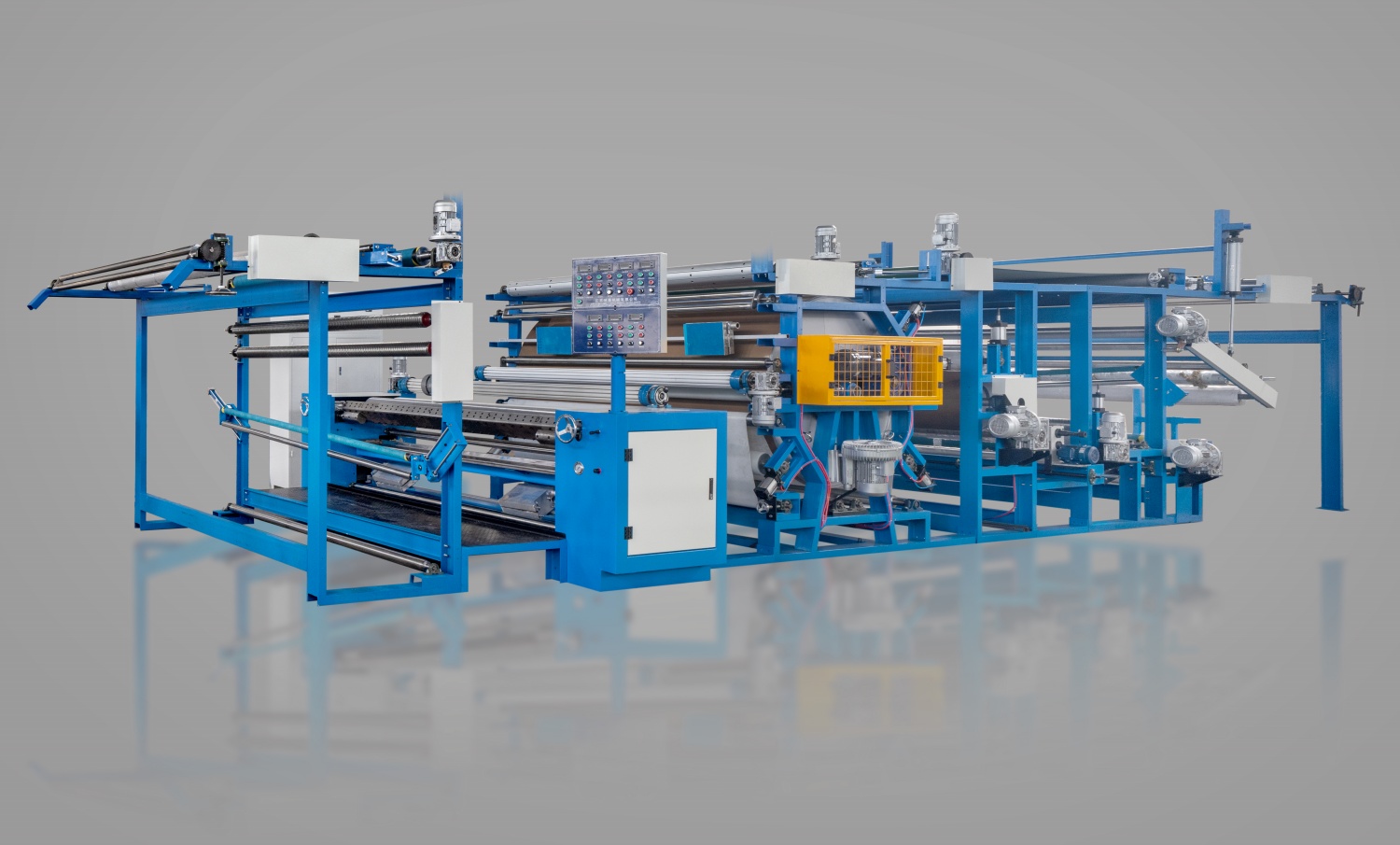
Fabric-to-fabric laminating platforms apply PUR hot-melt adhesive for textile composite applications. Image: KUNTAI product reference.
Criterion 4 — Build Material: Carbon Steel vs SS304
Structural build material is listed in standard practice as carbon steel or SS304 across the KUNTAI platforms. The choice affects more than equipment lifespan.
Carbon steel is the economical option in standard production environments where corrosive contact is limited and scheduled maintenance is already built into the operating plan. SS304 becomes the better fit where adhesive, solvent or cleaning agents come into contact with machine surfaces — including lines that are cleaned frequently during product changeovers, or where water-based processes introduce sustained moisture. The trade-off is upfront cost and fabrication behaviour: SS304 raises material cost and can require additional consideration in welding and surface finishing, which makes it less economical in processes where corrosion is only an occasional risk rather than a routine exposure.
Criterion 5 — Component Sourcing and Control Architecture
Component sourcing is the most under-examined differentiator between suppliers, because it rarely appears in headline marketing specifications. On the published KUNTAI platform specifications, component selection is stated consistently across the range:
| Component | Specified source | Where it appears |
|---|---|---|
| Motor | Siemens (made in China) | KT-PB, KT-PUR, KT-PUR-1800, KT-FT, KT-FT-XC, KT-HY |
| Inverter | Yaskawa | KT-PB, KT-PUR, KT-FT, KT-FT-XC, KT-HY |
| Inverter | Inovance | KT-PUR-1800 |
| Electric components | Schneider | Across the laminating range |
| PLC and touch screen | Siemens | KT-PB |
| Bearings | NSK | KT-PB |
Component sourcing as published in the KUNTAI product specification set. Buyers should request the complete installed component list for the specific model under evaluation.
Why this belongs on a procurement checklist: these components govern after-sales maintainability and total cost of ownership. A platform built on widely available Schneider electrics and standard motor and inverter brands can be serviced faster locally than one built around proprietary or undocumented components. A buyer can verify this directly by asking the supplier for the full list of installed electrical and drive brands, whether those parts are stocked locally, and whether they are interchangeable across the model range.
Criterion 6 — Supporting Equipment and System Integration
No laminating machine runs alone. Each platform specifies supporting equipment that sits outside its own boundary but inside the purchase scope:
- KT-PUR series includes a 200 kg glue melter and an oil heater, with four trolleys with air shafts.
- KT-PB flatbed laminating machine includes a Siemens PLC and touch-screen control system as part of the machine configuration.
- KT-SF glue spraying and powder scattering machine includes a 200 kg glue melter with automatic powder feeding, six glue spraying systems and four powder scattering systems.
- KT-HY flame laminating machine requires a gas tank and gas appliances, with pressure stability as a special operating requirement.
- In the aviation sound insulation application, the KT-PB and KT-HY-H double belt press are used with a water chiller as supporting equipment.
Overlooking these dependencies is one of the most common sources of post-purchase cost overrun. A machine specification that lists main-unit capability but not the supporting infrastructure it assumes is only half a procurement document.
Criterion 7 — Speed, Throughput and the Investment Boundary
Machine speed sets throughput and also constrains which configurations remain feasible:
| Platform | Machine speed | Installed capacity |
|---|---|---|
| KT-PB flatbed laminating machine | 0–25 m/min | 230 kW |
| KT-PUR-1800 hot melt coating laminating machine | 0–35 m/min | 60 kW |
| KT-PUR PUR laminating machine | 0–35 m/min | 70 kW |
| KT-PUR hot melt glue laminating machine (up to 3400 mm) | 0–40 m/min | 65 kW |
| KT-DS dot coating laminating machine | 5–20 m/min | Electric heating, max 130 °C |
| KT-SF glue spraying and powder scattering machine | 5–25 m/min | 155 kW |
| KT-LH-1800 / KT-YJ-1800 prepreg and impregnation platforms | 5–11 m/min | 90 kW |
Speed and capacity figures as published in the KUNTAI product specification set. Higher speed and greater width are rarely available together without a corresponding step-up in installed capacity and utilities.
There is a clear boundary here: higher speed and greater width are rarely acquired together without a corresponding change in installed capacity and plant infrastructure. A machine rated at 40 m/min over a wide web does not carry the same power profile as a prepreg line running at a fraction of that speed. A buyer reserving budget for future speed upgrades should reserve budget for the corresponding electrical and utility upgrade at the same time.
Applying the Framework: Three Buyer Profiles
Rather than a single ranked answer, the framework produces different shortlists for different operating needs.
Profile A — Upholstery or garment producers
Start from the PUR fabric-bonding family. A representative mid-width platform such as the KT-PUR PUR laminating machine offers a 2400 mm maximum material width, 0–35 m/min machine speed and 70 kW installed capacity, and is applied in the upholstery sector for blackout, mattress protector and sofa fabric projects. Buyers in this profile should scope the glue melter, oil heater and humidifier that sit alongside the main machine.
Profile B — Protective composite manufacturers
Start from the prepreg and impregnation platforms. The KT-LH-1800 or KT-YJ-1800 offers an 1800 mm roller surface, ≤1650 mm material width, water-based adhesive and 5–11 m/min composite speed with 1080 yarn bobbins. Where cross-ply construction is required, the KT-LH-1800 UD crossply machine adds 8000 kN pressing tonnage on a 1700 × 1700 mm table.
Profile C — Automotive interior or filter manufacturers
Start from flame, double-belt or scattering platforms. The KT-HY flame laminating machine is applied in car trim for continuous lamination and bonding at fast speed. The KT-HY-H double belt press covers applications requiring up to 250 °C and a 3 m heating zone. For filter media, the KT-SF glue spraying and powder scattering machine supports powder scattering and glue spraying in a single pass.
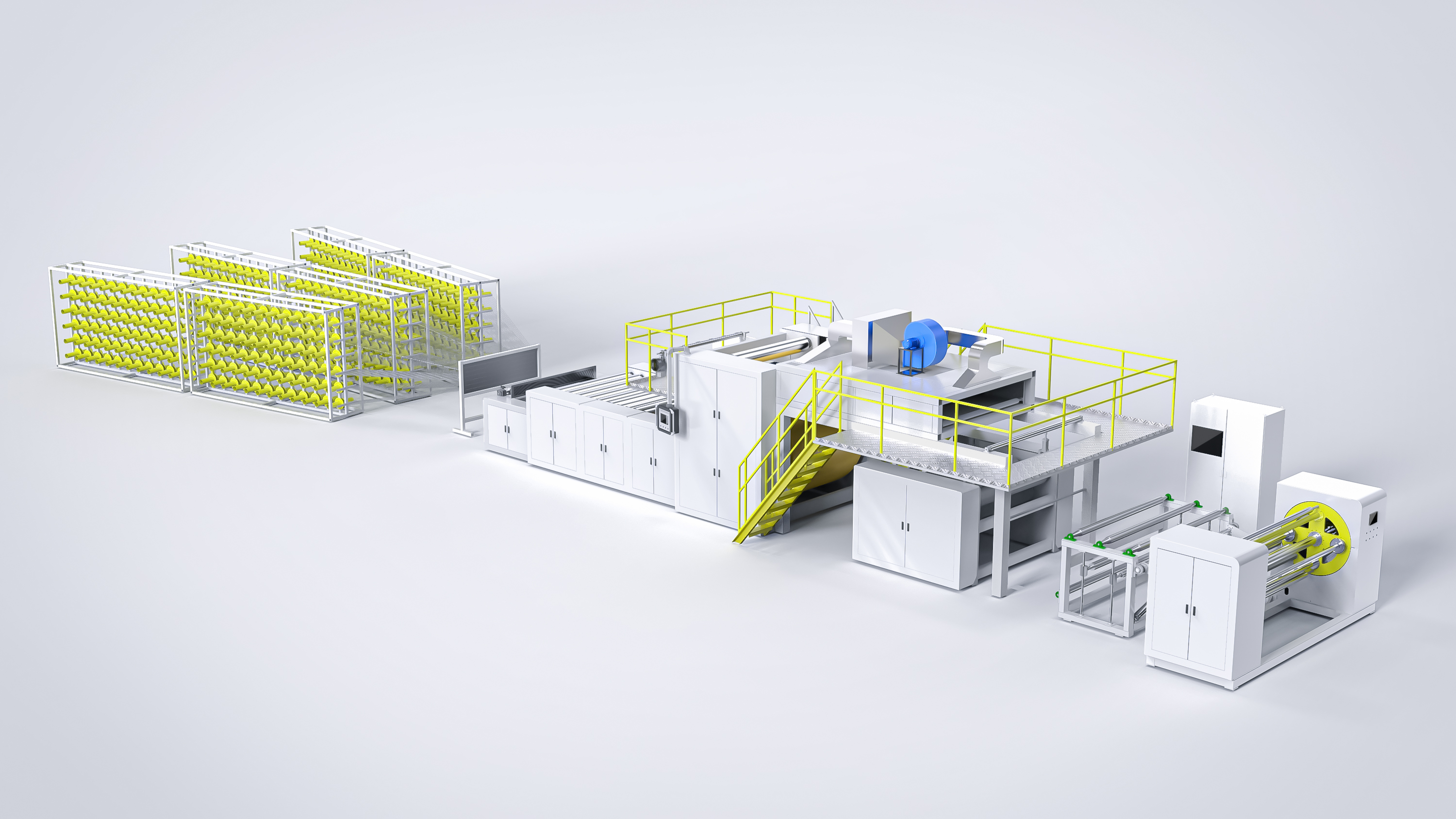
UD prepreg and impregnation platforms operate at slower composite speeds to achieve uniform fibre spreading and controlled impregnation. Image: KUNTAI product reference.
Market Trend Signals Relevant to This Framework
Laminating equipment demand is expanding. The global laminating machines market is estimated at USD 786.5 million in 2026 and projected to reach USD 1,356.7 million by 2033 (Coherent Market Insights). Analyst estimates differ on absolute size depending on scope — one alternative estimate places the 2025 market at USD 676.4 million (Future Market Insights) and another at USD 746.4 million in 2026 (Persistence Market Research) — but the direction is consistent.
Prepreg and composite demand supports impregnation platforms. The global prepreg market reached USD 15.07 billion in 2024 (Maximize Market Research), with aerospace prepreg alone at USD 3.5 billion in 2024 (MarketsandMarkets). This underpins demand for UD impregnation and crossply equipment.
PUR hot-melt adhesives remain a growth category. The PUR hot-melt adhesives market is expected to grow at a CAGR of 7.2% through 2034, reaching USD 7.1 billion (Dataintelo) — a signal that PUR laminating platforms will see continued process adoption.
Regional equipment activity is concentrated in Asia-Pacific. Asia-Pacific held a 72.70% share of the textile machinery market in 2025, led primarily by automation surges in China (Fortune Business Insights). For buyers sourcing in this region, that concentration implies a denser supplier ecosystem and shorter response cycles.
Comparison with Traditional Purchasing and the Limits of This Framework
Traditional procurement often starts from a fixed budget and a single headline specification, then works backwards to the cheapest qualifying quotation. In categories where components are largely commoditised, that approach can work. In industrial laminating machines it commonly produces either an over-specified asset or an idle one.
The traditional approach has the advantage of speed and price clarity. Its limitation is that it ignores platform-to-product interdependence. Three failure patterns recur:
- Width mismatch. Buying a 3400 mm platform for occasional wide runs leaves the machine operating well below its design envelope for most of the shift.
- Heating-method regret. Selecting a gas flame machine in a facility without gas infrastructure, or a 265 kW electric platform on an inadequate supply, delays commissioning.
- Supporting-equipment gaps. Buying a main unit without scoping the glue melter, oil heater, water chiller or gas appliances forces emergency separate purchases, sometimes from another supplier, and pushes back the production start date.
The framework itself has a real boundary. A criteria-based comparison cannot substitute for factory acceptance testing, pilot runs, or sample validation on the specific material combination a buyer intends to process. Two platforms that read identically on a specification sheet can still behave differently under actual adhesive, fabric and speed combinations. Buyers should treat the framework as a shortlisting instrument — not as a replacement for physical validation before committing capital.
Future Outlook
As composite applications continue to expand, comparison criteria are likely to become more structured rather than less. Three developments are worth building into capital planning:
- Explicit component sourcing disclosure becoming a standard expectation rather than a premium-model feature, as buyers increasingly price maintainability alongside purchase cost.
- Greater standardisation of control platforms, as customers migrate validated adhesive recipes across lines and expect control behaviour to travel with them. The use of HMI+PLC control and variable-frequency plus servo drive across the KT-LH-1800 and KT-YJ-1800 platforms is a current example of this direction.
- Growing attention to installed capacity and utility contracting as a first-order procurement criterion, rather than a downstream engineering detail.
- Continued alignment with safety standards. Textile machinery safety is governed by the ISO 11111 series, with Parts 2 through 7 covering safety requirements for different machinery types — a reference point buyers can raise directly with suppliers when reviewing documentation.
For buyers planning capital purchases into 2027 and beyond, the comparison framework will increasingly include lifecycle compatibility of the installed control platform and transparency of component sourcing, not just maximum speed and price.
FAQ
1. How much wider than my widest product should a laminating machine's material width be?
It is generally practical to select a material width that covers the widest routine product SKU with a modest operating margin, rather than the absolute maximum the plant might one day process. If routine production runs at roughly 2100 mm, a platform with a 2400 mm maximum material width — such as the KT-PUR PUR laminating machine — covers that requirement while avoiding the premium and higher installed capacity attached to larger formats in the 3400–4500 mm class.
2. What is the practical difference between an electric and a gas flame laminating machine?
An electric platform requires only electrical supply but typically a higher installed capacity — for example, the KT-PB flatbed laminating machine uses electric heating at 230 kW installed capacity with a maximum heating temperature of 230 °C. A gas flame platform uses natural gas or liquefied gas as its heat source and requires far lower machine drive power — the KT-HY runs at 15 kW machine drive power — but it requires a gas tank and gas appliances. The appropriate choice depends on the plant's available utilities rather than on the machine in isolation.
3. How do PUR and hot-melt laminating machines differ in the applications they suit?
Both PUR and hot-melt platforms apply hot-melt adhesive. The distinction is the adhesive system and the product requirement. PUR hot-melt bonding is applied in upholstery, garment, footwear and related sectors to deliver waterproof and sun-protection characteristics, for instance in blackout, mattress protector and sofa fabric production. The PUR hot-melt adhesives market is expanding at a CAGR of 7.2% through 2034 (Dataintelo), reflecting broader adoption of the process across sectors.
4. When is SS304 the right build material rather than carbon steel?
SS304 is the appropriate choice in environments where adhesive, solvent or cleaning agents contact machine surfaces, where it improves service life and reduces maintenance burden. Carbon steel remains the economical option in standard production environments where corrosive contact is limited and scheduled maintenance is planned. The decision is a trade-off between upfront material cost and operating durability rather than a single correct answer.
5. What should be scoped alongside the main laminating machine when planning capacity?
The supporting equipment specified for the chosen platform belongs in the same purchase scope. For the KT-PUR series that includes a 200 kg glue melter and an oil heater. For the KT-HY flame laminating machine it includes a gas tank and gas appliances. For the KT-SF glue spraying and powder scattering machine it includes a 200 kg glue melter with automatic powder feeding. In aviation sound insulation applications, the KT-PB and KT-HY-H are used with a water chiller. Buyers should confirm utilities — voltage stability in particular — before committing.
6. Why do prepreg and impregnation platforms run slower than standard laminating machines?
UD prepreg and impregnation platforms operate at lower composite speeds because they must achieve uniform fibre spreading and controlled adhesive impregnation across up to 1080 yarn bobbins — the KT-LH-1800 and KT-YJ-1800 run at 5–11 m/min composite speed. General fabric and PUR bonding platforms run faster, with the KT-PUR reaching 0–35 m/min and the wider KT-PUR hot melt glue laminating machine reaching 0–40 m/min. Speed differences between platform types reflect process physics, not machine quality.
7. How does ISO 11111 apply to laminating machine procurement?
ISO 11111 is the series of textile machinery safety standards, and Parts 2 through 7 address safety requirements for different machinery types. Procurement teams can ask suppliers to identify the relevant part of the series for the machine category under evaluation and to show how the design and documentation align with it. This question is typically raised alongside CE certification review during supplier assessment.
Tem questões ou precisa de mais detalhes?
Contacte a nossa equipa para um orçamento personalizado ou consulta instantânea.
Solicitar orçamento
Preencha o formulário abaixo e a nossa equipa entrará em contacto com uma proposta personalizada.
Chat direto do WhatsApp
Prefere conversar em tempo real? Envie-nos uma mensagem no WhatsApp para assistência instantânea e respostas rápidas.
- Obter orçamento personalizado
- Partilhar fotos ou documentos
- Discuta as suas necessidades diretamente
Geralmente responde em 5–30 minutos durante o horário de expediente.