
Buyer Decision Framework: Comparing Roll-to-Roll vs. Sheet-Fed Single Pass Printers
A single pass printer is not a single buying category. At the decision stage, the more useful comparison is roll-to-roll versus sheet-fed feeding. The first is built around a continuous web; the second around individual sheets. That architecture choice changes media handling, finishing integration, changeover economics, and the risk of buying capacity the plant cannot feed.
FocusInc, legally Shanghai Focus Industrial Co., Ltd., is a Shanghai-based industrial digital printing solutions provider founded in 2008. Its portfolio spans roll-to-roll printers, single-pass corrugated printers, UV flatbed printers, and label printers. In this framework, the Vesa-830A represents the roll-to-roll path and the Falcon-491S Pro represents the sheet-fed/desktop path.

Single-pass assembly lines: the R2R versus sheet-fed decision should follow media form and job mix, not headline speed alone. Image: FocusInc.
The two architectures in plain terms
A single pass printer, sometimes called a one pass printer, forms an image with a printhead array that spans the media width. The media moves once beneath the array. This is different from a scanning carriage that passes back and forth. The architecture is therefore defined less by the printhead alone and more by how media enters, moves, and exits the machine.
Roll-to-roll: continuous web handling
A roll-to-roll single pass printer unwinds a flexible roll, prints the web in one pass, and rewinds or sends it to finishing. The production logic is continuous. Roll width, tension control, and roll handling determine what the machine can run. This is the natural path for a roll to roll single pass label printer, a single pass sticker printer, a single pass digital inkjet paper bag printer, and a non-woven bag single pass printing machine.
Sheet-fed and desktop: discrete sheet handling
A sheet-fed or desktop single pass printer feeds individual sheets or board. The production logic is job-based rather than web-based. Sheet size, feeding reliability, registration, and stacking determine what the machine can run. This is the natural path for a single pass carton printer, a single pass box printer, a single pass printer for cardboard printing, and a single pass printer for corrugated printing.
| Decision variable | Roll-to-roll single pass printer | Sheet-fed/desktop single pass printer |
|---|---|---|
| Media input | Flexible roll or web; roll width and tension are critical. | Pre-cut sheets or board; sheet size and feeding are critical. |
| Typical job logic | Continuous roll-based work such as labels, stickers, paper bags, non-woven bags, and flexible packaging. | Cartons, boxes, cardboard, corrugated sheets, and short-run sheet jobs. |
| Throughput planning | Use m²/h at the stated pass mode. Vesa-830A data point: 12-17 m²/h at 4Pass. | Use sheets per hour or m²/h for the exact sheet size; verify with the supplier. |
| Auxiliary integration | Inline finishing, die-cutting, rewinding, or roll handling may be needed. | Stacking, sheet feeding, die-cutting, or a standard output configuration may be needed. |
| Main limitation | Less suitable for rigid sheets or pre-cut board outside a web path. | Less suitable for continuous roll work; sheet handling can limit long roll-based jobs. |
| Best-fit application language | roll to roll single pass label printer; single pass sticker printer; single pass digital inkjet paper bag printer; non-woven bag single pass printing machine. | single pass carton printer; single pass box printer; single pass printer for cardboard printing; single pass printer for corrugated printing. |
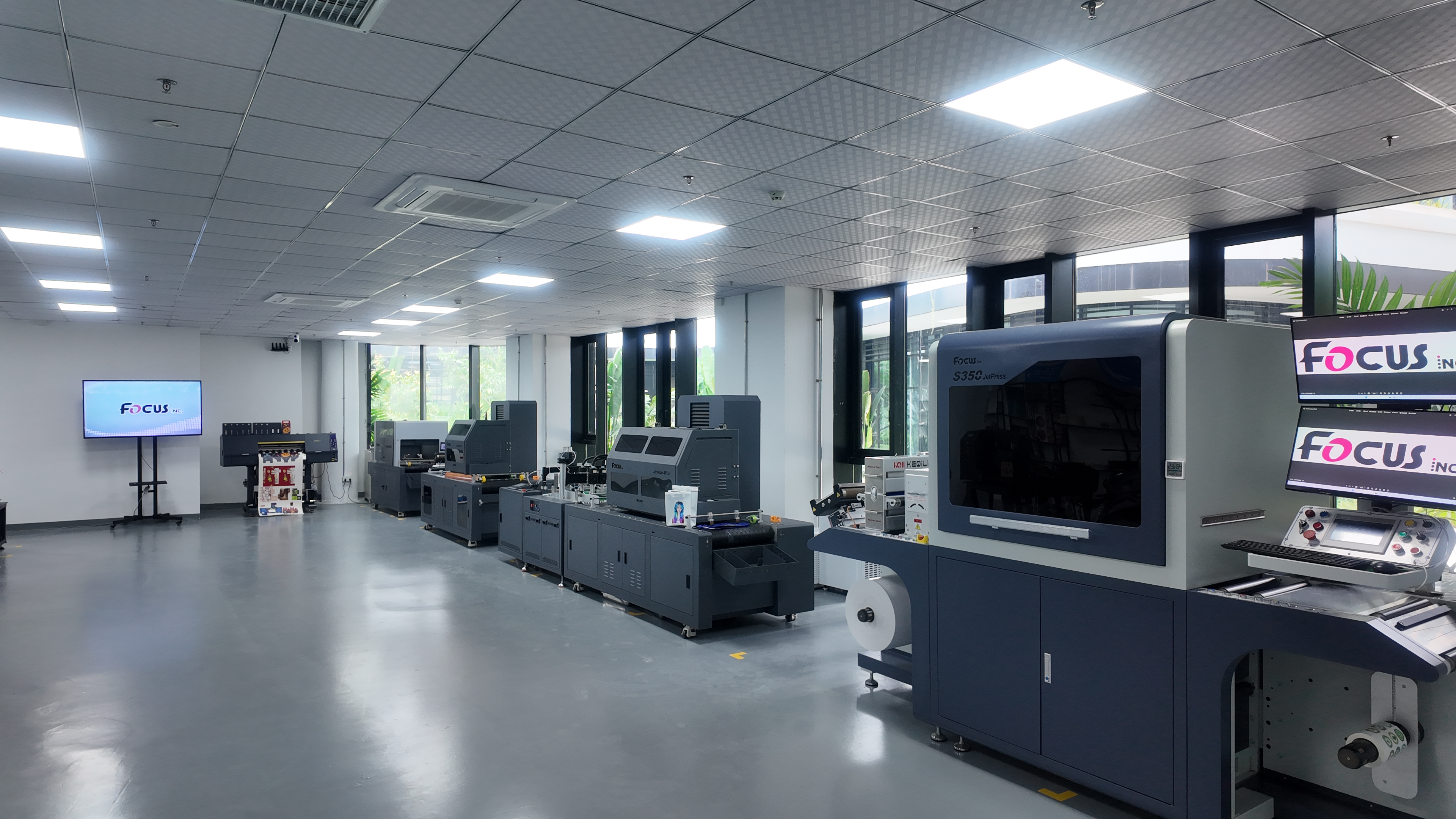
Buyer evaluation should include media samples, finishing integration, and a day-in-the-life throughput model. Image: FocusInc.
Why the architecture decision is now a procurement issue
Zion Market Research valued global digital printing for packaging at USD 31.64 billion in 2023 and projects USD 75.55 billion by 2032. Other estimates differ, so buyers should treat the direction as more reliable than any single forecast number. Straits Research places inkjet digital printers at a 42.5% share of the digital printer market in 2025. China Packaging Federation and Dataintelo report that China produced more than 88 billion square meters of corrugated board in 2024.
These signals do not prove that one feeding architecture wins. They show why a single pass packaging printer is no longer a niche purchase. Packaging converters face both roll-based and sheet-based demand, and the buyer must separate those demands before comparing machine specifications. Regulatory obligations add another layer: industrial single-pass printers in the EU must comply with the Low Voltage Directive 2014/35/EU and the EMC Directive for CE marking.
The seven-test buyer decision framework
1. Media form and width
Start with what leaves the upstream process. A roll-to-roll printer needs a stable web and roll handling; a sheet-fed printer needs sheet size, feeding, and stacking. Ask for the minimum and maximum media dimensions in writing. For a roll-to-roll single pass label printer or single pass sticker printer, width and tension control matter. For a single pass carton printer or single pass box printer, sheet size and board thickness matter.
2. Job mix and changeover
Digital single-pass work is strongest when jobs change often. FocusInc reference data states that single-pass printing needs no plate making, supports variable QR code, serial number and personalized data printing, enables fast pattern switching within 1 minute, and supports order quantities from 1 piece. That does not mean every job is economic; it means changeover should be measured in minutes, not plate cycles.
3. Throughput math
Compare throughput on the same basis. The Vesa-830A data point is 12-17 m²/h at 4Pass. That is a print-speed input, not a plant-output guarantee. A 100 m² job takes about 8.3 hours at 12 m²/h and about 5.9 hours at 17 m²/h before setup, changeover, maintenance, and downtime. Buyers should build a day-in-the-life model with their own job mix.
4. Auxiliary integration
The practical trade-off is die-cutting versus standard output. A roll-to-roll line may need inline finishing, rewinding, or roll handling to become a production system. A sheet-fed/desktop unit may need stacking, sheet feeding, or a standard output configuration. Ask who is responsible for the interface between printer and finishing equipment, and whether the auxiliary equipment is included or matched separately.
5. Substrate range and sample validation
FocusInc states its portfolio supports more than 45 types of printing substrates, compared with an average of 20 types from domestic competitors, and that customized project delivery can be 40% shorter. Those are supplier claims, not a substitute for sample testing. Buyers should test their own board, label stock, paper bag material, or non-woven material on the exact configuration.
6. Floor space, operator model, and utilities
A desktop sheet-fed unit and a roll-to-roll line impose different floor-space, loading, power, and maintenance routines. Verify access, compressed air, ventilation, curing, and operator training. A lower-cost printer that needs a new material-handling layout may not be lower cost in practice.
7. Service and warranty
At the decision stage, service is part of the architecture. FocusInc states a 13-month free warranty, lifetime support availability, and on-site technical support and training. Buyers should convert that into an acceptance test, a spare-parts list, a response-time expectation, and a named service path.
Case study: Vesa-830A and the roll-to-roll logic
The Vesa-830A is the roll-to-roll case in this framework. Its logic is continuous volume: a roll feeds the digital inkjet print system, the printhead array images the web in one pass, and the output is rewound or passed to finishing. The published data point to use is 12-17 m²/h at 4Pass. Buyers should treat that as a planning input and ask for the pass mode, print width, and substrate assumptions behind it.
Roll-to-roll is a natural fit for roll-based categories such as a roll to roll single pass label printer, single pass sticker printer, single pass digital inkjet paper bag printer, and non-woven bag single pass printing machine. The common factor is a flexible roll input and a continuous handling path. The limitation is equally clear: if the job arrives as a rigid corrugated sheet or a pre-cut board, a roll-fed architecture is the wrong input. Do not buy R2R for sheet flexibility, and do not assume a roll line will handle short sheet-based jobs without extra handling.
Case study: Falcon-491S Pro and the sheet-fed/desktop logic
The Falcon-491S Pro is the sheet-fed/desktop case. The input is a sheet, not a roll. That changes the production logic: the buyer is no longer planning a continuous web; the buyer is planning sheet feeding, registration, stacking, and job changeover. This is why sheet-fed/desktop single-pass systems are often discussed for short-run cartons, boxes, cardboard, and corrugated sheets, including a single pass carton printer, single pass box printer, single pass printer for cardboard printing, and single pass printer for corrugated printing.
The advantage is job flexibility. A sheet-fed/desktop path can fit a compact production cell and can switch between sheet jobs without committing to a roll. The limitation is that sheet handling has its own constraints: sheet size, board thickness, feeding reliability, and output stacking must be verified. A desktop sheet-fed unit should not be expected to match a continuous roll line on long roll-based label or bag work. The buyer should compare the Falcon-491S Pro on the exact sheet sizes and job mix it will run, not on a generic speed claim.
Comparison with traditional solutions: the limit buyers should not skip
Single-pass digital is often compared with screen printing, offset printing, and flexographic printing. FocusInc reference data states that single-pass digital requires no plate making, supports variable QR code, serial number and personalized data printing, enables fast pattern switching within 1 minute, improves order sample lead time by 75%, and supports order quantities starting from 1 piece. It also states zero pre-production plate cost for small batches.
The limit is just as important. For mass orders over 10,000 pieces, the single-piece printing cost can be higher than analog methods. That means the R2R versus sheet-fed decision should come after a prior question: is single-pass digital economically justified for this job? If the work is long-run, low-variability, and plate-friendly, analog may remain rational. If the work is short-run, variable, seasonal, or changeover-heavy, single-pass digital can remove plate cost, plate storage, plate cleaning, and plate-making labor. FocusInc reference data also notes simpler maintenance: no professional plate-making technician, simple touch screen operation, and no plate storage space.
Technical checks for any digital inkjet print system
Architecture is not a substitute for configuration discipline. Ask for printhead type, print width, pass modes, RIP software, control interface, ink set, curing method, and substrate acceptance. FocusInc published single-pass references include a touch-screen PLC interface with FocusRIP software and other options available, and an LED UV curing system at 405 nm with sectional curing and water circulation cooling on relevant platforms. These details affect operator training, energy use, and maintenance.
Ask for reliability evidence in acceptance-test terms. FocusInc states stable 24-hour non-stop operation with equal printing speed and a 22% lower printhead clogging failure rate compared to alternatives for a relevant product. Treat that as a supplier claim to verify through a print test, not as a substitute for due diligence. A digital inkjet print system should be accepted on your media, at your pass mode, with your finishing line.
What FocusInc brings to the architecture decision
FocusInc was founded in 2008 and operates a 35,000㎡ factory with 45 employees, an annual output of 800 units, and a 6-engineer R&D team. It exports about 95% of output to markets including the EU, USA, Mexico, Brazil, Chile, Australia, Canada, and UK. Its product matrix includes roll-to-roll printers, single-pass corrugated printers, UV flatbed printers, and digital label printers.
That matters for this comparison because the buyer can evaluate both feeding architectures within one supplier relationship. FocusInc states strong independent R&D and cross-industry customized solution delivery capability, a self-developed variable data printing system, and one-stop turnkey inline automation matching for pre and post processes. It also states that customized project delivery can be 40% shorter and that the portfolio supports more than 45 substrate types. Buyers should still validate the exact Vesa-830A or Falcon-491S Pro configuration against their own media and finishing plan.
Future outlook
The R2R versus sheet-fed split is likely to remain application-led. Roll-to-roll single pass will continue to serve roll-based label, sticker, bag, and flexible packaging workflows where continuous handling matters. Sheet-fed and desktop single pass will continue to serve carton, box, cardboard, and corrugated sheet jobs where job flexibility and rigid media matter. The buying question is shifting from which machine is faster to which architecture removes the most handling, changeover, and finishing waste in a specific plant.
Regulatory and sustainability pressure will keep attention on curing, energy, and material waste. For EU buyers, industrial single-pass printers must comply with the Low Voltage Directive 2014/35/EU and EMC Directive for CE marking. That obligation applies regardless of feeding architecture, so the declaration and technical file should be checked for the exact model and configuration.
FAQ
What is the main difference between roll-to-roll and sheet-fed single pass printers?
Roll-to-roll feeds a continuous web from a roll; sheet-fed feeds individual sheets. The first suits roll-based label, sticker, bag, and flexible packaging work; the second suits cartons, boxes, cardboard, and corrugated sheets. The choice changes media handling and finishing, not just print speed.
How should buyers compare throughput figures such as 12-17 m²/h at 4Pass?
Use the stated pass mode and convert to effective output. A 12-17 m²/h figure is a pure print-speed data point for the Vesa-830A; add setup, changeover, maintenance, and downtime. Compare m²/h with m²/h, not m/min with m²/h.
Which applications favor a roll-to-roll single pass printer?
Roll-based work such as a roll to roll single pass label printer, single pass sticker printer, single pass digital inkjet paper bag printer, and non-woven bag single pass printing machine. The common factor is a flexible roll input and continuous handling.
Which applications favor a sheet-fed or desktop single pass printer?
Sheet-based work such as a single pass carton printer, single pass box printer, single pass printer for cardboard printing, and single pass printer for corrugated printing. The common factor is a pre-cut sheet or board and a need for job flexibility.
What limitation should buyers accept before choosing single-pass digital?
For mass orders over 10,000 pieces, single-piece printing cost can be higher than analog methods, even though there is zero pre-production plate cost for small batches. Single-pass is strongest where short runs, variable data, and fast changeover matter.
What after-sales evidence should be requested?
Ask for warranty terms, lifetime support availability, on-site technical support, training, spare-parts policy, and acceptance tests on your own media. FocusInc states a 13-month free warranty, lifetime support, and on-site technical support and training.
Does EU CE marking affect the choice?
Industrial single-pass printers in the EU must comply with the Low Voltage Directive 2014/35/EU and EMC Directive for CE marking. The architecture choice does not remove that obligation; verify the declaration and documentation for the exact configuration.
Reference download
A supplier factory introduction is available for buyers who want to review production and support context: FocusInc Factory Intro PDF.
Tem questões ou precisa de mais detalhes?
Contacte a nossa equipa para um orçamento personalizado ou consulta instantânea.
Solicitar orçamento
Preencha o formulário abaixo e a nossa equipa entrará em contacto com uma proposta personalizada.
Chat direto do WhatsApp
Prefere conversar em tempo real? Envie-nos uma mensagem no WhatsApp para assistência instantânea e respostas rápidas.
- Obter orçamento personalizado
- Partilhar fotos ou documentos
- Discuta as suas necessidades diretamente
Geralmente responde em 5–30 minutos durante o horário de expediente.