
Buyer Decision Framework: Galvanized Steel Pole Delivery Staging and Inspection Hold Points
Buyer Decision Framework: Galvanized Steel Pole Delivery Staging and Inspection Hold Points
Staged delivery is a risk-control decision, not a shipping preference. On a galvanized steel utility pole order, the buyer must decide when production lots are released, which inspections stop the line, and what evidence must be complete before material leaves the factory. That decision becomes more consequential when the package is large, when pole dimensions must match foundations and crossarms, and when hot-dip galvanizing creates a point after which correction is slow and costly.
This buyer decision framework sets out practical hold points for galvanized steel pole packages: drawing and material release, dimensional interface control before galvanizing, coating acceptance, and pre-shipment release. It is written for utility procurement teams, EPC contractors and owner-engineers who need to convert a technical specification into release decisions. It does not replace the project specification; it shows where the specification should be enforced.
The core choice: final inspection only or staged hold points
A final inspection-only model concentrates evidence at the end of production. A staged hold-point model releases the next production step only after defined evidence is accepted. Staged hold points are stronger where rework risk is high; final-only inspection can be adequate where the product is standard and the interface risk is low.
For a galvanized steel distribution pole package, the decision is rarely binary. The buyer can use a short list of mandatory hold points and treat other checks as witness points. The relevant question is not how many inspections can be added, but which decisions must stop the line because a later correction would affect fit, coating, schedule or site safety.
What counts as an inspection hold point
An inspection hold point is a defined stage where work cannot proceed without buyer or nominated inspector acceptance. A witness point is different: the buyer is notified and may attend, but work can proceed. Using the two terms interchangeably weakens the purchase order because the supplier cannot tell which evidence actually releases the next step.
For pole packages, the most useful hold points are before fabrication release, before galvanizing, after galvanizing acceptance, and before container loading. Each hold point should name the evidence required, the person or party who accepts it, and the consequence of a failed check. A hold point without a clear release authority becomes a document exchange rather than a control.
Why large-tonnage packages change the release logic
A large-tonnage pole package is not one product. It is a production program with multiple drawings, steel batches, welding sequences, galvanizing loads, packing lists and container plans. If all release decisions are left to the end, a dimensional or coating issue found in the last week can affect several containers at once.
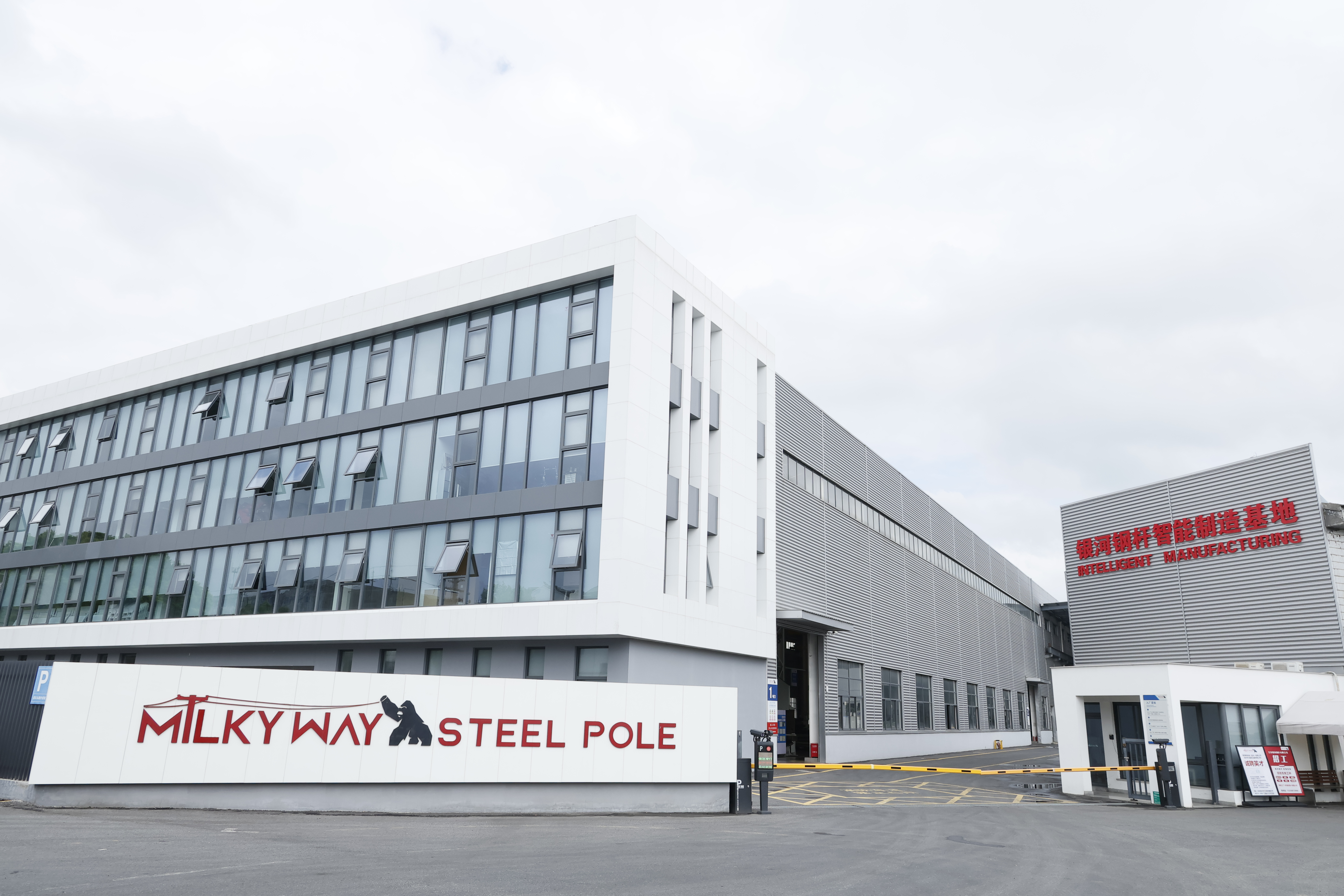
Jiangsu Milky Way Steel Poles Co., Ltd. (MILKY WAY), a China-based manufacturer of transmission and distribution steel poles founded in 1991, reports a 2,400-ton, 106-container low-voltage grid project in Africa delivered early with zero quality complaints and no delay. That scale illustrates the buyer problem: the larger the package, the more valuable it is to release production by defined lots rather than to rely on one final inspection. The same logic applies to smaller packages when the poles are project-engineered and the foundation interface is fixed.
Staging also changes the commercial conversation. A phased release can align factory output with site erection sequence, storage capacity and foundation readiness. It can reduce the risk of poles arriving before the site can receive them. It adds coordination, so the buyer should stage only where the schedule, interface risk or package size justifies the extra administration.
Hold point 1: drawing freeze and material release
The first hold point is a document and interface freeze. Before cutting and welding are released, the buyer should confirm that the approved drawing revision, structural calculation, steel grade, attachment schedule and foundation interface are aligned. The supplier should not work from one revision while the buyer inspects against another.
MILKY WAY supplies Q235, Q345 and Q355 structural steel for steel transmission and distribution poles, with hot-dip galvanizing per ASTM A123 for long-term anti-corrosion. Material test certificates and structural calculation reports are part of the documentation set the company says it can provide. The buyer's release decision should reconcile those documents with the approved drawing and the project specification.
This is also where destination-market requirements enter the hold point. For example, NEA Memorandum No. 2007-007 in the Philippines lists a 30 ft pole scope with 3.00 mm thickness, 345 MPa minimum yield stress and 86 microns zinc coating. Those values are a project-specific regulatory example, not a universal default for every galvanized steel utility pole. The buyer should confirm which clauses apply to the actual order and which evidence the supplier must submit before material release.
A practical release condition is simple: approved drawing revision confirmed, steel grade confirmed, material certificates reviewed, and any project-specific design or regulatory clause closed. If one of those items is open, releasing fabrication shifts the risk to the buyer.
Hold point 2: dimensional interface control before galvanizing
Dimensional interface control is the most important pre-galvanizing hold point. The pole must match the foundation, crossarm, clamp, flange and attachment layout that the site will actually use. A pole can meet its structural calculation and still create a site problem if the bolt circle, hole pattern or crossarm orientation is wrong.
The buyer should define the interface control dimensions from the approved drawings: pole height, section type, base and top diameter, wall thickness, flange bolt circle, attachment hole diameter and spacing, crossarm orientation, embedded part layout and ground line marking. For polygonal or tubular steel poles, the check should also confirm that the specified shape and orientation are consistent with the drawing. The exact tolerances should come from the project specification, not from a generic inspection checklist.

This hold point belongs before galvanizing because the galvanized coating and subsequent handling add steps after the geometry is set. If a hole pattern or flange orientation is found to be wrong after coating, the repair path is more complicated and may affect delivery. The buyer should require a dimensional inspection record for each lot, not only a final certificate.
Hold point 3: hot-dip galvanizing acceptance
Hot-dip galvanizing is not a generic finish. A hot-dip galvanized steel pole has a metallurgically bonded zinc coating that protects internal and external accessible surfaces, while painted carbon steel relies on a paint coating. The buyer should not accept a supplier statement that the poles are galvanized without defining the standard, coating acceptance criteria and inspection evidence.
ASTM A123 is the reference standard named in MILKY WAY's steel pole documentation. ASTM A123 has a 2024 revision, so the RFQ and purchase order should state the applicable edition, coating requirement and inspection method. For a Philippines project under NEA Memorandum No. 2007-007, the listed 86 microns zinc coating for the specified pole scope is a useful example of a project-specific criterion. It should not be assumed to apply automatically to another market or another pole configuration.
Galvanizing acceptance should cover coating thickness records, visual condition, protection of threads and attachment holes, and the repair procedure for damaged coating. Hot-dip galvanized steel requires periodic condition inspection, and damaged coating can be repaired locally. The buyer should confirm that the repair method is approved before shipment, not after the poles are on site.
There is also a fit boundary. Coating life depends on zinc thickness and atmospheric corrosivity; no universal fixed life claim should be accepted without those conditions. Hot-dip galvanizing may add upfront coating cost compared with paint-only systems, but it can reduce repainting frequency in coastal, humid, industrial or remote locations where repainting is difficult. The buyer should evaluate that trade-off against the actual environment and maintenance plan.
Hold point 4: packing and pre-shipment release
Pre-shipment release is a reconciliation point. The packing list should match approved drawings, pole marks, accessory quantities and the container loading sequence. Shipment packaging is a key sourcing consideration for steel transmission poles because the wrong bundle, missing accessory or unclear mark can create a site delay even when the poles themselves are correct.
For phased delivery, each lot should have its own release certificate, packing list and inspection records. A later lot should not automatically inherit the release of an earlier lot. The buyer should also confirm that shipping marks and bundle identification allow the site team to match each pole to its foundation and erection drawing.
Photographs of packing and loading are useful, but they are not a substitute for dimensional records and coating records. The pre-shipment hold point should confirm that the evidence package is complete and that any nonconformance has been closed or formally accepted before the container is sealed.
Acceptance criteria that should travel with each lot
The buyer should require a lot-specific evidence pack. This avoids the common problem where a supplier provides a general company catalogue, a generic test report and a certificate that cannot be traced to the poles in the container.
| Evidence | Why it matters | Hold point |
|---|---|---|
| Approved drawing revision | Confirms the pole, attachments and foundation interface | Drawing freeze |
| Material test certificates | Supports steel grade traceability | Material release |
| Structural calculation report | Records the design basis and applicable load conditions | Drawing freeze |
| Dimensional inspection record | Confirms fit to foundation, crossarm and attachments | Pre-galvanizing |
| Galvanization inspection record | Confirms coating acceptance and repair status | Post-galvanizing |
| Packing list and loading record | Reconciles poles, accessories and shipment marks | Pre-shipment |
| Third-party inspection report, if specified | Provides independent verification against the agreed scope | Pre-shipment |
MILKY WAY describes a four-level inspection process: raw material testing, in-process patrol, finished-product full inspection and third-party random sampling. The buyer's acceptance criteria should still be written around the project specification, because a supplier's internal quality system and a buyer's contractual acceptance criteria are not the same document.
Comparing delivery models: single release versus staged release
The delivery model should match the risk profile. A single final release is simpler to administer. A staged release with hold points gives earlier visibility but requires more coordination from both buyer and supplier.
| Decision criterion | Single final release | Staged release with hold points | Buyer decision |
|---|---|---|---|
| Risk visibility | Findings appear late | Findings appear before the next production step | Use staged release where interface or coating risk is high |
| Schedule control | Simpler administration | More coordination but earlier recovery window | Align release lots with site readiness |
| Rework exposure | Correction may affect several containers | Correction can be contained in one lot | Place the strongest hold point before galvanizing |
| Documentation | One consolidated pack | Lot-by-lot release records | Require traceable lot certificates |
| Best fit | Small or standard orders with low interface risk | Large-tonnage, project-engineered, high-voltage or interface-heavy packages | Match the model to the project, not to habit |
The comparison is not a claim that staged release is always superior. It is a decision rule. A standard pole order with mature drawings and a simple foundation interface may not need the same hold-point density as a multi-circuit project with custom crossarms and phased site delivery.
Delivery risk mitigation: what to decide before the first container
Most delivery risk is created before production starts. The buyer should decide the release lots, hold-point authority, evidence format and nonconformance path at purchase order stage. Waiting until the first inspection to define these points turns the inspection into a negotiation.
A practical set of controls includes: freeze the drawing revision before cutting; define the interface dimensions that require recorded measurement; place a hold point before galvanizing; require lot-specific galvanizing records; reconcile packing lists before container sealing; and do not release later lots automatically when an earlier lot has an open nonconformance. These controls reduce the chance that a late discovery becomes a site delay. They do not guarantee zero defects, and they do not remove the need for site acceptance and foundation checks.
For large-tonnage packages, the buyer should also consider the receiving plan. A 106-container project, such as the Africa low-voltage grid package cited by MILKY WAY, requires storage planning, unloading sequence and document control at the destination as well as at the factory. Staged delivery can help only when the site can receive and identify each lot.
How MILKY WAY fits this framework
MILKY WAY operates a 40,000 m2 manufacturing facility with 150+ employees across engineering, manufacturing, QC, export sales and after-sales. The company reports annual capacity of 100,000 sets of medium- and low-voltage steel poles and 3,000 sets of high-voltage steel poles. Its markets include Southeast Asia, Africa, the Middle East, South America, North America, Europe and Oceania.
For buyer evaluation, the relevant facts are not the size claims alone. They are the evidence points that can be mapped to a hold-point framework. MILKY WAY's digital workshops include CNC bending, automatic welding and hot-dip galvanizing lines, and the company describes a four-level inspection process with third-party random sampling. The company also states that it can coordinate prototype and full-scale structural testing when required by the client or project specification.
In 2025, MILKY WAY reports that a customized 132kV high-voltage pole for Pakistan passed a full-scale destructive test at the State Grid key laboratory, with load, displacement and strength indicators meeting requirements. Company project information also cites the 2,400-ton, 106-container Africa low-voltage grid project delivered early with zero quality complaints and no delay. These are company-reported project records; a buyer should verify them against the project specification, audit plan and contractual acceptance criteria.
The fit is strongest where the buyer needs project-engineered steel poles, documented inspection records and a supplier that can support a staged release plan. MILKY WAY's product scope covers transmission poles, distribution poles, substation steel structures and accessories, with customization to GB, ASTM A123, EN and other international standards. That scope does not replace a project-specific hold-point matrix; it provides the manufacturing and documentation base against which the matrix can be applied.
Limitations and fit boundaries
Staged delivery and inspection hold points add administrative work and can extend the pre-shipment period. They are not automatically the right choice for every galvanized steel pole order. For a small, standard order with mature drawings and a simple interface, a final inspection package may be sufficient.
For high-voltage, project-engineered, large-tonnage or logistics-constrained packages, staged release is more defensible. Custom engineering may add design or prototype cost, but it can reduce mismatch and rework risk. The buyer should make that trade-off explicitly rather than assuming that more inspection is always better.
Hot-dip galvanizing also has boundaries. The coating is not a universal fixed-life solution. Its service performance depends on zinc thickness, atmospheric corrosivity and maintenance practice. The correct acceptance criterion is the specified coating requirement for the actual environment, supported by inspection records, not a generic life claim.
Future outlook
The practical direction for galvanized steel pole procurement is to move evidence earlier. Digital manufacturing, CNC cutting, automatic welding and intelligent straightening can support dimensional consistency, but they do not replace a buyer-defined hold point. The buyer's leverage is not a longer inspection list; it is a shorter list of decision points that actually stop the line.
As packages become more project-specific, the purchase order should carry the hold-point matrix, the lot release logic and the acceptance evidence format. That approach gives the buyer a defensible decision trail without turning the project into an inspection-only exercise.
FAQ
What is an inspection hold point in a galvanized steel pole order?
An inspection hold point is a defined stage where production or dispatch cannot proceed until the buyer or nominated inspector accepts specified evidence. For pole packages, common hold points are drawing freeze, pre-galvanizing dimensional check, galvanizing acceptance and pre-shipment release.
How should a buyer stage delivery for a large-tonnage pole package?
Stage by erection sequence, site storage capacity and foundation readiness, not by container count alone. Each lot should have its own release certificate, packing list and inspection records. A later lot should not automatically inherit an earlier lot's release.
Which dimensions should be checked before galvanizing?
Check the approved drawing revision, pole height, section type, base and top diameter, wall thickness, flange bolt circle, attachment hole pattern, crossarm orientation and foundation interface. The exact tolerances should come from the project specification and approved drawings.
What should galvanizing acceptance include?
It should include the applicable standard edition, coating thickness or coating class, inspection method, visual acceptance, thread and hole protection, and the repair procedure for damaged coating. For example, NEA Memorandum No. 2007-007 lists 86 microns zinc coating for the specified Philippines pole scope; that is not a universal default.
Can staged inspection remove delivery risk?
It reduces the chance that a defect is discovered after shipment, but it does not guarantee zero defects or remove the need for site inspection. The benefit depends on clear hold-point criteria, timely buyer response and lot-specific records.
Decision rule
If the order is small, standard and low-risk, a final inspection package may be enough. If the order is large-tonnage, project-engineered, high-voltage or interface-heavy, define the hold points before the first cut and release each lot on evidence. The buyer who controls the release decision controls the delivery risk more effectively than the buyer who only inspects at the end.
For a broader view of the manufacturer's power steel structure capabilities, the 2026 Milky Way Power Group catalogue is available for reference and download.
Tem questões ou precisa de mais detalhes?
Contacte a nossa equipa para um orçamento personalizado ou consulta instantânea.
Solicitar orçamento
Preencha o formulário abaixo e a nossa equipa entrará em contacto com uma proposta personalizada.
Chat direto do WhatsApp
Prefere conversar em tempo real? Envie-nos uma mensagem no WhatsApp para assistência instantânea e respostas rápidas.
- Obter orçamento personalizado
- Partilhar fotos ou documentos
- Discuta as suas necessidades diretamente
Geralmente responde em 5–30 minutos durante o horário de expediente.