
Buyer Review: HEART+, PROBIO, EYES+ and FIT+ ODT Strips

Novohope's pet oral strip range. This independent buyer review focuses on four models: HEART+, PROBIO, EYES+ and FIT+.
Pet health supplements have shifted from a specialist purchase to a mainstream shelf category, and the delivery format is moving with them. Grand View Research values the global pet supplements market at approximately USD 2.8 billion in 2025, with projected growth to USD 4.6 billion by 2033, and places North America at 48.1% of global revenue share in that same year. Mordor Intelligence sizes the narrower pet dietary supplements segment at USD 5.11 billion by 2026, growing at a CAGR of 7.42% through 2031.
Growth of that scale changes what buyers actually argue about. Price and ingredient lists still matter, but the harder questions now sit around format: how a supplement is administered, how consistent each dose is, what documentation travels with the shipment, and whether the unit specification on the label matches what the factory can repeat. Oral disintegrating tablet (ODT) and orally disintegrating film (ODF) formats are increasingly part of that conversation, because they remove the feeding step that pet owners most often abandon.
This review looks at four models from the Novohope pet health oral strip line — HEART+, PROBIO, EYES+ and FIT+ — strictly on the terms an independent buyer would use: documented form, documented pack specification, intended use, supporting certificates, and the purchasing terms that surround them.
Quick answer for buyers: the four models share a fast-dissolving oral matrix but are not interchangeable units. HEART+ is a 2.1 g cardiovascular ODT packed 10 pieces per pack. PROBIO is a 2.5 g digestive-care ODT packed 10 pieces per pack. EYES+ is documented as an ODF (orally disintegrating film) eye-care and tear-stain product at 2.1 g / 0.074 oz. FIT+ is a weight-management ODT documented at 10 pieces per pack, with no per-piece weight stated in the product unit. Buyers comparing them should compare intended use first, pack specification second, and supporting documentation third.
The reformulation question buyers are actually asking
Most sourcing briefs for pet health supplements still open with ingredient questions. In practice, the failure points in this category are administrative and behavioural rather than chemical. A pet refuses a tablet, an owner stops dosing, a label claim does not match the market's requirements, or the delivered unit weight drifts from the approved artwork.
Fast-dissolving formats address the first two directly. Instead of a tablet or powder that has to be hidden in food, the unit is placed in the mouth and dissolves on contact with saliva; the product literature for this line describes dissolution within roughly 10 seconds and no requirement for any feeding action. The remaining questions — dosage consistency, documentation, repeatability — are the ones a buyer has to verify, and they are the questions this comparison is organised around.
The four models at a glance
The table below uses only the specifications and documents available in the reviewed product and compliance data. Where a field is not stated, it is marked as such rather than estimated.
| Model | Documented form | Documented pack specification | Material base | Intended use | Model-level documentation in the reviewed data |
|---|---|---|---|---|---|
| HEART+ | ODT (Orally Disintegrating Tablet) | 2.1 g, 10 pcs | Oral fast-dissolving matrix and cardiovascular nutrients | Targeted nutritional support and daily maintenance for heart and vascular health | Certificate of Analysis DTI2026EC050626-4, issued by Shenzhen Deesev Testing International Corporation |
| PROBIO | ODT (Orally Disintegrating Tablet) | 2.5 g, 10 pcs | Oral fast-dissolving matrix and probiotic digestive nutrients | Intestinal care and probiotics support for digestion and nutrient absorption, with coat condition noted as an associated benefit | No model-specific certificate listed in the reviewed data; covered by the facility-level FDA registration |
| EYES+ | ODF (Orally Disintegrating Film) | 2.1 g / 0.074 oz | Oral fast-dissolving matrix and eye care nutrients | Support for overall vision health and management of tear stains | Test report DTI2026EC050626-2-2 against US FDA 21 CFR 175.300; SDS DTI2026EC060626-2 against OSHA 29 CFR 1910.1200 (HCS) |
| FIT+ | ODT (Orally Disintegrating Tablet) | 10 pcs (per-piece weight not stated in the product unit) | Oral fast-dissolving matrix and weight management ingredients | Appetite management and support for healthy, lean body mass | No model-specific certificate listed in the reviewed data; covered by the facility-level FDA registration |
Reading note: the form designation differs across the four models. HEART+, PROBIO and FIT+ are documented as ODT; EYES+ is documented as ODF. For label artwork and import paperwork, the form named on the specification sheet should be treated as the controlling version, not the marketing shorthand "strip".
What the fast-dissolving matrix changes for a buyer
All four models are built on an oral fast-dissolving matrix designed for pet consumption. That shared base is what makes the comparison possible in the first place: the difference between the models is the nutrient direction, not the delivery mechanism.
Mechanically, the unit is a thin sheet that dissolves on contact with saliva and releases its ingredients into the oral cavity. Novohope's product literature states that the active ingredients are absorbed through the oral mucosa rather than passing through the stomach, and that this route suits the short intestine and high gastric acidity typical of pets. The same literature states an absorption rate as high as 95% for this route, against roughly 35% for conventional formats.
That 95% figure is a manufacturer claim. It is presented in company material, not in an independent trial, and buyers should treat it as a positioning statement until a third-party study is supplied. What can be checked externally is the direction of travel: sector-level reporting on oral dissolving film innovation in the pet space describes development work focused on disintegration times below 25 seconds and taste-masking palatability improvements of up to 47% (Market Reports World). That is a category signal, not a model-specific measurement for any of the four strips.
The practical consequences for a buyer are threefold. First, the dosage is fixed by the unit rather than by how much powder an owner spoons out, so consistency depends on manufacturing control of the matrix. Second, because each unit carries a fixed mass, higher inclusion levels have to be formulated into the matrix rather than added at feeding time. Third, storage and handling are straightforward: room-temperature storage and use, with no tools or dosing devices required.
Model-by-model buyer notes
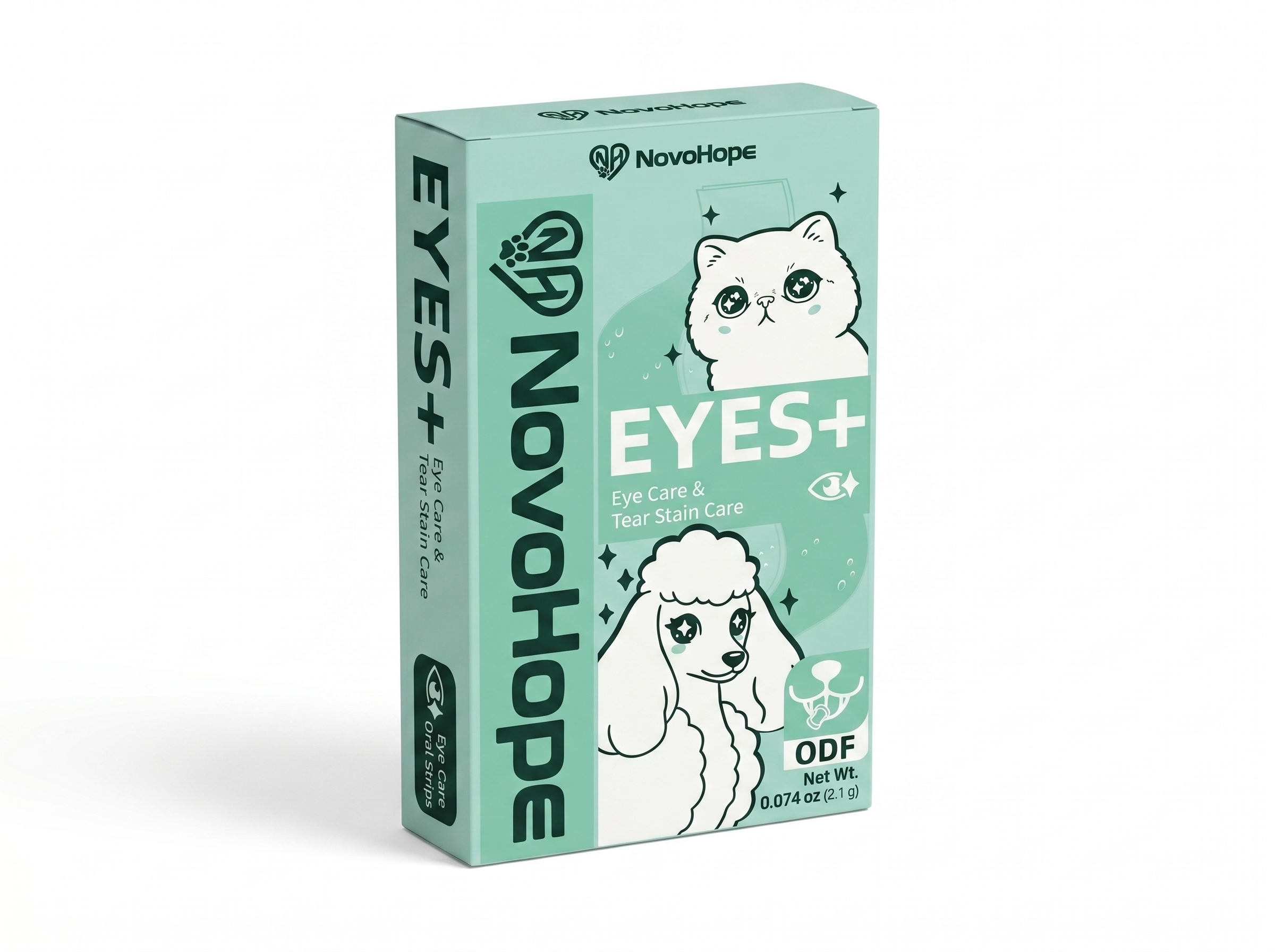
EYES+ is documented as an ODF rather than an ODT — a detail that matters for label and import documentation.
HEART+ — cardiovascular support, 2.1 g ODT
HEART+ is classified as a pet cardiovascular supplement and is formulated to provide targeted nutritional support and daily maintenance for heart and vascular health. The documented unit is 2.1 g with 10 pieces per pack, built on the standard fast-dissolving matrix.
On documentation, HEART+ is the strongest of the four in the reviewed material: a Certificate of Analysis, number DTI2026EC050626-4, issued by Shenzhen Deesev Testing International Corporation, for a customized full ingredient composition analysis test using client-designated test items. A buyer should read that scope precisely — it is a composition analysis, not an efficacy or stability study. It confirms what is in the product; it does not confirm a health outcome.
PROBIO — digestive care and probiotics, 2.5 g ODT
PROBIO is the digestive-care model, positioned around intestinal care and probiotics support, healthy digestion, nutrient absorption and improved coat condition. At 2.5 g per piece with 10 pieces per pack, it carries the largest documented unit mass of the four models.
That weight difference is not cosmetic. If a buyer is calculating pack economics per gram, HEART+ and EYES+ at 2.1 g sit in a different cost band from PROBIO at 2.5 g, even before formulation costs are considered. In the reviewed data, PROBIO does not carry a model-specific certificate of its own; coverage comes from the facility-level FDA registration described below. Buyers who need per-model COA or SDS documentation should request it explicitly at quotation stage rather than assume it exists.
EYES+ — eye care and tear stain management, ODF
EYES+ is formulated to support overall vision health and to manage or reduce tear stains. It is the only one of the four documented as an ODF rather than an ODT, with a stated specification of 2.1 g / 0.074 oz.
Its documentation is also the most market-specific. A test report, number DTI2026EC050626-2-2, issued by Shenzhen Deesev Testing International Corporation, certifies compliance with US FDA 21 CFR 175.300 for the US market, and a Safety Data Sheet, number DTI2026EC060626-2 from the same issuer, conforms to the OSHA Hazard Communication Standard 29 CFR 1910.1200 (HCS). For a US-bound tear-stain line, that pairing is the most directly reusable documentation set of the four models — but it still describes material compliance and hazard communication, not clinical performance.
FIT+ — weight management, 10-piece ODT
FIT+ is formulated to help manage appetite and support healthy, lean body mass so that pets stay active. It is documented as an ODT with 10 pieces per pack.
The gap in the product unit is that no per-piece weight is stated for FIT+. For a buyer, that is not a trivial omission: net content per unit is the figure that appears on pack artwork, drives dosage instructions, and is checked at customs. A weight-management SKU without a stated unit mass should be treated as incomplete until the specification sheet supplies it.

FIT+ is documented as an ODT at 10 pieces per pack; the per-piece weight is not stated in the product unit and should be requested before artwork is approved.
Purchasing terms that decide the comparison
Specifications decide whether a model fits; purchasing terms decide whether an order is workable. The Novohope capability data set for this line lists a monthly capacity of 200,000,000 units, a lead time of 35–45 days, and a minimum order quantity of 3,000 per SKU. Quality control is described as 100% full inspection before delivery plus third-party authoritative sampling testing. Customization covers recipe, brand, packaging design and other requirements, and production is offered on an OEM/ODM basis. Export markets are listed as Europe, North America, Southeast Asia, the Middle East and East Asia, with remote after-sales support.
Those numbers interact with a four-model comparison in a specific way. The MOQ applies per SKU, not per order, so a mixed assortment across HEART+, PROBIO, EYES+ and FIT+ multiplies the minimum commitment by four. The 35–45 day lead time is quoted production time and does not include artwork approval or the market-specific documentation review that EYES+ in particular will trigger for US-bound shipments.
One reference point on repeatability: a private-label engagement covering 200,000 units across a three-year period is documented for chain supermarkets and retail stores in Germany, the United Arab Emirates, Canada, Australia, France and the United States, with repeat orders attributed to category sales performance and ease of use. That is a single commercial case, not a general performance guarantee, but it does indicate that volumes of this scale have been produced and shipped.
Acceptance criteria: a checklist for comparing the four
Independent buyers tend to lose money on details that were never written into the purchase order. The following criteria translate the differences above into items that can be specified and inspected.
| Acceptance item | What to require | Why it matters for these four models |
|---|---|---|
| Form designation | State ODT or ODF explicitly on the specification sheet and the label | EYES+ is documented as ODF while the other three are ODT |
| Net content per unit | Per-piece weight in grams and ounces | Stated for HEART+ (2.1 g), PROBIO (2.5 g) and EYES+ (2.1 g / 0.074 oz); not stated for FIT+ |
| Pieces per pack | Confirmed pack count on artwork and shipping carton | Documented as 10 for all four models |
| Model-level test documentation | COA or test report naming the specific model | Supplied for HEART+ (COA DTI2026EC050626-4) and EYES+ (DTI2026EC050626-2-2, plus SDS DTI2026EC060626-2); request for PROBIO and FIT+ |
| Facility registration | Current FDA Food Facility Registration and its expiry date | Registration 18753066908 for Wuxi Nuohui Biotechnology Co., Ltd is documented with an expiry of 2026-12-31 |
| Label claim language | Nutrient-support wording only, no therapeutic claims | The corpus describes support and maintenance, not treatment |
| Market seals | Confirm any additional seal required by the destination retailer | The reviewed data documents FDA registration, SDS and COA; the NASC Quality Seal is not listed |
| Retention samples | Sealed samples per batch, held against the approved artwork | Fixed-dose units are only as consistent as the batch record behind them |
Where the format stops short
Fast-dissolving strips are not a universal upgrade over powders, tablets and chews, and the four models illustrate several of the boundaries.
The first is documentation symmetry. A buyer comparing the four side by side will find that the paperwork is not evenly distributed: HEART+ has a composition COA, EYES+ has a US-market test report and an SDS, and PROBIO and FIT+ are covered at facility level rather than model level. That does not mean the products differ in quality; it means the buyer has to request the missing documents rather than infer their existence.
The second is specification completeness. FIT+ is documented at 10 pieces per pack without a stated unit weight, which is enough for a category comparison but not enough to approve artwork.
The third is regulatory interpretation. FDA Food Facility Registration under Section 305 of the US Public Health Security and Bioterrorism Preparedness and Response Act of 2002 registers a facility; it is not a product approval and it does not certify a health claim. Registration 18753066908 is documented with an expiry of 2026-12-31, which means renewal has to be tracked as part of supply continuity rather than assumed. Separately, the NASC Quality Seal is a recognised US industry standard requiring adherence to Good Manufacturing Practices and rigorous labeling audits; the reviewed data for these four models does not list it, so a buyer selling into US specialist retail should confirm the position directly instead of assuming coverage.
The fourth is the evidence base. No clinical or efficacy data appears in the reviewed material for any of the four models, and the headline absorption figure is a manufacturer claim. Traditional formats also retain advantages the strip format does not replace: they are familiar to owners, they are supported by established dosing conventions in many markets, and they can carry larger single-unit inclusion levels without reformulating a thin matrix. Where a pet readily accepts a chew and the market expects that format, switching brings no automatic benefit.
Market trend: competition is moving to delivery
The category backdrop explains why format comparisons are appearing in sourcing conversations at all. North America held 48.1% of global pet supplement revenue in 2025 according to Grand View Research, while Mordor Intelligence identifies Asia-Pacific as the fastest-growing region, driven by rising pet humanisation and healthcare spending in China and India. Growth in the second region tends to favour formats that travel well and require no preparation — a category advantage for flat, room-temperature-stable units.
At the same time, functional segmentation is getting narrower. In tear-stain supplementation specifically, third-party e-commerce tracking has reported top products reaching monthly volumes of around 100,000 units on major platforms, with growth linked to antioxidant blends. That kind of volume rewards suppliers who can hold a fixed unit specification across large batches, and it puts pressure on the documentation side: a private-label buyer commissioning a tear-stain SKU needs the model-level test report, the SDS, and the registration status to line up before the first container ships.
Future outlook
For the next buying cycle, three developments are worth watching in this line and in the category generally. The first is documentation parity — the expectation that every model in a range carries its own COA and SDS rather than relying on facility-level coverage. The second is specification discipline on pack artwork, particularly where a range mixes ODT and ODF forms or leaves a unit weight unstated. The third is the shift from ingredient storytelling to delivery storytelling in retail listings, which favours formats that can be explained in one sentence to an owner.
None of that changes the underlying buying logic. A four-model range is useful precisely because it lets a buyer assemble a functional assortment from one manufacturing base — cardiovascular, digestive, eye care and weight management — while keeping the matrix, the pack format and the quality system consistent. The comparison work is in matching the documented specification to the intended market, and in requesting the documents that are not already on the table.
FAQ
What is the difference between HEART+, PROBIO, EYES+ and FIT+?
The difference is the intended nutritional direction, not the delivery system. HEART+ is a cardiovascular support formula, PROBIO is a digestive care and probiotics formula, EYES+ is an eye care and tear stain formula, and FIT+ is a weight management formula. All four are built on an oral fast-dissolving matrix.
Are all four models the same dosage form?
No. HEART+, PROBIO and FIT+ are documented as ODT (Orally Disintegrating Tablet). EYES+ is documented as ODF (Orally Disintegrating Film) at 2.1 g / 0.074 oz. The form named on the specification sheet should match the form printed on the label.
What pack specifications should a buyer verify before ordering?
Three figures: form designation, net content per piece, and pieces per pack. HEART+ is documented at 2.1 g with 10 pieces per pack, PROBIO at 2.5 g with 10 pieces per pack, EYES+ at 2.1 g / 0.074 oz, and FIT+ at 10 pieces per pack with no per-piece weight stated in the product unit.
Which certifications and documents apply to these pet ODT strips?
The reviewed data documents FDA Food Facility Registration number 18753066908 for Wuxi Nuohui Biotechnology Co., Ltd, issued by the U.S. Food and Drug Administration under Section 305 of the US Public Health Security and Bioterrorism Preparedness and Response Act of 2002, with an expiry of 2026-12-31. Model-level documents include a Certificate of Analysis for HEART+ (DTI2026EC050626-4) and, for EYES+, a test report against US FDA 21 CFR 175.300 (DTI2026EC050626-2-2) and a Safety Data Sheet against OSHA 29 CFR 1910.1200 (DTI2026EC060626-2), all issued by Shenzhen Deesev Testing International Corporation. Trademark application acceptance notices for the NovoHope brand are also documented with the National Intellectual Property Administration in China.
What are the minimum order quantity and lead time?
The capability data lists a minimum order quantity of 3,000 per SKU and a lead time of 35–45 days, with monthly capacity of 200,000,000 units. Because the MOQ applies per SKU, a four-model assortment carries four separate minimums.
Can recipes, branding and packaging be customized?
Yes. The documented customization scope covers recipe, brand, packaging design and other customized requirements, produced on an OEM/ODM basis. Quality control is described as 100% full inspection before delivery plus third-party authoritative sampling testing, and after-sales support is provided remotely.
Is the claimed 95% absorption rate independently verified?
The reviewed material does not include an independent trial supporting that figure; it appears in the manufacturer's product literature, which contrasts it with roughly 35% for conventional formats. External sector reporting on oral dissolving films for pets focuses on disintegration times below 25 seconds and taste-masking improvements of up to 47%, which describes category development rather than a measurement of these specific models.
Taken together, the four models are best read as one manufacturing platform pointed at four different health targets. The buying decision turns on which target fits the market, whether the pack specification is complete enough to print, and whether the documentation package covers the destination — three checks that can be completed before a sample is ever requested.
Tem questões ou precisa de mais detalhes?
Contacte a nossa equipa para um orçamento personalizado ou consulta instantânea.
Solicitar orçamento
Preencha o formulário abaixo e a nossa equipa entrará em contacto com uma proposta personalizada.
Chat direto do WhatsApp
Prefere conversar em tempo real? Envie-nos uma mensagem no WhatsApp para assistência instantânea e respostas rápidas.
- Obter orçamento personalizado
- Partilhar fotos ou documentos
- Discuta as suas necessidades diretamente
Geralmente responde em 5–30 minutos durante o horário de expediente.