
Buyer's Decision Framework: From Thread Size to Compliance
Every sealed enclosure begins with a decision that is easy to underestimate: how the cable gets in. A plastic cable gland is the accessory that turns an opening in a panel, cabinet or junction box into a controlled, sealed cable entry. When that decision is driven by unit price or sample appearance alone, the cost tends to surface later — at commissioning, during a washdown cycle, or after the first seasonal temperature swing.
For engineers, the difficulty is that a cable gland has to pass two independent tests at the same time. It has to fit: thread, panel cut-out, thread length and the actual outside diameter of the cable. And it has to be provable: supported by documentation showing that the material, the sealing system and the manufacturing process meet a recognised standard. This article sets out a six-step framework for that decision, using the plastic cable gland ranges of Zhejiang Gutai Connector Co., Ltd. (Gutai) as the working example. Gutai is a manufacturer of waterproof cable glands, solar MC4 connectors, mini waterproof boxes and connectors, and hose fitting series, based in Wenzhou, Zhejiang, China, and exporting roughly 80% of its output to markets including the Middle East, Southeast Asia, India, Pakistan, the EU, the United Kingdom and the United States.
Why the Decision Splits Into Fit and Proof
A cable gland purchase is not one decision but two, and in most organisations the two are made at different times by different people. A design engineer fixes the thread and the cable diameter. A procurement or quality team then asks for certificates. Problems appear when those conversations never meet: a perfectly certified gland threaded for PG conduit is still the wrong part in a Metric-punched panel.
The commercial backdrop makes a repeatable method more valuable, not less. The global cable glands market was valued at approximately USD 2.16 billion to USD 2.25 billion in 2024–2025, with growth forecasts varying between roughly USD 3.07 billion and USD 4.96 billion by 2034, according to published estimates from Straits Research and Spherical Insights. The spread between forecasts is largely methodological — different analysts scope the category differently — which is itself a useful reminder: in this category, a number means little without its definition.
Regionally, Asia Pacific is the leading market for cable glands, accounting for approximately 38% to 42% of global revenue, primarily driven by industrialisation in China and India. A wider supplier base and a wider geographic spread of demand increase the importance of a selection method that can be applied consistently across projects and markets.
Step 1 — Lock the Thread Interface First
Thread is the non-negotiable interface. If it does not match the equipment, nothing else about the gland matters. Two measurements belong in this step: the nominal thread size and the thread outside diameter (O.D.).
Gutai's PG series covers thread sizes PG7 to PG48, with a thread O.D. from 12.5 mm to 59.3 mm. The Metric series covers M12 to M63, with a thread O.D. from 12 mm to 63 mm. Thread length runs from 9 mm to 21 mm across both ranges. Gutai also states that its cable glands are available in four mainstream thread types — Metric, PG, G thread and NPT — so mixed equipment on one site can be served from a single supplier catalogue.
Two practical rules follow from this. First, Metric and PG sizes are separate systems and are not interchangeable; a gland chosen for one will not seat correctly in a panel cut-out made for the other. Second, the thread O.D. is a physical footprint, not a label — it determines clearance around the entry point when several glands sit close together on a plate.
Step 2 — Match the Cable Range, Not the Gland Name
Cable range is the second gatekeeper, and it is where specification errors most often originate. Both Gutai series cover a cable range of 3 mm to 45 mm, but the number that matters for any single cable is the band that the chosen thread size accepts.
The key point is that a cable range is a band, not a fixed diameter. A gland declared suitable for a given band will accept any cable whose measured outside diameter falls inside that band. That is what makes a wide-range plastic gland efficient: one part number can cover a family of cable sizes on the same line.
Conversely, an oversized gland on a thin cable is not a safer choice. A wider band does not improve sealing; it only increases the risk that the clamping and sealing geometry does not engage as intended.
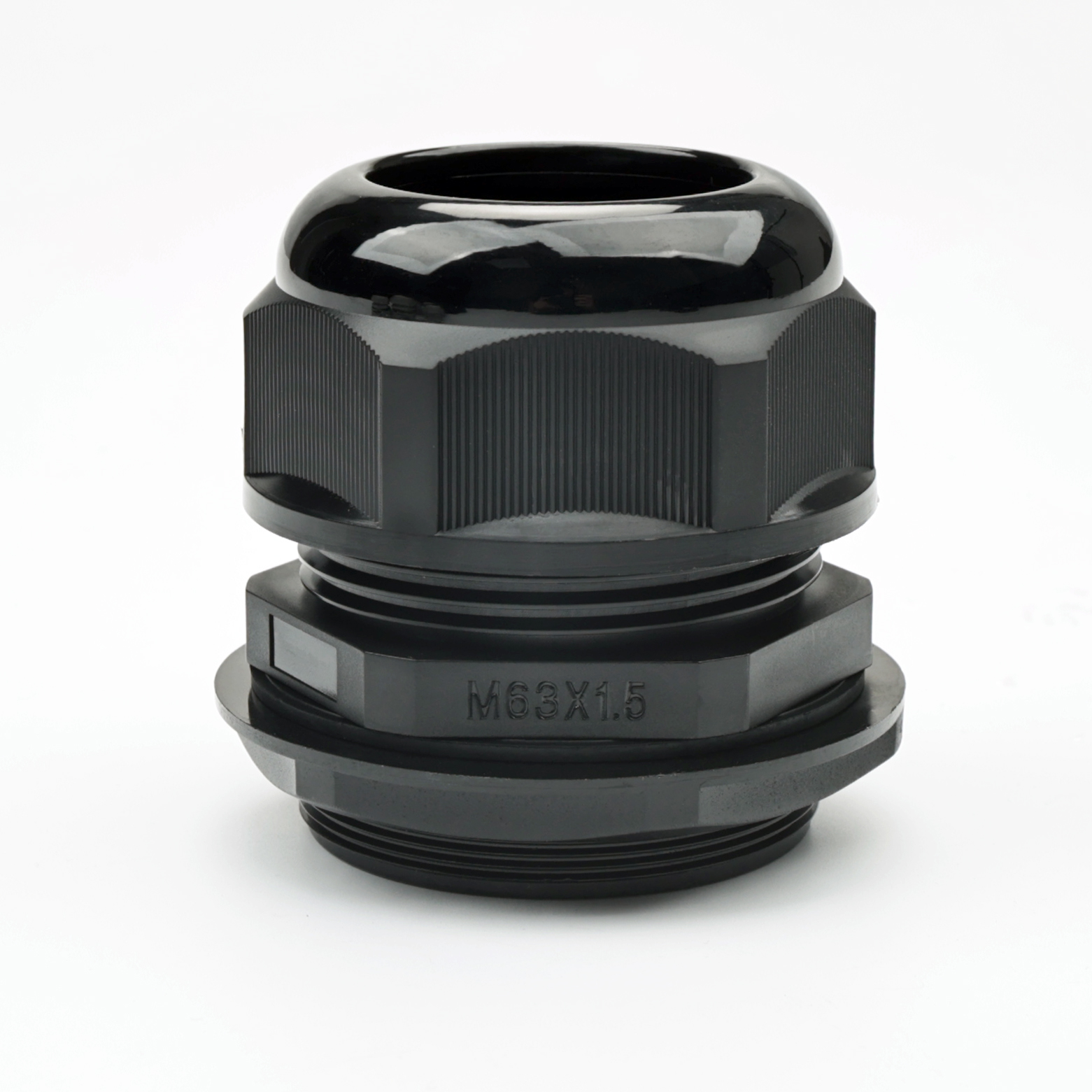 Metric Series cable gland at the upper end of the range, where thread O.D. and clamping geometry both reach their design limits.
Step 3 — Turn the Range Table Into One Comparison
The fastest way to remove ambiguity in a tender or an internal specification is to collapse the catalogue into a single comparison table and use it as the common reference for design and purchasing.
| Series | Thread sizes | Thread O.D. | Cable range | Thread length |
|---|---|---|---|---|
| Metric Series | M12 – M63 | 12 – 63 mm | 3 – 45 mm | 9 – 21 mm |
| PG Series | PG7 – PG48 | 12.5 – 59.3 mm | 3 – 45 mm | 9 – 21 mm |
Each column answers a different question. Thread sizes decide the interface with the enclosure. Thread O.D. decides physical clearance. Cable range decides which cables the gland can actually seal. Thread length decides how much wall thickness or plate depth the gland can pass through and still be tightened properly. Read together, the table is a fit check; read separately, each column is a source of specification error.
Step 4 — Treat Material and Sealing as the Long-Term Variables
Fit gets a gland installed. Material and sealing decide how long it keeps working. In Gutai's plastic cable gland construction, components A, C, E and F use nylon PA66, chosen for high strength and anti-aging performance, while sealing parts B and D use NBR nitrile butadiene rubber for sealing reliability and oil resistance. The nylon PA66 material used in the product is UL approved and complies with environmental standards for European and American export markets.
The stated operating envelope for these glands is:
- Static conditions: −40 °C to 100 °C, with a peak instantaneous temperature up to 120 °C
- Dynamic conditions: −20 °C to 80 °C, with a peak instantaneous temperature up to 100 °C
Chemical performance matters just as much as temperature in exposed installations. The glands are stated to resist salt spray, acid, alkali, alcohol, grease and common solvents — a property set that maps directly onto marine engineering, shipbuilding, food-adjacent washdown areas and outdoor telecom cabinets.
Standard colours are Black (RAL9005), Light Grey (RAL7035) and Silver (RAL7001), and custom colours are available on request. On most projects colour is a visual and inventory decision rather than a performance one, but it is worth locking early because it affects batch planning and lead time.
Step 5 — Separate Certificates From Claims
This is the step where buyers most often accept a statement that sounds like evidence but is not yet evidence. Gutai's plastic cable glands are certified with CE, RoHS, REACH, IP68 and CCC, and the company operates an ISO9001 international quality management system. Those are the headline facts. The decision value, however, comes from three scope questions that sit underneath them.
Material approval versus product listing
The nylon PA66 used in the glands is UL approved. That is a statement about the raw material compound, not automatically a product-level listing for the finished gland. Buyers who specifically require a product listing should request the exact document they need rather than assuming that a material approval satisfies it.
IP68 is a test condition, not an absolute
IP68 is defined under IEC 60529 and is the benchmark ingress protection rating for waterproof connectors; it requires the device to withstand continuous immersion in water under specified conditions. On a cable gland, that rating applies to the assembled and correctly installed part. The letter of the rating is inseparable from the conditions of the test and from the models listed on the certificate — which is why submerged or washdown applications should always be matched against the tested configuration, not against the two characters alone.
Standards define the method, not the outcome
IEC 62444, and its European adoption EN 62444, governs the construction and performance requirements for cable glands for electrical installations, and replaced the older BS EN 50262. A supplier's compliance claim is only useful when it names the standard and the model range it covers. A certificate is normally scoped to the products and materials listed on it, not to an entire catalogue.
Step 6 — Weight the Evidence by Function
The final step is to stop counting certificates and start assigning each document to the decision it actually supports. This is the core of the framework: evidence has no value in isolation, only in relation to a specific question.
| Decision question | Evidence to request | What it resolves |
|---|---|---|
| Does it physically fit? | Thread size, thread O.D., thread length, cable range | Correct threading and correct clamping geometry |
| Will it seal in service? | Ingress protection rating and its test basis (e.g. IEC 60529 IP68) | Whether the rating matches the real environment |
| Will the material last? | Material grade and approvals (UL-approved nylon PA66, NBR sealing parts) | Aging, temperature and chemical exposure |
| Is the supplier consistent? | ISO9001 quality management system | Repeatability across production batches |
| Can it be sold in my market? | CE, RoHS, REACH or CCC, depending on region | Market access and environmental compliance |
Applied this way, a certificate that does not answer the buyer's own environmental question has no decision value, however impressive it looks on a supplier deck. Equally, a technical specification without a supporting document is an unverified claim.
Applying the Framework: Where Plastic Cable Gland Ranges Are Used
Gutai's cable glands are intended for the new energy sector, industrial automation and advanced manufacturing, construction and infrastructure, and marine engineering and shipbuilding. The Metric Series is designed for use in waterproof electrical connector systems and intended for the new energy, industrial automation, construction and marine engineering industries, while the PG Series is designed for industrial automation and advanced manufacturing.
In project terms, that translates into cable entries on PV plants and panels, wind turbine cable outlets, EV charging stations and distribution boxes, energy storage system wiring, rail transit and telecom wiring, and industrial automation cable protection. The gland's job in each case is the same combination of functions: cable entry sealing, water and dust protection, mechanical fixation and strain relief, so that the electrical connection stays reliable over years of operation.
The equipment these glands are matched to is equally consistent: combiner boxes and junction boxes, inverters, storage cabinets, EV charger enclosures, rail transit electrical cabinets, industrial control cabinets, and conduit or corrugated tubing systems. Most of these are fixed panel or enclosure mounting; a smaller share involves on-site plug-and-play connection.
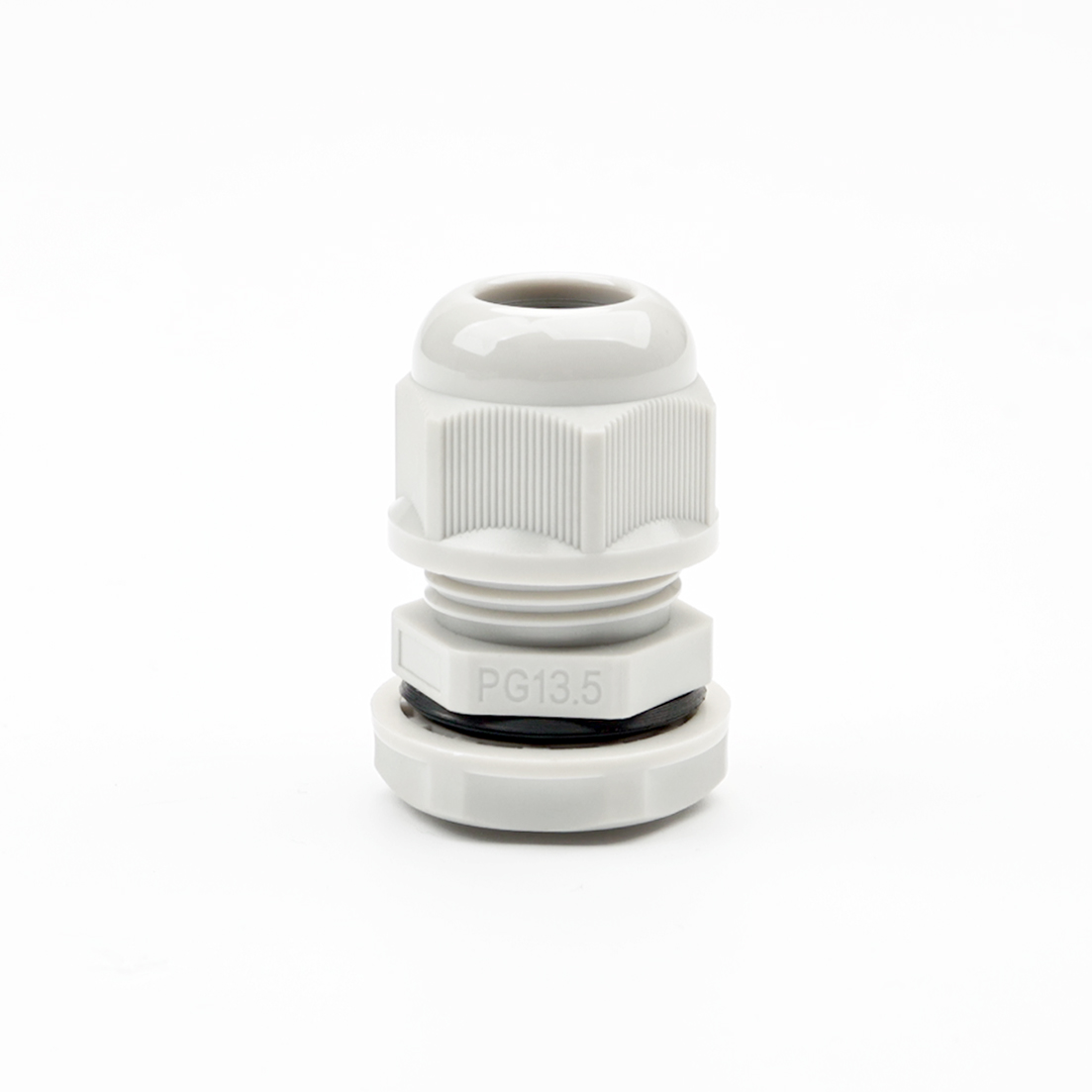 A PG Series nylon cable gland for smaller cable diameters — the entry-level end of a 3–45 mm cable range.
Two application requirements recur across these settings and should be written into the specification rather than left implicit. The first is environmental: UV resistance and weatherability, corrosion resistance and flame retardancy for outdoor installations. The second is mechanical and interface-related: specific thread and flange interfaces, customised multi-hole solutions, and sealing levels that match the project. Where a project needs certificates or material certificates, they should be requested as a named deliverable at the specification stage, not at shipment.
Market Trend Analysis
Category growth is steady, and regional concentration is high. With Asia Pacific holding approximately 38% to 42% of global cable gland revenue and the overall market valued in the low single-digit billions of US dollars, this is not a fast-moving consumer category. It is a specification-driven one, which means purchase decisions are won on documentation and fit rather than on novelty.
The adjacent waterproof connector market is expanding faster. One published estimate places the global waterproof connector market at approximately USD 13.4 billion in 2024, projected to reach USD 25.48 billion by 2033 at a CAGR of 7.4%. That figure comes from an industry intelligence source of medium reliability and should be treated as directional rather than definitive — but the direction is consistent with the growth of energy storage, EV charging and renewable generation, all of which multiply the number of sealed cable entries per installation.
Standardised interfaces concentrate volume. In the solar PV connector segment, the market was valued at USD 1.31 billion in 2024, and MC4 connectors hold about 68% of that segment. The pattern is instructive for cable gland buyers: once an interface becomes the de facto norm, the competition shifts from the interface itself to the quality of the evidence behind it.
Compliance-driven sourcing is becoming the default. As European, North American and Chinese market requirements diverge — EN 62444 in Europe, CCC in China, with RoHS and REACH cutting across both — the documentation burden migrates to the supplier. Buyers who build certificate checks into their specification template early tend to see fewer disputes at acceptance.
Comparing Traditional and Current Approaches
Older projects often standardised on a single thread type and a narrow band of glands, with performance verified against BS EN 50262. The approach was simple and predictable, but inflexible: a change in cable size or equipment supplier meant a new part number, and a change in market meant a new compliance exercise.
The current approach, represented by wide-range plastic cable glands, changes the trade-off. A cable range of 3 mm to 45 mm across a single family means fewer part numbers in stock and fewer specification errors at line level. Four thread types — Metric, PG, G thread and NPT — let one catalogue serve mixed equipment. And multi-standard certification (CE, RoHS, REACH, IP68, CCC) lets a single part number satisfy several markets without redesign.
Where this approach stops is just as important as where it works. Nylon PA66 glands operate within a stated thermal envelope, and where an application demands continuous temperatures beyond the static or dynamic bands, or mechanical loads and impact resistance beyond what a polymer body is engineered for, a metal-housed gland or a project-specific construction is usually the more appropriate answer. Equally, IP68 is achieved as part of a correctly assembled system — it is not a property a gland retains independently of how it is installed. Buyers who treat the rating as a standalone guarantee rather than an installed-system result are the ones who discover the gap in the field.
It is also worth placing any supplier in context. The global cable gland and connector sector includes established international competitors such as ABB Ltd., Eaton Corporation, Amphenol Corporation, LAPP Group and HUMMEL AG. Comparisons between a specialist manufacturer and these companies are only meaningful when both are assessed on the same decision axes — thread fit, cable range, material envelope, certificate scope and market access — rather than on brand recognition.
Future Outlook
Three shifts are likely to shape cable gland procurement over the next few years. First, certificate scope statements will become more explicit, because buyers are increasingly asking which models and materials a document covers rather than whether a certificate exists. Second, material-level approvals will move from a differentiator to a baseline expectation, particularly where long-term UV and aging performance matter. Third, the growth of energy storage, EV charging infrastructure and distributed solar will keep increasing the number of sealed cable entries per installation, which raises the cost of getting the fit-and-proof framework wrong even once.
For engineers, the practical implication is modest but consistent: keep the framework, and apply it at the specification stage rather than at the goods-in inspection stage.
FAQ
What is a plastic cable gland used for?
A plastic cable gland is a cable entry accessory that secures a cable where it passes through a panel, enclosure or junction box, and seals that opening against water and dust. In Gutai's range, cable glands are classified as plastic, nylon and metric or PG cable glands depending on the series, and are used for cable entry sealing, water and dust protection, mechanical fixation and strain relief in new energy, industrial automation, construction and marine engineering applications.
How do I choose between a Metric cable gland and a PG cable gland?
Choose by the thread interface already present on the equipment, not by preference. Gutai's Metric series covers M12 to M63 with a thread O.D. of 12 mm to 63 mm, while the PG series covers PG7 to PG48 with a thread O.D. of 12.5 mm to 59.3 mm. Both series cover a cable range of 3 mm to 45 mm and a thread length of 9 mm to 21 mm, so once the thread type is fixed, the deciding variable is normally the cable's outside diameter.
What does IP68 actually confirm on a cable gland?
IP68 is an ingress protection rating defined under IEC 60529, indicating that a device withstands continuous immersion in water under specified conditions. Applied to a cable gland, it describes the assembled and correctly installed part, so the rating should always be read together with the test conditions and with the specific models listed on the certificate.
Which certificates should a buyer verify before ordering cable glands?
The required set depends on the destination market. Gutai's plastic cable glands are certified with CE, RoHS, REACH, IP68 and CCC, the company operates an ISO9001 quality management system, and the nylon PA66 material used in the product is UL approved. Buyers should confirm which models and materials each document covers, because a certificate's scope is normally limited to the products listed on it.
What are the limitations of nylon PA66 cable glands?
Nylon PA66 glands operate within a stated temperature envelope: static conditions from −40 °C to 100 °C with a peak instantaneous temperature up to 120 °C, and dynamic conditions from −20 °C to 80 °C with a peak up to 100 °C. Outside those bands, or where mechanical demands exceed what a polymer body is designed for, a metal-housed gland or a project-specific construction is normally more suitable.
Can plastic cable glands be supplied in custom colours?
Standard colours in Gutai's plastic cable gland range are Black (RAL9005), Light Grey (RAL7035) and Silver (RAL7001). Custom colours are available on request.
A full overview of thread sizes, cable ranges, materials and certification status for the Metric and PG series is available in Gutai's product catalogue: Gutai product catalogue (PDF).
Tem questões ou precisa de mais detalhes?
Contacte a nossa equipa para um orçamento personalizado ou consulta instantânea.
Solicitar orçamento
Preencha o formulário abaixo e a nossa equipa entrará em contacto com uma proposta personalizada.
Chat direto do WhatsApp
Prefere conversar em tempo real? Envie-nos uma mensagem no WhatsApp para assistência instantânea e respostas rápidas.
- Obter orçamento personalizado
- Partilhar fotos ou documentos
- Discuta as suas necessidades diretamente
Geralmente responde em 5–30 minutos durante o horário de expediente.