
Buyer's Decision Framework: Thread Sizes to Compliance Evidence
A waterproof cable gland is one of the least expensive line items on a bill of materials and one of the most frequent causes of a rejected enclosure. It sits between two systems that are usually specified by different people: the cable, chosen by an electrical engineer, and the enclosure entry, cut or ordered by a panel builder. A third person often makes the final call — procurement — working from a part number and a certificate request.
The practical answer for buyers is to treat the decision as a sequence of five gates, applied in order: thread geometry, cable range, material and sealing performance, compliance evidence, and supply documentation. The first two gates decide whether the part physically works. The last two decide whether the choice can be defended eighteen months later during an audit, a warranty claim, or a second production run.
This framework matters at scale. The global cable glands market was valued at approximately USD 2.16 billion to USD 2.25 billion in 2024–2025, with third-party forecasts for 2034 ranging from about USD 3.07 billion to USD 4.96 billion depending on methodology (Straits Research; Spherical Insights). Asia Pacific is estimated to account for roughly 38–42% of global revenue, driven primarily by industrialisation in China and India (Dataintelo; Straits Research). The adjacent waterproof connector market was valued at approximately USD 13.4 billion in 2024 and is projected to reach USD 25.48 billion by 2033 at a 7.4% CAGR (AOHUA / Industry Intelligence).
Why the Sealing Interface Is a Procurement Decision
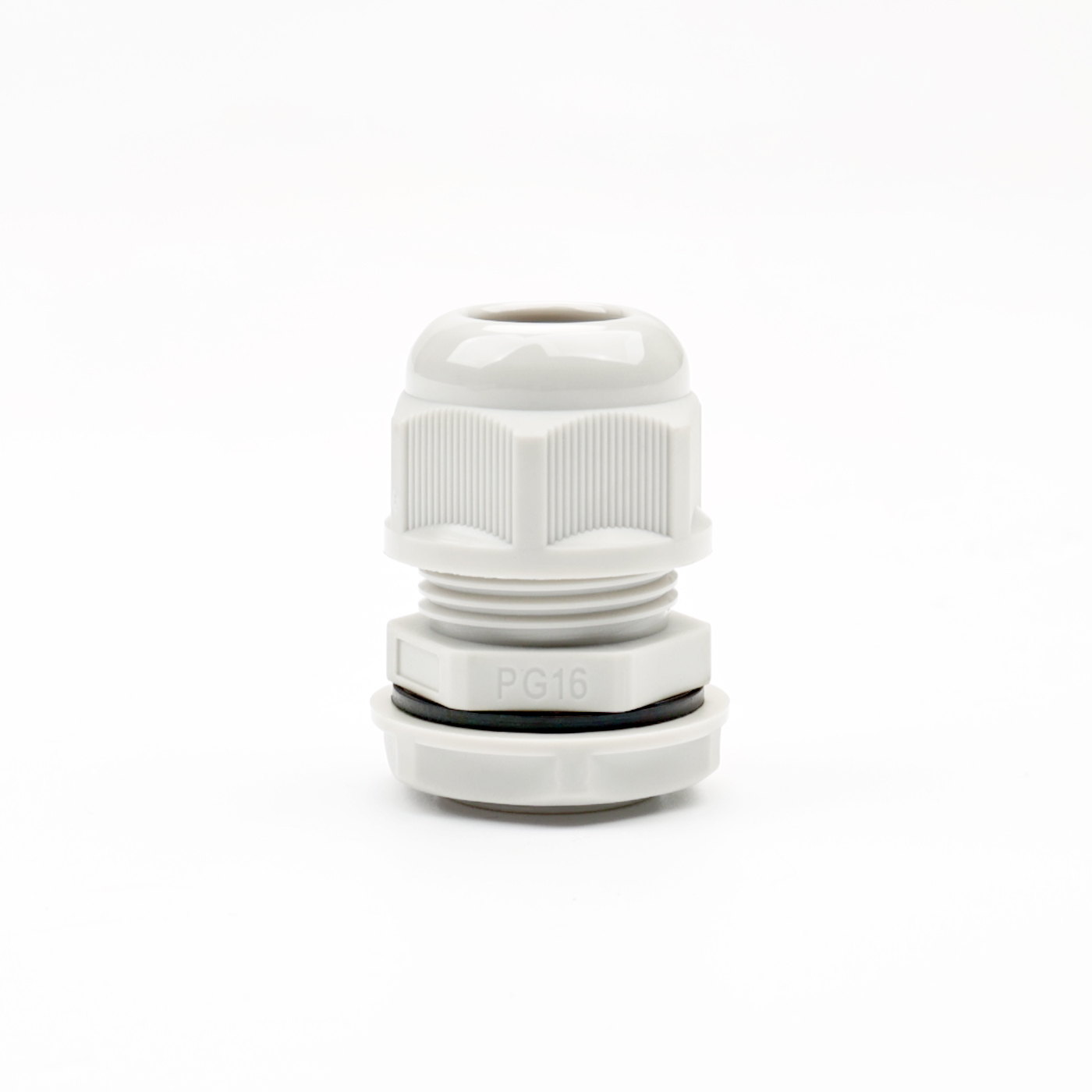
In Gutai's catalogue, the nylon cable gland series is described in two configurations. The Metric Series is classified as a plastic cable gland and a metric cable gland, with a model designation of Metric Series. The PG series is classified as a plastic cable gland, a nylon cable gland, a PG cable gland, and a metric cable gland, with a model designation of PG. Both are intended for the new energy sector, industrial automation, construction and infrastructure, and marine engineering and shipbuilding industries.
That overlap is exactly where buying errors begin. The same physical product family is described by thread standard, by body material, and by ingress rating — and buyers who search by only one of those attributes often end up with a gland that matches the search term but not the panel.
Problem: Two Failure Modes Buyers Keep Paying For
Failure mode one is functional mismatch. A gland is ordered against the cable diameter, shipped, and then discovered to be the wrong thread for the enclosure entry. The cable fits, the panel does not accept the part. The cost is not the gland — it is the re-machining, the delayed assembly line, and the expedited re-order.
Failure mode two is a documentation gap. The part fits and works, but when a customer, a notified body, or an internal quality team asks for the compliance file, the answer is a supplier statement rather than a certificate that names the model family. This gap is rarely visible at the sample stage. It becomes visible when production scales.
Both failures come from the same root cause: the buying decision is made in the wrong order. Thread and cable range should be resolved before price, and compliance evidence should be resolved before the first purchase order — not after the sample is approved.
Gate 1 — Thread Geometry Comes Before Everything Else
The thread is the mechanical contract between the gland and the enclosure. It is determined by the panel entry, not by the cable. Two dimensions matter: the thread outside diameter and the thread length.
| Series | Thread size range | Thread O.D. | Thread length | Cable range |
|---|---|---|---|---|
| Cable gland, Metric Series | M12–M63 | 12–63 mm | 9–21 mm | 3–45 mm |
| Cable gland, PG | PG7–PG48 | 12.5–59.3 mm | 9–21 mm | 3–45 mm |
The 12.5–59.3 mm thread outside diameter span of the PG series and the 12–63 mm span of the Metric Series cover the majority of panel entries in industrial control cabinets, junction boxes and equipment housings. Thread length matters for a different reason: a gland threaded into a thin enclosure wall may not reach the locking nut, while a gland with excessive thread length on a thick casting can bottom out before the seal seats.
A buyer working from an existing drawing should also check which thread convention the drawing actually uses. Metric and PG threads are not interchangeable without an adapter, and both conventions remain in active use across Europe, the Middle East, South Asia and North America.
Gate 2 — Cable Range (3–45 mm) and Clamping Behaviour
Thread and cable range are independent variables, and this is the single most common source of specification error. The nylon series spans a 3–45 mm cable range across the family, but each individual size accepts only a defined sub-range.
| Metric size | Cable range | PG size | Cable range |
|---|---|---|---|
| M12 | 4–8 mm | PG7 | 4–8 mm |
| M12S | 3–6.5 mm | PG7S | 3–6.5 mm |
| M16 / M16S | 6–10 mm / 4–8 mm | PG9 / PG11 | 4–8 mm / 6–10 mm |
| M18 | 6–10 mm | PG13.5 | 6–12 mm |
| M20 / M20S | 8.5–14 mm / 6–12 mm | PG16 | 8.5–14 mm |
| M25 / M25S | 12.5–18 mm / 8.5–14 mm | PG19 / PG21-type | 12–15 mm |
| M32 | 18–25 mm | PG25 / PG29 | 15–21 mm / 18–25 mm |
| M50 | 31–41 mm | PG36 / PG42 | 24–32 mm / 31–41 mm |
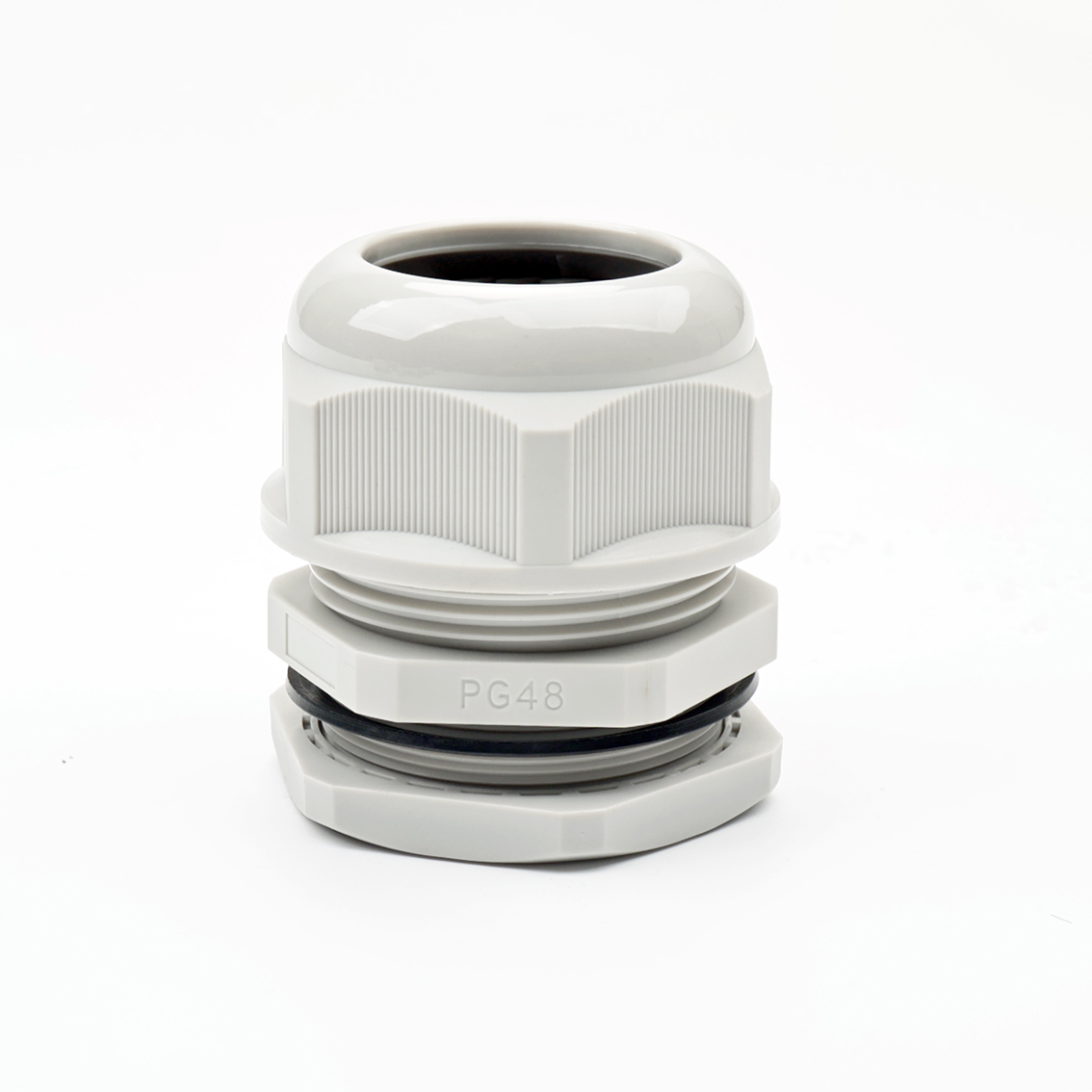
| M63 | 35–45 mm | PG48 | 35–45 mm |
Two engineering consequences follow. First, always specify a cable diameter range rather than a nominal cable diameter, because cable tolerances vary between manufacturers and between production batches. Second, note that larger cable ranges are not automatically better. A gland clamping a cable near the lower edge of its range has less elastic deformation available in the seal, while a cable at the upper edge of two adjacent sizes may be better served by the next size up.
The structural design behind this is a clamping claw combined with a rubber sealing element. The claw distributes pull-out load; the rubber element performs the sealing. Gutai describes the nylon series as using a special clamping claw and rubber sealing structure, designed to give a wide clamping range with pull-out resistance.
Gate 3 — Material and Sealing Performance
Once geometry is fixed, the material set determines how long the gland survives in the environment it was specified for. The nylon cable gland series uses two material groups: components A/C/E/F are made from UL-certified Nylon PA66, selected for strength and anti-aging performance; sealing parts B/D are NBR nitrile butadiene rubber, selected for sealing reliability and oil resistance. The overall material designation for the series is Nylon PA66 with NBR.
Performance windows for the series, as published in the product specification, include:
- Temperature, static condition: −40 °C to +100 °C, with peak instantaneous temperature up to +120 °C.
- Temperature, dynamic condition: −20 °C to +80 °C, with peak instantaneous temperature up to +100 °C.
- Ingress protection: IP68 rated for waterproof and dustproof performance.
- Chemical resistance: resistant to salt spray, acid, alkali, alcohol, grease and common solvents.
- Standard colours: Black (RAL9005), Light Grey (RAL7035) and Silver (RAL7001); custom colours are available upon request.
The static-versus-dynamic distinction is frequently ignored during specification. A gland that holds a fixed cable in a control cabinet operates under very different mechanical conditions from one that guides a moving cable on automated equipment. The published windows are not the same, and a specification written against the static figure will be optimistic if the real application flexes.
Gate 4 — Compliance Evidence: What a Certificate Actually Covers
Compliance is where the difference between a marketing claim and a verifiable file becomes measurable. The nylon cable gland series is described in the product specification as certified with CE, RoHS, REACH, IP68 and CCC, with the nylon PA66 material UL approved, in line with environmental standards for European and American export markets.
Each of those items answers a different question. Reading them as a single quality score is a common buyer mistake.
| Evidence | What it addresses | What it does not establish |
|---|---|---|
| CE marking | Conformity route for the applicable EU directives | Does not by itself define sealing class or mechanical performance |
| RoHS / REACH | Restricted substances and chemical compliance for EU-market supply | No performance or durability statement |
| IP68 (per IEC 60529) | Ingress protection against continuous immersion under specified test conditions | Does not automatically extend to every cable diameter, torque value or installation method |
| CCC | China market compulsory certification scope | Market-specific only; not a global performance mark |
| UL recognition of PA66 material | Recognition of the raw material used in components A/C/E/F | Material-level recognition, not a finished-assembly listing |
| ISO9001 | Quality management system of the manufacturer | Not a product performance certificate |
| IEC 62444 / EN 62444 | Construction and performance requirements for cable glands for electrical installations | Supersedes the older BS EN 50262; legacy drawings may still cite the withdrawn standard |
Two verification habits separate experienced buyers from first-time importers. First, confirm the certificate names the model family being purchased — a system certificate covers the factory, not the part. Second, confirm the market the certificate was issued for. RoHS and REACH matter for EU supply, CCC for China, and UL recognition for North American expectations; none of them substitutes for the others.
Gate 5 — Supply and Documentation Verification
The final gate is the one most often skipped: confirming that the entity issuing the certificates is the entity that will actually produce the order. For Zhejiang Gutai Connector Co., Ltd., the published company profile states a 5,000 m² facility, 80 employees, a 10-engineer R&D team, annual output of 10,000,000 units, and an export ratio of 80%, with main markets in the Middle East, Southeast Asia, India, Pakistan, the EU, the United Kingdom and the USA. OEM production is accepted.
Those numbers are not a quality claim on their own. They are a capacity statement, and their value to a buyer is that they can be checked against the certificate holder's name, the shipping address, and the audit documents. A certificate issued to a trading entity that subcontracts production creates a traceability gap that surfaces at the worst possible moment.
Application Fit: Where the Nylon Series Belongs
The nylon cable gland series is intended for the new energy sector, industrial automation and advanced manufacturing, construction and infrastructure, and marine engineering and shipbuilding. In practice, that maps to specific installation points:
- PV plant and panel cable entries, and wind turbine cable outlets
- EV charging station and distribution box cable entries
- Energy storage system wiring
- Rail transit and telecom wiring
- Industrial automation cable protection and general control cabinet entries
The matched equipment set is equally specific: combiner boxes and junction boxes, inverters, storage cabinets, EV charger enclosures, rail transit electrical cabinets, industrial control cabinets, and conduit or corrugated tubing systems. In each case the gland performs four functions simultaneously — cable entry sealing, water and dust protection, mechanical fixation, and strain relief — which is why a gland selected only on ingress rating tends to underperform somewhere else.
Installation is primarily fixed, with panel or enclosure mounting; some quick-connect products in the wider accessory range are used for on-site plug-and-play connection. Where a project demands UV resistance and weatherability, corrosion resistance, flame retardancy, specific thread or flange interfaces, customised multi-hole solutions, or a defined sealing level, those requirements should be stated at the enquiry stage rather than assumed from a generic catalogue page.
Market Trend: Evidence Is Moving Earlier in the Buying Cycle
Three shifts are visible in how waterproof electrical connector accessories are being purchased.
First, the centre of production and consumption continues to move toward Asia Pacific, which holds an estimated 38–42% of global cable gland revenue. That concentrates supplier selection decisions in a region where documentation quality varies widely between manufacturers, making certificate verification a differentiating purchasing skill rather than an administrative step.
Second, end markets with the strictest documentation habits are growing fastest. Solar PV connectors, a neighbouring accessory category, were valued at USD 1.31 billion in 2024, with MC4 connectors holding a 68% share of that segment (Global Market Insights). Solar and energy storage projects are financed and insured, and financed projects generate documentation requirements that flow straight down to accessory suppliers.
Third, buyers are asking for compliance files at the sampling stage rather than at the purchase order stage. The practical effect is that suppliers with an organised certificate set win evaluations earlier, and suppliers who assemble documents after the fact lose time in the same evaluations.
Comparison with Traditional Practice — and the Limits of the Nylon Series
Traditional sourcing practice, still visible in a great deal of legacy documentation, ran in a different order: pick a gland that fits the cable, request a sample, approve the sample on physical inspection, and treat certificates as a closing formality. The framework described above reverses that order, and the differences are consequential:
| Decision point | Traditional practice | Sequenced framework |
|---|---|---|
| Entry point | Cable diameter | Enclosure thread, then cable range |
| Standard reference | May still cite BS EN 50262 | IEC 62444 / EN 62444 as the current reference |
| Evidence timing | After sample approval | Before sample approval |
| Certificate reading | Count of marks | Scope, model family and market of each mark |
| Temperature basis | Single figure | Static and dynamic windows stated separately |
Honest boundaries matter as much as the framework itself. The nylon cable gland series is designed around defined material and temperature windows — static −40 °C to +100 °C with peaks to +120 °C, dynamic −20 °C to +80 °C with peaks to +100 °C. Applications that run continuously above those windows, that impose heavy mechanical load or sustained vibration, or that require electromagnetic shielding fall outside the design intent of a nylon gland. Those requirements belong to a different product family; Gutai's wider portfolio includes EMC cable glands, porous cable glands, brass screw caps and watertight corrugated tubing fittings, so an EMC or metal-construction route is a separate selection rather than an upgrade of the nylon part.
A second boundary concerns IP68. The rating is verified against a tested configuration. It is not a blanket promise that every cable diameter used with that gland in the field will achieve the same result, because sealing depends on cable surface, clamping torque and installation quality. A third boundary concerns customisation: custom colours and OEM adaptations are available, but a custom variant is a separate configuration and buyers should confirm explicitly whether the existing series certificates cover it.
Future Outlook
Two directions look durable. On the standards side, the replacement of BS EN 50262 by IEC and EN 62444 has already reset the reference point for cable gland construction and performance requirements, and legacy drawings that still cite the withdrawn standard will continue to be corrected as projects are revised. Buyers who state the current standard in their enquiries avoid a slow, recurring source of rework.
On the supply side, documentation is becoming part of the product. As Asia Pacific's share of cable gland revenue holds near 38–42% and demand grows in financed end markets such as solar and energy storage, the suppliers who can present a coherent certificate set for a named model family — rather than a folder of unrelated marks — will be easier to qualify and easier to keep in a long-term programme.
For reference, the full series specification, sizes and material details are compiled in the downloadable product brochure.
FAQ
Should a buyer specify a metric thread or a PG thread?
The choice is normally determined by the enclosure entry already in place, not by preference. Metric series glands cover M12 to M63 with thread outside diameters of 12–63 mm, while the PG series covers PG7 to PG48 with thread outside diameters of 12.5–59.3 mm. Both series share a cable range of 3–45 mm and a thread length range of 9–21 mm. New designs generally standardise on the metric convention, while PG sizes remain relevant when maintaining or retrofitting equipment originally built to older European thread conventions.
Does the thread outside diameter indicate which cable will fit?
No. Thread outside diameter and cable range are independent dimensions. A thread size describes how the gland attaches to the enclosure; a cable range describes what the gland can clamp. Within the same series, for example, an M20 accepts cables from 8.5 mm to 14 mm while an M25 accepts 12.5 mm to 18 mm. Buyers should specify the cable diameter range rather than a nominal figure, since cable tolerances vary.
What does an IP68 rating actually verify?
IP68 is defined under IEC 60529 and requires the device to withstand continuous immersion in water under specified conditions. It verifies the performance of the tested configuration, not an unlimited promise for every installation. Because sealing depends on the cable diameter used, the clamping torque applied and the quality of installation, a buyer should confirm that the rating for the specific gland size matches the intended cable and mounting method.
Which compliance documents should be on file before a purchase order is released?
For the nylon cable gland series, the applicable set includes CE, RoHS, REACH, IP68 and CCC, together with UL recognition for the nylon PA66 material used in components A/C/E/F. At manufacturer level, an ISO9001 quality management system certificate applies. At product level, IEC 62444 or EN 62444 governs construction and performance requirements for cable glands. Buyers should check that each document names the model family being purchased and the market it was issued for.
Are nylon cable glands suitable for outdoor and marine environments?
The nylon series is intended for the new energy sector, industrial automation, construction and infrastructure, and marine engineering and shipbuilding, and it is described as resistant to salt spray, acid, alkali, alcohol, grease and common solvents, with IP68 rating and a static temperature window of −40 °C to +100 °C. Suitability therefore depends on the specific exposure profile. Where continuous operation exceeds the stated temperature windows, where heavy mechanical load or sustained vibration is present, or where electromagnetic shielding is required, a metal or EMC cable gland family is the appropriate selection instead.
Tem questões ou precisa de mais detalhes?
Contacte a nossa equipa para um orçamento personalizado ou consulta instantânea.
Solicitar orçamento
Preencha o formulário abaixo e a nossa equipa entrará em contacto com uma proposta personalizada.
Chat direto do WhatsApp
Prefere conversar em tempo real? Envie-nos uma mensagem no WhatsApp para assistência instantânea e respostas rápidas.
- Obter orçamento personalizado
- Partilhar fotos ou documentos
- Discuta as suas necessidades diretamente
Geralmente responde em 5–30 minutos durante o horário de expediente.