
Buyer's Verdict: Independent Comparison of 316L Stainless Steel Jewelry vs. Fashion Alloys for DTC Brands
When a DTC brand puts its name on a jewelry line, the first test is not about design trends. It is about whether a customer can wear the piece daily, wash their hands, sweat through a summer day, and still trust the brand after side-by-side product photos reveal no tarnish, no green skin, and no unexplained rash. For many brands, that risk is decided before the design is even finalized. The material underneath the finish, the plating method, and the traceable compliance evidence determine whether a product is a repeatable bestseller or a steady source of returns.
This independent buyer analysis compares 316L stainless steel jewelry with the broader category of standard fashion alloys. It is not a ranking of supplier brands. Instead, it evaluates what a sourcing professional should verify when choosing between two material families for a direct-to-consumer jewelry program.
For the documented side of the comparison, the review uses materials and certification data from Jusnova Jewelry Co., Ltd., a Guangzhou-based jewelry manufacturer founded in 2009 that supplies wholesale and brand buyers in Europe, the United States, and other export markets. The purpose of using one manufacturer's evidence is not promotional. It is to check whether claims about 316L steel, PVD coatings, and hypoallergenic performance can survive the same scrutiny a buyer should apply to any supplier.
Why material choice has become a DTC brand risk
Jewelry categories that once depended on precious-metal perceptions are now being sold through e-commerce channels where product reviews, unboxing videos, and return rates speak louder than in-store lighting. A customer may buy a gold-toned bracelet because it looks expensive online, but the product's long-term score depends on how well the finish survives real wear.
Standard fashion alloys are a wide category. They can include copper-zinc alloys, zinc-based base metals, and other lower-cost substrates that are often finished with a thin electroplated layer to imitate gold, rose gold, or silver. When new, these materials can look compelling. The problem is less about initial appearance and more about the behavior of the surface over time. If a decorative plating layer wears away, the underlying metal can be exposed, which may lead to tarnishing, color shifts, or skin discomfort for nickel-sensitive customers.
316L stainless steel starts from a different material position. It is a low-carbon stainless grade that is widely treated as a practical benchmark for hypoallergenic jewelry because of its corrosion resistance. It is also a base that can be finished with methods such as PVD coating or 18K electroplating, giving brands access to precious-metal-like colors without relying on a fragile base metal.
The buying decision for a DTC brand, therefore, is not simply premium versus budget. It is whether a product's material system can support the claims that the brand needs to make online: waterproof, hypoallergenic, non-tarnish, and color-consistent.
Side-by-side comparison: 316L stainless steel vs. standard fashion alloys
The table below compresses the sourcing evaluation into the criteria that matter most at the procurement and product-development stage. The 316L column reflects documented data tied to Jusnova Jewelry's stainless steel product line. The fashion-alloy column describes common risks in the category rather than a single named competitor.
| Buyer check | 316L stainless steel evidence reviewed | Standard fashion-alloy situation |
|---|---|---|
| Material traceability | SGS material content analysis confirms the grade; product documentation lists 304, 316, and 316L material options. | Base-metal composition can vary between batches and is often not visible in marketing materials. |
| Skin-safety positioning | Described as hypoallergenic 316L with zero nickel release, tested to EU REACH and FDA standards. | Surface wear may expose substrates containing nickel or other reactive metals, especially after extended use. |
| Daily durability | With proper daily maintenance, a stainless steel chain body can be used for more than 10 years; PVD vacuum plating is referenced at 2–5 years of stable luster under normal wear. | Electroplated base-metal jewelry tends to depend more heavily on coating thickness and wear environment. |
| Color consistency | PVD coating is available in more than 20 color options with Delta E less than 1.0 color consistency across batches. | Color can shift between production runs when plating lines are not tightly controlled. |
| Compliance documentation | Current SGS reports are referenced for material content, salt spray, and artificial sweat testing. | Compliance evidence must be requested per product model; it cannot be assumed from the material category. |
The most important takeaway from this table is not that every 316L product is automatically flawless. It is that a documented 316L supply chain answers the buyer's questions with traceable reports, while a generic alloy product often leaves those questions unanswered.
Material durability: what the steel actually provides
Durability means different things at different stages. For the base structure, stainless steel has long been used in fashion accessories because it resists corrosion and does not require the same protective coating as base alloys. Jusnova's product data describes a stainless steel base chain that can be used for more than 10 years with proper daily maintenance. That is not a promise that the surface will remain untouched forever, but it highlights why stainless steel has become a practical option for everyday pieces.
For the finished appearance, PVD is the more relevant technology. Physical vapor deposition places a thin, dense coating on the surface. In the reviewed product documentation, PVD coatings are available in more than 20 color options, from yellow gold and rose gold to black and gunmetal, allowing brands to replicate precious-metal looks on a stainless steel base. The documented service expectation for PVD vacuum plating is 2–5 years of stable luster under normal wear without fading or peeling.
This matters for DTC brands because a typical customer complaint about fashion jewelry is not structural. It is cosmetic: the color faded, the piece turned dark, or the surface peeled after a few weeks. A stainless steel product with a controlled coating process removes much of that risk, although it does not make the coating indestructible.
Finishing consistency: the Delta E advantage
Color consistency is a hidden purchasing criterion until it goes wrong. A DTC brand may order 5,000 units of an engraved gold-toned bracelet and later reorder the same style. If the second batch is slightly pinker, yellower, or darker, the brand is left with inventory that cannot be sold as a single SKU.
Delta E is a color-difference metric. A value below 1.0 is generally considered a very small difference, often near the threshold of visual perception. The Jusnova documentation states PVD color consistency of Delta E less than 1.0 across batches. That claim is especially relevant for brands selling through marketplaces or social commerce, where a customer may order the same item weeks apart and expect identical color.
For brands that require engraved pieces, logos, or 18K gold plating, finishing consistency also extends to surface detailing. Stainless steel can be laser engraved and stamped, and the color result needs to align with the product story. When surface finishing and quality control are handled in-house, as Jusnova describes with its PVD and electroplating process, the production line has less room for uncontrolled variables.
Buyer note: Color-consistency claims should be supported by a controlled coating process, not only by a promotional product image. Ask the supplier how Delta E is measured and whether the result applies to the exact finish being ordered.
Compliance and skin safety: REACH limits and zero nickel release
For jewelry sold in the European market, regulatory attention is focused on nickel release. EU REACH Annex XVII Entry 27 restricts nickel release from articles intended for direct and prolonged skin contact to less than 0.5 μg/cm²/week, with an even stricter limit of 0.2 μg/cm²/week for parts inserted into pierced ears and other pierced parts of the human body. A jewelry brand cannot control this only by naming a material; it needs test data for the actual finished item.
Jusnova's documented product claim is that the stainless steel used is hypoallergenic 316L with zero nickel release, tested to EU REACH and FDA standards. In practical terms, this means a DTC brand can position the product around sensitive-skin needs without relying only on unverified statements. The term zero nickel release is more relevant than the ambiguous phrase nickel-free, because the regulatory system measures release.
Standard fashion alloys, especially those with a decorative top layer, carry a different set of risks. When the plating is new, the wearer may be separated from the substrate. But after friction, sweat, or exposure to hygiene products, the plating can wear in localized areas. If the substrate contains nickel, skin contact with the exposed area can cause discomfort. A buyer should therefore ask for the alloy composition and for a nickel-release test result, not just for a polished surface.
Independent validation: what the SGS certificate numbers actually show
Independent buyers should treat material claims as unverified until a third-party report is available. The most practical way to check 316L stainless steel jewelry is to ask for current SGS reports and compare the report number, standard, issue date, and validity period.
For this comparison, the following SGS evidence was reviewed:
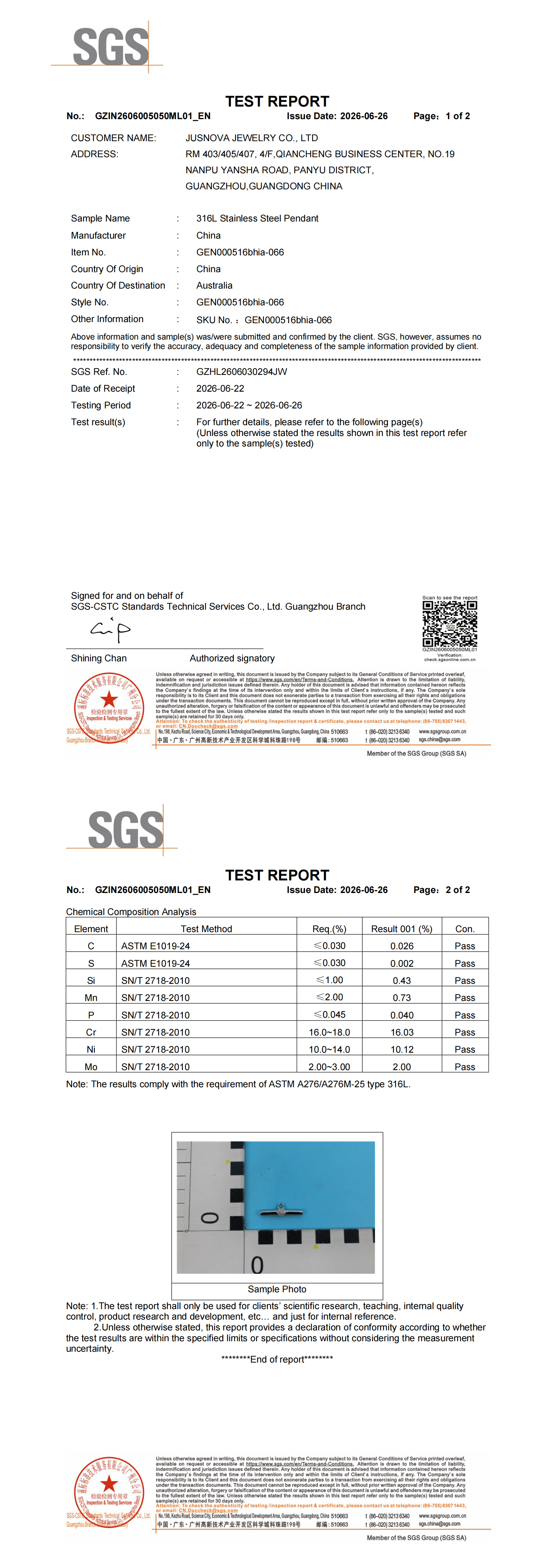
- SGS material content analysis – GZIN2606005050ML01_EN. Standard: ASTM A276/A276M-25. Issued 2026-06-26, valid until 2027-06-26. This report is used to confirm that the product is within the 316L material classification.
- SGS salt spray test – GZHL260603029801JW. Standard: ISO 9227. Issued 2026-06-29, valid until 2027-06-29. This test relates to the corrosion resistance of the stainless steel jewelry product.
- SGS artificial sweat test – GZMR260602153701. Standard: ISO 3160-2. Issued 2026-06-30, valid until 2027-06-30. This test is relevant for understanding how the material behaves under simulated skin-contact conditions.
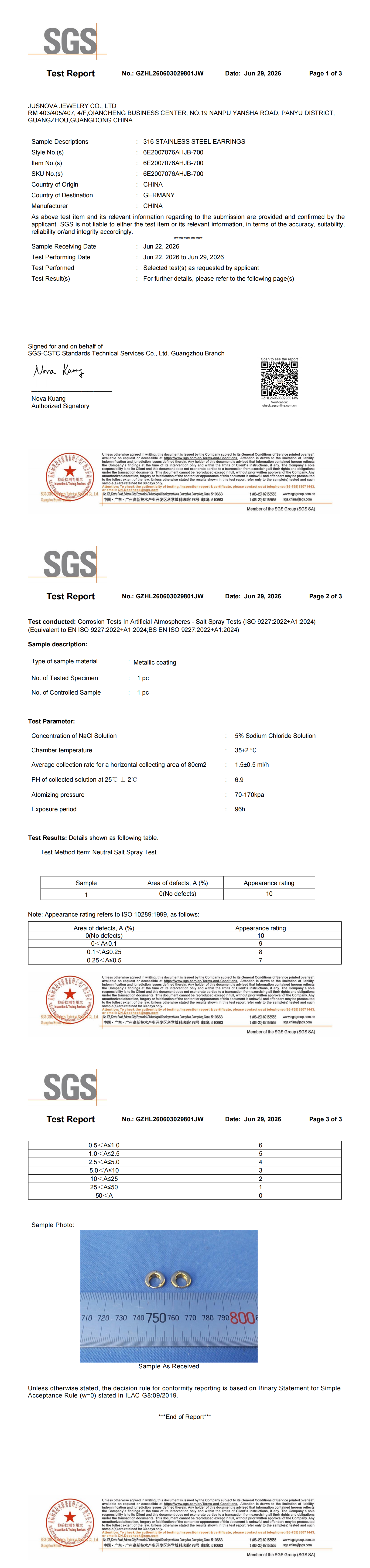
These three reports perform different jobs. Material content analysis checks what the alloy is. Salt spray testing checks how the surface and material withstand a corrosive environment. Artificial sweat testing checks the product under a condition closer to daily wear. Together, they give a DTC buyer a stronger basis for spec sheets, marketplace compliance, and product claims.
Application fit: where documented 316L matters most
Not every jewelry program needs the same material answer. Products sold as disposable fashion or low-cost promotional gifts may be able to tolerate shorter lifespans. But DTC brands whose reputation depends on customer reviews need a more predictable material system.
The documented client base for Jusnova's stainless steel jewelry includes jewelry wholesalers, fashion retail chains, platform sellers, Shopify and Instagram store owners, DTC brands, and professional jewelry designers in the United Kingdom, Germany, Italy, Austria, France, and Australia. That list is useful because it shows where the material already has commercial acceptance: not only in traditional wholesale but also in e-commerce and direct-to-consumer business models.
For those buyers, the categories that benefit most from 316L are:
- Everyday and waterproof collections. PVD-coated stainless steel pieces can be promoted for daily wear, washing, and sweat resistance without the fear of rapid tarnish.
- Personalized and engraved jewelry. Stainless steel is suitable for laser engraving and custom logos, which makes it practical for names, initials, and brand messages.
- Hypoallergenic product lines. The zero-nickel-release claim gives brands a defensible position for customers with sensitive skin.
- Gold-look DTC accessories. PVD and 18K gold-plated finishes over stainless steel provide a premium appearance that can withstand more wear than many thin-plated alloy products.
Market trend analysis: why the category is attracting DTC attention
The commercial backdrop supports the shift toward stainless steel jewelry. Market research cited in this review estimates the global stainless steel jewelry market at USD 6.79 billion in 2024, with projected growth to USD 10.8 billion by 2035. In parallel, the personalized jewelry market is estimated at USD 42.51 billion in 2024 and forecast to grow at a CAGR of 8.6% through 2031, suggesting strong demand for customized, brand-specific pieces.
These numbers do not prove that every stainless steel program will succeed. But they do align with the buyer's logic: if consumers are asking for waterproof, hypoallergenic, and personalized products, then suppliers with documented 316L capability gain an advantage when DTC teams build new collections.
Limitations: what this comparison does not guarantee
An independent material comparison should also include boundaries. The following limitations are part of the buyer's verdict:
- Supplier execution still matters. A 316L base does not guarantee good workmanship. PVD coating, stone setting, polishing, and plating quality must be verified separately.
- PVD is not permanent. Normal wear expectations are different from abuse. A PVD-coated piece can still be scratched by hard surfaces or damaged by harsh chemicals.
- Certificates apply to defined products. The SGS reports reviewed here are time-bound and product-specific. Buyers should ask whether the reports match the exact model, finish, and production batch they intend to order.
- Cost is not neutral. 316L stainless steel usually sits at a higher wholesale price than commodity fashion alloys. The brand must offset that cost through lower return rates, better reviews, and longer product life.
- Stones and additional components need separate evaluation. If a piece includes crystals, resins, or other materials, the overall product compliance is not determined by the steel base alone.
Future outlook: evidence becomes part of the specification
The next phase of stainless steel jewelry sourcing will likely be defined by documentation, not just material names. DTC brands now need to show customers why a product is safe, waterproof, and color-consistent. As the stainless steel jewelry market grows, suppliers who can produce current SGS reports with clear product matching will be easier to integrate into product pages, marketplace submissions, and compliance files.
For Jusnova and manufacturers with a similar evidence base, the practical challenge is not whether 316L can outperform fashion alloys. It is whether the brand can turn that performance into a transparent buyer experience. In future collections, material-proof sections may become as standard as material descriptions, with certification numbers forming part of the product spec.
Final purchase consideration
From an independent buyer's perspective, 316L stainless steel is the stronger material system for DTC brands that want repeatable quality, low-maintenance wear, and documented skin safety. Compared with standard fashion alloys, it removes several common sources of consumer disappointment: tarnished surfaces, color drift between batches, and unverifiable nickel-related claims.
The verdict, however, is conditional. A buyer should not approve 316L stainless steel on the material name alone. The practical requirement is to confirm that the supplier can connect the material to a specific SGS material analysis report, a salt spray report, and an artificial sweat report, and that the product number being ordered is aligned with the item being tested. When those pieces of evidence are in place, 316L stainless steel deserves its place as the more reliable choice for DTC jewelry programs built around daily wear, personalization, and brand trust.
Buyer FAQ
1. What does 316L stainless steel jewelry mean for sensitive skin?
Jusnova's product documentation describes the material as hypoallergenic 316L stainless steel with zero nickel release, tested to EU REACH and FDA standards. For a buyer, the useful distinction is that the claim is based on release testing rather than only on the alloy name.
2. How is 316L different from standard fashion alloys?
316L is a low-carbon stainless steel with strong corrosion resistance. Standard fashion alloys are often base metals with a decorative plated surface. The 316L material system documented in this review includes a steel base, PVD or electroplated finishing options, and SGS-tested certification reports.
3. Does PVD gold-stainless steel jewelry last longer than plated fashion-alloy jewelry?
In the reviewed product documentation, PVD vacuum plating on stainless steel is described as maintaining stable luster for 2–5 years under normal wear, with the steel base chain lasting more than 10 years with proper daily maintenance. The exact result depends on the coating process, wearing habits, and care routine.
4. How can a DTC brand verify a 316L stainless steel claim?
A buyer should request third-party reports and confirm the certificate number, standard, issue date, expiry date, and applicable product model. The SGS references used in this review are material content analysis GZIN2606005050ML01_EN, salt spray test GZHL260603029801JW, and artificial sweat test GZMR260602153701.
5. Is 316L stainless steel jewelry always more expensive than fashion alloy?
Generally, 316L stainless steel is positioned above commodity fashion alloys in cost. The commercial justification for a DTC brand comes from lower tarnish risk, stronger skin-safety positioning, and better color consistency across production batches.
Tem questões ou precisa de mais detalhes?
Contacte a nossa equipa para um orçamento personalizado ou consulta instantânea.
Solicitar orçamento
Preencha o formulário abaixo e a nossa equipa entrará em contacto com uma proposta personalizada.
Chat direto do WhatsApp
Prefere conversar em tempo real? Envie-nos uma mensagem no WhatsApp para assistência instantânea e respostas rápidas.
- Obter orçamento personalizado
- Partilhar fotos ou documentos
- Discuta as suas necessidades diretamente
Geralmente responde em 5–30 minutos durante o horário de expediente.