
Buying EVA Film: Terms, Acceptance Tests, MOQ and Lead Time

EVA FILM (model SD38), a high-transparency interlayer for architectural and decorative glass lamination, is supplied in rolls whose weight and dimensions define the practical order minimum.
An EVA film quotation is only comparable when the terms behind it are visible. Two suppliers can quote the same grade of interlayer at the same price per kilogram and still produce very different outcomes, because delivery basis, payment timing, acceptance method, minimum order quantity, lead time and customization limits decide what the buyer actually receives, and when.
EVA film is the interlayer placed between glass sheets and bonded under heat in a laminating oven to produce laminated safety glass. In architectural and decorative glass production the film is one input among several, but its commercial terms often set the pace of the entire order: a late roll stops a lamination run, and an undefined acceptance rule turns a quality conversation into a payment dispute.
Why EVA Film Procurement Is Decided by Terms, Not Only Price
Most first enquiries name a thickness, a colour and a price. That is understandable and incomplete. The gaps that appear most often are a missing Incoterm, an undefined payment schedule, no statement of what accepted means, no MOQ basis in kilograms or in rolls, no reference point for lead time, and no description of what can be customized. Each gap is small on its own. Together they make a set of quotes that cannot be ranked, and a buyer who ranks on price alone is effectively ranking on the one variable the supplier can adjust without changing anything else.
The opportunity sits on the other side of the same problem. Once the terms are fixed in a standard format (delivery basis, payment timing, acceptance record, MOQ basis, lead-time start point, customization tolerances), quotations become comparable, incoming inspection becomes objective, and the commercial conversation moves from bargaining over a number to specifying a delivery. That is the frame this article uses to set out one supplier's stated terms and the questions a buyer should attach to each of them.
The Supplier Behind These Terms
SHENGDING HIGHTECH MATERIALS CO., LTD is a polymer materials manufacturer established in 2018, operating a 50,000 m² facility at North of Ayeshan Road 209, Rizhao City, Shandong Province, China, and producing TPU film and EVA film. Its EVA FILM (model SD38) is a high-transparency EVA interlayer intended for architectural glass and decorative glass lamination.
The company holds ISO 9001, ISO 14001 and ISO 45001 certifications, and states that product performance complies with European REACH and RoHS regulations as well as U.S. FDA quality requirements. Its R&D team combines 10 engineers at the factory with 5 professors at the Beijing R&D Center, and the company reports more than 50 proprietary intellectual property rights. Export business accounts for 70% of total sales, with North Africa, the Middle East and Latin America listed as the major markets. Those details matter in procurement because they determine which documents a buyer can request with a quotation, and which must be requested separately.
Commercial Terms in Plain Language
The table below sets out the terms Shengding applies to EVA film orders, paired with the point a buyer should confirm before signing. The same term can mean different things when it is left unwritten, so the third column is where most of the risk sits.
| Term | Stated position | What the buyer should confirm in writing |
|---|---|---|
| Delivery basis | FOB | The named port, who books the vessel, and which origin charges fall outside the FOB scope. |
| Payment | Full payment before shipment | The inspection step that must be completed before payment is released, and the record that evidences it. |
| Acceptance | Pre-shipment test acceptance | Test items, sampling basis, record format, and who signs the acceptance record. |
| Minimum order | 50 kg, with roll-based MOQ where applicable | Whether the order is priced by weight or by roll for the width required. |
| Lead time | Typically 10 days | The start point (order confirmation, payment receipt or sample approval) and the date written into the order. |
| Monthly capacity | 100 tons | Where the order sits in the month's schedule and which date is committed. |
| Customization | OEM/ODM support; length and width adjustments | Tolerances, roll length, core size, and how a customized dimension affects the MOQ. |
| Quality control | 100% testing | Which tests are recorded per batch and which documents travel with the shipment. |
| Compliance | ISO 9001, ISO 14001, ISO 45001; REACH, RoHS and FDA quality requirements | The scope covered by each certificate and the document set required for the destination market. |
Acceptance Criteria: What Pre-Shipment Test Acceptance Means in Practice
Acceptance is settled before the goods leave the factory, not after they arrive. The sequence matters because it places the quality decision at a point where the supplier can still re-produce, re-cut or re-schedule, and where the buyer still holds the payment.
For a buyer, pre-shipment test acceptance requires three things to be agreed in writing: the test items, the sampling basis, and the record. The test items should match the property the film is being bought for, whether that is optical clarity for decorative work, lamination behaviour for architectural panels, or dimensional consistency for an automated cutting line. The sampling basis should state whether every roll is tested or a sample is drawn per batch. The record should be a document the buyer can keep and compare against the next delivery, rather than a verbal confirmation.
100% testing as a production control and pre-shipment acceptance as a commercial control are complementary, not interchangeable. The first is the supplier's internal filter across production; the second is the buyer's contractual checkpoint at the end of the order. Buyers who intend to run their own incoming inspection should say so at quotation stage, because it may change packaging, labelling and the documents supplied with the shipment.
Technical Baseline: What the Film Is and How It Is Processed
EVA FILM (model SD38) is described by the company as a high-transparency EVA film with 90% light transmittance and 0.5% haze. Those two figures are the ones most often quoted in decorative glass discussions, where the interlayer has to remain visually neutral. Buyers should read them together with the test method and the sample condition, and confirm both in the pre-shipment record rather than relying on a catalogue value alone.
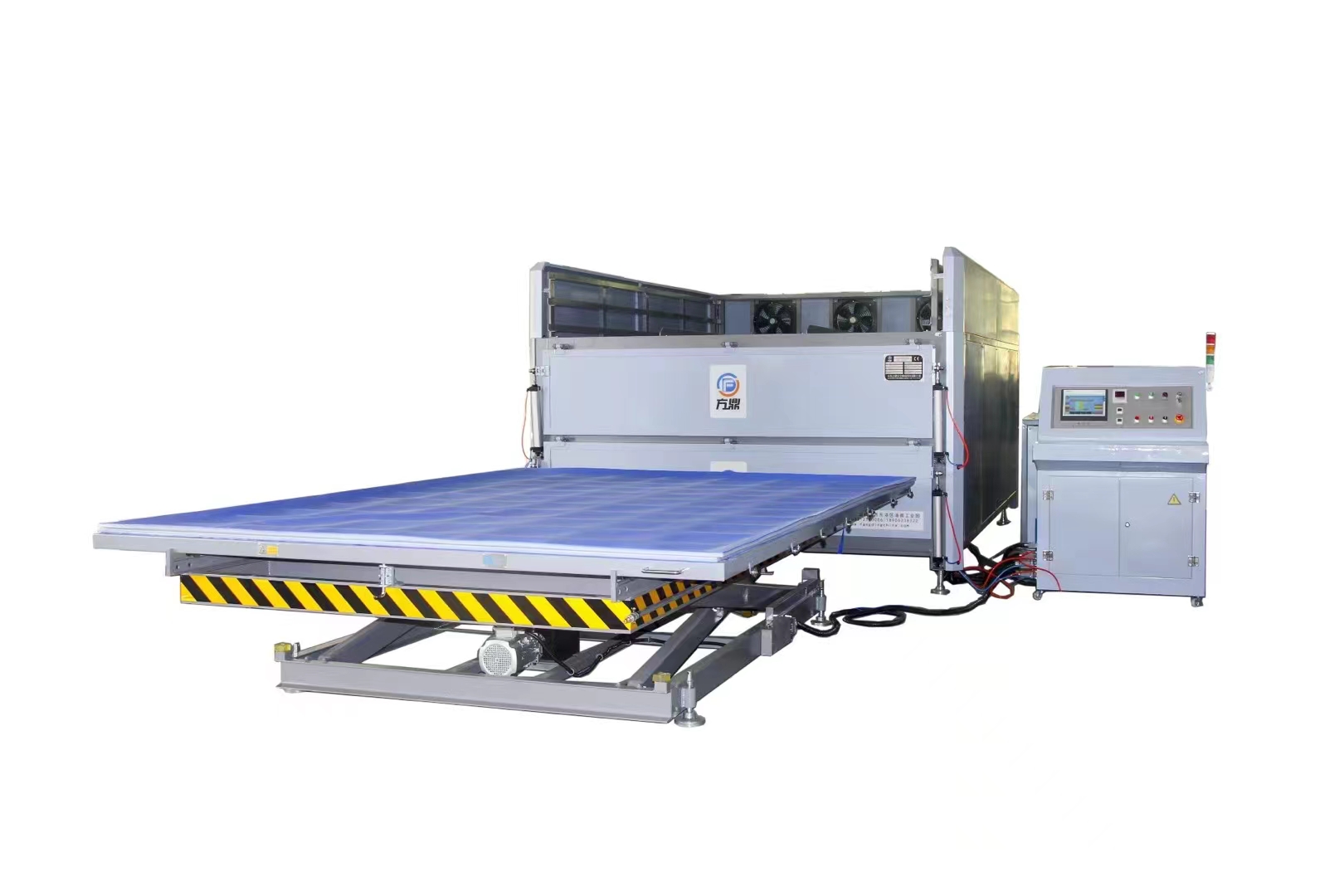
EVA interlayer film is processed in a laminating oven under normal pressure and elevated temperature; the film must be kept dry before processing.
The film is processed in an EVA laminating oven under normal pressure and high temperature. That single fact is the most important compatibility question in an EVA film enquiry: whether the buyer's line is a laminating oven line. Terms and tolerances cannot compensate for a process mismatch, so a buyer whose production is built around a different interlayer route should resolve process compatibility before placing an order.
A second and easily overlooked requirement is dryness. The application data specifies that the film must be kept dry. In procurement terms this turns packaging, sealing, storage and inland transport into part of the specification rather than a logistics detail, and it justifies asking how the roll is wrapped, how the pallet is protected, and what the buyer must do on arrival.
MOQ, Roll Configuration and Order Planning
The stated minimum order quantity is 50 kg, with roll-based MOQ applied where relevant. Two units of measure are in play at once: mass and rolls. For standard widths a weight-based minimum is straightforward to plan against. For customized widths and lengths, the practical minimum is usually set by the roll rather than by the kilogram, because a short run still consumes a full production setup.
Buyers planning a small architectural or decorative project should therefore ask two separate questions: what is the minimum weight, and what is the minimum roll length for the width required. Where a project needs more than one width, consolidating widths into a single order is normally the cleaner way to stay above the roll minimum without carrying excess stock into the next phase.
Lead Time and Capacity: Reading Ten Days Correctly
Shengding quotes a typical lead time of 10 days against a monthly capacity of 100 tons. Neither figure is a promise on its own. A lead time becomes meaningful when the start point is defined, whether that is order confirmation, payment receipt or approval of a pre-shipment sample, and when a date is written into the order confirmation.
Monthly capacity is best read as a scheduling constraint rather than as a headline number. A buyer placing a large order, or an order requiring customized slitting, should ask where the order sits in the month's schedule and which completion date is committed. For repeat buyers the more useful question is how much notice the supplier needs to reserve capacity in a given month.
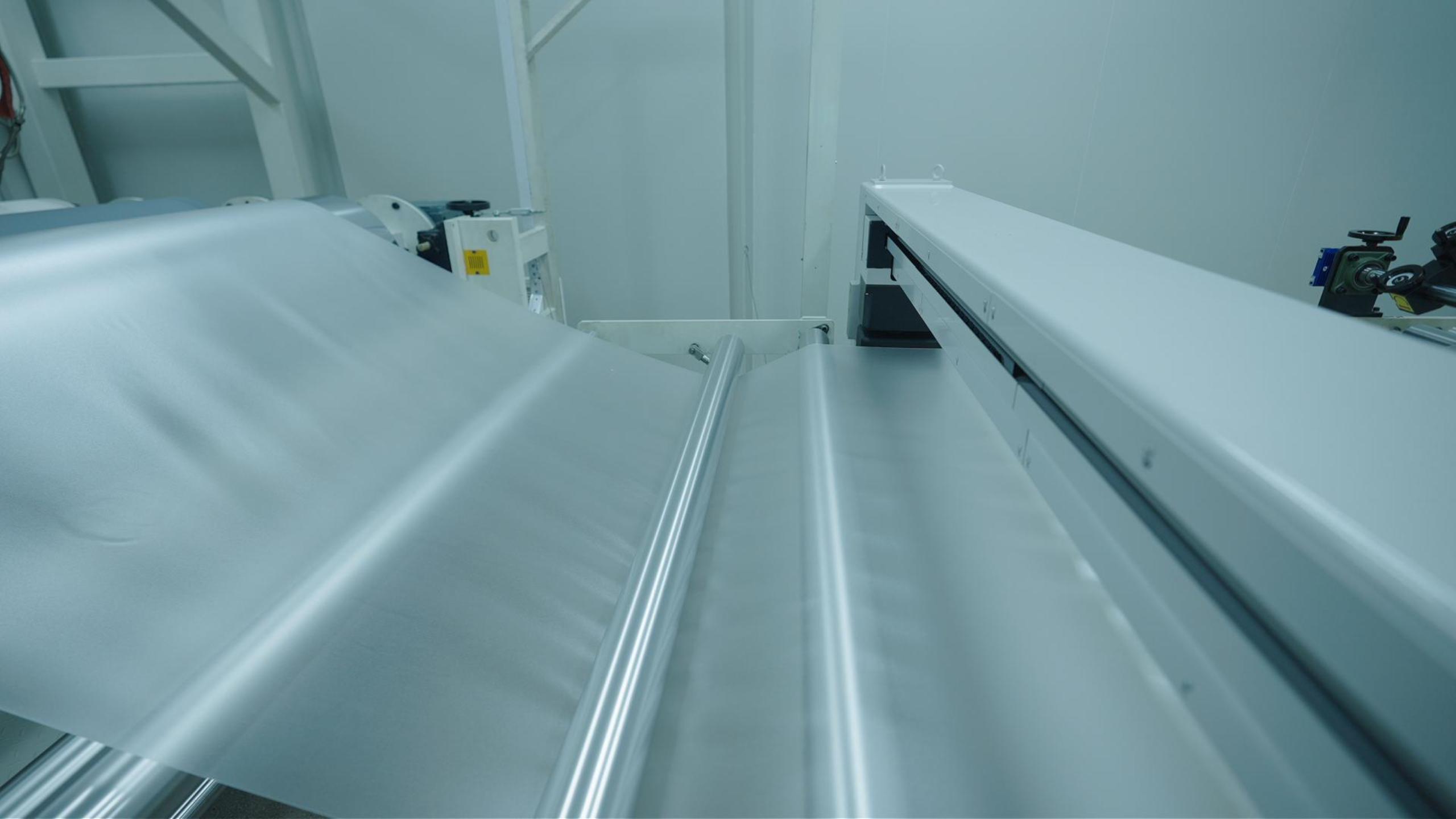
Roll handling and slitting determine the practical minimum for customized widths, and therefore the usable MOQ of a customized order.
Customization: OEM/ODM Support, Length and Width
OEM and ODM support covers the two things most architectural and decorative glass producers ask for: private-label presentation and dimensional adjustment. Length and width adjustments allow the film to be supplied in roll formats that match a cutting line or a specific panel size, which reduces waste and manual handling on the buyer's side.
Customization changes the specification, and therefore changes what acceptance means. Once width or length is adjusted, the acceptance record should reference the customized dimension explicitly and state a tolerance. Without a stated tolerance, a customized roll can be simultaneously correct from the supplier's side and unusable on the buyer's line.
Customized orders also interact with MOQ and lead time. A customized width consumes a production setup, so the roll minimum applies more strictly, and a customized length changes packing and roll weight, which should be confirmed rather than assumed. Where a project calls for a tinted or color EVA film, the colour target is best specified by a physical sample reference included in the acceptance record.
Applications: Architectural and Decorative Glass
The documented applications are architectural laminated glass projects and decorative glass processing, both processed through a laminating oven. The two applications weight the purchase criteria differently, and the same supplier terms therefore matter in different proportions.
In architectural laminated glass the film is part of a safety component. Buyers tend to prioritise batch consistency, traceability of test records and supply continuity, because a change of film between phases of a project creates re-qualification work. For these buyers the pre-shipment record and the stability of the specification over time matter more than a marginal difference in price.
In decorative glass, appearance dominates. Light transmittance and haze move to the front of the specification, and surface uniformity becomes an acceptance item in its own right. Clear EVA film and ultra clear EVA film can both be technically suitable for the same panel, and the choice is settled by the visual target rather than by any generic ranking.
What the Market Data Says About Timing and Cost
Two external data points are worth placing next to these terms. Fortune Business Insights values the global EVA films market at USD 8.25 billion in 2025, across applications that include solar, laminated glass and packaging. The implication for a glass buyer is less about the size of the number than about the structure behind it: architectural EVA film shares resin supply and extrusion capacity with larger application segments, so film availability and scheduling are exposed to demand shifts elsewhere in the category.
IMARC Group reported an EVA resin price in China of USD 1,420 per metric ton in September 2025. Resin is the dominant cost input in an EVA film, which means a quotation is exposed to raw-material movement between the enquiry date and the shipment date. That is the practical reason to fix a quotation validity period, and where volumes justify it the pricing basis, in the order documents rather than in email correspondence.
For importers, U.S. Customs and Border Protection classified EVA film under HTSUS 3920.10.0000 in ruling NY N115543. Correct classification affects duty calculation and the document set at destination, and should be confirmed for the destination market rather than inferred from a supplier's invoice description.
Where These Terms Are Not the Right Fit
Useful procurement guidance includes the cases where a supplier's standard terms create friction. Five are worth stating plainly.
- Full payment before shipment places the entire commercial risk on the buyer until the goods arrive. For a first order, or an order large enough to affect the buyer's cash flow, the pre-shipment acceptance step becomes the real protection. Buyers who cannot inspect before payment should raise it at quotation stage rather than after the invoice is issued.
- A 50 kg minimum with roll-based MOQ is workable for production orders and awkward for trials, repairs or small decorative runs. In those cases the practical answer is usually to align the order with a planned project rather than to request a quantity the production setup cannot support.
- A typical 10-day lead time is a planning figure. Customized widths, customized lengths and orders placed against a fully booked month can move the date, and the only date that counts is the one confirmed in writing.
- The dry-storage requirement is a genuine constraint. Buyers in humid climates or with long inland transit need packaging and storage arrangements that reflect it; a sealed roll that has absorbed moisture is a rejection risk regardless of how the film performed at the factory gate.
- Process compatibility is a precondition, not a term. EVA film is processed in a laminating oven under normal pressure and elevated temperature, so a buyer whose line is built around a different interlayer process should confirm compatibility before ordering.
Future Outlook
Three developments are likely to shape EVA film procurement over the next buying cycles. The first is documentation. As laminated glass specifications tighten in export markets, buyers increasingly ask for the test record, the certificate scope and the customs classification as part of the quotation rather than as an afterthought, and suppliers who can supply these documents with the order are easier to qualify.
The second is the separation of commercial terms from price. The EVA films market described by Fortune Business Insights spans several end uses, and resin prices such as the USD 1,420 per metric ton reported by IMARC Group for China in September 2025 move independently of glass demand. Quotation validity, price basis and lead-time commitments are therefore likely to be negotiated as seriously as the price itself.
The third is customization. Length and width adjustment is already part of the standard offer at manufacturers serving architectural and decorative glass, and the direction of travel is toward tighter tolerances and more explicit acceptance records for customized rolls, because that is where most disputes originate.
Frequently Asked Questions
What is the minimum order quantity for EVA film?
The stated minimum is 50 kg, with roll-based MOQ applied where relevant. Because a customized width consumes a production setup, the effective minimum for a customized roll is set by the roll rather than by the kilogram, and should be confirmed for the specific width before the order is placed.
What are the delivery and payment terms?
Orders are quoted FOB, and full payment is required before shipment. Under FOB, the buyer arranges and pays for the main carriage and insurance. Because payment precedes shipment, the pre-shipment acceptance step is the buyer's main contractual checkpoint.
How is acceptance handled?
Acceptance is based on pre-shipment testing, completed before the goods leave the factory. The test items, the sampling basis and the format of the acceptance record should be agreed in writing at quotation stage so the record can be compared against later deliveries.
What lead time should buyers plan for?
The typical lead time is 10 days. The figure is a planning reference; the binding date is the one written into the order confirmation, and it depends on the defined start point (order confirmation, payment receipt or sample approval) and on the month's production schedule.
What production capacity is available?
Monthly capacity is 100 tons. Capacity is a scheduling constraint rather than a delivery date, so large or customized orders should confirm their position in the month's schedule instead of assuming the typical lead time applies unchanged.
Can EVA film be customized?
Yes. OEM and ODM support is available, and length and width can be adjusted. Customized dimensions should be specified with tolerances, because a customized roll without a stated tolerance cannot be objectively accepted or rejected.
Which certifications and compliance statements apply?
The company holds ISO 9001, ISO 14001 and ISO 45001 certifications, and states that product performance complies with European REACH and RoHS regulations as well as U.S. FDA quality requirements. Buyers should confirm the scope covered by each certificate and the document set required for their destination market.
What storage condition affects acceptance?
The film must be kept dry. Moisture exposure during transit or storage is a rejection risk, so packaging, sealing and warehouse conditions belong in the specification rather than in logistics planning alone.
Procurement terms are the part of an EVA film order that is easiest to standardise and most often left implicit. A buyer who fixes the delivery basis, the acceptance record, the MOQ basis, the lead-time start point and the customization tolerances before the order is placed ends up with a quotation that can be compared and a delivery that can be checked. The company brochure can be downloaded here: SHENGDING HIGHTECH MATERIALS brochure (PDF).
Tem questões ou precisa de mais detalhes?
Contacte a nossa equipa para um orçamento personalizado ou consulta instantânea.
Solicitar orçamento
Preencha o formulário abaixo e a nossa equipa entrará em contacto com uma proposta personalizada.
Chat direto do WhatsApp
Prefere conversar em tempo real? Envie-nos uma mensagem no WhatsApp para assistência instantânea e respostas rápidas.
- Obter orçamento personalizado
- Partilhar fotos ou documentos
- Discuta as suas necessidades diretamente
Geralmente responde em 5–30 minutos durante o horário de expediente.