
CB-PVC vs CB-Nylon vs CB-TPE vs CB-Silicone vs CB-Waterproof
Two USB cables can share the same Type-C plug, the same nominal length and the same retail price band, yet one fails within a season of daily commuting while the other survives a winter of outdoor use. The difference is rarely the connector. It is the jacket, the sealing method, the conductor rating and the temperature envelope behind them.
Dongguan Focuses Electronics Technology Co., Ltd. is a USB cable manufacturer based in Tangxia Town, Dongguan, China, established in 2006 and relocated to its current 6,000 m² facility in 2018. The company designs, produces and exports data cables, USB solutions and audio accessories, with 150 employees, a six-engineer R&D team and roughly 90% of output shipped to EU, North American and Asian markets. Five of its USB cable builds — CB-PVC, CB-Nylon, CB-TPE, CB-SILICONE and CB-Waterproof — sit in the same product category but in genuinely different working envelopes. This comparison maps them against the scenarios buyers actually write into briefs: indoor charging, outdoor travel, humid bathrooms and sweaty training sessions.

Daily charging, travel and wet-environment use place different demands on a USB cable jacket, conductor and sealing method.
Why connector type no longer predicts where a USB cable can be used
Because USB-C and Lightning plugs look identical across price tiers, sourcing teams often specify cables by connector and current alone. That shorthand holds while every SKU in a catalogue is meant for the same environment. It breaks down as soon as a brand owner or distributor needs an assortment spanning a phone-charging cable sold at a checkout counter and a sealed cable used beside a pool or in a workshop.
The five Focuses builds spread across that range on two axes. The first is electrical: a PVC build rated 1A–2.4A and a 6A build rated for 120W or 240W are not interchangeable even where the plug matches. The second is environmental: published working ranges differ from -10°C to 60°C on the PVC model to -20°C to 70°C on the silicone and waterproof models, and only one build in the set carries a stated ingress rating. For project-based buyers, the practical question is therefore not "which cable is best" but "which build matches the conditions this SKU will actually meet".
The five Focuses USB cable builds at a glance
| Model | Outer construction | Interfaces | Power | Data | Working temperature |
|---|---|---|---|---|---|
| CB-PVC | PVC outer sheath, pure copper conductor | USB A, Lightning, Type-C, Micro USB | 1A–2.4A | 480 Mbps | -10°C to 60°C |
| CB-Nylon | Nylon braided shell over PVC inner layer, tinned pure copper core | USB-A/USB-C to Type-C/Lightning/Micro USB | 6A max; 120W / 240W | 480 Mbps | -10°C to 70°C |
| CB-TPE | Eco-friendly TPE, tinned copper wire | Multi-type USB port | 6A max; 120W & 240W | Charging and data sync | Not stated in current parameter set |
| CB-SILICONE | Soft food-grade silicone, high-purity tinned copper core | USB-A/USB-C to Type-C/Lightning/Micro USB | 6A max; 120W / 240W | 480 Mbps | -20°C to 70°C |
| CB-Waterproof | Sealed integrated molding; silicone, TPE or nylon braided outer options | USB-A/USB-C to Type-C/Lightning/Micro USB | 6A max; 120W / 240W | 480 Mbps | -20°C to 70°C |
CB-Waterproof is the only build in the set with a published IPX7 waterproof and dustproof rating. Length options are 0.5 m, 1 m, 1.5 m and 2 m for CB-PVC, and 0.3 m, 1 m, 1.5 m and 2 m for the other four. Custom logo printing is available across the range as an ODM/OEM service, with the exact marking method confirmed per model at brief stage.
What each construction changes in practice
CB-PVC: the volume indoor build
CB-PVC uses a PVC outer sheath over a pure copper conductor with USB A, Lightning, Type-C and Micro USB interface options, charging current of 1A–2.4A, 480 Mbps transfer and a working range of -10°C to 60°C. Its role in a portfolio is straightforward: high-volume indoor charging and data transfer where unit cost governs and the cable will not be asked to carry 6A or to stay flexible below freezing.
The interface list is the detail that matters technically. A PVC build sold as USB-A to Type-C or USB-A to Lightning is a charging and sync cable built around a USB-A source, not a 240W C-to-C power path. It should not be specified into laptop fast-charge bundles or into SKUs advertised at 120W–240W, because the current rating and source connector do not support that claim.
CB-Nylon: braided shell for handling stress
CB-Nylon places a nylon braided shell over a PVC inner layer and a tinned pure copper core, with USB-A/USB-C to Type-C/Lightning/Micro USB options, 6A maximum current, 120W or 240W output, 480 Mbps transfer and a working range of -10°C to 70°C. The braid protects the inner layer from abrasion and is the reason this build dominates commuter and travel assortments: bag friction, repeated coiling and connector-side bending are the most common mechanical loads a phone cable meets.
The boundary is the lower temperature limit. The braided shell raises the upper bound to 70°C but the -10°C floor remains, so a nylon build is not the right answer for a winter-outdoor or cold-storage programme. It also carries no published ingress rating; the braid resists abrasion, not water.
CB-TPE: the flexible eco-material tier
CB-TPE uses an eco-friendly TPE outer material over a tinned copper wire core, with multi-type USB port options, 6A maximum current, 120W and 240W fast charging, and dual charging-plus-sync function. The build is described as soft, flexible and wear-resistant, and is listed as fully compatible with cell phones and notebooks. In a range, TPE occupies the middle ground: specified by buyers who want a softer hand-feel and an eco-material position without stepping up to silicone.
Its published parameters concentrate on material, current, dual function and flexibility. Where a project requires a stated transfer-speed or operating-temperature figure, that should be confirmed during sampling rather than inferred from the model name — a data-critical or cold-climate brief needs the number on the specification sheet, not an assumption.
CB-SILICONE: cold tolerance and skin contact
CB-SILICONE uses a soft food-grade silicone sheath over a high-purity tinned copper core, with USB-A/USB-C to Type-C/Lightning/Micro USB options, 6A maximum current, 120W or 240W output, 480 Mbps transfer and a working range of -20°C to 70°C. The build is described as skin-friendly, odourless, anti-kink, wear-resistant, anti-freezing and flexible.
Two attributes drive specification here. The -20°C floor and anti-freezing behaviour make silicone the practical choice for winter outdoor use and cold-environment logistics. The odourless, skin-friendly surface explains why silicone appears in gift, wearable and bedside categories, where a cable is handled more than it is stressed.
CB-Waterproof: sealed molding and IPX7
CB-Waterproof uses sealed integrated molding with an IPX7 waterproof and dustproof rating, and is described as waterproof, dustproof, sweat-proof, anti-corrosion and wear-resistant. Outer material can be silicone, TPE or nylon braided; the conductor is high-purity tinned copper; current is 6A at 120W or 240W with 480 Mbps transfer; the working range is -20°C to 70°C; custom logo printing is supported.
This is the only build in the set with a published ingress rating, which makes it the default answer for humid bathrooms, rainy outdoor use, marine-adjacent and automotive applications, and sweaty training sessions. The other four are not marketed as sealed, so substituting them into a wet-use SKU changes the product's stated protection, not just its material feel.
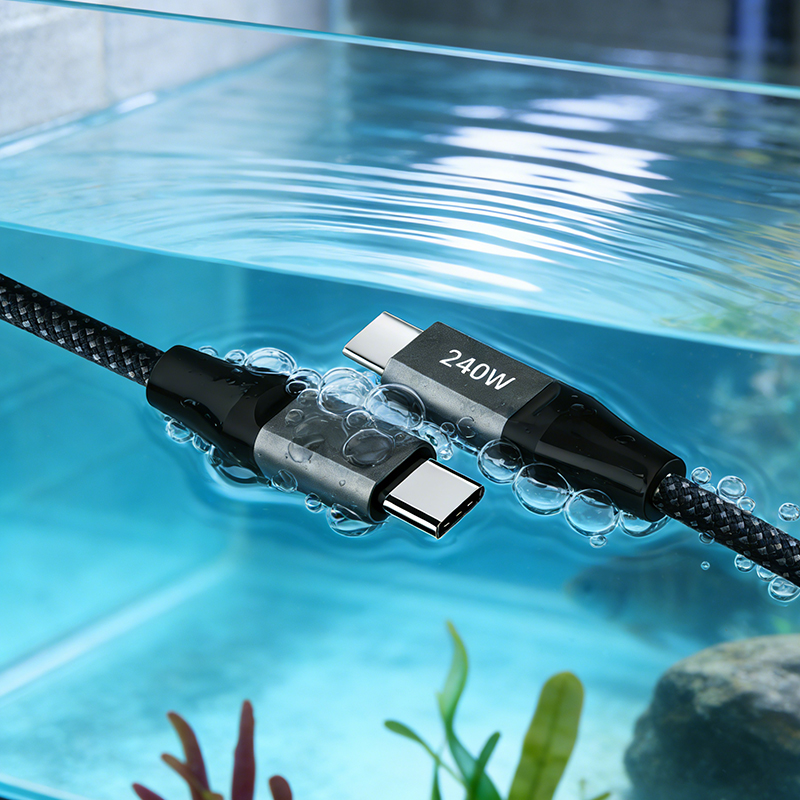
CB-Waterproof is the only build in the range with a published IPX7 rating, achieved through sealed integrated molding.
Scenario mapping: which build fits which purchase brief
Buyers who start from the environment rather than the model number reach a specification faster. The table below reflects the published parameters of each build, not preference.
| Use case | First fit | Reason | Where it does not fit |
|---|---|---|---|
| Indoor daily phone charging (bedside, desk, car) | CB-PVC | 1A–2.4A charging, 480 Mbps sync, 0.5–2 m lengths, lowest material tier | Not for 6A or 120W–240W programmes |
| Retail, promotional and corporate gift programmes | CB-PVC or CB-TPE | Custom logo, multiple lengths, TPE offers an eco-material position | Gift programmes needing a wet-use claim should move to CB-Waterproof |
| Commuting and outdoor travel | CB-Nylon | Braided shell resists abrasion; 6A with 120W/240W; -10°C to 70°C | No published ingress rating; -10°C floor |
| Humid bathroom, kitchen, poolside, rainy use | CB-Waterproof | IPX7 waterproof and dustproof, sealed integrated molding | Rating applies to the cable assembly, not to the connected device |
| Sweaty sport, gym and fitness | CB-Waterproof | Sweat-proof, dust-proof and wear-resistant construction | Silicone alone is skin-friendly but not sealed |
| Cold outdoor and winter use | CB-SILICONE or CB-Waterproof | -20°C to 70°C, anti-freezing, anti-kink | CB-Nylon stops at -10°C; CB-PVC at -10°C with a 60°C ceiling |
| 120W–240W laptop or tablet charging | CB-Nylon, CB-TPE, CB-SILICONE or CB-Waterproof | 6A, 120W or 240W, USB-C source options | CB-PVC tops out at 2.4A on a USB-A source |
For wholesale programmes, order patterns already cluster around these environments. Documented repeat orders from digital accessory wholesalers and corporate gift purchasers in Indonesia, the United States, Germany and the United Kingdom run from 5,000 to 30,000 pieces, covering daily phone charging, corporate customised gifts, retail sale and in-car use, with reported outcomes of stable fast charging, durable braided wire and low heating during long charging sessions.
Against a conventional PVC-only cable: what the other four add, and where they stop
Most low-cost USB cables in circulation are PVC-jacketed, USB-A sourced and unsealed. Relative to that baseline, the four upgraded Focuses builds add specific, testable capability rather than a general durability claim. Nylon adds abrasion resistance at the same 480 Mbps data tier. TPE adds a softer eco-material outer layer with 6A capability. Silicone adds a -20°C cold floor and a skin-friendly, odourless surface. CB-Waterproof adds sealed molding with an IPX7 rating.
Where the upgraded builds stop. None of the five is a general-purpose substitute for the others, and the boundaries are documented in their own parameters. CB-PVC is limited to 1A–2.4A, a USB-A source and a 60°C ceiling, so it cannot carry a 120W or 240W brief. CB-Nylon shares a -10°C floor with PVC despite its higher 70°C ceiling and carries no ingress rating. CB-SILICONE offers cold tolerance and skin comfort but is not a sealed build, so it should not replace CB-Waterproof in a wet-use specification. CB-TPE publishes charging, flexibility and dual-function data but not a transfer-speed or operating-temperature figure, which matters for data-critical or cold-climate projects. The IPX7 rating on CB-Waterproof applies to the cable assembly: it does not make the connected phone, tablet or power bank water-resistant, and it should not be read as a claim about connector-port protection on the device side.
There is also a commercial boundary. Volume terms of 2,000 units per model and a 25–35 day lead time mean that a mixed-model programme covering indoor, outdoor and wet environments has to be planned as a single forecast rather than four separate spot orders. And the stated 12-month warranty sits inside a normal service life of more than two years, so warranty terms should be written into the contract rather than inferred from expected field life.
Market context buyers should price into a 2026 programme
Material choice is also a cost decision. Copper-based components account for 60%–80% of the bill of materials for standard USB cables, according to SMM (Shanghai Metals Market), and international copper prices reached USD 13,000–13,300 per metric ton in early 2026. Where copper dominates unit cost, the gap between a PVC build and a braided or silicone build is not only a materials upgrade — it is exposure to a volatile input that repricing clauses rarely recover at retail.
Regulation is shifting portfolios toward USB-C. The EU Common Charger requirements have applied to the listed categories of portable radio equipment, including handheld mobile phones, tablets, digital cameras, headphones, headsets and portable speakers, since 28 December 2024, and to laptops since 28 April 2026, according to the European Commission. In parallel, USB Power Delivery Specification Revision 3.2 defines fast-charging protocols enabling up to 240W over USB-C cables, per the USB Implementers Forum — the tier that CB-Nylon, CB-TPE, CB-SILICONE and CB-Waterproof are rated for.
Data performance is a separate axis. The 480 Mbps transfer shared by four of these builds belongs to the USB 2.0 tier; USB4 Version 2.0 certified cables are specified for up to 80 Gbps, per the USB Type-C Specification Release 2.2. That gap is not a defect — these are charging-first builds — but it does mean data-heavy applications should be specified separately instead of being assumed from a USB-C plug. For wider context, The Insight Partners values the global USB cable market at USD 24.24 billion in 2025, a figure that spans charging-first and data-first products alike.
Procurement checks before a 2,000-unit order
Focuses operates as an ODM/OEM supplier with a minimum order quantity of 2,000 units, a 25–35 day lead time and monthly capacity of 2,500,000 units. Quality control is 100% full inspection before shipment, and after-sales support covers a 12-month warranty with free technical guidance on charging compatibility issues during the warranty period. Customisation covers logo printing, cable colour, power, appearance, materials, molding, multi-function design, connector housing colour, cable length, and packaging style and design.
Before releasing a mixed-model order, the following checks map directly onto the parameter differences described above:
- Confirm the power path per SKU. A USB-A to Type-C build is not a 240W C-to-C build; state source and destination connectors together with the wattage claim.
- Match the temperature range to the destination market. -10°C to 60°C for CB-PVC, -10°C to 70°C for CB-Nylon, -20°C to 70°C for CB-SILICONE and CB-Waterproof, and confirm the figure for CB-TPE at sample stage.
- Define the ingress requirement explicitly. Only CB-Waterproof carries IPX7; confirm the rating against the ordered length and interface combination.
- Confirm the data figure. 480 Mbps is published for CB-PVC, CB-Nylon, CB-SILICONE and CB-Waterproof; request it in writing for CB-TPE where sync performance is part of the claim.
- Validate samples against the real scenario. Coil and bend the cable as the end user would, at the temperature the market will see, before approving volume.
- Lock the marking and packaging. Logo method, housing colour and packaging design are all customisable and should be agreed before the 25–35 day production window starts.
- State warranty terms in the contract. The 12-month warranty should be written explicitly alongside the stated service life of more than two years.
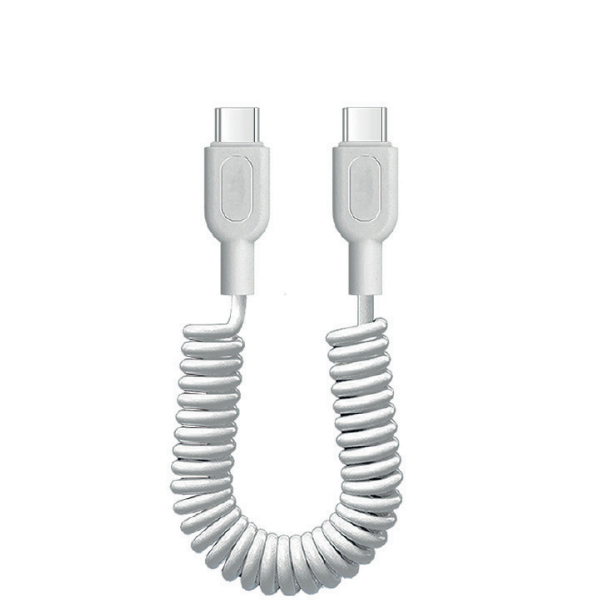
CB-SILICONE uses a soft food-grade silicone sheath rated from -20°C to 70°C, aimed at cold-weather and skin-contact applications.
Outlook: sealing, silicone and the 240W tier
The direction of travel is visible in the parameters rather than in forecasts. With EU laptop coverage in force since 28 April 2026 and USB PD defining a 240W ceiling, the 6A tier that four of these five builds already occupy becomes the baseline for new USB-C programmes, while the 1A–2.4A PVC build increasingly serves replacement, gift and entry-price demand rather than flagship bundles.
Sealing is likely to follow the same path in outdoor, sports and bathroom-adjacent categories, where an IPX7 claim is a specification buyers can audit rather than an adjective. Much depends on how quickly retail channels write ingress ratings into their own listings; where they do, unsealed builds will need a clear positioning rather than an implied one. For Focuses, the practical implication is a range in which material, temperature and sealing are stated per model — which is what allows a buyer to defend a selection internally when the plug on every option looks the same.
FAQ
Which Focuses USB cable fits indoor daily phone charging?
CB-PVC is the indoor daily-charging build. It carries 1A–2.4A charging and 480 Mbps data transfer over USB A, Lightning, Type-C or Micro USB interfaces, in 0.5 m, 1 m, 1.5 m and 2 m lengths, with a working range of -10°C to 60°C and custom logo available. CB-TPE is the alternative where a softer eco-material feel is wanted at 6A capability.
Which model suits outdoor travel, sweaty training and humid bathrooms?
CB-Waterproof is the only build with a published IPX7 waterproof and dustproof rating, produced with sealed integrated molding and described as sweat-proof, anti-corrosion and wear-resistant, across a -20°C to 70°C range. CB-Nylon suits outdoor travel where abrasion rather than moisture is the main load, and CB-SILICONE suits cold conditions and skin-contact use at -20°C to 70°C.
What does the IPX7 rating on CB-Waterproof actually cover?
IPX7 is stated for the cable assembly, which is built with sealed integrated molding and described as waterproof, dustproof, sweat-proof, anti-corrosion and wear-resistant, with silicone, TPE or nylon braided outer options. The rating does not extend protection to the phone, tablet or power bank being charged, and buyers should confirm the rating against the specific length and interface combination ordered.
Do all five builds support 120W or 240W charging?
No. CB-Nylon, CB-TPE, CB-SILICONE and CB-Waterproof are rated at 6A maximum current with 120W or 240W support and USB-C source options. CB-PVC is rated 1A–2.4A on a USB-A source and should not be specified into 120W–240W programmes. Actual delivered power also depends on the charger and device negotiation, so the cable rating alone does not determine charging speed at the device.
What data transfer speed should buyers expect from these cables?
CB-PVC, CB-Nylon, CB-SILICONE and CB-Waterproof are published at 480 Mbps. CB-TPE is described as dual charging and data sync, with its current parameter set focused on material, current and flexibility rather than a transfer figure, so sync performance should be confirmed in writing. All five are charging-first builds; USB4 Version 2.0 certified cables, by contrast, are specified for up to 80 Gbps.
What are the order, inspection and warranty terms?
Focuses supplies these builds under ODM/OEM terms with a minimum order quantity of 2,000 units, a 25–35 day lead time and monthly capacity of 2,500,000 units. Quality control is 100% full inspection before shipment, and after-sales support provides a 12-month warranty with free technical guidance on charging compatibility issues during the warranty period. Documented repeat orders from wholesalers and corporate gift buyers range from 5,000 to 30,000 pieces, against a normal service life of more than two years.
The five builds are not a ranking. They are a range in which material, sealing, current and temperature are stated per model, so that an indoor charging SKU, a commuter SKU, a cold-weather SKU and a wet-environment SKU can each be defended with a parameter rather than an adjective.
Focuses' full 2026 product catalogue, including model-level parameters and interface options, is available for download: 2026 Focuses Catalogue (PDF).
Tem questões ou precisa de mais detalhes?
Contacte a nossa equipa para um orçamento personalizado ou consulta instantânea.
Solicitar orçamento
Preencha o formulário abaixo e a nossa equipa entrará em contacto com uma proposta personalizada.
Chat direto do WhatsApp
Prefere conversar em tempo real? Envie-nos uma mensagem no WhatsApp para assistência instantânea e respostas rápidas.
- Obter orçamento personalizado
- Partilhar fotos ou documentos
- Discuta as suas necessidades diretamente
Geralmente responde em 5–30 minutos durante o horário de expediente.