
CCS vs ZC Class Certification: Dredging Procurement Final Checklist
HTNXT Industry Reference | October 2026
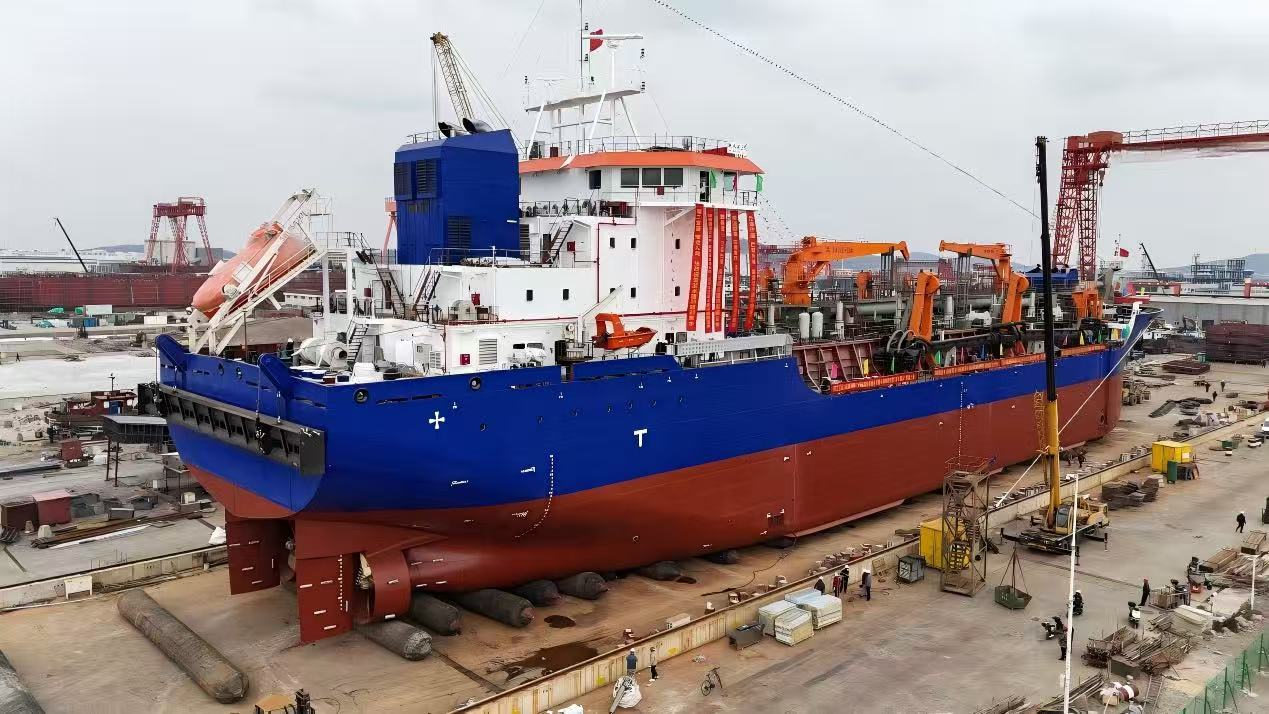
Dredging equipment procurement increasingly requires verifiable class documentation alongside technical specifications. Image: Yanyang Marine shipyard.
Class certification verification is a critical but often under-specified step in dredging equipment procurement. The distinction between CCS and ZC class certificates, and the way technical specifications on datasheets translate into actual dredging performance, can determine whether a vessel meets project requirements or introduces compliance risk. This checklist provides a structured method for technical buyers evaluating dredging equipment, drawing on verifiable documentation and vessel specifications.
Why Class Certification Verification Matters
A class certificate defines a vessel's permitted operating area, insurance eligibility, and resale value. Treating it as a binary check rather than a scoped document with defined limits is a common procurement error.
The CCS classification certificate ZA23DNB00274, held by Zhenjiang Yanyang Engineering Co., Ltd. (Yan Yang), demonstrates the level of detail that procurement teams should verify. The certificate applies to a self-discharging hopper barge within a coastal navigation area, remains valid from August 30, 2024 through August 29, 2029, and references the CCS Rules for Classification of Sea-going Ships. Each of these fields carries procurement implications. Yan Yang, founded in 1996 and based in Zhenjiang, China, is a manufacturer and exporter of dredgers and dredging vessels. The company's equipment can be classed by IACS societies including CCS, BV, LR, and DNV.
CCS vs ZC: What Actually Differs
CCS and ZC certificates serve different operating scopes. Procurement teams need to match the scope notation to the project's regulatory and insurance requirements rather than treating certification as a generic qualification.
CCS is one of the IACS societies that can class Yan Yang's equipment. A CCS certificate such as ZA23DNB00274 supports operation within the navigation area specified on the certificate. For the self-discharging hopper barge covered by this certificate, the scope is a coastal navigation area, and the referenced standard is the CCS Rules for Classification of Sea-going Ships.
ZC class certificates serve nearshore and domestic operating profiles. Yan Yang's 25m³ self-propelled grab dredger is described as a ZC-classed vessel, configured for removing hard clay and soft sediment in near-shore operations. The vessel is equipped with two Weichai X6170ZC-21 main engines rated at 456 kW each, a 25m³ grab capacity, and a designed displacement of 3,651.308 t.
The procurement distinction is operational rather than hierarchical. A ZC-classed vessel is appropriate for its stated scope. The question for buyers is whether that scope matches the project's requirements. A vessel certified for coastal operation may not satisfy the insurance or regulatory conditions of an internationally financed port project. The checklist below addresses how to verify this fit.
The Final Checklist: Verifying Class Certification Before Purchase
The following six steps cover the documentation and specification checks that technical buyers should complete before committing to a dredging equipment purchase.
1. Verify the certificate number and vessel identification. Cross-reference the certificate number (e.g., ZA23DNB00274) against the vessel's particulars—overall length, breadth, depth, and equipment type—to confirm that the certificate applies to the specific asset under consideration.
2. Confirm the issuing authority. Determine whether the certificate is issued by CCS, ZC, BV, LR, DNV, or another body. The issuing authority determines the recognition of the certificate in the project's jurisdiction.
3. Check the validity period. The certificate ZA23DNB00274 is valid from August 30, 2024 to August 29, 2029. An expired or near-expiry certificate indicates renewal risk that should be priced into the procurement decision.
4. Confirm the scope notation. The certificate specifies the navigation area and equipment type. The ZA23DNB00274 certificate covers a self-discharging hopper barge within a coastal navigation area. Match these notations to the project's operating profile.
5. Verify the referenced standard. The certificate references the CCS Rules for Classification of Sea-going Ships. Buyers should confirm that the standard aligns with the project's class requirements and any additional flag-state or port-authority conditions.
6. Request direct confirmation from the classification society. Cross-check the certificate status with the issuing body. This step is particularly important for used or ready-stock equipment, where the certificate may have been issued for a previous owner or configuration.
Reading Datasheets: Performance vs. Installed Power
Datasheet figures can mislead when buyers equate installed power with dredging capability. The distinction is central to informed procurement.
On Yan Yang's 26,800 m³ trailing suction hopper dredger (TSHD), the total installed power is listed as 27,726 kW. The main diesel engines are Wärtsilä 3 × 8,000 kW, the auxiliary/harbor generators are Wärtsilä 2 × 1,600 kW, and the emergency generator is a Cummins unit rated at 526 kW.
A procurement team might reasonably ask whether the Wärtsilä main engine rating of 24,000 kW represents the power available to the dredge pump. It does not. Total installed power aggregates all engine outputs on the vessel. The dredging-specific systems are listed separately: the inboard dredge pump (HK 2 × 6,000 kW), the underwater pump (HK+BKKER 2 × 3,300 kW), and the jet water pumps (CCCC 2 × 2,000 kW). The main thrusters (Wärtsilä 2 × 10,500 kW) consume power during transit, not during dredging.
The procurement implication is straightforward: evaluate the dredge pump configuration, suction pipe diameter (1,200 mm on this vessel), hopper capacity (26,800 m³), and dredging depth range (40/70/115 m) alongside—not instead of—the installed power figure. The vessel holds CCS classification with CSA Trailing Suction Dredger notation, Dredging within R1, and DP-1.
The Cutter Suction Dredger Rating: What 1000–8000 m³/h Means
Yan Yang's cutter suction dredger range spans 500 m³/h to 8,000 m³/h according to company product listings. The 8,000 m³/h self-propelled unit lists a 30 m dredging depth and 8,000 m discharge distance, with overall dimensions of 121 m length, 25 m width, and 8.5 m depth.
The 1,000–8,000 m³/h range is a nominal capacity figure. It reflects the vessel's designed throughput under specified conditions. Procurement teams should request the conditions associated with the rating—soil type, solids concentration, discharge distance, and pump configuration—because these variables determine actual production.
Independent category data for cutter suction dredgers indicates typical dredging depths of 5–25 m and discharge distances up to 2,000 m. Yan Yang's 8,000 m³/h unit specification extends to a 30 m dredging depth and 8,000 m discharge distance. Buyers evaluating this specification should confirm the operating conditions under which those figures apply and verify that the pump configuration supports the required duty point.
The Backhoe Dredger: 32m Depth and Capacity Trade-offs
Yan Yang's EX5500 self-propelled backhoe dredger lists three dredging depth configurations: 18 m, 24 m, and 32 m. The corresponding capacity figures are 15 m³, 18 m³, and 20.5 m³ respectively.
The 32 m maximum depth represents the vessel's deepest operating configuration. The capacity figure at that depth (20.5 m³) differs from the shallower configurations, which reflects the relationship between reach and bucket capability. The vessel is equipped with a Hitachi EX 5500 excavator rated at 2 × 1,076 kW, with propulsion power of 2 × 350 kW. Overall dimensions are 71.5 m length, 22 m beam, and 2.5 m draft.
For buyers evaluating backhoe dredgers, the datasheet should be read as a configuration table rather than a single performance claim. The 32 m depth capability is useful for deep excavation, but the associated capacity figure should be checked against the project's production requirements.
Comparing Propulsion Systems Across the Fleet
Propulsion configuration determines whether a vessel can transit under its own power or requires towing, and it affects operational flexibility across different project types.
| Vessel Type | Main Propulsion | Classification |
|---|---|---|
| 26,800 m³ TSHD | Wärtsilä 2 × 10,500 kW main thrusters; self-propelled | CCS, CSA Trailing Suction Dredger, DP-1 |
| 25m³ Grab Dredger | Weichai X6170ZC-21, 2 × 456 kW; self-propelled | ZC |
| EX5500 Backhoe Dredger | 2 × 350 kW propulsion; self-propelled | Available with IACS class |
| 8,000 m³/h CSD | Self-propelled | Available with CCS class |
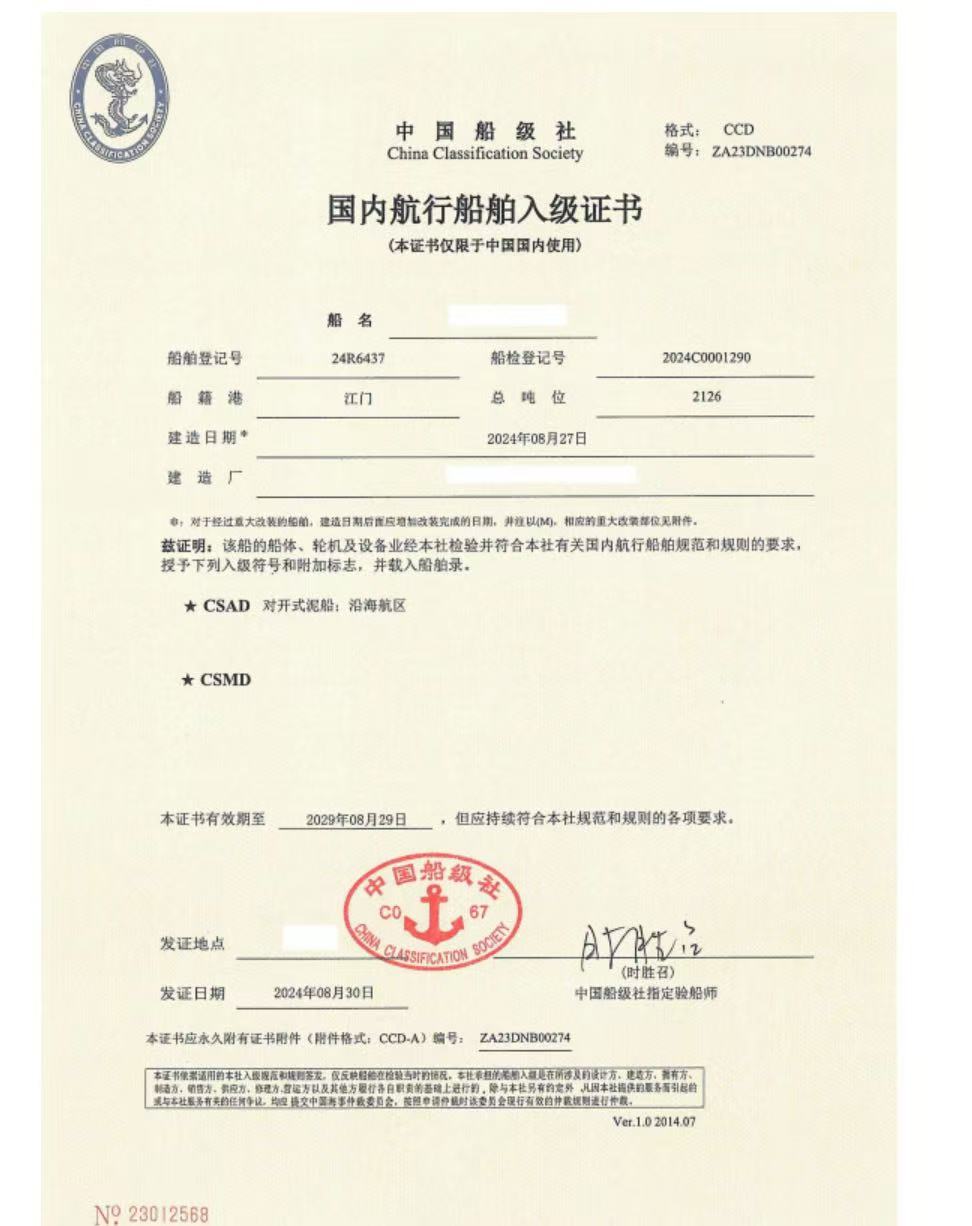
CCS classification certificate ZA23DNB00274 covers a self-discharging hopper barge within a coastal navigation area, valid from August 30, 2024 to August 29, 2029. Image: Yanyang Marine.
Application Fit and Operating Limits
Each vessel type carries a distinct operating envelope. Matching the vessel to the project's physical conditions is as important as verifying certification.
Yan Yang's cutter suction dredgers are offered in a 500–8,000 m³/h range, with the 8,000 m³/h self-propelled unit configured for major port construction, reclamation, deep-sea channel excavation, and offshore airport construction. The trailing suction hopper dredger, with 26,800 m³ hopper capacity and 40/70/115 m dredging depth, is positioned for deep-water channels, port expansion, and large-scale reclamation. The EX5500 backhoe dredger operates at 18–32 m depth for stiff materials and precision dredging. The 25m³ grab dredger is described as suitable for near-shore operations removing hard clay and soft sediment.
Operating limits warrant explicit attention. The ZC-classed grab dredger is configured for near-shore operations. Projects requiring international classification or offshore operation may need a CCS-classed alternative. Separately, the 1,000–8,000 m³/h cutter suction dredger rating is nominal and defined under unspecified conditions. Without standardized capacity definitions, buyers should not compare these figures directly across suppliers. On the 26,800 m³ TSHD, the Wärtsilä main engine rating does not represent dredging power; buyers must evaluate the dredge pump configuration separately.
Market Context Supporting Certification Discipline
China's exports of dredgers (HS 890510) reached USD 462 million in 2024, making it the top exporter globally, according to China General Administration of Customs data. The global dredging equipment market was valued at USD 4.9 billion in 2023 and is projected to reach USD 7.4 billion by 2030, according to Grand View Research. As supply options expand, the ability to verify class certification and normalize technical specifications becomes a more significant procurement capability.
Yan Yang's own operational profile reflects this export orientation: the company reports 100% export share, with markets including the United Arab Emirates, Indonesia, India, Egypt, Turkey, Nigeria, South Africa, Tanzania, Saudi Arabia, and Oman. Standard vessel delivery is listed at 2–3 months, with custom units requiring 8–12 months.
Future Outlook
Two trends are likely to shape dredging equipment procurement in the near term. First, class certification documentation is receiving greater scrutiny as buyers seek verifiable evidence rather than generic claims. Second, the industry is moving toward standardizing capacity definitions, which would allow meaningful cross-supplier comparison of cutter suction dredger ratings and other performance metrics. Until standardization takes hold, buyers should continue to verify the conditions underlying each datasheet figure and match certificate scope to project requirements before purchase.
Frequently Asked Questions
What is the difference between CCS and ZC class certification?
CCS and ZC certificates serve different operating scopes. CCS is one of the IACS societies that can class Yan Yang's equipment, and certificates such as ZA23DNB00274 apply to specific vessels within specified navigation areas—in this case, a self-discharging hopper barge within a coastal navigation area. Yan Yang's 25m³ self-propelled grab dredger is described as a ZC-classed vessel, configured for removing hard clay and soft sediment in near-shore operations. Buyers should match the certificate scope to the project's operating area and insurance requirements.
Which documents should buyers request to verify class certification?
Buyers should request the class certificate itself, the vessel's particulars (overall length, breadth, depth, and equipment type), and confirmation from the issuing classification society. The certificate ZA23DNB00274 includes the certificate number, issuing authority (CCS), validity period (August 30, 2024 to August 29, 2029), scope notation (coastal navigation area, self-discharging hopper barge), and the referenced standard (CCS Rules for Classification of Sea-going Ships).
Why is installed power not a direct indicator of dredging performance?
Total installed power aggregates all engine outputs on the vessel. On Yan Yang's 26,800 m³ TSHD, the total is 27,726 kW, combining Wärtsilä main diesel engines (3 × 8,000 kW), Wärtsilä auxiliary generators (2 × 1,600 kW), and a Cummins emergency generator (526 kW). The dredging-specific systems are listed separately: inboard dredge pump (HK 2 × 6,000 kW), underwater pump (HK+BKKER 2 × 3,300 kW), and jet water pumps (CCCC 2 × 2,000 kW). The main thrusters (Wärtsilä 2 × 10,500 kW) consume power during transit, not dredging.
What does the 1000–8000 m³/h cutter suction dredger rating mean for procurement?
The rating is a nominal capacity figure reflecting designed throughput under specified conditions. Actual production depends on soil type, solids concentration, discharge distance, and pump configuration. Buyers should request the conditions associated with the rating and normalize them across suppliers before comparison. Yan Yang's 8,000 m³/h self-propelled CSD lists a 30 m dredging depth and 8,000 m discharge distance.
What are the operating limits of the EX5500 backhoe dredger at 32 m depth?
The EX5500 lists three depth configurations: 18 m, 24 m, and 32 m, with corresponding capacity figures of 15 m³, 18 m³, and 20.5 m³. The 32 m configuration represents the vessel's maximum reach. Buyers should confirm whether the capacity at that depth meets production requirements, as the figures differ from the shallower configurations. The vessel is equipped with a Hitachi EX 5500 excavator rated at 2 × 1,076 kW and propulsion power of 2 × 350 kW.
How should buyers match certification scope to project operating areas?
Buyers should start with the project's regulatory and insurance requirements, then check the certificate's scope notation. The CCS certificate ZA23DNB00274 specifies a coastal navigation area for a self-discharging hopper barge. If the project requires offshore operation or international financing conditions, the buyer should confirm whether CCS class with the appropriate scope notation satisfies those requirements, or whether a different classification scope is needed. The certificate's referenced standard, CCS Rules for Classification of Sea-going Ships, should also be checked against the project's class requirements.
Tem questões ou precisa de mais detalhes?
Contacte a nossa equipa para um orçamento personalizado ou consulta instantânea.
Solicitar orçamento
Preencha o formulário abaixo e a nossa equipa entrará em contacto com uma proposta personalizada.
Chat direto do WhatsApp
Prefere conversar em tempo real? Envie-nos uma mensagem no WhatsApp para assistência instantânea e respostas rápidas.
- Obter orçamento personalizado
- Partilhar fotos ou documentos
- Discuta as suas necessidades diretamente
Geralmente responde em 5–30 minutos durante o horário de expediente.