
CE Scope vs Yibero S–XL: A Baby Diaper Buyer Comparison
Baby diaper sourcing into Europe rarely fails at the absorbency stage. It fails at the document stage — when an importer discovers that the certificate presented during negotiation lists a different size span, a different construction, or a different responsible economic operator than the shipment about to be produced.
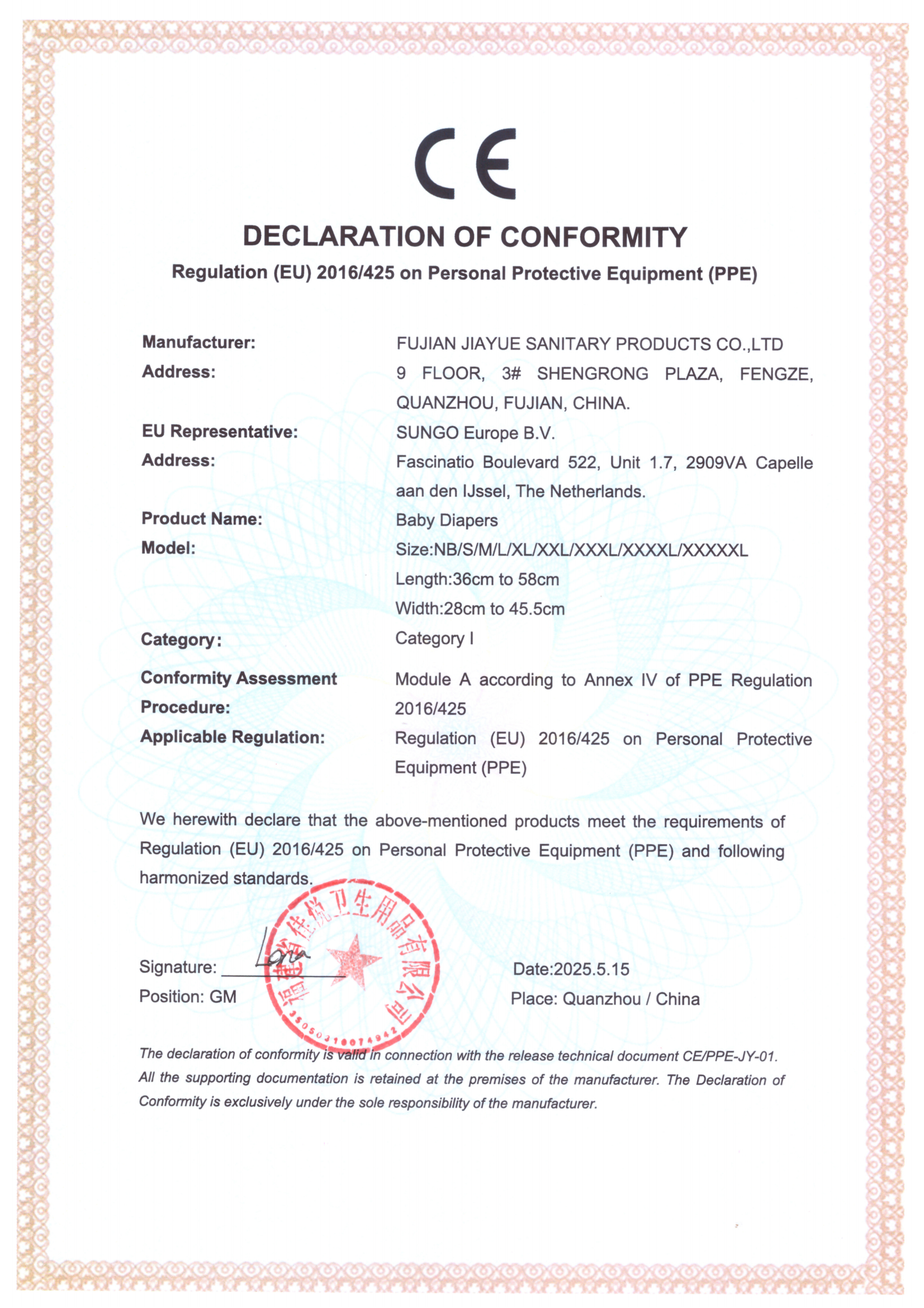
Two documents show the problem in concrete form. The first is a CE Declaration of Conformity, reference CE/PPE-JY-01, issued on 15 May 2025 by Fujian Jiayue Sanitary Products Co., Ltd. — a hygiene and personal-care products manufacturer based in Quanzhou, Fujian, China, established in 2016 — with SUNGO Europe B.V. named as EU representative. It declares baby diapers from size NB through XXXXXL under Regulation (EU) 2016/425 on personal protective equipment, Module A according to Annex IV, Category I.
The second is the commercially documented Yibero Premium tape-style range: four sizes, S, M, L and XL, each with a published dimension, baby-weight band, reference absorbency and unit weight.
The two documents do not contradict each other. They answer different questions, and the distance between them is exactly where a buyer's confirmation work sits.

What CE/PPE-JY-01 Declares — and What It Does Not
A declaration of conformity is a scope statement. It identifies a product group, a regulatory route and the responsibilities attached to it. The document in this file states the following.
| Document type | EU Declaration of Conformity (PPE Category I) |
| Reference number | CE/PPE-JY-01 |
| Issued | 15 May 2025 |
| Expiry recorded | None stated on the document as supplied |
| Declared by | Self-declaration by Fujian Jiayue Sanitary Products Co., Ltd. |
| EU representative | SUNGO Europe B.V. |
| Product scope | Baby diapers |
| Declared sizes | NB, S, M, L, XL, XXL, XXXL, XXXXL, XXXXXL |
| Declared dimensions | Length 36–58 cm; width 28–45.5 cm |
| Regulation cited | Regulation (EU) 2016/425 on Personal Protective Equipment; Module A according to Annex IV |
Three details in that table carry more weight than the rest. The declared size list runs from NB to XXXXXL, which is wider than most private-label briefs and wider than the published product specification discussed below. The declared dimensional window is fixed at 36–58 cm by 28–45.5 cm. And the document is a self-declaration, issued with an EU representative named but with no expiry date recorded.
What the document does not do is equally important. It does not report what a specific size absorbs, how much it weighs, how a batch performs under a given test method, or whether every size on the list is in current production. A conformity declaration answers a market-access question. Performance evidence comes from a separate set of documents.
What the Yibero Premium S–XL Range Documents Commercially
The Yibero Premium Quality Ultra Cloudy Baby Diapers is the tape-style disposable model with published specification data covering four sizes. Yibero is the brand under which Fujian Jiayue Sanitary Products Co., Ltd. markets this line; the company operates its own production through Quanzhou Jiarun Paper Industry Co., Ltd. in a facility of approximately 20,000 m².
| Size | Dimensions | Baby weight band | Reference absorbency | Unit weight |
|---|---|---|---|---|
| S | 400 × 320 mm | 4–8 kg | 500 ml | 26 g |
| M | 450 × 320 mm | 6–11 kg | 600 ml | 29 g |
| L | 500 × 340 mm | 9–14 kg | 700 ml | 33 g |
| XL | 540 × 340 mm | 12–17 kg | 800 ml | 35 g |
Construction is documented as a soft topsheet, an imported SAP and fluff-pulp absorbent core, reusable magic tape, a nonwoven frontal tape, an elastic waistband and a cloth-like breathable backsheet. Shelf life for the listed configuration is five years under recommended storage conditions.
This is the layer that tells a buyer what the product is. It is sized, weighted and measured. It is also narrower than the declaration: four sizes, not nine.
Where the Two Documents Meet — and Where the Gap Sits
The size gap is real but bounded
Nine sizes are declared; four have published commercial data. The overlap is S, M, L and XL. Outside it sit NB at the small end and XXL through XXXXXL at the large end. A buyer whose range is S–XL is working entirely inside the declared list. A buyer adding NB or an extended-size tier is working inside the declaration but outside the published specification — which means the absorbency, unit weight and dimension references that support a purchasing decision have to come from the supplier directly, confirmed by sample, rather than from a published table.
The dimensions sit inside the declared envelope
The declaration fixes an outer boundary of 36–58 cm in length and 28–45.5 cm in width. The four published Yibero tape-style sizes measure 400 × 320 mm, 450 × 320 mm, 500 × 340 mm and 540 × 340 mm. On both axes, every one of those figures falls within the declared window: 400–540 mm sits inside 360–580 mm, and 320–340 mm sits inside 280–455 mm. For the documented sizes the dimensional check passes on the paperwork alone, which is a necessary condition for a clean file — not a substitute for sample approval.
Absorbency is a per-size value, not a range claim
Reference absorbency is listed as 500, 600, 700 and 800 ml for S, M, L and XL respectively, alongside unit weights of 26, 29, 33 and 35 g. Two practical consequences follow. First, a range-level statement such as high absorbency describes a direction of travel, not a specification; the number a buyer signs off belongs to a size. Second, reference values are reference values. A supplier that publishes 800 ml for XL is telling a buyer where to set the sampling conversation, and the agreed test method, sampling level and acceptance criteria still have to be written into the contract.
Four Document Types, Four Different Jobs
Compliance files arrive mixed together, and buyers often treat them as interchangeable evidence. They are not.
| Document | Reference and validity | What it covers | What it does not establish |
|---|---|---|---|
| CE Declaration of Conformity | CE/PPE-JY-01; issued 15 May 2025; no expiry recorded | Declared conformity of baby diapers, sizes NB–XXXXXL, under the cited regulation and module | Batch performance, current production status of every listed size, or test results |
| ISO 9001 certificate | NOA2314690, NOA Testing & Certification Group Ltd.; 12 Dec 2023 – 11 Dec 2026 | Quality management system for sales of sanitary products, maternal and infant products and Class I medical devices | Product-level performance or market approval |
| ISO 13485 certificate | NOA2314356, NOA Testing & Certification Group Ltd.; 6 Dec 2023 – 5 Dec 2026 | Medical device quality management system, scope limited to Class I medical device sales | That baby diapers are medical devices, or that manufacturing itself is certified to this standard |
| SGS and other test reports | Product-, market- and order-specific | Testing of a defined sample against a defined method | Universal coverage across every size in a range |
The ISO 13485 point deserves emphasis because it is routinely overstated in supplier presentations. The certificate in this file is scoped to Class I medical device sales. It is a management-system document, not a product classification, and it does not convert every diaper in a catalogue into a medical device or replace the destination market's own registration, labelling and testing requirements.
When the Build Changes, the Paperwork Has to Be Rechecked
Core structure and nonwoven choice
Customization at this supplier spans product size and weight, absorbency target, SAP and fluff-pulp or composite core, hot-air or spunbond nonwoven, cloth-like backsheet, tape or pull-up format, 3D leak guards, wetness indicator, waistband, graphics, printed bags and cartons, and pack count with size mix. Each of those is a specification decision, and several of them change what the product physically is.
The distinction buyers should hold on to: a fluff pulp and SAP core combines cellulose fluff pulp with superabsorbent polymer, while an ultra-thin SAP paper core uses SAP paper as the main absorbent structure. Both options exist within the supplier's capability. Neither carries a universal performance advantage without testing under the same conditions. More to the point for this comparison, a change of core type, topsheet nonwoven or backsheet is a change of configuration — and the conformity declaration on file describes a product, not a template. Buyers should confirm in writing that the configuration being ordered corresponds to the declared scope, and ask what additional test evidence the change triggers.
Artwork, pack count and the economic operator
Private-label artwork is a commercial layer, not a compliance layer. Printed bags and cartons, pack counts and brand graphics are all customizable, and none of them alters the underlying declaration. What artwork does affect is the labelling file: the responsible economic operator still has to be identified in the form the destination market requires, and in this case that role is held by SUNGO Europe B.V. as EU representative.
A practical rule for the approval pack: confirm the declaration reference and issue date on the supplier's file, confirm that the EU representative named matches the label artwork, and confirm that on-pack claims stay inside what the declared scope and the agreed test evidence can support. Artwork that promises more than the file demonstrates is one of the most common causes of a delayed first shipment.

How This Differs From a Sample-Led Sourcing Process
Most importers evaluate a new baby diaper supplier in the same order: request samples, judge feel and fit, negotiate price, place a trial order, then ask for documents. The sequence feels efficient because the first three steps are fast. It becomes expensive when the documents arrive after the price has been agreed.
A document-led sequence runs the other way. Read the declaration scope first, map the intended size range against it, then read the specification table, then sample. On this supplier's file that sequence produces a short, specific question list rather than a general request for certificates: which sizes in the NB–XXXXXL list are currently produced, what reference absorbency and unit weight apply to any size outside S–XL, and which test reports exist for the two or three sizes actually being ordered.
The trade-off is honest and worth stating. A document-led process is slower at the front end, requires someone who can read a scope statement, and will sometimes surface a documentation gap on a size the buyer wanted anyway. A sample-led process reaches a tactile decision faster and defers the paperwork risk to the moment when changing suppliers is most costly. Neither approach is universally right, and buyers running short seasonal programmes sometimes legitimately choose speed.
Who This Comparison Matters To
Importers building a first private-label range. The four documented sizes cover the volume tiers most European retail programmes start with. The question to settle before deposit is whether NB is needed for newborn positioning, because that is the point where the file moves from documented specification to supplier-confirmed specification.
Distributors mixing sizes in a container. Baby diaper containers can mix three to four sizes. Since reference absorbency and unit weight differ by size, a mixed load needs the specification approved per size rather than per range.
Brand owners changing construction. Buyers moving from a fluff pulp and SAP core to an ultra-thin SAP paper core, or from spunbond to hot-air nonwoven, are changing the product. Confirm what the ordered configuration is and what documentation follows it.
Procurement teams planning repeat supply. Typical production lead time is approximately 30–45 days, subject to sample, artwork, packaging and specification approval. Monthly capacity supports more than 100 × 40HQ containers across the supplier's self-owned factory. One anonymised private-label importer is documented as starting from a trial container and progressing to repeat orders, with specification and absorbency adjustment, artwork coordination and size-mix planning as the recurring work.
Market Context Behind the Documentation Question
The documentation question is not a niche concern. Grand View Research valued the global baby diaper market at USD 83.3 billion in 2025, and Fortune Business Insights reported Asia Pacific holding 61.92% of the global diaper market in the same year. Customs data cited by the supplier places Fujian province baby diaper exports at CNY 8.74 billion in 2024.
For European buyers this means supply density is concentrated in a region where export documentation is routine and where a well-formed compliance file is a normal expectation rather than a differentiator. It also means that scope statements — which sizes, which product, which representative — are the part of the file that actually distinguishes one supplier from another.
Limits in This File Buyers Should Not Paper Over
The comparison above is favourable to the supplier on dimensions and unfavourable on one important point, and it is worth stating both plainly.
The extended sizes have declared coverage but no published specification. NB and XXL through XXXXXL appear on the declaration but not in the commercial specification table summarised here. A buyer who needs those sizes has a scope statement and nothing to check it against. That gap has to be closed with the supplier before the order, not after production.
Two management-system certificates fall due shortly. The ISO 9001 certificate expires on 11 December 2026 and the ISO 13485 certificate on 5 December 2026. Both were valid at the time of writing, and both are close enough to renewal that a buyer starting a long-run programme in late 2026 should confirm current status with the issuing body rather than rely on a scanned copy.
The declaration carries no printed expiry. A document of this type does not expire on a stated date in the way a test report does; its relevance depends on the product still matching what was declared. Confirm that the reference number, issue date and size list match the specification being approved.
Reference absorbency is not a test result. The 500/600/700/800 ml figures are reference values for S/M/L/XL. Batch evidence depends on the agreed method, sampling level and acceptance criteria — quality control here runs on specification review, pre-production sample approval, in-process checks and pre-shipment inspection, with the test method and acceptance criteria agreed in the contract.
The declared product scope is baby diapers. The declaration does not list baby pull-up pants or adult products. Buyers adding a pull-up SKU to the same programme should ask what documentation covers it.
Future Outlook
Two directions are visible from this file. The first is that size breadth is becoming a documentation question rather than a product question: ranges that once stopped at XL now extend into XXL and beyond, and every extension widens the gap between what is declared and what is specified. Suppliers that publish specification data across the full declared range will be easier to buy from, simply because fewer questions remain open.
The second is that artwork and labelling review are moving earlier in the process. As private label spreads, the label becomes the point where commercial identity, economic-operator information and on-pack claims meet — and where mismatches are cheapest to fix before printing rather than after.
For buyers, the practical takeaway is stable regardless of how the market develops. Read the declaration as a scope statement, read the specification as a product statement, and treat the distance between them as the confirmation list for the next supplier conversation.
FAQ
Does the CE Declaration of Conformity cover every baby diaper size?
The declaration CE/PPE-JY-01 lists baby diapers in sizes NB, S, M, L, XL, XXL, XXXL, XXXXL and XXXXXL, with a declared length of 36–58 cm and width of 28–45.5 cm. That is the declared scope. It does not confirm that every listed size is in current production or that a published specification exists for each one.
What absorbency do the Yibero S–XL tape-style diapers reference?
Reference absorbency is 500 ml for size S, 600 ml for M, 700 ml for L and 800 ml for XL, with unit weights of 26, 29, 33 and 35 g and baby-weight bands of 4–8 kg, 6–11 kg, 9–14 kg and 12–17 kg respectively. These are reference values; batch performance is confirmed against the agreed test method.
Does ISO 13485 mean the baby diapers are certified medical devices?
No. ISO 13485 is a quality-management-system standard, and certificate NOA2314356 is scoped to Class I medical device sales. It does not classify baby diapers as medical devices, approve a product for a specific market, or demonstrate that manufacturing itself is certified to the standard.
Who is the EU representative named on the declaration?
SUNGO Europe B.V. is named as the EU representative on CE/PPE-JY-01, which is a self-declaration issued by Fujian Jiayue Sanitary Products Co., Ltd. on 15 May 2025 and records no expiry date on the document as supplied.
What should buyers confirm before ordering a size outside S–XL?
For NB or XXL through XXXXXL, buyers should confirm the size is currently produced, obtain the dimension, unit weight and reference absorbency for that specific size, and agree the applicable test evidence. The declaration covers those sizes; the published commercial specification summarised here does not.
Does changing the core structure or artwork affect the documentation?
The supplier offers customization across core type, nonwoven, backsheet, format, leak guards, wetness indicator, graphics, printed packaging and pack count. A change of core or material is a change of product configuration, so buyers should confirm in writing that the ordered build corresponds to the declared scope and ask what additional test evidence applies. Artwork does not change the declaration, but it must keep the economic-operator information and on-pack claims consistent with the file.
The JIAYUE 2026 product catalogue, covering baby diapers, pull-up pants and related hygiene products, is available as a downloadable PDF: JIAYUE Product Catalog 2026.
Tem questões ou precisa de mais detalhes?
Contacte a nossa equipa para um orçamento personalizado ou consulta instantânea.
Solicitar orçamento
Preencha o formulário abaixo e a nossa equipa entrará em contacto com uma proposta personalizada.
Chat direto do WhatsApp
Prefere conversar em tempo real? Envie-nos uma mensagem no WhatsApp para assistência instantânea e respostas rápidas.
- Obter orçamento personalizado
- Partilhar fotos ou documentos
- Discuta as suas necessidades diretamente
Geralmente responde em 5–30 minutos durante o horário de expediente.