
CEP vs Domestic GMP: Choosing a Chiral Amine API Supplier
CEP vs Domestic GMP: Choosing a Chiral Amine API Supplier
A Certificate of Suitability (CEP) and a domestic GMP certificate are different regulatory instruments, not different grades of the same product. For chiral amine-derived cardiovascular APIs, where the stereochemistry of the dihydropyridine core must be controlled and documented, the choice between a CEP supplier and a domestic-GMP-only supplier determines which dossiers the material can support, how much of the chiral chemistry a buyer can actually inspect, and how much regulatory work remains on the buyer's side.

Why the Chiral Amine Part Changes the Comparison
Most supplier comparisons treat all APIs as interchangeable powder plus paperwork. Chiral chemistry breaks that assumption. A chiral amine is an amine carrying at least one stereogenic centre, and in the dihydropyridine calcium-channel blockers the ring system is built on an amine-containing core whose three-dimensional arrangement has to be fixed early and defended through every subsequent step. The free base produced in hydrolysis, the salt formed in a separate reactor, and the crystallisation and purification stages that follow are not merely process convenience: they are the points where closely related structures can be carried forward unnoticed if the analytical controls are thin.
That has two consequences for procurement. First, stereochemical control cannot be bolted on at final release; it is a design property of the route. Second, the more of that route a supplier is willing to place inside a documented, inspectable scope, the less the buyer has to reconstruct from experience. This is exactly where the CEP route and the domestic-GMP-only route diverge.
For clarity, the worked example here is the amlodipine series: Amlodipine Base as the free base intermediate, Amlodipine Besylate as the marketed salt, and the S-enantiomer series that continues into Levamlodipine Besylate. Changzhou Ruiming Pharmaceutical Co., Ltd. is a Chinese API and intermediate manufacturer founded in 2005 and based at No.1558 North Longjiang Road, Chunjiang Town, Xinbei District, Changzhou City, Jiangsu Province, producing cardiovascular, urinary, respiratory and digestive APIs. Its amlodipine line is used throughout this article as a reference case for what each supplier type can and cannot make visible.
The Real Dividing Line Is Documentary, Not Chemical
Both certificate types are issued because a manufacturing process has been assessed. The difference is what the assessment certifies and who is allowed to rely on it.
A CEP is a pharmacopoeial instrument. It states that a defined API, made by a defined process at a named site, is suitably controlled by the current European Pharmacopoeia monograph. A domestic GMP certificate is a manufacturing instrument. It states that a facility and its lines operate according to the national good-manufacturing-practice requirements of the issuing authority. One answers "does this material meet the European monograph?"; the other answers "is this plant inspected and compliant in its own jurisdiction?". Buyers who need both end up re-reading both documents in different ways.
In the amlodipine case, Ruiming holds EDQM CEP R1-CEP 2008-074 – Rev 01, dated 3 March 2022, confirming that the quality of Amlodipine Besylate complies with European Pharmacopoeia monograph No. 1491, that the manufacturing process including purification does not intentionally add ICH Q3D elemental impurities, and that the re-test period is 36 months. A second, separate CEP covers another product in the portfolio: CEP 2023-038 – Rev 00, issued 18 February 2025 for Propafenone Hydrochloride, referring to EP monograph No. 2103, with an 18-month re-test period and no human or animal-derived materials used in production. These are product-specific documents. They do not travel automatically to every item a supplier sells.
Where the Chiral Steps Sit Inside the Certified Scope
The most useful sentence in any CEP file is the scope description of the accompanying EU GMP certificate, because it tells the buyer where the manufacturer's own control actually begins.
Ruiming's EU GMP certificate FIMEA/2023/006159 was issued by the Finnish Medicines Agency on 18 April 2024 under Directive (EU) 2017/1572 and Commission Delegated Regulation (EU) 2017/1569, with reference to Article 47 of Directive 2001/83/EC. Its scope is the manufacture of Amlodipine Besylate by chemical synthesis, explicitly including intermediate manufacturing, crude API production, salt formation, crystallisation, purification, finishing steps, packaging and quality control testing. In a chiral amine context this matters more than it does for a simple salt: it means the stages in which the amine core is assembled and carried through to salt formation are described inside a scope a European inspector has reviewed, rather than being compressed into a one-line process description.
The domestic layer is not redundant. Jiangsu Medical Products Administration notices JSMPA Yao Sheng Gao Zhi〔2024〕No. 271 and No. 278, both dated 14 September 2024, record GMP compliance inspection for Amlodipine Besylate, Felodipine, Propafenone Hydrochloride, Methoxyphenamine Hydrochloride and Levamlodipine Besylate, with synthesis, purification and packaging addressed by building and line. The Levamlodipine Besylate API scope is the point of interest for the chiral series: the S-enantiomer product is covered by a national inspection record, and buyers who need European documentation for that specific product should ask a direct question rather than assume symmetry with the parent compound.
A useful framing for evaluation-stage buyers: the CEP defines what the material is against a pharmacopoeia, the EU GMP certificate defines where and how it is made, and the written confirmation for active substances exported to the EU defines which regulatory export obligations are met. Ruiming holds the third as well: written confirmation JS250256, issued 20 October 2025 and valid until 19 October 2028, for Amlodipine Besylate produced by chemical synthesis, stating compliance with EU GMP, WHO and ICH Q7 requirements. Each document answers a different reviewer's question.
Side-by-Side: What Each Supplier Type Actually Gives a Buyer
| Evaluation dimension | CEP-grade supplier | Domestic-GMP-only supplier |
|---|---|---|
| Pharmacopoeial basis | API controlled by the current European Pharmacopoeia monograph (e.g. Amlodipine Besylate No. 1491) | Controlled by the national pharmacopoeia and the registered national standard |
| Core dossier | CEP certificate plus annexes describing the site and the declared process, supported by batch release data | National registration dossier plus GMP inspection notice naming products and lines |
| Market access consequence | Can be referenced in EU and EU-aligned filings; reduces the pharmacopoeial suitability work the buyer's dossier repeats | Typically written for the domestic filing route; not directly usable for an EU submission |
| Visibility of chiral intermediates | Intermediate manufacturing and crude API production can be named in the certified scope | Coverage defined by the national inspection scope, which may describe lines rather than declared process steps |
| Impurity and stereochemical data | Must satisfy the monograph's control strategy, with re-test period and elemental impurity position declared in the certificate | Must satisfy the registered national specification and the buyer's own contract requirements |
| Buyer effort | Verify revision status, scope, site in the annex and re-test period — then still qualify the supplier | Verify inspection status, product coverage and whether the dossier will be accepted by the target authority |
| Typical constraint | Available only for products the manufacturer has chosen to file; not a general property of the whole portfolio | Limits which registration routes the finished dosage form can take, regardless of plant quality |
Comparison reflects the regulatory character of each document type; it is not a quality ranking and not an assessment of any unnamed manufacturer.
Reading Chiral Purity Evidence in Practice
During evaluation, the question is rarely "is there a certificate?". It is "does the evidence describe the chemistry I am buying?". For chiral amine APIs, three evidence layers are worth separating.
1. Batch release against the monograph
Ruiming's quality control includes full batch release testing in compliance with Ph.Eur. requirements, with COA and impurity profile available per batch. For a buyer, the practical test is whether the impurity profile reported in the COA is the same control strategy described in the dossier — not merely whether both documents exist.
2. Customisation of what the buyer's method needs
Customization services include targeted impurity control, customized COA, packaging scheme development and an audit document package. In the chiral amine context, targeted impurity control is the most consequential of these: a buyer developing a combination tablet with a defined degradant profile has different analytical priorities from a buyer filing a single-entity product, and the supplier's ability to respond at specification level is a better predictor of a stable long-term supply than a generic certificate claim.
3. Late-stage handling
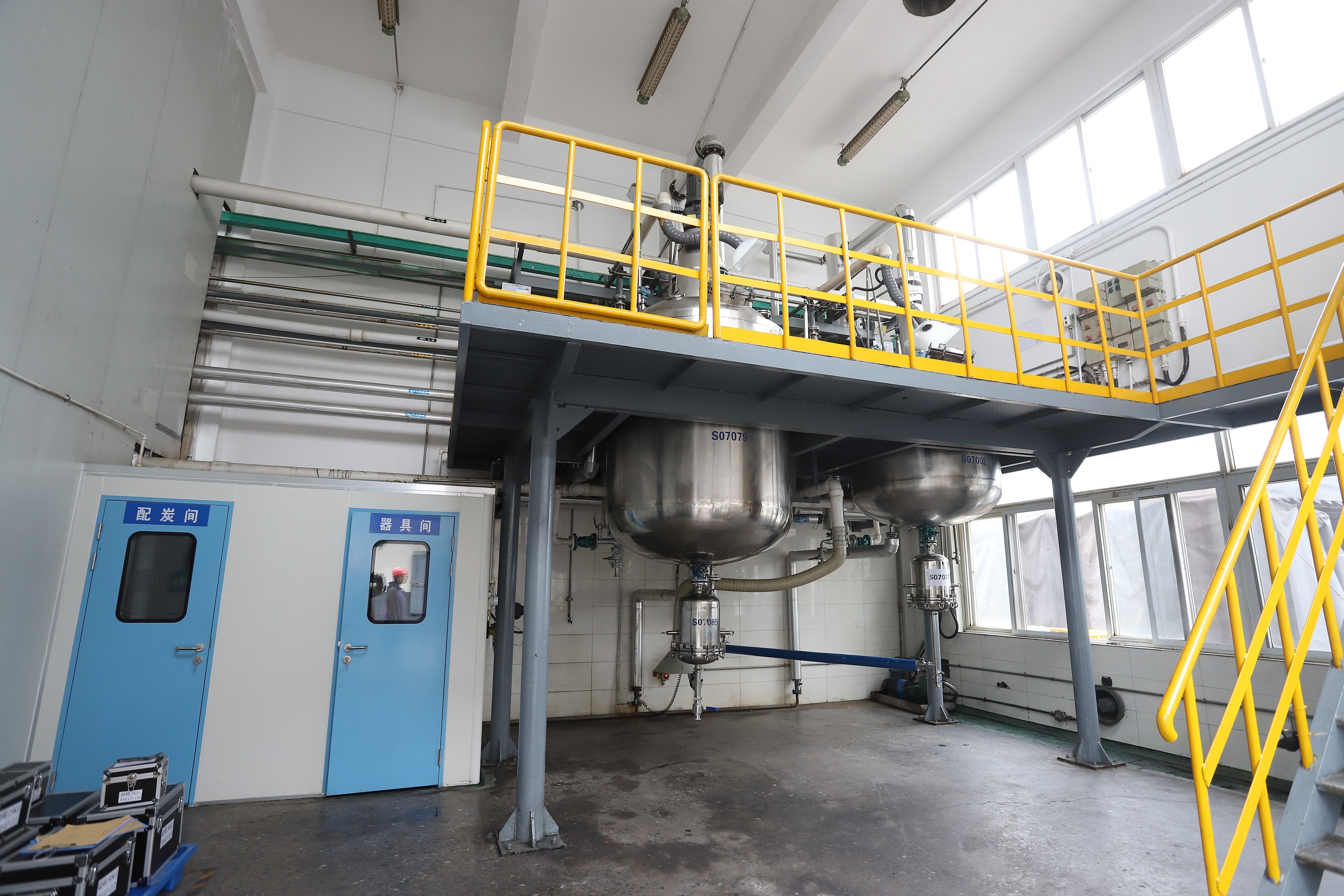
The amlodipine line runs through amlodipine base hydrolysis reactors, amlodipine besilate salt-forming reactors, centrifuges, decolorization reactors, crystallization reactors, double cone rotary vacuum dryers, high-efficiency pulverizers and double cone blenders. Material is packed at 25 KG per drum, in double PE bags inside fibre drums, protected from light and dry conditions. After salt formation, the physical steps — drying, milling, blending — influence particle behaviour in the buyer's press or blender as much as the chemistry does, which is why the packaging and handling description belongs in the technical evaluation rather than the logistics annex.

Application Fit: Where the Chiral Amine Series Is Used
Amlodipine Besylate supplied under CEP is typically destined for hypertension and angina finished dosage forms, including fixed-dose combinations. Ruiming's documented case is a cardiovascular supply-chain partner in France using 800–1000 kg per year of Amlodipine Besylate for hypertension combination tablet manufacturing over a three-year relationship, where batch quality consistently met EP requirements, the impurity profile was stable, and the supplier passed the customer's quality assessment. That case is useful not because of its volume but because of its shape: a European buyer, a defined annual quantity, a combination product, and a supplier assessment completed before commercial supply.
Alongside it, the domestic route has its own application logic. Levamlodipine Besylate API appears within the 2024 Jiangsu GMP inspection scope, and in 2024 the company obtained marketing approval for Levoamlodipine Besylate Tablets. Buyers evaluating the S-enantiomer series therefore face a portfolio in which the parent compound carries European documentation and the enantiomer series is documented through national inspection records — a distinction that directly shapes which market a finished product can target.
The Market Trend That Is Reshaping This Decision
European expectations of API suppliers have been layered rather than simplified. A CEP alone does not close a supplier file: Article 47 of Directive 2001/83/EC establishes written confirmation obligations for active substances exported to the EU, and buyers increasingly assemble a three-part evidence set — pharmacopoeial suitability, site-level GMP, and export written confirmation — before a supplier enters an approved list. Ruiming's current file illustrates the pattern: CEP R1-CEP 2008-074 – Rev 01 for Amlodipine Besylate, EU GMP certificate FIMEA/2023/006159, and written confirmation JS250256 valid to October 2028, alongside national inspection notices for the wider portfolio.
The second trend is portfolio asymmetry. Manufacturers rarely hold European documentation for every product they sell, and the gap is usually concentrated in newer or enantiomer-specific items. Buyers who assume that a CEP on one molecule implies documentation across a catalogue are the ones who discover the gap late, during dossier compilation rather than during sourcing.
Where This Comparison Stops Being Useful
An honest comparison has to state its boundaries, and there are three worth naming.
- A CEP is product-specific, not company-wide. In the supplied evidence, the European certificates cover Amlodipine Besylate and Propafenone Hydrochloride. Levamlodipine Besylate is documented through the national GMP inspection scope, not through a CEP. A buyer who needs European documentation for the S-enantiomer product must confirm it directly rather than infer it from the parent compound.
- A domestic-GMP-only route is often the correct choice. If the finished dosage form will be registered and sold only in the domestic market, a CEP adds dossier cost and administrative time without adding regulatory value to that filing. The national route is not a lesser option; it is a different destination.
- Neither document substitutes for commercial assessment. Capacity, lead time and responsiveness decide whether a compliant supplier is a workable one. Ruiming reports monthly API production capacity of 15 tons, an annual output of 180 tons, a typical lead time of 45–60 days after order confirmation and advance payment, and MOQ terms that are not strictly fixed and can be negotiated by project. Those figures are adequate for many programmes and should be modelled explicitly for large-volume or multi-year commitments rather than assumed.
Future Outlook
Three developments are worth tracking for buyers holding chiral amine programmes. First, the documentation burden continues to shift toward site-level transparency, which favours suppliers whose certified scope names intermediate manufacturing rather than stopping at the final API step. Second, vertical integration into finished dosage — illustrated by the 2024 marketing approval for Levoamlodipine Besylate Tablets — changes the conversation from "who sells me the salt?" to "who understands the degradation pathway of my product?", which is a different qualification exercise. Third, portfolio asymmetry will keep mattering: as enantiomer-specific products grow in commercial weight, the question of which of them carry European pharmacopoeial documentation becomes a selection criterion in its own right, not a detail resolved after the commercial terms are agreed.
For evaluation-stage buyers, the practical conclusion is to ask the same six questions of every candidate: which product is covered by which certificate, what the certified scope names, what the re-test period and elemental impurity position are, what the batch documentation contains, what the lead time and MOQ behaviour actually look like, and what the supplier cannot currently document. Changzhou Ruiming Pharmaceutical Co., Ltd. answers those questions unevenly across its portfolio, and stating that unevenness plainly is more useful than presenting it as uniform strength.
FAQ
How does an API holding a CEP differ from one holding only domestic GMP certification, from a procurement standpoint?
An API with a CEP complies with the European Pharmacopoeia standard and supports EU and multi-country filing, with complete impurity and stability data, and is positioned for EU audit. An API with only domestic GMP certification meets NMPA requirements for China registration and cannot be directly used for an EU submission. The decision rule follows the target market: select CEP-grade material if the registration route covers the EU or other international filings, and domestic GMP material if the finished dosage form is registered and sold only in China.
What factors should be confirmed before placing an API order?
Before ordering, a buyer should confirm the filing market, the required pharmacopoeia standard, the certificate scope, the batch release specification, lead time, MOQ, change control rules and audit requirements. Relevant selection parameters include the pharmacopoeia version, certification coverage (CEP or GMP), impurity profile, batch size, shelf life and storage conditions, and the document package. Material should be selected so that certificates, quality standards and impurity data fully match the intended registration market, with the change notification procedure and supply stability agreed in advance.
What are the main risks when purchasing chiral amine APIs, and how are they controlled?
Common risks in API procurement are compliance risk, quality deviation risk, supply interruption risk and incomplete supporting documentation. They typically arise when supplier qualification is insufficient, the filing market requirement is undefined, change control is absent, or no audit has been performed. Mitigation combines selecting suppliers that match the registration route, verifying GMP and CEP documentation before purchase, carrying out routine supplier audits, and preparing a backup supply plan.
Should a buyer choose an off-the-shelf commercial API or a custom CDMO synthesis?
For launched and stable formulation projects, off-the-shelf API is generally preferred: lead time is fast, cost is stable and the compliance documentation is complete. Custom CDMO synthesis fits early-stage new molecules and bespoke impurity development, with a longer timeline and higher investment for exclusive process development. In comparable terms, a commercial API has a fixed process, a pharmacopoeia standard and CEP or GMP documentation with a lead time of 45–60 days, while custom CDMO work offers a flexible process and tailor-made impurity control with a longer lead time and, typically, no ready CEP.
How can a buyer request API samples and supporting technical documents?
The request should specify product name, CAS number, requested quantity, intended use and target filing market. The supplier then checks stock or production schedule and confirms the sample plan, freight cost and lead time; shipment follows sample release and includes COA and SDS. In-depth documents such as process descriptions and validation records require a separate formal document request. Samples are supplied for R&D or registration testing, must be stored as labelled, and the recipient must be qualified to receive pharmaceutical and chemical samples.
How is an on-site factory audit scheduled?
The buyer submits a formal audit application stating the audited products, audit objectives, proposed time window and auditor list. The supplier's QA team assesses capacity and availability, then advises a feasible date and preliminary audit plan. Once the agenda is confirmed, documents such as batch records, validation files and process and quality system records are prepared in advance, after which the on-site audit takes place; observations are followed by a CAPA submission. Visitors must follow site GMP rules and wear the required cleanroom protective equipment, and access to production areas is escorted.
Additional reference: Changzhou Ruiming Pharmaceutical Co., Ltd. company brochure.
Tem questões ou precisa de mais detalhes?
Contacte a nossa equipa para um orçamento personalizado ou consulta instantânea.
Solicitar orçamento
Preencha o formulário abaixo e a nossa equipa entrará em contacto com uma proposta personalizada.
Chat direto do WhatsApp
Prefere conversar em tempo real? Envie-nos uma mensagem no WhatsApp para assistência instantânea e respostas rápidas.
- Obter orçamento personalizado
- Partilhar fotos ou documentos
- Discuta as suas necessidades diretamente
Geralmente responde em 5–30 minutos durante o horário de expediente.