
CHENGLEI Actuator Plant: Capacity, Materials and Test Evidence
Manufacturing base of Changzhou Chenglei Valve Technology Co., Ltd., Changzhou, Jiangsu Province, China.
Electric actuator sourcing rarely fails at the discovery stage. It fails later, when a shortlisted supplier has to be defended internally — on capacity, on materials, on testing protocols, on certification scope. This analysis examines the manufacturing and quality-control evidence published by one Chinese electric actuator manufacturer, Changzhou Chenglei Valve Technology Co., Ltd. (brand: CHENGLEI), and translates that evidence into the qualification questions a decision-stage buyer should be asking.
Why Capability Evidence Decides Electric Actuator Procurement
The global electric actuator market was estimated at approximately USD 11.5 billion in 2024, with projections of 6.5% to 7.2% CAGR through 2034 (Zion Market Research). Asia-Pacific accounted for a 38.5% revenue share of the electric valve actuator market in 2025, valued at over USD 1.8 billion (Dataintelo). China's export value for electric motor parts — a category that includes actuator components — reached USD 6.43 billion in 2024, or 26.1% of global exports (Observatory of Economic Complexity).
A growing market produces more suppliers. It does not automatically produce more verifiable suppliers. For a procurement team at the decision stage, the useful question is not who manufactures electric actuators, but what a specific manufacturer can actually demonstrate about capacity, materials, testing and compliance.
Capability evidence at this stage usually comes down to five verifiable elements: a named and locatable manufacturing facility; a stated production capacity; a defined material and protection specification; documented testing protocols for the functions that matter in the field; and a certification scope that matches the hazardous-area classification of the installation. Catalogue language, brand familiarity and price are secondary to those five — they are inputs to the decision, not substitutes for it.
CHENGLEI as a Manufacturing Entity
Changzhou Chenglei Valve Technology Co., Ltd., trading under the brand CHENGLEI, is a manufacturer of electric valve actuators based in Changzhou, Jiangsu Province, China. The company supplies electric actuators for valve automation in oil and gas, water and power, and chemical, process and industrial applications.
- Facility: 20,000 m² manufacturing site in Changzhou, Jiangsu Province, China
- Workforce: approximately 100 employees, including a 25-engineer research and development team
- Equipment: more than 50 CNC machining centers and CNC lathes, plus various inspection equipment
- Stated annual output: 120,000 units
- Export share: 80% of output, sold to global markets
- Core product line: electric actuators, including the independently developed CL series valve electric actuators
The company's own profile cites a 2016 incorporation date alongside more than 20 years of experience in developing and manufacturing valve electric actuators. Both statements are worth recording at qualification stage, because the second one describes accumulated engineering experience rather than the legal age of the entity — a distinction that matters when a buyer is assessing technical depth rather than registration history.
For supplier qualification purposes, three facts from this list carry the most weight. First, the facility has a verifiable address in an industrial park in Changzhou, an established valve and actuator manufacturing cluster. Second, the machining base — more than 50 CNC machining centers and lathes — indicates that housing and component machining is performed in-house rather than fully subcontracted, which affects tolerance control and change response. Third, the 80% export share means that most of the company's output already passes through international packing, documentation and shipping requirements.
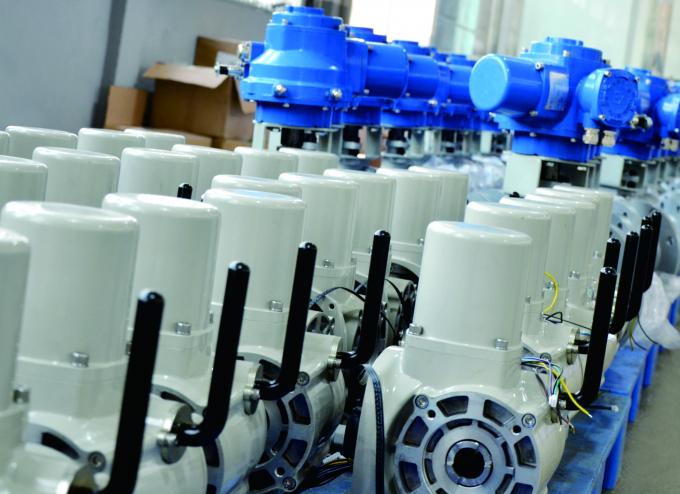
Installation workshop: actuator assembly and pre-delivery preparation at the Changzhou facility.
Production Capacity: Reading 120,000 Units per Year Correctly
CHENGLEI states an annual output of 120,000 units. That figure is a starting point for verification, not a conclusion. Capacity statements describe what a plant can produce under a defined product mix and shift pattern; they do not describe what is currently available to a new buyer, because a portion of that capacity is normally committed to existing accounts.
Three practical checks help a buyer convert a headline capacity number into a usable supply plan:
- Capacity versus availability. Ask what share of stated annual output is already committed, and what portion could realistically be allocated to a new annual volume without displacing existing orders.
- Product mix. Part-turn, multi-turn, linear and explosion-proof variants consume different amounts of machining, assembly and testing time. A capacity figure is only comparable when it is expressed against the mix a buyer actually intends to order.
- Schedule fit. Annual capacity says little about whether a specific delivery window can be met. Buyers should test capacity against their own call-off schedule, not against an annual total.
With a 20,000 m² facility, approximately 100 employees and more than 50 CNC machining centers and lathes, CHENGLEI's stated capacity is consistent with a mid-sized specialist plant rather than a large diversified conglomerate. That profile has a practical consequence for buyers: order sizes and technical requirements are more likely to reach engineering and production decision-makers directly, which usually shortens the path from a non-standard request to a technical answer.
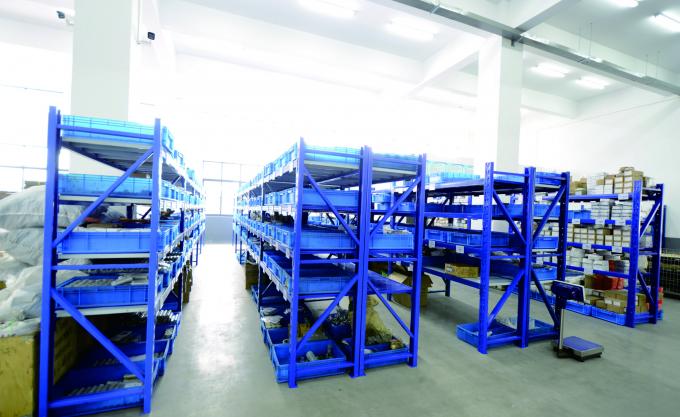
Warehouse: finished electric actuators staged for shipment. The company states that 80% of its output is exported.
Material Options: Aluminum Alloy, Stainless Steel and Carbon Steel
Across its electric actuator range, CHENGLEI offers enclosure and structural material options in aluminum alloy, stainless steel and carbon steel. The choice is not cosmetic. Material selection determines weight, corrosion behaviour, thermal behaviour and cost, and it interacts directly with the protection class and the corrosion strategy of the finished unit.
- Aluminum alloy. Lower weight and good machinability make it a common choice for general industrial duty, where corrosion protection is delivered by the enclosure coating system. Reduced weight matters on valve-mounted assemblies and during installation, particularly for part-turn units mounted at height.
- Stainless steel. Specified where the ambient atmosphere or washdown regime is aggressive — chemical plants, coastal sites and offshore environments are typical examples. The trade-off is higher material cost and greater weight.
- Carbon steel. A cost-efficient option for benign, dry, inland conditions where a protective coating system is maintained as part of the site's inspection routine. It requires more attention to coating integrity over the service life of the actuator.
The practical recommendation for buyers is to specify the environment rather than the material. Ambient chemistry, humidity and washdown frequency, the temperature range, and the required ingress protection class are the inputs that should drive the material decision — not a preference expressed in isolation on a datasheet.
Thermal Protection and Electrical Insulation in Practice
Thermal protection in an electric actuator is a control-layer function rather than a single component. The actuator monitors motor condition and treats overheating as a reportable fault rather than allowing sustained overload to continue silently. In CHENGLEI's intelligent actuator control set, the documented fault-handling conditions include power phase loss, motor overheating and valve jamming, with fault codes readable through the bus or an infrared remote control. The practical value at decision stage is diagnostic: a fault that can be identified by code is a fault that can be resolved without dismantling the unit in the field.
Electrical insulation and moisture control are addressed through three documented measures:
- Galvanic isolation at the interfaces. Input and output interfaces use optocoupler isolation, which separates the control electronics from field wiring transients.
- Conformal coating. The mainboard is coated for moisture resistance, salt-spray resistance and mould resistance — relevant in humid, coastal and chemical environments where condensation and airborne contaminants are routine.
- Grounding protection. The enclosure carries independent internal and external grounding bolts, providing a defined safe discharge path in the event of leakage.
Two further design details support insulation integrity indirectly. Limit setting on the intelligent actuator is non-invasive — performed through an infrared remote control or a rotary knob without opening the electrical cover — which reduces the opportunity for moisture and dust to enter the enclosure during commissioning. And for three-phase asynchronous motors, built-in phase sequence detection and automatic correction mean the actuator either operates normally or refuses to start and reports an error when live wires are reversed on site, rather than starting in the wrong direction.
Explosion-Proof Compliance: Certificates, Standards and Classifications
Explosion-proof electric actuators are standardized under IEC 60079-0 (general requirements) and IEC 60079-1 (flameproof enclosures, type of protection 'd') for hazardous environments, according to IECEx documentation. Within that framework, actuators are classified by gas group — IIA, IIB and IIC — and by temperature class from T1 to T6, with Group IIC required for hydrogen environments.
CHENGLEI's documented certification requirement is that actuators used in explosion-proof areas must hold national explosion-proof certificates, such as Ex d / Ex e, together with 3C certification. This is stated as a mandatory access condition rather than an optional upgrade. For a buyer, the operative question is therefore not whether an explosion proof actuator exists in a catalogue, but whether the specific certificate covers the specific unit being ordered.
Designations such as CT4 and BT4 that appear on actuator nameplates combine a gas group with a temperature class. They should be read as a match-or-mismatch question against the installation's zone classification, gas group and temperature class — not as a general quality label. A higher or lower group letter is not automatically better; it is either correct for the atmosphere or it is not.
The company's product documentation includes an explosion-proof ZXC series of intelligent electric motor linear actuators, alongside intelligent electric actuators in on/off and modulating versions. Buyers evaluating these families should request the certificate scope, the nameplate marking and the temperature class for the exact configuration quoted.
Environmental and Reliability Targets, and Their Conditions
| Specification area | Documented target | What the buyer should confirm |
|---|---|---|
| Ingress protection | IP68, with submersion tested for 48 hours | The exact test condition and the delivered configuration |
| Operating temperature | −40 °C to +70 °C, extendable to −60 °C | Whether the −60 °C extension applies to the site |
| Service life | ≥30,000 operations without maintenance, depending on operating conditions | Duty cycle and medium assumptions behind the figure |
| Reliability | MTBF greater than 50,000 hours | The calculation basis and scope |
| Control precision | Adjustable dead zone from 0.5% to 5%; absolute encoder position acquisition | Whether the process requires the tighter end of the range |
| Torque behaviour | Continuous torque monitoring with anti-seizure function | How the function is configured for the valve type |
Each of these figures is a design or targeting statement rather than an outcome guarantee. They are conditional on duty cycle, medium, ambient conditions and installation quality. That conditionality is exactly why a decision-stage buyer should ask for the test condition behind each number, not simply record the number in a comparison sheet.
One product detail reinforces the temperature point: the company's documentation includes a high-speed low-temperature electric actuator rated for −60 °C with Bluetooth connection for valve control. Its existence signals that extreme cold is treated as a distinct configuration problem rather than an extension of the standard range.
Selection and Commissioning Controls: Quality Beyond the Factory Gate
A significant share of electric actuator problems originate in selection and commissioning rather than in the motor or the enclosure. Mismatched torque, incorrect travel, an incorrect voltage level or an inaccurate limit setting can produce failures that no amount of manufacturing quality will prevent. CHENGLEI's documented controls address this stage directly.
- Selection database. A sizing tool requires mandatory input of medium characteristics, maximum pressure differential and pipe diameter, and automatically matches actuators with a safety factor of 1.5 times or more.
- Technical review system. For large projects or non-standard working conditions such as high temperature or explosion-proof areas, documents must be countersigned and confirmed by the sales, technical and production departments.
- Error-proofing at the junction box. Voltage level labels and wiring schematics are applied at the junction box to prevent incorrect power connections on site.
- Valve position memory. A self-learning function for full-open and full-close limits prevents over-torque caused by inaccurate manual setting.
- Maintenance design. Fault codes are read through the bus or an infrared remote control; control modules have strong interchangeability with one-click copying of software parameters, which shortens replacement time.
The countersignature requirement deserves a note of realism: it is a genuine quality control, and it is also a schedule factor. Buyers with non-standard requirements should expect a documented technical review before production release rather than an immediate order confirmation.
Application Fit: Where This Capability Set Matters
The capability set described above maps onto three scenario groups that recur in electric actuator specification.
Harsh environments. Strong vibration and high temperature in alumina plants, extreme cold down to −40 °C in Russian installations, and highly corrosive oil fields in the Middle East are the conditions where enclosure construction, coating integrity and temperature rating stop being theoretical. For these sites, the split-type control unit — which separates the control head from the actuator body to suit vibration, high temperature or high altitude — is the relevant configuration rather than a standard integrated unit.
Critical process sections. High-temperature digestion, emergency shut-off of oil and gas pipelines, and flow control on regulating valves are duties where an intelligent modulating electric valve actuator is normally specified, because position feedback and torque monitoring feed directly into process safety rather than into convenience.
Intelligent plants. Where remote monitoring, predictive maintenance and integration with DCS or PLC systems are required, the actuator becomes a data node as well as a mechanical device. Bus communication over Profinet, Modbus or Profibus, absolute encoder position acquisition and continuous torque monitoring are the functional requirements that follow from that role.
The company's CL series valve electric actuators are used across oil and gas, water and power, and chemical, process and industrial applications. In the high-end Russian market, the company states that a project achieved a breakthrough for China's intelligent manufacturing and successfully replaced some traditional European and American brands — a claim that is relevant to decision-stage buyers specifically because it describes substitution in a demanding market rather than a first-time installation in a low-specification application.
Trend Watch: Intelligent Actuators Are Moving onto Industrial Networks
Intelligent electric actuators are shifting toward Industrial Ethernet protocols such as Profinet and EtherNet/IP, and toward 5G edge connectivity for digital twin integration, according to market analysis of the Chinese intelligent actuator segment (IndexBox). This is a change in where actuator value is created: the mechanical function becomes standardized, and the differentiating work shifts to data, diagnostics and integration.
CHENGLEI's intelligent actuator control set supports bus communication over Profinet, Modbus and Profibus, which places it within that trend rather than outside it. The commercial consequences are documented as well. A bus system can save a significant amount of cabling, cable trays and IO cards, reducing total installation cost by 20% to 40%. Standby power consumption in bus mode is below 5 W. Output torque on demand reduces energy consumption by 15% to 30% compared with traditional methods.
For buyers, the implication is that the comparison between an intelligent electric actuator and a conventional unit should be run on installed and lifecycle cost, not on unit purchase price. The two figures move in opposite directions, and the balance point depends on site infrastructure.
Where the Intelligent Option Is Not the Right Answer
Capability evidence is only useful if it also identifies boundaries. Several limits follow directly from the specifications above.
- Higher initial cost. The initial procurement cost of an intelligent actuator is approximately 1.5 to 2.5 times that of a traditional model, depending on functionality.
- Infrastructure dependency. The 20% to 40% installation saving depends on replacing conventional cabling, trays and IO cards. A brownfield site with no network infrastructure may not realise that saving at all.
- Configuration complexity in extreme conditions. High-vibration, high-temperature or high-altitude installations may require the split-type control unit, which adds engineering scope rather than reducing it.
- Temperature range is bounded. The standard operating range is −40 °C to +70 °C. The −60 °C capability is an extension requiring specific configuration, not a default.
- Ingress protection has a stated condition. IP68 is stated against a 48-hour submersion test. It should not be read as an unlimited immersion rating.
- Life figures are conditional. A service life of 30,000 operations without maintenance and an MTBF above 50,000 hours both depend on operating conditions.
- Selection data quality. The automatic matching process requires accurate medium characteristics, differential pressure and pipe diameter. Incomplete or approximate process data produces a technically reviewed but wrongly sized actuator.
A buyer who needs a small number of simple on/off electric valve actuators in a benign, dry, indoor environment is unlikely to recover the premium of an intelligent, bus-connected unit. The intelligent path pays back where duty is heavy, access is difficult, downtime is expensive, or process visibility has operational value.
Supplier Qualification Checklist Built From This Evidence
| Evidence area | Documented input | Verification question |
|---|---|---|
| Manufacturing footprint | 20,000 m² Changzhou facility; more than 50 CNC machining centers and lathes; inspection equipment | Which lines would serve this order, and is machining performed in-house? |
| Capacity | Stated annual output of 120,000 units; 80% export share | What portion of capacity is uncommitted against this delivery schedule? |
| Materials | Aluminum alloy, stainless steel and carbon steel options | Which material and coating system matches the ambient and medium conditions? |
| Electrical protection | Optocoupler-isolated I/O; conformal-coated mainboard; internal and external grounding bolts | What insulation and coating specification applies to the quoted configuration? |
| Explosion-proof scope | Requirement for national explosion-proof certificates (Ex d / Ex e) and 3C certification in hazardous areas | Does the certificate cover the exact unit, gas group and temperature class? |
| Environmental performance | IP68 (48-hour submersion); −40 °C to +70 °C, extendable to −60 °C | Do the test conditions match continuous site conditions? |
| Reliability targets | ≥30,000 operations without maintenance; MTBF above 50,000 hours | What duty assumptions underpin those figures? |
| Selection and review | Selection database with 1.5x safety factor; multi-department countersignature for non-standard projects | Who signs off the technical review, and what data is required? |
What to Expect Next
Three developments are likely to shape how electric actuator suppliers are qualified over the next several years.
Documented evidence is becoming the baseline rather than a differentiator. As buyers in Europe, the Middle East and North America increasingly request test conditions, certificate scope and duty assumptions in writing, suppliers who already publish this information will spend less of each tender cycle answering qualification questions.
Network integration will continue to move up the specification list. With intelligent actuators migrating toward Industrial Ethernet and edge connectivity, the actuator specification will increasingly be written by automation and controls engineers alongside mechanical engineers — which changes what buyers need to verify before purchase.
Regional supply structure will remain a planning constraint. Asia-Pacific held a 38.5% revenue share of the electric valve actuator market in 2025, and that concentration means lead-time planning will continue to depend on how well individual manufacturers can evidence capacity, materials and compliance rather than on regional averages.
Frequently Asked Questions
What is CHENGLEI's stated electric actuator production capacity?
Changzhou Chenglei Valve Technology Co., Ltd. states an annual output of 120,000 units, produced in a 20,000 m² facility in Changzhou, China, with approximately 100 employees and a 25-engineer research and development team. The company also states that 80% of its output is exported to global markets. Buyers evaluating this figure should ask how much of the stated capacity is already committed, how the mix is distributed across part-turn, multi-turn and linear units, and how a specific order profile fits the production schedule. A capacity statement describes what a plant can produce under defined conditions; it does not by itself guarantee availability for a new order.
Which enclosure materials are available, and how should a buyer choose between them?
CHENGLEI's electric actuator range covers aluminum alloy, stainless steel and carbon steel material options. The selection is normally driven by the installation environment rather than by preference. Stainless steel is specified where the ambient atmosphere or washdown regime is aggressive, such as chemical plants, coastal sites and offshore environments, at higher material cost and weight. Aluminum alloy reduces weight and suits general industrial duty where the coating system provides corrosion protection. Carbon steel is cost-efficient where a protected structure and a maintained coating system are acceptable. The relevant inputs for the decision are ambient chemistry, humidity and washdown frequency, temperature range and required ingress protection class.
How is explosion-proof compliance verified for an electric actuator?
Explosion-proof electric actuators are standardized under IEC 60079-0 for general requirements and IEC 60079-1 for flameproof enclosures, and are classified by gas group (IIA, IIB, IIC) and temperature class (T1 to T6), with Group IIC required for hydrogen environments. CHENGLEI's documented requirement is that actuators used in explosion-proof areas must hold national explosion-proof certificates such as Ex d / Ex e together with 3C certification. In practice, a buyer should compare the nameplate marking — including designations of the BT4 or CT4 type, which combine a gas group with a temperature class — against the zone classification, gas group and temperature class of the actual installation, and confirm that the certificate covers the exact configuration quoted.
What do the IP68 and temperature specifications mean in practice?
IP68 is stated against a 48-hour submersion condition, and the standard operating temperature range is −40 °C to +70 °C, extendable to −60 °C. The company's documentation also includes a high-speed low-temperature electric actuator rated for −60 °C with Bluetooth connection for valve control, which indicates that extreme cold is handled as a distinct configuration rather than as part of the standard range. These are defined test and configuration conditions. A buyer with continuous immersion, high ambient temperature or extreme cold should confirm that the delivered configuration matches the stated condition rather than assuming that a headline rating covers every environment.
Is an intelligent electric actuator harder to commission than a conventional one?
The commissioning controls documented for CHENGLEI's intelligent actuators are designed to reduce on-site risk rather than increase it. Limits can be set through an infrared remote control or a rotary knob without opening the electrical cover, which limits moisture and dust ingress during commissioning. Three-phase asynchronous motors include phase sequence detection and automatic correction, so the actuator either operates normally or refuses to start and reports an error when live wires are reversed on site. Full-open and full-close limits are self-learned, preventing over-torque caused by inaccurate manual setting. Commissioning still requires correct power connections and correctly configured parameters, which junction-box voltage labels and wiring schematics are intended to support.
What is the cost trade-off between intelligent and traditional electric actuators?
Initial procurement cost for intelligent units is approximately 1.5 to 2.5 times that of traditional models, depending on functionality. Documented offsetting factors include a 20% to 40% reduction in total installation cost where the bus system replaces significant amounts of cables, trays and IO cards; standby power consumption below 5 W in bus mode; and 15% to 30% lower energy consumption through on-demand output torque compared with traditional methods. Because the installation saving depends on existing site infrastructure, the comparison should be made on total lifecycle cost rather than purchase price alone.
Reference Material
Detailed product and capability information, including the CL series valve electric actuators, is available in the CHENGLEI company brochure: download the brochure (PDF). Manufacturer information is published at electricvalvesactuators.com.