
CNC Lathe Machine Supplier Continuity: Year 10-18 Evidence
CNC Lathe Machine Supplier Continuity: Year 10-18 Evidence
A double-spindle vertical lathe is not a two-year asset. JUXIN MACHINE TOOL puts the service life of its core components at roughly 12 to 18 years, which means the machine will still be cutting parts long after the sales conversation that produced it has been forgotten — unless the supplier was selected on continuity evidence rather than on a specification sheet.
That is the gap this evaluation addresses. Procurement teams moving from decision into execution normally compare spindle runout, chuck capacity, control system and price. Those criteria decide whether a machine performs in its first year. They say very little about whether the same supplier will still hold the drawings, castings, spindle assemblies and monitoring-module support in year 12, or whether after-sales engineering will still be reachable in year 15.
Supplier continuity is not a personality judgement, and it is not a matter of trusting a brand narrative. It can be scored against disclosed structural facts — founding year, engineering headcount, patent record, manufacturing floor area, annual capacity, export share and the age of its cooperation record — and against stated reliability indicators that come with a measurement basis. The framework below separates the two, shows what JUXIN has made publicly checkable, and marks the points where a buyer still needs audit evidence before signing.
Why the year 10 to 18 window is the real procurement test
Core-component life defines the support horizon. If a lathe’s bed, spindle units and key mechanical assemblies are expected to remain serviceable for 12 to 18 years, then a supplier chosen today is implicitly committing to a support relationship of the same duration. Support rarely collapses all at once. It erodes at three predictable points: availability of parts that are not catalogued, such as special fixtures, custom tooling and non-standard spindle arrangements; engineering knowledge of a specific machine configuration after the original project team disperses; and software or monitoring support where an intelligent monitoring module is part of the delivered package.
Downtime economics sharpen the argument in automated cells. A JUXIN dual-spindle vertical lathe is designed so that one operator can run two to three machines. In that arrangement an unplanned stop does not idle one spindle; it idles the cell and the operator assigned to it. That is why an annual fault-rate figure deserves more weight in a long-horizon evaluation than a marginal difference in rapid-traverse speed.
The practical consequence for a buyer at the execution stage is that supplier evaluation should be run twice: once on the machine, and once on the organisation that will still be answering the phone in a decade.
Six indicator families that survive a brochure test
Brochures describe capability. Continuity review needs evidence of persistence. Six families of indicators are worth collecting because each can be checked, dated or requested under NDA — and each degrades visibly when a supplier is overstating its depth.
- Operating age and corporate form. A founding year shows how many machine generations the company has already supported. It does not prove financial strength, but it makes a twenty-year support promise plausible rather than rhetorical.
- Engineering retention. The count of engineers and technicians, together with a patent record, indicates whether design knowledge sits inside the company or with individuals who may leave it.
- Physical manufacturing capacity. Floor area and annual set capacity determine whether rebuilds, retrofits and spare-part runs can be absorbed alongside new-build orders.
- Installed-base references with dates. An aged cooperation record tests spare-part continuity and model-revision history in a way a recent logo wall cannot.
- Stated reliability metrics with conditions. Fault frequency and maintenance cadence are usable only if the machine population, operating hours and shift pattern behind them are defined.
- After-sales architecture. Lifelong technical support, scheduled inspection and accessory upgrade paths are the operational form that continuity actually takes.
JUXIN MACHINE TOOL: the baseline a continuity review can start from
JUXIN MACHINE TOOL (Juxin Machine Tool Co., Ltd.) is a Chinese manufacturer of specialised CNC machine tools founded in 2005 and based on Jintang North Road, Eastern New District, Wenling, Zhejiang. Its product focus is shaft-and-disc turning equipment: double-spindle CNC vertical lathes for shaft and disc parts, double-head CNC lathes, and milling, facing and centring machines for shafts, together with automation packages for shaft-and-disc production. Its official site is JUXIN MACHINE TOOL.
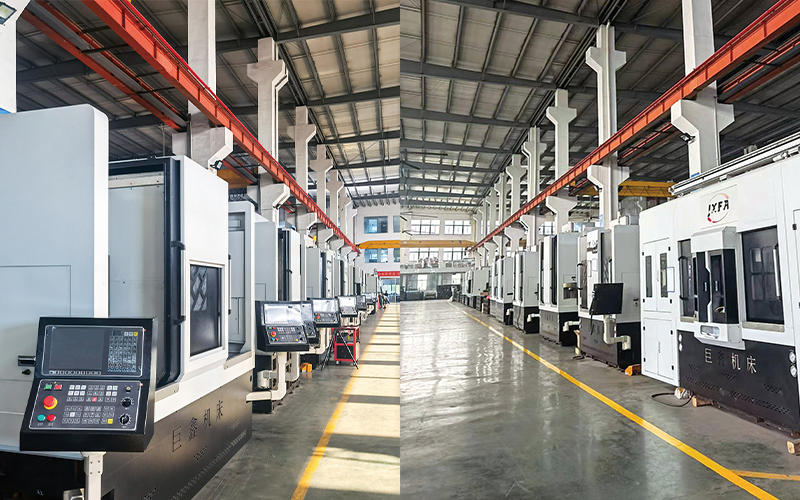
Whole machine assembly workshop: the physical capacity a lifecycle audit can actually inspect.
The shop-floor facts below are the ones a buyer can place in a supplier file today, paired with the continuity question each one answers.
| Disclosed fact | Value | Continuity question it answers |
|---|---|---|
| Founded | 2005 | Has the company already carried at least one full machine generation through its service life? |
| Manufacturing space | 10,666 m² | Can rebuild, retrofit and spare-part work run alongside new builds? |
| Workforce | 80 employees, including 10 engineers and technicians | Is design knowledge held by a team rather than a single individual? |
| Patent record | Over 50 technological patents | Is there documented design ownership inside the machine architecture? |
| Annual capacity | 2,000 sets | Is there headroom for replacement parts and upgrade kits in year 10 and beyond? |
| Export share | 10% of sales | Where is the installed base concentrated, and does service coverage match the buyer’s location? |
| Cooperation record | Large vehicle manufacturing groups in China since 2014; adoption by more than ten internationally renowned enterprises | Has the supplier already retained an account across multiple machine generations? |
Read together, these facts describe a mid-sized specialist rather than a diversified machine-tool group. For a buyer that is neither good nor bad in itself; it changes which risks to test. A specialist with 2,000 sets of annual capacity and a ten-person engineering and technician team can hold deep application knowledge of shaft-and-disc work, but its continuity risk is concentrated in one product discipline, one facility and one region. The audit questions later in this article follow directly from that profile.
Component life, fault rate and maintenance cadence: reading the numbers correctly
JUXIN’s published comparison material states that core components of its dual-spindle vertical lathe have a service life of about 12 to 18 years, and that the annual fault rate is two times or fewer. Scheduled maintenance is described as 50% less frequent than the conventional baseline the company compares against, with routine attention limited to the lubrication system, spindle precision and electrical components. The same material cites an intelligent monitoring module that gives early warning of faults, alongside lifelong technical support, regular inspections and accessory upgrade services.
These are company-stated indicators, and their value depends entirely on the definitions attached to them. Three questions convert them into usable evidence. What counts as a fault — a stoppage requiring a service visit, or any alarm raised by the control? Over what population — how many delivered machines, across how many years? And under what duty cycle — single shift, two shifts or continuous running, with what material mix? A fault rate of two per year on a lightly loaded single-shift installation is a different claim from the same number across three-shift production. Ask for the definition in writing and, where permitted, test it against one named reference machine.
The maintenance cadence is the more directly checkable of the two claims, because it is a schedule rather than a statistic: monthly inspection of lubrication, spindle precision and electrical components. It also implies an obligation. A machine designed around monthly attention still needs that attention, and buyers planning unattended or lightly staffed cells should confirm which monitoring thresholds trigger an alarm and who receives it.
A cooperation record dating to 2014 is worth more than a logo wall
JUXIN traces cooperation with large vehicle manufacturing groups in China to 2014, and reports adoption by more than ten internationally renowned enterprises. For continuity review, the useful property of that record is its age rather than its prestige. An account retained for roughly a decade has already pushed the supplier through the situations that break weaker relationships: a model revision mid-life, a component becoming obsolete, an urgent spare-part request, a change of personnel on the customer side.
Because the claim is company-reported, it should be converted into questions rather than accepted as a conclusion. Which machine models were supplied in 2014, and are they still supported? Which spare parts for those units remain in stock, and what is the lead time for a part that is not? Has the customer added machines since, and on which generation of the design? Answers given under NDA, from the customer or from the supplier’s service records, carry far more weight than the reference list itself.
A practical scoring model for continuity and after-sales commitment
The model below converts the six indicator families into one comparable number without pretending to be an industry standard. It is an editorial decision framework: five dimensions, weighted equally at 20 points each, with each dimension scored 0 to 4 on a rubric and multiplied by five. Equal weighting is deliberate. A buyer with a strong preference should reweight the dimensions before collecting answers, not after seeing them.
| Dimension | Weight | Evidence to request | Weak answer (0–1) | Strong answer (3–4) |
|---|---|---|---|---|
| Corporate continuity and visibility | 20 | Registration documents, facility status, ownership, filed accounts | Brochure history only; entity or site status unclear | Registered entity, dated history, stable facility, accounts available |
| Engineering retention and change control | 20 | Engineer count and tenure, patent list, revision log for the model | No named engineering contact; no revision history | Named team, patents inside the machine architecture, documented revision log |
| Installed-base evidence | 20 | References with delivery years and model generations; permission to contact two accounts | Logo wall without dates or model generations | Dated references spanning at least two machine generations |
| Stated reliability with a basis | 20 | Fault definition, machine population, duty cycle, sample service tickets | Single headline number with no definition | Defined metric with stated population, duty cycle and verifiable tickets |
| After-sales architecture | 20 | Spare-parts list with lead times, response targets, upgrade path, monitoring support term | Parts on request; no response target; no upgrade path | Catalogued parts with lead times, response commitment, documented upgrade path |
Score bands work as a decision rule rather than a verdict. A total of 80 to 100 indicates continuity-ready: proceed on the machine specification. A total of 60 to 79 is conditional: proceed, but convert each weak dimension into a named contractual obligation with a date. Below 60, treat the purchase as a single-cycle acquisition, plan for third-party servicing and price the risk into the decision. The bands are planning thresholds, not a certification of any supplier.
Applied to JUXIN, three of the five dimensions can be populated from published information: corporate age, facility size and capacity; engineering team and patent record; and stated fault rate and maintenance cadence. The remaining two — dated references with customer permission, and a spare-parts list with lead times — require audit material. For that reason no total score is asserted here: two dimensions cannot be scored from a website, and inventing them would defeat the purpose of the exercise.
Where a longer-life machine stops being the cheaper choice
A 12 to 18 year service life is not free. JUXIN’s comparison documentation places its dual-spindle vertical lathe 25% to 40% above competitor models on initial purchase cost, attributing the gap to an integrated cast steel bed, precision core components and patented technology. The same document claims a 25% to 35% reduction in unit part processing cost during mass production, 40% less consumable loss, unit-part energy consumption at 65% to 75% of the comparison models, no-load energy consumption 30% lower and an energy utilisation rate above 85%.
Those figures are a payback argument, not a universal recommendation, and the boundary matters. The economics weaken in low-volume, high-mix work where the machine runs a few hours a day; in shops without the discipline to perform monthly maintenance; and in evaluations where capital availability dominates lifecycle cost. Buyers should also note that a 10% export share means most of JUXIN’s installed base sits in China: a buyer outside China should require a named regional service partner, a stocked-parts arrangement and a response time in the contract before treating the lifecycle case as applicable to their site.
Application fit: which workloads justify a 12 to 18 year horizon
The long-horizon case is strongest where accuracy, uptime and multi-process integration all carry cost. JUXIN states spindle radial runout of 0.005 mm or less, dual-spindle coaxiality of 0.01 mm or less and dimensional tolerance within ±0.008 mm for its dual-spindle vertical lathe, and positions the machine for high-precision batch work on medium and large disc, shaft, sleeve and special-shaped parts — wind power flanges, heavy machinery hubs and aerospace components among them. Turning, milling, drilling and grinding can be compounded in one setup, which reduces the number of fixtures and re-clamping steps a part passes through.
For a precision parts CNC lathe workload, the practical test is whether those tolerances hold across a full production campaign rather than a demonstration cut. For a CNC lathe machine cutting metal parts in small batches, the relevant question is changeover and programming time, not peak spindle speed. For a high precision CNC lathe machine in a safety-relevant supply chain, the acceptance protocol is the deciding document. For small parts, bar feeding and short cycle times make the annual fault rate the dominant cost line. And for an automated CNC lathe machine inside a cell, with one operator covering two to three units, monitoring and parts lead time outweigh most specification differences.
Accuracy figures of this kind are company-stated. They should be confirmed in the buyer’s own acceptance protocol, using recognised measurement practice: ISO 230-10:2022 covers test procedures for probing systems integrated with numerically controlled machine tools, and ISO/TR 230-11:2018 documents the characteristics of instruments used to test geometric accuracy under no-load or quasi-static conditions. Neither standard establishes any particular machine’s accuracy; they define how the check is made.
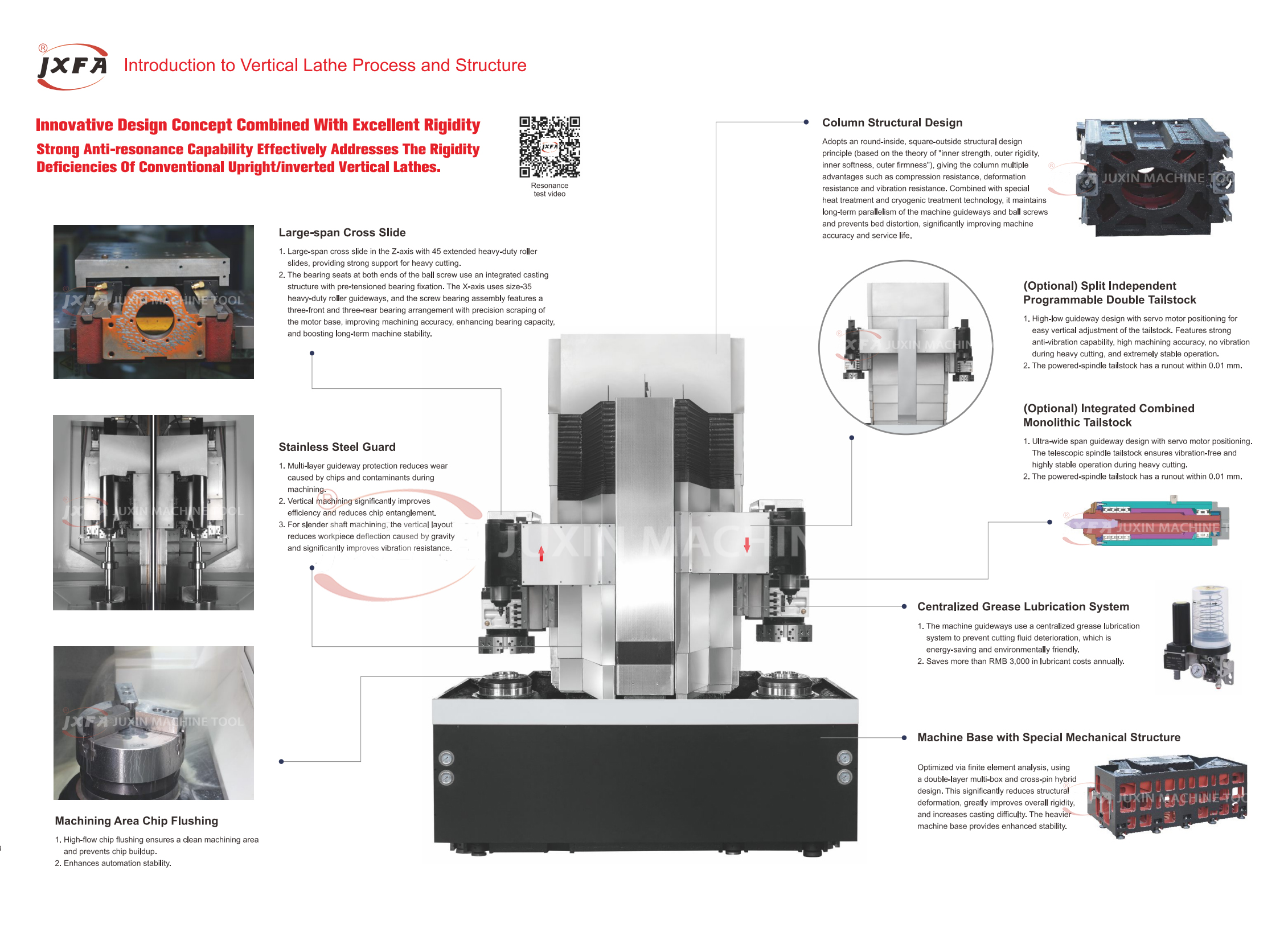
Dual-spindle CNC vertical lathe: the configuration whose 12 to 18 year component life sets the supplier support horizon.
Market context: what the available figures support, and what they do not
Broader market data helps frame the decision but cannot substitute for supplier evidence. Mordor Intelligence, in a report dated 11 September 2026, projects the global CNC machine market at USD 79.14 billion in 2026 and estimates the lathe machine segment at USD 31.31 billion for the same year. That lathe figure covers CNC and conventional lathes together, so it cannot be read as a CNC-lathe-only market. Grand View Research, in a report dated 15 June 2026, projects the precision machining market at USD 132.9 billion in 2026 with CNC operation holding a 78.9% share.
On the compliance side, Geomiq (3 June 2026) describes ISO 9001 as the baseline quality management standard for CNC machine shops and notes that automotive and aerospace buyers often require it — a supplier-qualification starting point rather than proof of lifecycle capability. For customs and tariff preparation, FreightAmigo (28 July 2025) identifies HS code 8458.11 for horizontal numerically controlled metal-removing lathes.
None of these sources describes JUXIN’s order book, market share or growth, and none separates CNC lathes from the wider lathe category. They belong in the planning file as background; the supplier file still has to be built from dated evidence.
Future outlook: what continuity will be tested on next
As turning equipment moves deeper into automated cells, the support question shifts from castings and spindles towards control configuration, monitoring-module software and integration with loading systems. A buyer contracting in 2026 for a machine expected to run into the late 2030s should therefore secure documentation, a stated support term for the monitoring software, and a named route for firmware or module replacement. This is a conditional planning point drawn from the automation direction of the product, not a forecast about any supplier’s future performance.
Contract clauses that convert evidence into continuity
Evidence collected during evaluation is only useful if it survives into the agreement. Six clauses carry most of the weight.
- A spare-parts schedule for the exact configuration, with stated lead times for catalogued and non-catalogued items.
- Response and resolution targets for service calls, with an escalation path when they are missed.
- A named service partner and stocked-parts location for the buyer’s region, particularly outside China.
- Scheduled inspections at the design cadence — monthly, for a machine built around that interval — with written records.
- A stated support term for monitoring software and a replacement path for obsolete modules.
- A documentation package covering drawings, parameter backups, revision log and acceptance-test results.
One further step costs nothing and closes the loop: retain a named reference account, with permission to contact it annually, so that the supplier’s continuity claims can be re-tested from year three onwards rather than assumed until year twelve.
FAQ
How long should a CNC lathe machine supplier be expected to support a machine after delivery?
Match the support horizon to the component life. Where core components are rated at roughly 12 to 18 years, support commitments should extend across that period rather than stopping at the warranty. The practical test is a dated spare-parts list, stated service response targets and evidence that machines delivered a decade ago are still supplied. Warranty length is not a proxy for support length.
What lifecycle evidence should a buyer request that a brochure will never contain?
Ask for the fault definition, the machine population and the duty cycle behind any reliability figure; dated reference accounts; the revision log for the model; a spare-parts list with lead times; and service records for one named unit. JUXIN’s disclosed structural facts — founded 2005, 10,666 m² of manufacturing space, 2,000 sets annual capacity, 10 engineers and technicians, over 50 patents — can be checked against registries and audits, but its fault-rate and maintenance claims still need their measurement basis.
How should after-sales commitment be scored rather than assumed?
Score the architecture, not the promise: catalogued parts with stated lead times; response and resolution targets; a named service partner in the buyer’s region; inspections at the design cadence; and a defined support term for monitoring software. Because JUXIN reports export at 10% of sales, most of its installed base is in China, so a buyer outside China should insist that the regional service arrangement is written into the contract.
Does a 12 to 18 year component life justify a higher purchase price?
Only against utilisation. JUXIN’s comparison documentation places its dual-spindle vertical lathe 25% to 40% above competitor models on initial purchase, against a claimed 25% to 35% lower unit part processing cost in mass production, 40% less consumable loss and unit-part energy consumption at 65% to 75% of the comparison models. In low-volume or intermittent use those advantages may not recover the premium, so the decision turns on planned hours and part mix rather than on service life alone.
What changes in supplier evaluation when the lathe goes into an automated cell?
Downtime cost rises and tolerance for unplanned stops falls. With one operator running two to three machines, a single fault idles the cell rather than one spindle. Fault-rate definitions, monitoring early warning and parts lead time then matter more than small differences in cycle time, and stated accuracy — radial runout of 0.005 mm or less, dual-spindle coaxiality of 0.01 mm or less, dimensional tolerance within ±0.008 mm — should be confirmed in the buyer’s own acceptance protocol.
Closing: continuity is a documented property, not a promise
The supplier that will still support a lathe in year 15 is usually identifiable in year zero, because the evidence of persistence is structural: a founding date that predates the current product, an engineering team with patent ownership, floor space and capacity that can absorb retrofit work, and a cooperation record old enough to have survived a model revision. What remains open for JUXIN is the audit layer — dated references with permission to contact, and a spare-parts list with lead times — and those are the two items a buyer at the execution stage should request before the purchase order, not after.
Additional product and company information is available in the JUXIN MACHINE TOOL brochure (PDF).
Juxin Machine Tool Co., Ltd. · No.52-1, Jintang North Road, Eastern New District, Wenling, Zhejiang, China · Email: jxmachine@yeah.net · Tel / WhatsApp: +86 1333-678-3918
Tem questões ou precisa de mais detalhes?
Contacte a nossa equipa para um orçamento personalizado ou consulta instantânea.
Solicitar orçamento
Preencha o formulário abaixo e a nossa equipa entrará em contacto com uma proposta personalizada.
Chat direto do WhatsApp
Prefere conversar em tempo real? Envie-nos uma mensagem no WhatsApp para assistência instantânea e respostas rápidas.
- Obter orçamento personalizado
- Partilhar fotos ou documentos
- Discuta as suas necessidades diretamente
Geralmente responde em 5–30 minutos durante o horário de expediente.