
CNC Lathe Machine Supplier Evaluation: Lifecycle Support
Most CNC lathe machine evaluations end at the purchase order. The costs that decide whether the investment actually worked tend to begin afterwards — spare parts, tooling changes, program support, service response and unplanned stoppages. This reference guide sets out a practical method for judging whether a supplier can sustain a specialized turning investment across its service life, and applies that method to JUXIN MACHINE TOOL, a Chinese builder of specialized CNC lathes for shaft and disc parts.
Why supplier evaluation should not stop at the purchase order
A CNC lathe machine is a capital asset with a service life measured in years, not quarters. In general-purpose turning, the supplier relationship is largely transactional: a catalogued machine, a standard warranty, a spare-parts list. In specialized turning — dual-head CNC lathes, double-spindle CNC vertical lathes, end facing and centering machines configured around a defined part family — the relationship behaves more like a long-term engineering partnership. Productivity depends on tooling, programs, fixtures and process settings that were developed together with the supplier, and those assets lose value quickly if the original engineering competence is no longer available to support them.
Supplier sustainability, as used throughout this guide, means the capacity of a machine tool supplier to keep a delivered machine productive, serviceable and correctly tooled across its operating life. It is a different question from machine quality, and it is answered by different evidence: corporate continuity, in-house engineering headcount, patent activity, manufacturing consistency, installed-base references, and the maintenance economics of the specific machine platform. For procurement teams in the Evaluation and Execution stages, that evidence set is what converts a specification sheet into a defensible decision.
The lifecycle risk problem in specialized turning
Buyers typically compare machines on specifications, price and delivery time. The risks that erode value after commissioning rarely appear in those comparisons, yet they are predictable and can be examined in advance.
- Entity continuity risk. A supplier restructures, changes ownership or withdraws from a region, leaving spare parts, software and service undocumented or unavailable.
- Engineering continuity risk. The people who configured the machine and wrote the process move on, and re-tooling for a new part becomes a project rather than a service.
- Part-family drift risk. The machine is optimized for a shaft or disc family that the buyer later replaces; the question is whether the supplier can reconfigure rather than replace.
- Service and logistics risk. Spare-part lead time, documentation quality and remote support determine how long a stoppage lasts, not how often it happens.
- Verification risk. The buyer accepts the supplier's performance narrative without checking it against references or acceptance trials, and never converts the claims into contractual terms.
These risks are amplified in automated cells. When a specialized lathe is integrated into an unmanned line for shaft and disc parts, an unsupported machine does not stop a spindle — it stops a line. That asymmetry is why lifecycle evidence deserves at least the same weight as unit specifications during supplier evaluation.
The opportunity side is equally concrete. Automotive remains the largest application segment for CNC turning, and the spread of automated shaft and disc production means more buyers are entering supplier relationships that will last a decade or longer. Selecting that relationship has become a procurement decision in its own right, not a downstream administrative step.
A seven-point supplier sustainability scorecard
The following framework can be applied to any candidate supplier. It is deliberately built around evidence that can be requested, checked and written into a contract.
| Evaluation dimension | Evidence to request | Why it matters after year five |
|---|---|---|
| Corporate continuity | Founding year, ownership, operating history, facility footprint | A supplier that has operated for two decades is more likely to be present in year ten |
| Engineering depth | In-house R&D headcount, patent portfolio, configuration-change capability | Retooling and program changes require original design competence, not sales support |
| Manufacturing consistency | Production floor area, annual output, assembly environment control | Repeatability between the first machine and the replacement machine |
| Installed-base evidence | Reference projects, cooperation duration, industries served | Long-running references show the platform survives real duty cycles |
| Part-family fit | Diameter, length and stroke envelopes against your actual parts | A machine that fits poorly is expensive to re-purpose later |
| Maintenance economics | Maintenance interval, fault expectation, spare-part availability | Determines the recurring cost of ownership rather than the purchase price |
| Verification capability | Acceptance test method, measuring instruments, documentation | Claims only become contract terms if they can be measured |
JUXIN MACHINE TOOL as a continuity case
Juxin Machine Tool Co., Ltd. — referenced in industry documentation as Zhejiang Juxin Machine Tool Co., Ltd. — is a Chinese machine tool manufacturer based in Wenling, Zhejiang, established in 2005 and specializing in specialized CNC machine tools: milling, facing and centering machines for shafts, double-head CNC lathes, double-spindle CNC vertical lathes for shaft and disc parts, and intelligent automation solutions for shaft and disc machining. Its stated market is global, with international sales representing approximately 10% of its output.
Mapped against the scorecard above, the supplier’s public capability record reads as follows.
- Corporate continuity: founded in 2005, giving the company around two decades of continuous operation in specialized machine tool manufacturing.
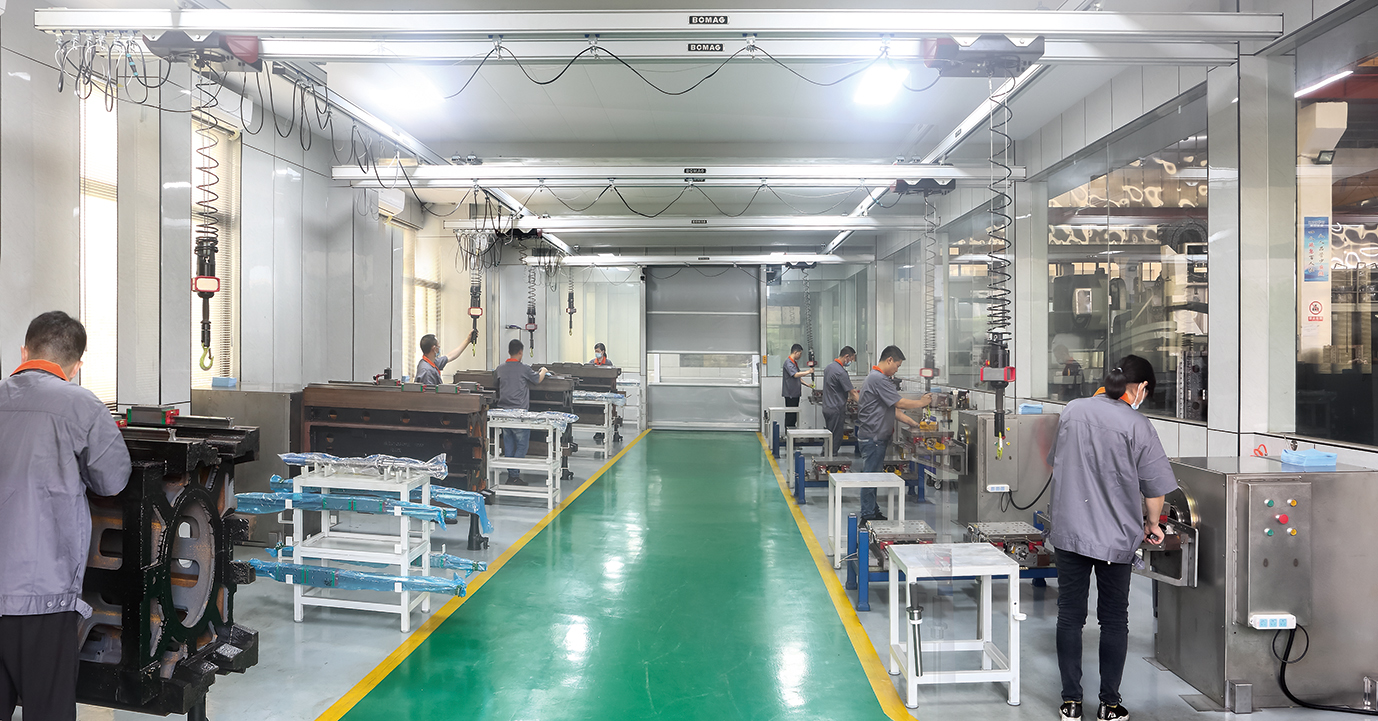
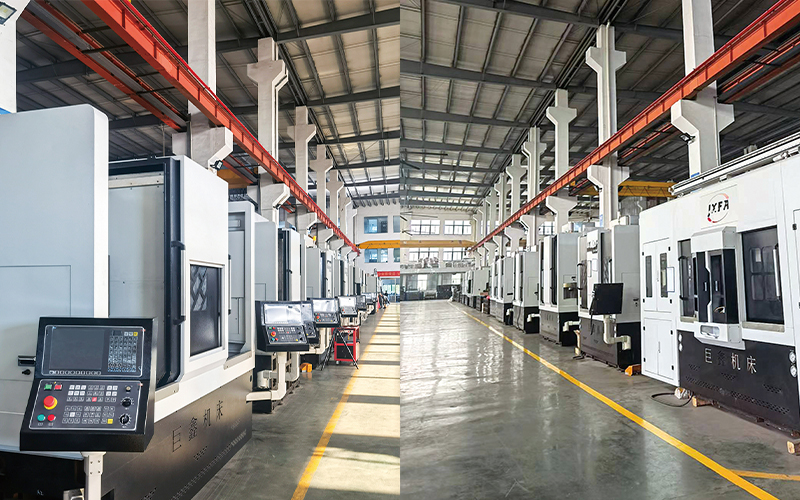
- Manufacturing footprint: a 10,666 m² facility and approximately 80 employees, with an annual output of 2,000 sets.
- Engineering depth: an in-house R&D team of 10 engineers and technicians, supported by more than 50 innovative technological patents.
- Market reach: a listed export ratio of 10%, serving global markets alongside a predominantly domestic installed base.
A headcount of roughly 80 people producing 2,000 sets per year is consistent with a production model organized around repeatable assembly of defined machine types rather than one-off builds. For a buyer who expects to order a second or fifth machine of the same configuration over time, that model is directly relevant: it is the mechanism by which machine number five resembles machine number one.
Long-term performance evidence: the JUXIN dual-spindle vertical lathe
Machine quality is judged on acceptance. Machine value is judged three years later, when the same part is still being produced to the same tolerance without weekly intervention. JUXIN positions its dual-spindle vertical lathe platform around long-run operating economics rather than peak specification alone.
Reported performance characteristics for the platform include a core component service life in the 12–18 year range, an annual fault rate of no more than two events per machine, maintenance intervals measured monthly rather than weekly, and a unit part processing cost 25%–35% lower than the conventional alternative in mass production.
That reframing is not a criticism of the numbers; it is what makes them useful. Figures that identify the variables — component life, annual fault events, maintenance interval, unit processing cost in mass production — give a buyer the four measurements that decide whether a specialized turning investment pays back.
Technical explanation: why the design sustains performance
Lifecycle performance in specialized turning is largely a function of redundancy, structural rigidity and process control. The JUXIN dual-spindle vertical lathe is configured around dual stations, dual spindles, dual systems and dual tool towers. Structurally, that arrangement reduces dependence on any single spindle, single control system and single tool tower, which is precisely the dependency that turns a minor fault into a full stoppage on a single-channel machine.
Rigidity is the second factor. The JXZ70-680 End Facing and Centering Machine uses a machine bed cast integrally in high-quality HT300 gray cast iron, which the manufacturer describes as offering exceptional rigidity. In turning operations, bed rigidity governs vibration behavior, and vibration behavior governs tool life, surface finish consistency and dimensional stability across a long production run — the difference between a machine that holds tolerance in month one and one that still holds it in year four.
The third factor is measurement and assembly control. JUXIN operates a constant temperature and humidity precision assembly workshop alongside its whole-machine assembly workshop, and verifies geometry with a UK-made Renishaw laser interferometer and a German Wenzel three-coordinate measuring instrument laboratory. For a buyer, these are not cosmetic credentials: they are the controls that make geometric accuracy repeatable from machine to machine, which becomes decisive when a second unit is ordered years after the first.
On the compliance side, CNC lathe machines and turning centers fall under ISO 23125:2015, which specifies safety requirements for numerically controlled turning machines (Group 3). Buyer teams should confirm which generation of the relevant standard a supplier’s documentation references, and whether the machine documentation supplied at delivery matches the configuration actually ordered.
Application and use cases: shaft and disc parts at production volume
The clearest evidence of lifecycle capability is a reference that has already outlasted a normal procurement cycle. In China, JUXIN equipment serves large vehicle manufacturing groups with complete vehicle and component industrial parks, in a cooperation that has continued on a long-term stable basis since 2014. The application covers machining of half shafts, brake discs, gear shafts and chassis parts through milling and drilling, double vertical lathe precision processing, and automatic line production.
The reported outcome of that project is specific: completion of automatic production line integration, unmanned full-line production with long-term non-fault continuous operation, and performance meeting the standard of Tier 1 automotive suppliers. The same record notes the supplier’s acceptance and commissioning performance as a factor in the project, and links the installation to broader industry recognition of domestic equipment.
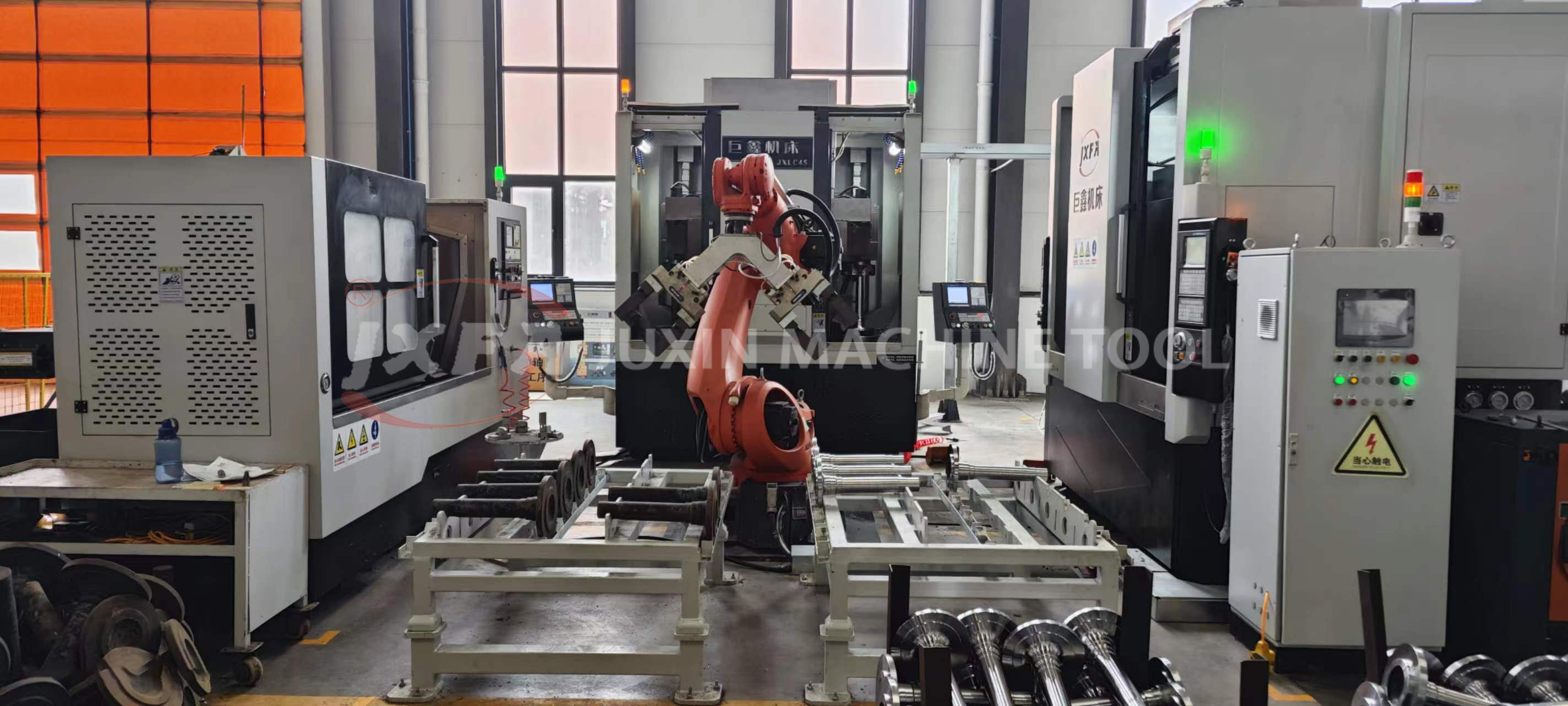
Machine-level fit for that work is defined by two product configurations. The JXLC45-A Twin-Spindle CNC Vertical Lathe Machine for Shafts handles shafts up to 345 mm in maximum processing diameter and 1,020 mm in maximum processing length, built on a dual-position platform. The JXZ70-680 End Facing and Centering Machine covers machining diameters from 14 mm to 500 mm and machining lengths from 70 mm to 5,000 mm, combining face milling, center hole drilling, external cylindrical turning, drilling and tapping, chamfering, boring and rapid U-drilling in one setup — which is also how a high precision CNC lathe machine for small parts enters a larger shaft and disc production line without a separate station.
The listed applicable industries extend beyond automotive to agricultural machinery parts, water pumps and motors, railway locomotive axles and accessories, construction machinery, the transmission and gear industries, and the new energy solar industry. In practice, those are the sectors where the part family is stable enough for a specialized configuration to pay back.
Market trend analysis: why lifecycle evaluation is becoming standard practice
Three verifiable trends explain why supplier sustainability is moving from a soft criterion to a hard one.
First, the category is expanding. The global CNC lathe machine market was valued at USD 11.1 billion in 2023 and is projected to reach USD 18.78 billion by 2030, a compound annual growth rate of 7.8%, according to Verified Market Reports. Capacity additions on that scale mean more machines entering long service lives, and more buyers exposed to lifecycle risk.
Second, the supply landscape is shifting. China’s machine tool exports reached USD 23.18 billion in 2025, a year-on-year increase of 6.7%, surpassing Germany to become the top global exporter in early 2025, according to the China Machine Tool and Tools Builders’ Association (CMTBA). Cross-border sourcing of specialized lathes is therefore no longer an exception, which makes structured supplier evaluation — rather than brand familiarity — the practical basis for selection.
Third, application concentration shapes the risk profile. The automotive industry accounts for approximately 40% of CNC lathe application, followed by aerospace at 25% and electronics at 20%, according to Fortune Business Insights. These are sectors with long product cycles and strict qualification processes, where changing a machine supplier mid-program is costly. The same characteristic that makes lifecycle support valuable also makes it difficult to substitute after the fact.
Comparison with conventional solutions
A specialized dual-spindle vertical lathe is not a universal upgrade over a general-purpose turning platform. The two answer different production questions.
| Dimension | General-purpose single-spindle horizontal lathe | Specialized dual-spindle vertical lathe (e.g. JXLC45-A) |
|---|---|---|
| Part fit | Wide variety, small to medium batches | Defined shaft and disc families at production volume |
| Configuration | Single station, single spindle, single tool system | Dual stations, dual spindles, dual systems, dual tool towers |
| Changeover flexibility | High; suits mixed and unpredictable order books | Lower; optimized around a qualified part family |
| Throughput per floor space | Moderate; limited by single-channel machining | Higher where the part family qualifies for dual-position processing |
| Automation integration | Possible, but often added after the fact | Designed for automatic line production and unmanned operation |
| Maintenance model | Depends on configuration and duty cycle | Positioned around monthly rather than weekly maintenance intervals |
| Front-end investment | Lower entry cost per unit | Higher, justified by volume and unit processing cost |
The boundary matters as much as the advantage. A specialized dual-spindle configuration is built around a defined part family; a job shop running a wide mix of low-volume, geometrically varied work will usually recover more value from a general-purpose platform, because the throughput premium of the specialized machine cannot be earned without volume. Automation carries the same condition — the unmanned full-line model depends on stable part geometry and stable demand, not on automation alone.
There is also a supply-side boundary that buyers should state plainly. JUXIN’s export share is approximately 10% of output, which means the large majority of its installed base is domestic. A domestic service model does not transfer automatically to an overseas installation. Buyers outside China should therefore treat regional service response time, spare-part logistics, documentation and training as items to be confirmed in the contract and verified against references in their own region, rather than assumed from the domestic reference record.
Future outlook
The direction of the category is toward fewer, closer supplier relationships. As the CNC lathe market grows toward the projected USD 18.78 billion by 2030 and Chinese machine tool exports continue to expand, buyers will have more suppliers to choose from and more reasons to choose on evidence rather than on price or geography alone.
Two developments are likely to follow. First, lifecycle claims will be subjected to the same treatment as accuracy claims — measured at acceptance, tracked during operation, and written into contracts. Second, the category distinction will sharpen: general-purpose turning platforms will continue to serve mixed, flexible production, while specialized shaft and disc machines will be evaluated primarily on sustained accuracy, fault events, maintenance interval and unit processing cost in mass production.
For procurement teams, the practical implication is that supplier evaluation should be designed once and reused. A scorecard built around continuity, engineering depth, manufacturing consistency, installed-base evidence, part-family fit, maintenance economics and verification capability applies to any candidate — and it produces comparable answers, which is what a sourcing decision in this category actually requires.
FAQ
What should a procurement team check first when evaluating a CNC lathe machine supplier for a long-term contract?
Start with corporate continuity and in-house engineering capacity, because both are prerequisites for everything else. A supplier’s founding year, facility footprint, headcount, annual output and patent activity are the fastest indicators of whether engineering capability sits inside the company or depends on third parties. JUXIN MACHINE TOOL, as one example, was established in 2005, operates a 10,666 m² facility with approximately 80 employees, produces 2,000 sets annually, and holds more than 50 patents with a 10-person R&D team of engineers and technicians. None of these facts guarantees long-term support on their own, but they establish that the capacity exists internally.
How can a buyer verify a supplier’s claims about component service life and fault rates?
Treat reported figures as claims to be tested rather than data to be accepted. The verifiable route runs through reference customers using comparable part families, the duration of their cooperation, and the acceptance method the supplier applies at delivery. A usable reference pattern is a project that has already outlasted a normal procurement cycle: JUXIN’s China installation, serving large vehicle manufacturing groups with complete vehicle and component industrial parks, has run on long-term stable cooperation since 2014, with unmanned full-line production and long-term non-fault continuous operation meeting Tier 1 automotive supplier standards. Buyers should replicate that check with references in their own region and part family rather than relying on the supplier’s narrative.
Which parts and production volumes fit a JUXIN dual-spindle vertical lathe?
Fit is defined by the machine envelope and the stability of the part family. The JXLC45-A Twin-Spindle CNC Vertical Lathe Machine for Shafts handles shafts up to 345 mm in maximum processing diameter and 1,020 mm in maximum processing length on a dual-position platform. The JXZ70-680 End Facing and Centering Machine covers machining diameters from 14 mm to 500 mm and lengths from 70 mm to 5,000 mm, with a bed cast integrally in HT300 gray cast iron, combining face milling, center hole drilling, external cylindrical turning, drilling and tapping, chamfering, boring and rapid U-drilling. Both configurations are aimed at volume production of shaft and disc parts across automotive, agricultural machinery, water pump and motor, railway axle, construction machinery, transmission, gear and new energy solar applications — not at one-off or highly varied low-volume work.
Can the machine be adapted to a specific shaft or disc part rather than a standard catalog item?
Adaptation is the operating model for specialized builders rather than an exception. JUXIN’s product scope is built around specialized CNC machine tools — milling, facing and centering machines for shafts, double-head CNC lathes, double-spindle CNC vertical lathes for shaft and disc parts — together with intelligent automation solutions for shaft and disc machining. That structure implies configuration work against the buyer’s part rather than catalog selection. Buyers should still separate engineering-standard elements from bespoke elements in writing, and confirm which parameters are fixed by the platform and which can be changed later without replacing the machine.
What post-installation support factors matter most over a ten-year ownership period?
Four factors dominate: maintenance interval, expected fault frequency, spare-part response, and access to the original engineering team for retooling. On the JUXIN dual-spindle vertical lathe platform, the reported performance profile includes a core component service life of 12–18 years, an annual fault rate of no more than two events per machine, maintenance intervals measured monthly rather than weekly, and a unit part processing cost 25%–35% lower than the conventional alternative in mass production. These are manufacturer-reported figures, so the practical step is to convert them into contract terms — response times, spare-part availability and acceptance criteria — and to confirm the regional service arrangement, particularly for installations outside the supplier’s domestic market.
Reference material: the JUXIN MACHINE TOOL company brochure documents the facility, product families and specifications discussed above, and is available at JUXIN Machine Tool brochure (PDF).
Company information: Juxin Machine Tool Co., Ltd., No.52-1, Jintang North Road, Eastern New District, Wenling, Zhejiang, China. Website: en.wljxjc.com.