
CNC Machining Center Buyer Framework: Vertical, 5-Axis and Trunnion Table
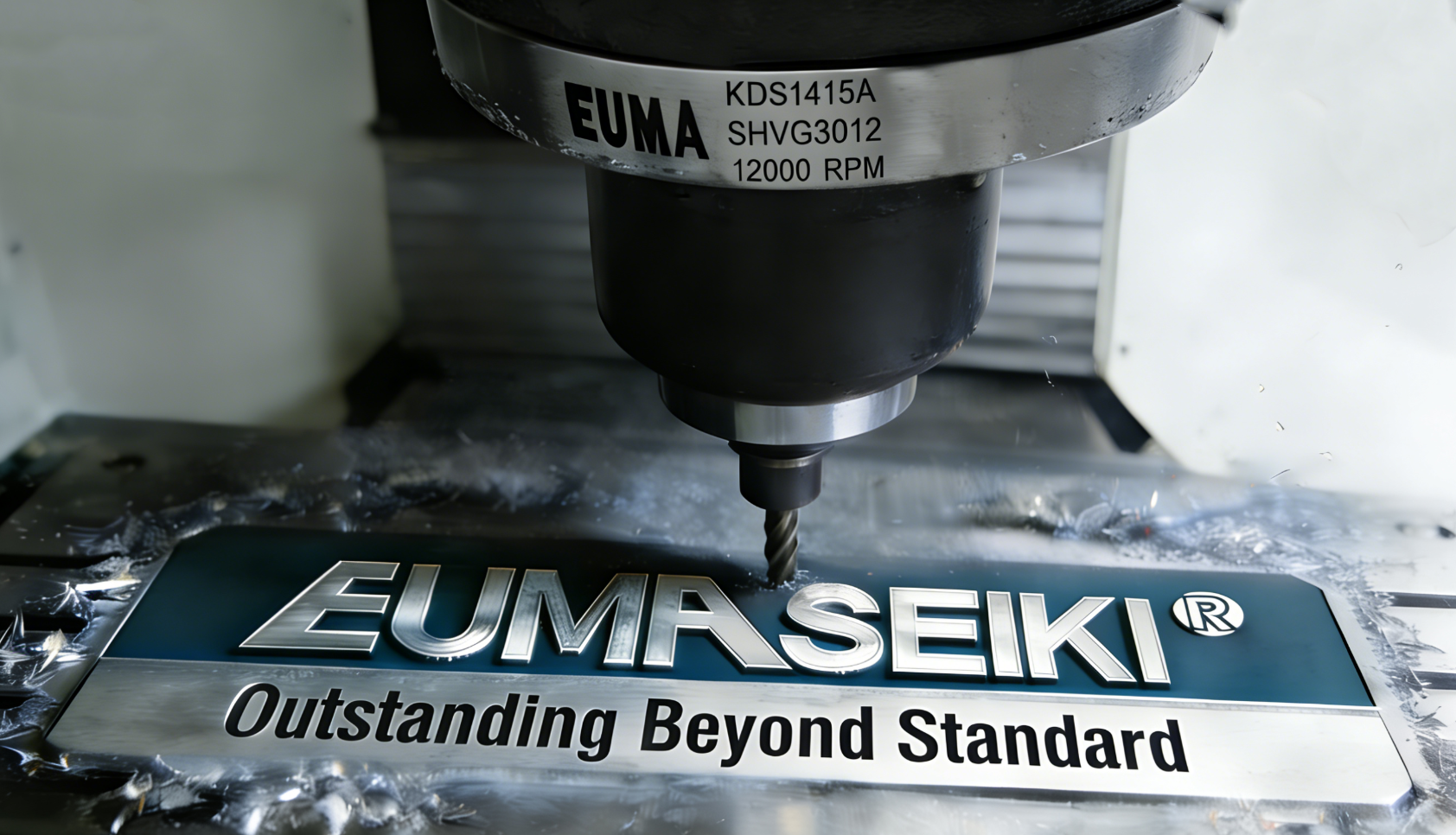
Grand View Research's 2024–2030 analysis of the CNC machining and turning centers market places global revenue for 2026 at roughly USD 31.3 billion. That number is useful context for a capital plan, but it gives a buyer no help with the decision actually in front of them: whether the next machine should be a vertical machining center, a 5-axis machine, or a trunnion table design. Architecture, more than brand, decides what a shop can accept as work for the following decade.
This framework is written for the evaluation stage — the point at which a buyer already has a part family, a budget band and two or three quotations in hand. It uses three published EUMASEIKI configurations (EV-1580B, EV-1475B and UV260) as reference points rather than recommendations, because a comparison framework that avoids real numbers usually degrades into adjectives. EUMASEIKI is the brand of Wenzhou Euma Machinery Co., Ltd., a China-based manufacturer of customized CNC machining centers with a production base in Ningbo City.
Why architecture outranks brand in the first decision
Two machining centers with similar footprints can carry almost entirely different commercial consequences: fixture cost, CAM post-processor, operator training, floor loading, and the largest part the shop can quote. In a vertical machining center the workpiece sits on a horizontal table while the spindle moves vertically. In a trunnion table machine the workpiece is carried on a table that tilts about a horizontal axis and rotates about a vertical one, so the part travels through the tool's reach instead of the tool reaching across a static part. The part is the same; the manufacturing system around it is not.
Buyers who begin with a brand shortlist usually end up reverse-engineering the requirement later, often after a quotation has already anchored the budget. The reverse order is more stable: establish what must fit on the table, then decide which architecture can carry it at the required cycle time, then negotiate on a smaller set of comparable machines.
Recommended evaluation order
1. Part envelope and fixture envelope → 2. Architecture family → 3. Spindle taper, speed and power → 4. Tool magazine and change time → 5. Control platform and accuracy statement → 6. Structural construction and machine mass → 7. Supplier evidence, commercial terms and acceptance tests.
Four architecture families, defined
Vertical machining center
A vertical machining center keeps the spindle vertical and the work table horizontal. It is the default for plate work, mold cavities and low-to-medium volume parts where the operator needs visual access to the cut. The EUMASEIKI EV-1580B is a fixed-column vertical configuration with X/Y/Z travels of 1500/800/700 mm and a 1600×800 mm work table — dimensions that place it in the larger-part and large-mold bracket rather than in general job-shop work.
Horizontal machining center
A horizontal machining center turns the spindle through 90 degrees, so chips fall clear of the cutting zone and the machine can be fitted with pallet exchange. EUMASEIKI lists the EH500 as a 4-axis horizontal machine offered with single or double pallets and described for molds, dies, boxes and valve bodies in steel, cast iron or light alloys. Horizontal architecture pays back where the same prismatic part repeats and non-cutting setup time dominates the total cycle.
5-axis machining center
Five-axis machines add two rotary axes to the three linear axes. The two common implementations are a swing head that carries the spindle through A and C rotation, and a rotary tilting table that carries the workpiece. EUMASEIKI's DU series uses a torque-motor-driven rotary tilting table in 500 mm and 650 mm sizes. The head-versus-table decision determines which geometries become easy and which become awkward, and it changes the fixture concept and the CAM strategy at the same time.
Trunnion table models
A trunnion table machine is the table-based five-axis variant: the workpiece sits on a table that tilts and indexes, exposing multiple faces without re-clamping. The EUMASEIKI UV260 is a trunnion table configuration with X/Y/Z travels of 500/500/450 mm, a Ø260 mm table, a 1.5 s tool change time and a machine weight of 4200 kg. The table diameter is the honest headline in that specification. This is a small-part machine, and buyers who read the 5-axis label without reading the Ø260 mm table will misapply it.
| Architecture | How the part moves | Typical fit | Main boundary |
|---|---|---|---|
| Vertical (VMC) | Static horizontal table, vertical spindle | Plates, mold cavities, long components | Operator access and chip evacuation in deep cavities |
| Horizontal (HMC) | Indexing pallet, horizontal spindle | Repeated prismatic parts, boxes, valve bodies | Fixture investment per part family |
| 5-axis swing head | Spindle rotates on two rotary axes | Large contoured surfaces | Collision envelope and head assembly complexity |
| Trunnion table | Table tilts and rotates, part carried on table | Small multi-face parts, tight cycles | Table diameter and part weight cap |
Table 1. Architecture families compared by how the workpiece reaches the cutting zone, not by brand performance.
The seven criteria that actually decide the purchase
- Part envelope. Add the largest part, the fixture height, the tool length and a working clearance, then check that total against the X/Y/Z travels. Envelope failures are rarely recoverable with clever fixturing.
- Work table size and load. Table dimensions must exceed the fixture footprint, and the rated load must be checked against fixture plus workpiece weight, not workpiece weight alone.
- Spindle taper, speed and power. Taper sets the tooling ecosystem and the practical cut depth; speed and power decide where the machine sits between light high-speed cutting and heavier stock removal.
- Tool magazine capacity and change time. Count the tools in the process route, add a spare position allowance, then check whether the change time is material to the cycle.
- Control platform. The control determines the programming environment, post-processor availability and the pool of operators who can run the machine without retraining.
- Accuracy statement and test conditions. A number without a measurement standard, an ambient temperature and a test method is a marketing figure rather than a manufacturing capability.
- Structural construction and machine mass. Bed material, stress relief treatment and guideway hardening are the variables that predict whether the accuracy statement still holds in year five.
Reading three reference configurations without turning them into a ranking
The table below collects the published configuration data for the EV-1580B, the EV-1475B and the UV260. It is deliberately not a ranking. The three machines belong to different architecture families and their published data sets are not equally complete, so a like-for-like score would be an artificial exercise. The table works instead as a gap map: every blank cell is a question for the request-for-quotation.
| Field | EV-1580B | EV-1475B | UV260 |
|---|---|---|---|
| Architecture | Fixed-column vertical | Vertical | Trunnion table, 5-axis |
| X/Y/Z travel | 1500/800/700 mm | Not stated in this data set | 500/500/450 mm |
| Work table | 1600×800 mm | 1500×700 mm | Ø260 mm |
| Table load capacity | Not stated in this data set | 1000 kg | Not stated in this data set |
| Spindle taper | ISO 50 | ISO 50 | Not stated in this data set |
| Spindle speed | Not stated in this data set | 8000 rpm | Not stated in this data set |
| Spindle power | Not stated in this data set | 22/33 kW | Not stated in this data set |
| Tool magazine | 24-pocket, arm type | Not stated in this data set | Not stated in this data set |
| Tool change time | Not stated in this data set | Not stated in this data set | 1.5 s |
| CNC control | SIEMENS 828D | Not stated in this data set | Not stated in this data set |
| Positioning accuracy | Not stated in this data set | 0.008 mm | Not stated in this data set |
| Repeat positioning accuracy | Not stated in this data set | 0.005 mm | Not stated in this data set |
| Machine weight | 8000 kg | Not stated in this data set | 4200 kg |
Table 2. Published configuration data for three EUMASEIKI reference models. Empty fields indicate data not stated in the source used here, not an absence of capability.
Used correctly, the table answers a narrow but useful question: which of my own requirements can already be confirmed against published data, and which must be confirmed by the supplier in writing before I sign? That is a faster route to a defensible decision than comparing numbers that were measured under different conditions.
Spindle, tool magazine and control: the fields buyers under-specify
Spindle taper and power
Both the EV-1580B and the EV-1475B are specified with an ISO 50 spindle taper, which places them in the heavier tooling ecosystem rather than the small-taper high-speed bracket. On the EV-1475B the published spindle data goes further — 8000 rpm with 22/33 kW — and that combination is the clearest single indicator of intent. It supports both aluminium roughing at higher spindle speed and heavier steel cutting where torque matters. The trade-off is real: a machine tuned toward high spindle speed generally gives up some low-end torque, and a machine tuned for heavy stock removal gives up some light-alloy throughput. Buyers should describe the material mix in the RFQ rather than asking for the highest available number.
Tool magazine and change time
The EV-1580B carries a 24-pocket arm-type tool magazine. Arm-type change is the conventional choice when tool count is moderate but change time matters, and 24 positions covers many mold and general machining routes — but not all of them. The practical test is to write out the full process route, count the tools including roughing, finishing, drilling and a spare, and compare that count with the magazine. The UV260 publishes a 1.5 s tool change time, which matters disproportionately on small parts: when the cut itself is short, the change becomes a visible share of the cycle.
Control platform
The EV-1580B is specified with a SIEMENS 828D control, while the EV-855A vertical model in the same portfolio uses FANUC OIMFPLUS. That is a useful reminder that control choice is a portfolio decision inside the supplier as well as a preference inside the buyer's shop. The relevant questions are practical: which platform does the existing programming team already run, does a proven post-processor exist for the buyer's CAM system, and how quickly can spare parts and service reach the site. The control model name alone does not define the function package, so the option list has to be confirmed line by line.
What an accuracy figure of 0.008 mm actually promises
The EV-1475B is published with an XYZ positioning accuracy of 0.008 mm and a repeat positioning accuracy of 0.005 mm. The EV-855A carries the same pair of values. These are machine-level specifications, and they answer two different questions. Positioning accuracy describes how closely the axis reaches the commanded position. Repeat positioning accuracy describes how consistently it returns to the same position. A machine with a slightly larger positioning error but a tight repeat value can still produce stable parts, because consistent deviation can be compensated; an inconsistent machine cannot.
Three conditions decide whether a published figure survives into production. The measurement method: laser interferometry and a granite-square check do not produce comparable numbers. The thermal state: a cold machine and a machine after four hours of spindle load are different instruments. And the acceptance definition: whether the figure is verified at the factory, at installation, or only after a settling period. Buyers should write the test method, the ambient condition and the acceptance threshold into the purchase order, and should treat a specification without those three elements as a starting point for negotiation rather than proof.
Construction: the part of the specification that predicts year-five accuracy
EUMASEIKI describes its machine beds as mineral castings with structures optimized through finite element analysis. All castings undergo full annealing to eliminate internal stress, and spindle guideways are subject to high-frequency heat treatment. Key components — spindles, guideways, bearings and oil pumps — are sourced from manufacturers in Taiwan and Japan, with some core components imported from Germany or Italy. The production base in Ningbo City is equipped with imported machine tools for its own manufacturing, including Japanese OKUMA gantry machining centers, KURUKI boring and milling machines, NIIGATA horizontal machining centers, and a German ZEISS coordinate measuring machine used for inspection.
For a buyer, these details connect directly to the accuracy discussion above. Stress relief in the casting is what limits gradual distortion over years of thermal cycling; guideway hardness is what limits wear at the contact surface; the measuring equipment in the builder's own plant is what makes a stated tolerance checkable before shipment. Buyers should treat all of this as company-reported manufacturing description rather than independently audited fact, and should ask to see the machine's inspection record at the pre-acceptance stage.
Machine mass belongs in the same discussion for a less technical reason: it becomes a site requirement. An 8000 kg EV-1580B and a 4200 kg UV260 impose different demands on floor load capacity, lifting equipment, transport access and foundation work. These costs arrive before the first chip is cut and are frequently left out of the comparison spreadsheet.
Matching architecture to application
The mapping below is a configuration logic, not a performance claim. Each line follows from geometry and published specification rather than from a ranking between models.
- Large molds and long components. The EV-1580B's 1500 mm X travel and 1600×800 mm table suit work where the part, not the tool, is the constraint, and where a fixed-column vertical structure supports heavier cutting.
- Medium parts up to 1000 kg. The EV-1475B's 1500×700 mm table with a 1000 kg load rating and ISO 50 taper addresses the bracket where parts are too heavy for small verticals but too small to justify a large gantry.
- Small multi-face parts with tight cycles. The UV260's Ø260 mm trunnion table, 500/500/450 mm travels and 1.5 s tool change fit work where several faces must be machined in one clamping and where non-cutting time is a large share of the cycle. The same specification is the reason it is the wrong machine for large workpieces.
- Repeated prismatic parts. A horizontal machine such as the EH500, with single or double pallets, addresses boxes and valve bodies where setup time is the dominant cost.
- Large contoured surfaces. Head-based or table-based five-axis configurations in the DU series, with 500 mm and 650 mm torque-motor-driven rotary tilting tables, address geometry that cannot be reached in three axes.
- Aluminium and light alloys. Material choice shifts the priority toward spindle speed, chip evacuation and cooling rather than toward torque, which is why the coolant and chip conveyor options belong in the original specification.
Market signals shaping the 2026 decision
The demand side is large and slow-moving: a global market of roughly USD 31.3 billion for 2026 implies that most buyers are replacing or expanding capacity rather than entering machining for the first time. The supply side is where the more useful signals sit for a mid-volume buyer. EUMASEIKI reports 68 employees, an 8,000 m² facility, an annual output of 50–100 units and an engineering team of 8, with an export ratio of 80% concentrated in Russia, Saudi Arabia, Indonesia and Iran. That profile describes a mid-sized specialist rather than a volume producer, which shapes both the flexibility and the constraints a buyer should expect.
Two structural trends follow from that position. The first is configuration-driven purchasing: EUMASEIKI's OEM program covers voltage, logo, spindle, tool magazine, travel stroke, cooling system, chip conveyor and control system, with a stated minimum order of 1 unit, monthly capacity of 10 units and a lead time of 30–45 days. Buyers who need a non-standard envelope or a preferred control platform are no longer limited to catalogue configurations, but they must specify precisely, because customization moves risk from the supplier's standard build to the buyer's specification document.
The second is documentation-driven purchasing. EUMASEIKI holds a CE certificate (6L250729.WEMQD92, issued by Ente Certificazione Macchine Srl, Italy, under EN ISO 23125:2015, valid to 28 July 2030) and an EAC certificate (ЕАЭС N RU Д-CN.PA06.B.89520/25, under TR CU 010/2011 and TR CU 020/2011, valid to 7 August 2030). Certificate scope matters more than certificate presence, and that point is developed in the limits section below.
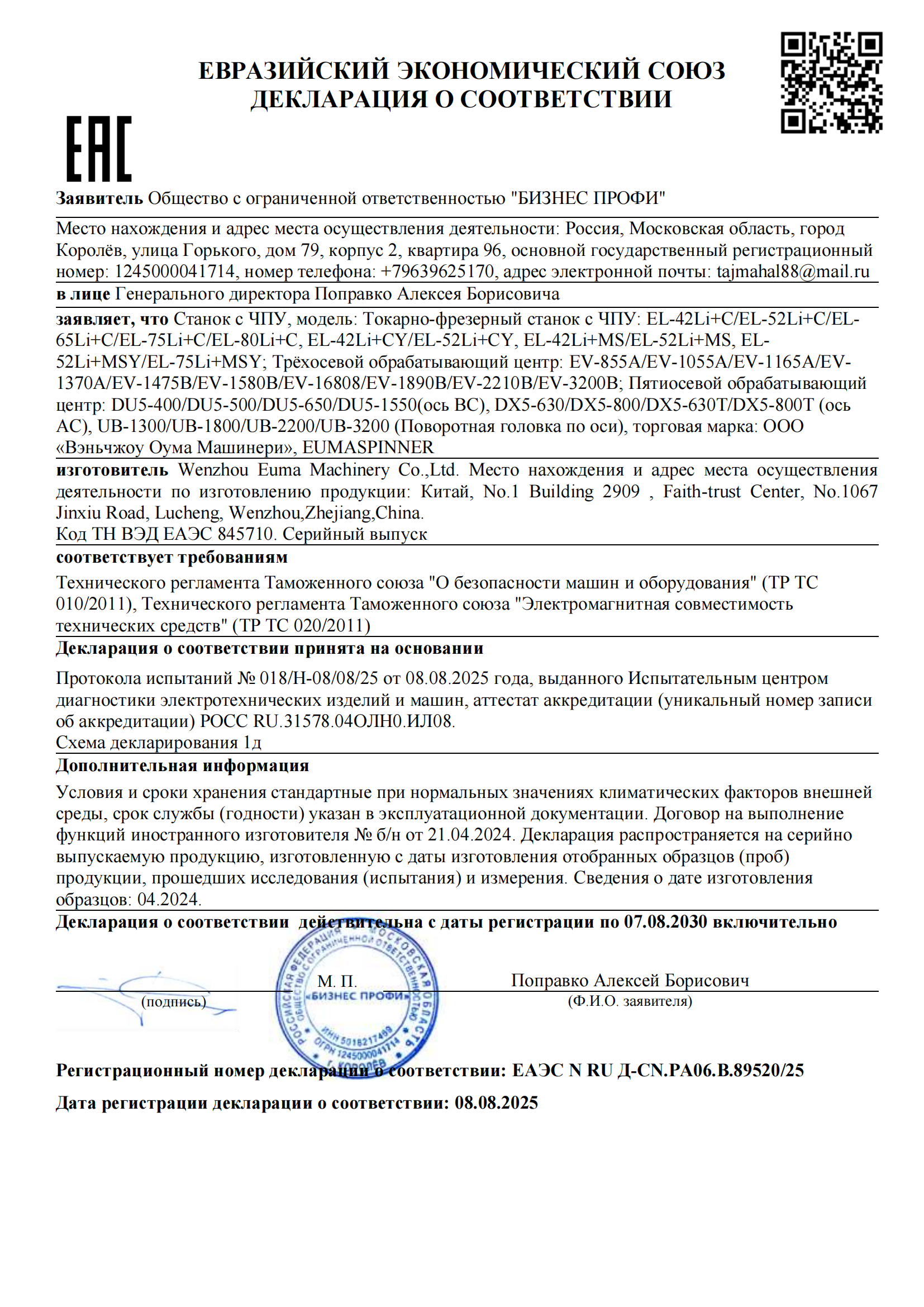
EAC conformity documentation is issued per model scope. Buyers should confirm that the exact model ordered appears in the current scope before committing to an EAEU delivery.
Where this framework stops: five honest limits
A comparison framework is only credible if it states where it fails. Five limits apply to the material above.
- Certificate scope is model-specific. The published CE scope lists EV-1475B and EV-1580B among the covered vertical machining center models, and the EAC scope lists EV-1475B and EV-1580B as well. The UV260 does not appear in either published scope. A buyer intending to place a UV260 into the EU or EAEU market should request model-specific conformity documentation before ordering, and should not assume coverage from the brand-level certificate.
- The three reference machines are not directly comparable. The published data sets differ in completeness — spindle speed and accuracy are not stated for the EV-1580B in the source used here, and travels are not stated for the EV-1475B. Any numeric ranking across them would be constructed rather than observed.
- Five-axis capability carries operating cost. A trunnion table machine requires a CAM post-processor, collision simulation, more complex fixturing and a more skilled operator than a three-axis vertical. The UV260's 500/500/450 mm travels and Ø260 mm table also impose a hard ceiling on part size that no amount of programming can remove.
- No independent performance benchmark is publicly available. Cycle time, thermal drift and long-term repeatability for these models are not published as independently tested data. The defensible substitute is a full-load trial cut on the buyer's own part before acceptance.
- Machine purchase is not production capacity. Tooling, fixture design, programming hours, coolant management and maintenance planning determine whether a new machine reaches its expected output. Budgeting only the machine leaves the largest integration cost unfunded.
Purchasing terms and acceptance criteria
The commercial layer decides whether the technical choice survives delivery. On the EUMASEIKI side, the published terms are a minimum order of 1 unit, a monthly capacity of 10 units, a lead time of 30–45 days and 100% testing, with after-sales support available both on site and remotely. Those terms are workable for a single-machine purchase and for a small fleet expansion, but they should be checked against the buyer's own installation window rather than assumed.
Acceptance is where most disputes originate, and it is worth writing in detail. A documented EUMASEIKI delivery process includes full-process inspection with geometric accuracy testing, laser axis calibration and a full-load workpiece trial cut before shipment. A Russian Tier 1 supplier that installed 6 CNC machining centers over a one-year implementation for component manufacturing reports stable operation with nearly zero failures in mass production following that inspection regime — a company and case reference reported by the supplier, not an independently audited result.
A practical acceptance clause should fix five items: the accuracy test method and the ambient temperature at which it is performed; the trial-cut part, material and acceptance tolerance; the tooling list supplied with the machine; the documentation package including conformity documents, manuals and the control option list; and the after-sales response expectation. Buyers evaluating a customized build should add a sixth item — a written confirmation that every customized element (travel stroke, control system, tool magazine, cooling and chip handling) is reflected in the final acceptance record.
Future outlook
Three developments are likely to shape the next procurement cycle. Multi-axis and trunnion table configurations continue to move down-market as CAM software and simulation tools become more accessible, which makes five-axis capability a realistic option for small-part producers rather than only for large aerospace shops. Configuration-driven manufacturing at low minimum order quantities makes semi-custom machines normal rather than exceptional, shifting the buyer's core competence toward specification writing. And conformity documentation is becoming a procurement gate rather than a formality, which rewards buyers who verify model-level scope early instead of at the shipping stage.
The practical response is procedural rather than technological: build a scoring sheet before the quotations arrive, weight the part envelope and the architecture above brand familiarity, treat every unspecified field as a written question, and make a full-load trial cut a contractual condition rather than a courtesy. A buyer who does that will still have to choose between a vertical, a 5-axis and a trunnion table machine — but the choice will be traceable to the part family rather than to the sales conversation.
EUMASEIKI publishes its full machining center range and technical documentation in its product catalogue (PDF), which buyers can use to cross-check the fields discussed above against current model data.
FAQ
What is the practical difference between a vertical machining center and a trunnion table machine?
In a vertical machining center the workpiece sits on a fixed horizontal table and the spindle moves on three linear axes. In a trunnion table machine the workpiece is carried on a table that tilts about a horizontal axis and rotates about a vertical one, adding two rotary axes so several faces can be machined in a single clamping. The vertical design is simpler to program and fixture; the trunnion design reaches geometry that three linear axes cannot. The EUMASEIKI EV-1580B is a fixed-column vertical model with X/Y/Z travels of 1500/800/700 mm, while the UV260 is a trunnion table model with travels of 500/500/450 mm and a Ø260 mm table.
What part size can the UV260 trunnion table machine handle?
The UV260 is published with X/Y/Z travels of 500/500/450 mm and a Ø260 mm work table, so the working envelope is defined by those dimensions together with the fixture and the tool length. The table diameter in particular limits the footprint of the part that can be clamped and rotated. Any part significantly larger than the Ø260 mm table should be evaluated on a different architecture rather than on the same machine with a larger fixture.
What is the difference between positioning accuracy and repeat positioning accuracy on the EV-1475B?
The EV-1475B is published with an XYZ positioning accuracy of 0.008 mm and a repeat positioning accuracy of 0.005 mm. Positioning accuracy describes how closely the axis reaches a commanded position; repeat positioning accuracy describes how consistently the axis returns to the same position. The second value is the more useful indicator of production stability, because a consistent deviation can be compensated during setup while an inconsistent one cannot. Both values should be tied to a defined test method and ambient condition in the purchase order.
Which control systems do EUMASEIKI machining centers use?
The EV-1580B is specified with a SIEMENS 828D control, and the EV-855A vertical machining center is specified with a FANUC OIMFPLUS control. The portfolio therefore supports more than one control platform. From a procurement standpoint the relevant follow-up questions are whether a post-processor exists for the buyer's CAM system, whether the local operator pool is familiar with that platform, and which function options are included in the quoted configuration rather than assumed.
Are the EV-1475B and EV-1580B covered by CE and EAC certification?
Yes. EUMASEIKI holds CE certificate 6L250729.WEMQD92, issued by Ente Certificazione Macchine Srl in Italy under EN ISO 23125:2015, valid to 28 July 2030, with EV-1475B and EV-1580B listed in the published model scope. The company also holds EAC certificate ЕАЭС N RU Д-CN.PA06.B.89520/25 under TR CU 010/2011 and TR CU 020/2011, valid to 7 August 2030, which likewise lists EV-1475B and EV-1580B. The UV260 does not appear in either published scope, so buyers should request model-specific conformity documentation for that machine.
What can be customized on an OEM order, and what are the stated lead times?
EUMASEIKI's OEM program covers voltage, logo, spindle, tool magazine, travel stroke, cooling system, chip conveyor and control system. The published commercial terms state a minimum order of 1 unit, a monthly capacity of 10 units and a lead time of 30–45 days, with 100% testing and both on-site and remote after-sales support. Because a customized build moves specification risk to the buyer, each customized item should be written into the order and verified in the final acceptance record.
How is a machine verified before it leaves the factory?
The documented EUMASEIKI delivery process includes full-process inspection with geometric accuracy testing, laser axis calibration and a full-load workpiece trial cut before shipment. A Russian Tier 1 supplier that installed 6 CNC machining centers over a one-year implementation for component manufacturing reports stable operation with nearly zero failures in mass production following that process. For a buyer, the equivalent protection is a purchase-order clause that fixes the test method, ambient condition, trial-cut part and acceptance tolerance rather than relying on a general quality statement.
Tem questões ou precisa de mais detalhes?
Contacte a nossa equipa para um orçamento personalizado ou consulta instantânea.
Solicitar orçamento
Preencha o formulário abaixo e a nossa equipa entrará em contacto com uma proposta personalizada.
Chat direto do WhatsApp
Prefere conversar em tempo real? Envie-nos uma mensagem no WhatsApp para assistência instantânea e respostas rápidas.
- Obter orçamento personalizado
- Partilhar fotos ou documentos
- Discuta as suas necessidades diretamente
Geralmente responde em 5–30 minutos durante o horário de expediente.