
CNC Machining Center Shortlist: EV-1580B, EV-1475B, UV260
CNC Machining Center Shortlist: EV-1580B, EV-1475B, UV260
This shortlist examines three models from EUMASEIKI, each aimed at a different point on that selection axis. EUMASEIKI is the brand of Wenzhou EUMA Machinery Co., Ltd., a high-tech enterprise integrating industry and trade, established in 2023, specialising in the customisation of CNC machining centers, with its production base located in Ningbo City, China. The three candidates are the EV-1580B fixed-column vertical machining center, the EV-1475B vertical machining center, and the UV260 trunnion table machining center.
None of the three is a general-purpose answer to every job. Each one is defensible for a defined range of work, and the value of a shortlist is that it makes those ranges explicit before a purchase order is raised.
Why Smart Manufacturing Shortlists Start With Part Geometry
Smart manufacturing is often discussed in terms of connectivity, data capture and automation. Those layers matter, but they sit on top of a mechanical reality: if a part does not fit inside the machine's travel envelope, or its fixture exceeds the table load, no amount of digital integration makes the cell work. Likewise, if the accuracy class of the machine is below the tolerance band of the part, the cell produces scrap faster than it produces output.
The practical sequence for a buyer is therefore mechanical before digital:
- Envelope: compare the largest part plus fixture against X, Y and Z travel.
- Load: compare workpiece plus fixture mass against the maximum table load.
- Spindle: match taper, speed and torque to the material and the tooling strategy.
- Accuracy and repeatability: confirm the stated figures, the standard used to measure them, and the conditions.
- Non-cutting time: tool change, chip removal and coolant handling decide whether a cell runs continuously or stalls.
The application profile documented for EUMASEIKI machining centers assumes indoor normal temperature and humidity, a 24/7 operating mode, and matched peripheral equipment including a chip conveyor, coolant system, tool magazine and oil mist collector, with spindle collision protection and long-term stability listed as specific requirements. That profile is a useful filter: any candidate machine that cannot be specified with those peripherals is not a serious candidate for continuous production.
The Shortlist at a Glance
The table below lists the published specifications of the three models on the criteria that most often eliminate a candidate: envelope, table load, spindle configuration, tool change and positioning accuracy. All values are the manufacturer's published parameters for these specific models.
| Criteria | EV-1580B | EV-1475B | UV260 |
|---|---|---|---|
| Machine type | CNC vertical machining center, fixed column | CNC vertical machining center | CNC trunnion table machining center |
| X / Y / Z travel | 1500 / 800 / 700 mm | 1400 / 750 / 750 mm | 500 / 500 / 450 mm |
| Work table | 1600 x 800 mm | 1500 x 700 mm | ⌀260 mm rotary table |
| Max. table load | 1200 kg | 1000 kg | 60 kg |
| Spindle taper / speed | ISO 50, 8000 rpm, belt drive | ISO 50, 8000 rpm, belt drive | ISO 40, 12000 rpm |
| Main motor power | 22 / 33 kW (S1 / S6 25%) | 22 / 33 kW (S1 / S6 25%) | 11 / 20 kW (S1 / S6 40%) |
| Tool magazine | 24 pockets, BT50, arm type | 24 pockets, BT50, arm type | 24 pockets, BT40, arm type |
| Tool change (tool to tool) | 3 sec | 3 sec | 1.5 sec |
| Positioning accuracy (XYZ) | 0.009 mm | 0.008 mm | 0.007 mm |
| Repeat positioning accuracy | 0.006 mm | 0.005 mm | 0.005 mm |
| CNC system | SIEMENS 828D | SIEMENS 828D | SYNTEC 220MA-5 |
| Machine net weight | 8000 kg | 7500 kg | about 4200 kg |
Table 1: Published specifications of the EUMASEIKI EV-1580B, EV-1475B and UV260, selected for envelope, load, spindle, tool change and accuracy.
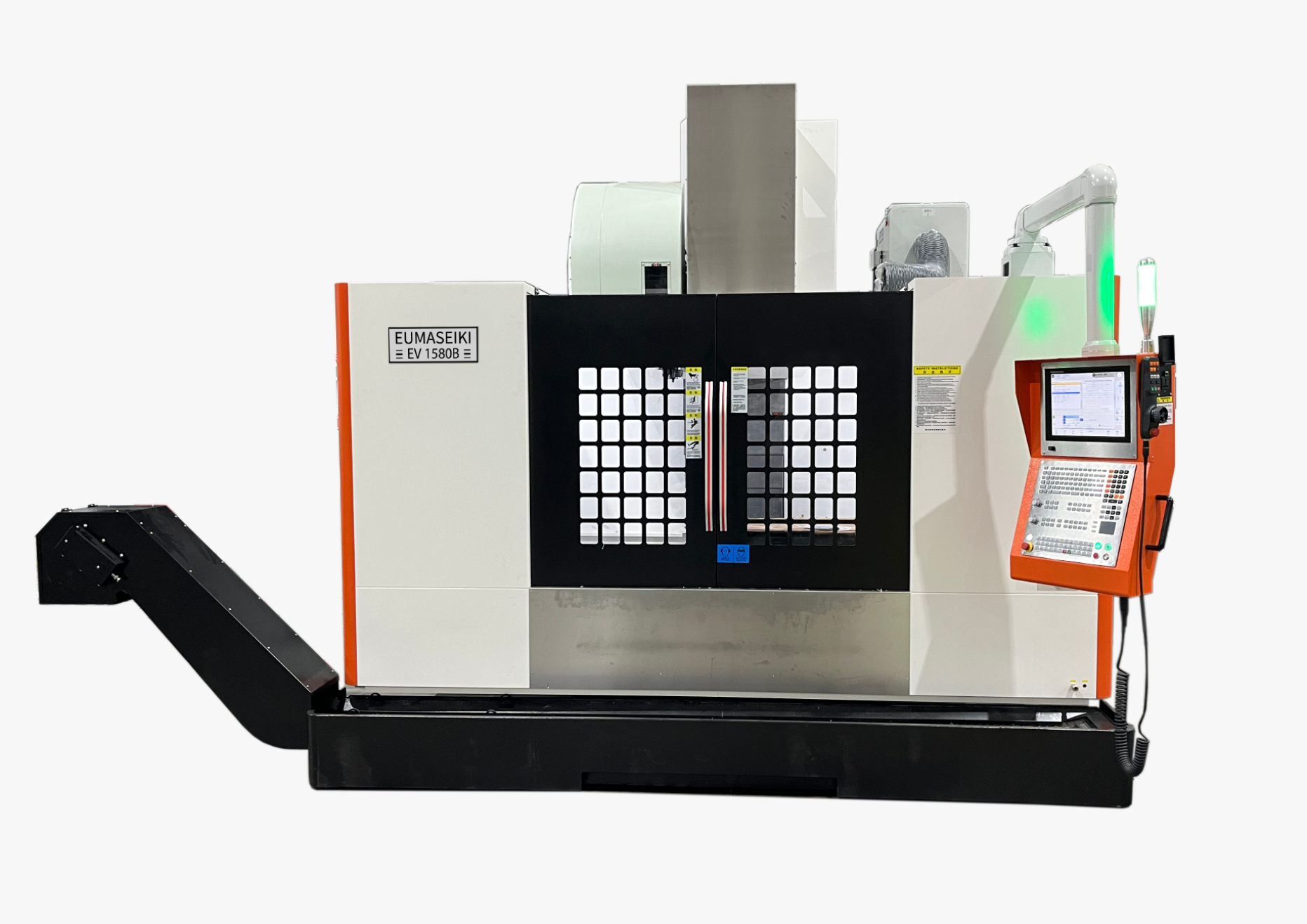
The EV-1580B fixed-column vertical machining center, shown with its 1600 x 800 mm work table and 1500/800/700 mm travel envelope.
EV-1580B — Fixed-Column Capacity for Large Parts
The EV-1580B is the largest of the three in physical terms and the one with the clearest single justification: it moves the workpiece envelope up to 1500 mm in X, 800 mm in Y and 700 mm in Z, on a work table measuring 1600 x 800 mm. Anything that must be clamped as a single piece — a large plate, a mould base, a welded frame, a bulky housing — is a candidate for this machine simply because the alternatives in the shortlist cannot physically hold it.
Table load is the second filter. The EV-1580B accepts up to 1200 kg on the work table, and the T-slot configuration is 22 x 110 x 7 mm, which accommodates substantial fixturing without the fixture itself consuming the entire load allowance. For buyers, the practical calculation is workpiece mass plus fixture mass, not workpiece mass alone.
The spindle configuration is oriented towards material removal in steel and cast iron rather than towards high-speed finishing. The machine uses an ISO 50 taper with a belt-driven spindle running to 8000 rpm, powered by a 22/33 kW main motor (S1 / S6 25%) with torque of 140/260 Nm and 210/380 Nm under the two duty ratings. Feed rates are 20/20/20 m/min rapid and 10000 mm/min cutting, on φ50/10 mm ball screws and 55/45*4/55 mm linear guideways.
Tooling is handled by a 24-pocket arm-type magazine on BT50 holders, with a maximum tool diameter of φ110 mm adjacent and φ220 mm non-adjacent, maximum tool length of 350 mm and maximum tool weight of 15 kg. Tool-to-tool change time is 3 seconds. Positioning accuracy is stated at 0.009 mm with repeat positioning accuracy of 0.006 mm. The machine is controlled by a SIEMENS 828D system, occupies 4000 x 3300 mm of floor space at a height of 3550 mm, draws a required power supply capacity of 35 kVA, and has a net weight of 8000 kg. Structurally, the base and column are made of marble mineral materials, with high-precision electronic components, special steel and cast iron used elsewhere in the assembly.
EV-1475B — Medium-Part Precision With Faster Axis Response
The EV-1475B occupies the middle of the shortlist. Its travels are 1400 mm in X, 750 mm in Y and 750 mm in Z, with a 1500 x 700 mm work table and a maximum table load of 1000 kg. Compared with the EV-1580B, the envelope is slightly narrower but the Z-axis stroke is 50 mm longer, which matters for taller workpieces and for fixturing that raises the part away from the table surface. Spindle nose to worktable distance is 150 to 900 mm, against 155 to 855 mm on the EV-1580B.
Where the EV-1475B differs most is in its positioning performance and axis dynamics. Positioning accuracy is stated at 0.008 mm with repeat positioning accuracy of 0.005 mm — both tighter than the EV-1580B figures. Rapid feed is 36/24/24 m/min, so the X axis moves faster than the 20 m/min of the larger machine, on a φ40/12 mm ball screw and 45/55*4/45 mm linear guideways. For a shop running batches of medium-sized parts with a lot of positioning and short cuts, that combination reduces cycle time without changing the workpiece envelope requirement much.
The spindle specification is the same family as the EV-1580B: ISO 50 taper, belt drive, 8000 rpm, 22/33 kW (S1 / S6 25%), and torque of 140/260 Nm with 210/380 Nm available under the higher duty rating. The tool magazine is also a 24-pocket BT50 arm-type unit with the same φ110/φ220 mm tool diameter limits, 350 mm maximum tool length, 15 kg maximum tool weight and 3-second tool-to-tool change. The CNC system is SIEMENS 828D, the required power supply capacity is 35 kVA, required air pressure is 6.5 kg/cm², machine dimensions are 3700 x 2900 mm at a height of 3300 mm, and net weight is 7500 kg.
A practical way to separate the EV-1475B from the EV-1580B is to ask which constraint is binding. If the part cannot fit in the EV-1475B envelope, the larger machine is the only option. If the part fits both, the EV-1475B offers tighter stated accuracy and faster rapid traverse — but a lower table load limit of 1000 kg and a smaller table area.
UV260 — Small Precision Components and a 1.5-Second Tool Change
The UV260 is not a smaller version of the vertical machines; it is a different architecture. It is a CNC trunnion table machining center built on a cross saddle carrying a five-axis tilting rotary table, with a ⌀260 mm worktable that tilts from -110° to +110° on the A axis and rotates 360° on the C axis. That geometry lets a small part be presented to the spindle at multiple angles in one setup, which is the reason this class of machine exists at all.
The trade-off is scale, and it is important to state it plainly. Travel is 500/500/450 mm, and the maximum load on the worktable is 60 kg — roughly one twentieth of what the EV-1580B accepts. The spindle nose to worktable distance range is 40 to 490 mm. This machine is intended for small and medium series components, not for large frames or heavy fixtures.
Within that envelope, the UV260 is specified for speed. The spindle runs to 12000 rpm on an ISO 40 taper with an 11/20 kW main motor (S1 / S6 40%) and torque of 52.5/95.5 Nm. Rapid feed is 24/24/24 m/min and cutting feed range is 1 to 12000 mm/min. The rotary axes carry A-axis rated torque of 270 Nm at 150 rpm and C-axis rated torque of 120 Nm at 200 rpm, with A-axis motor power of 4.56 kW and C-axis motor power of 2.6 kW.
The headline number for many buyers is the tool change: 1.5 seconds tool to tool, on a 24-pocket arm-type magazine using BT40 holders with a maximum tool diameter of φ76 mm adjacent and φ150 mm non-adjacent, maximum tool length of 250 mm and maximum tool weight of 8 kg. Stated accuracy per VDI 3441 is 0.007 mm positioning and 0.005 mm repeat positioning on X, Y and Z, with A and C axis division accuracy of ±20 arc seconds and repeat accuracy of ±4 arc seconds. The control system is SYNTEC 220MA-5, required power supply capacity is 30 kVA, required air pressure is 6 kg/cm², machine dimensions are 2000 x 2400 mm at a height of 2300 mm, and net weight is approximately 4200 kg.
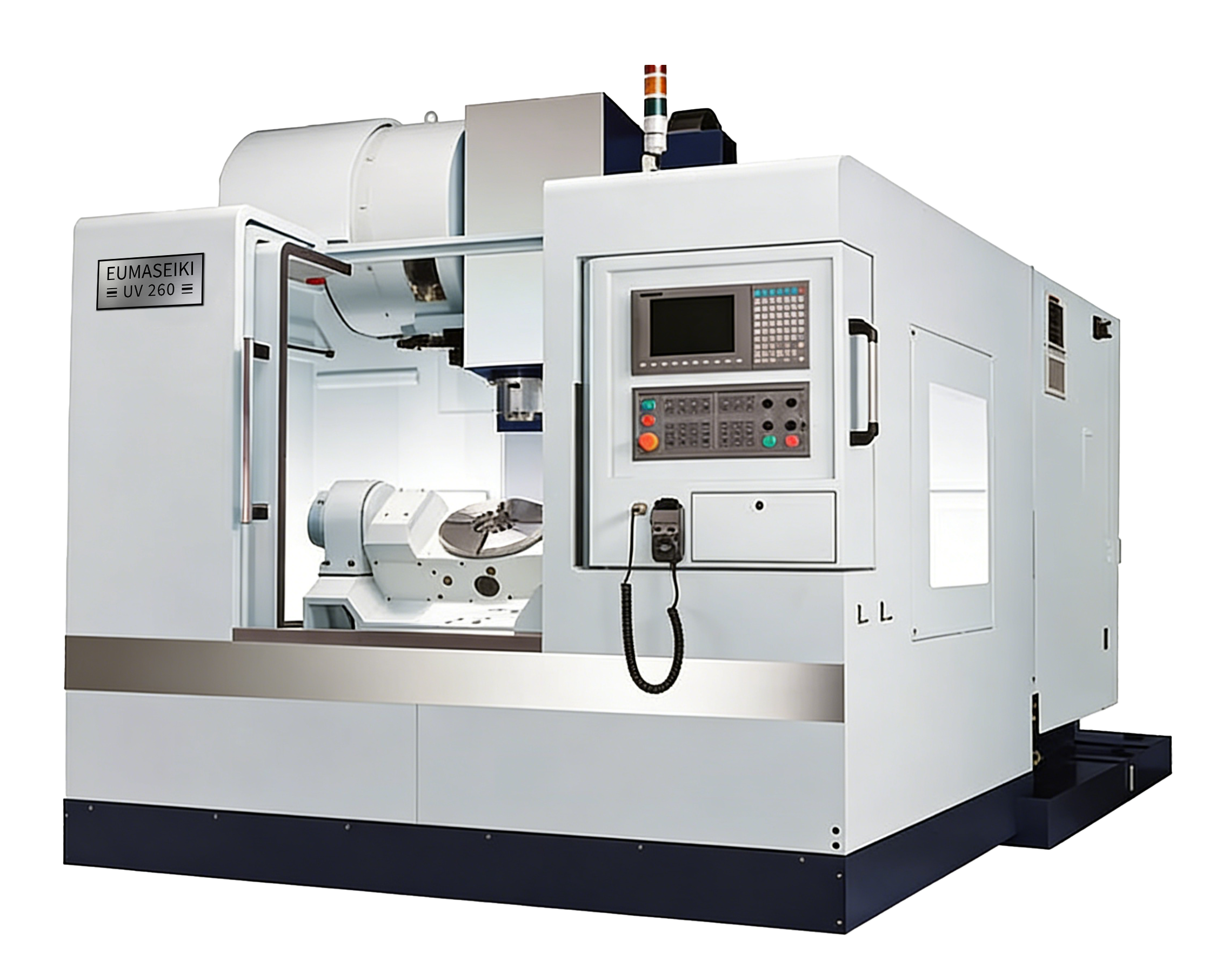
The UV260 trunnion table machining center: a ⌀260 mm tilting rotary worktable, 500/500/450 mm travel and a 1.5-second tool-to-tool change.
What the Specifications Actually Control
Travel and table size set the part envelope, not the difficulty of the job
Travel figures describe the volume the spindle can reach. A 1500 mm X stroke on the EV-1580B does not mean the machine is only useful for 1500 mm parts; it means that anything larger must be repositioned or machined on a different platform. Buyers should measure the actual part plus fixture, add clearance for tool entry and retraction, and compare that number against travel — not against table size.
Table load limits are a safety and accuracy boundary
Maximum table load is stated as 1200 kg (EV-1580B), 1000 kg (EV-1475B) and 60 kg (UV260). Exceeding it affects more than safety: excessive mass on a linear guideway changes the machine's dynamic behaviour and can degrade the accuracy the specification promises.
Spindle taper and speed define the material strategy
The two vertical models use ISO 50/BT50 tooling at 8000 rpm with 22/33 kW, which suits heavier cuts in steel and cast iron. The UV260 uses ISO 40/BT40 tooling at 12000 rpm with 11/20 kW, which suits smaller tools and higher spindle speeds on small precision parts. The maximum tool weight follows the same logic: 15 kg on the verticals, 8 kg on the trunnion machine.
Accuracy figures depend on the measurement standard
The UV260 accuracy figures are stated per German VDI 3441; the EV series verticals state positioning and repeat positioning accuracy for the XYZ axes, with the same VDI 3441 framing used for the wider EUMASEIKI range. ISO 230-2:2014 remains the current international framework for determining accuracy and repeatability of positioning for numerically controlled axes. A buyer comparing figures from different suppliers should confirm which standard was applied and whether the value covers the full travel of the axis.
Application Fit: Matching Each Machine to a Job
Mapping the three models to production scenarios clarifies where each one earns its place.
Large single-setup parts: EV-1580B. A 1600 x 800 mm table with a 1200 kg load ceiling and 1500/800/700 mm of travel is aimed at parts that cannot be split. In the wider EUMASEIKI product range, the sectors served include precision mould making, aerospace, automotive parts manufacturing, high-end equipment production, shipbuilding and engineering machinery — categories where large, heavy and sometimes awkwardly shaped workpieces are routine. The ISO 50 spindle with 140/260 Nm of torque supports heavier material removal in these jobs.
Medium parts at tighter tolerance: EV-1475B. With 0.008 mm positioning accuracy, 0.005 mm repeat accuracy and 36 m/min rapid feed on X, the EV-1475B is positioned for batch work where positioning speed and repeatability matter more than maximum part size — mould inserts, medium housings, plates and brackets where cycle time is measurable.
Small precision components: UV260. The documented application is drilling, tapping and milling of small and medium series components for precision mechanics, watchmaking, medical technology, electronics and general mechanics. The combination of a tilting A axis and a rotating C axis, 12000 rpm spindle and a 1.5-second tool change is aimed squarely at small parts with multiple faces and frequent tool changes — the profile where a trunnion table machine outperforms a three-axis machine with repeated re-fixturing.
How These Machines Are Built and Verified
Specifications describe intent; build and verification practices describe what a buyer can expect to receive. EUMASEIKI manufactures at a production base in Ningbo City covering 8,000 m², with approximately 68 staff, an annual production capacity of 50 to 100 units, and a research and development team of 8 engineers supported by a professional R&D centre and patented technologies.
Machine beds use mineral castings, with structures optimised through finite element analysis. Castings undergo full annealing to relieve internal stress, and spindle guideways receive high-frequency heat treatment. Key components such as spindles, guideways, bearings and oil pumps are sourced from manufacturers in Taiwan and Japan, while some core components are imported from original brands in Germany or Italy. Assembly and commissioning are carried out with a documented sequence covering casting, machining, assembly and testing.
The workshop is equipped with imported machinery including Japanese OKUMA gantry machining centers, KURUKI boring and milling machines and NIIGATA horizontal machining centers, alongside a German ZEISS coordinate measuring machine. That equipment supports in-house machining precision as well as trial machining and testing — which is the part of a supplier evaluation that a specification table cannot replace.
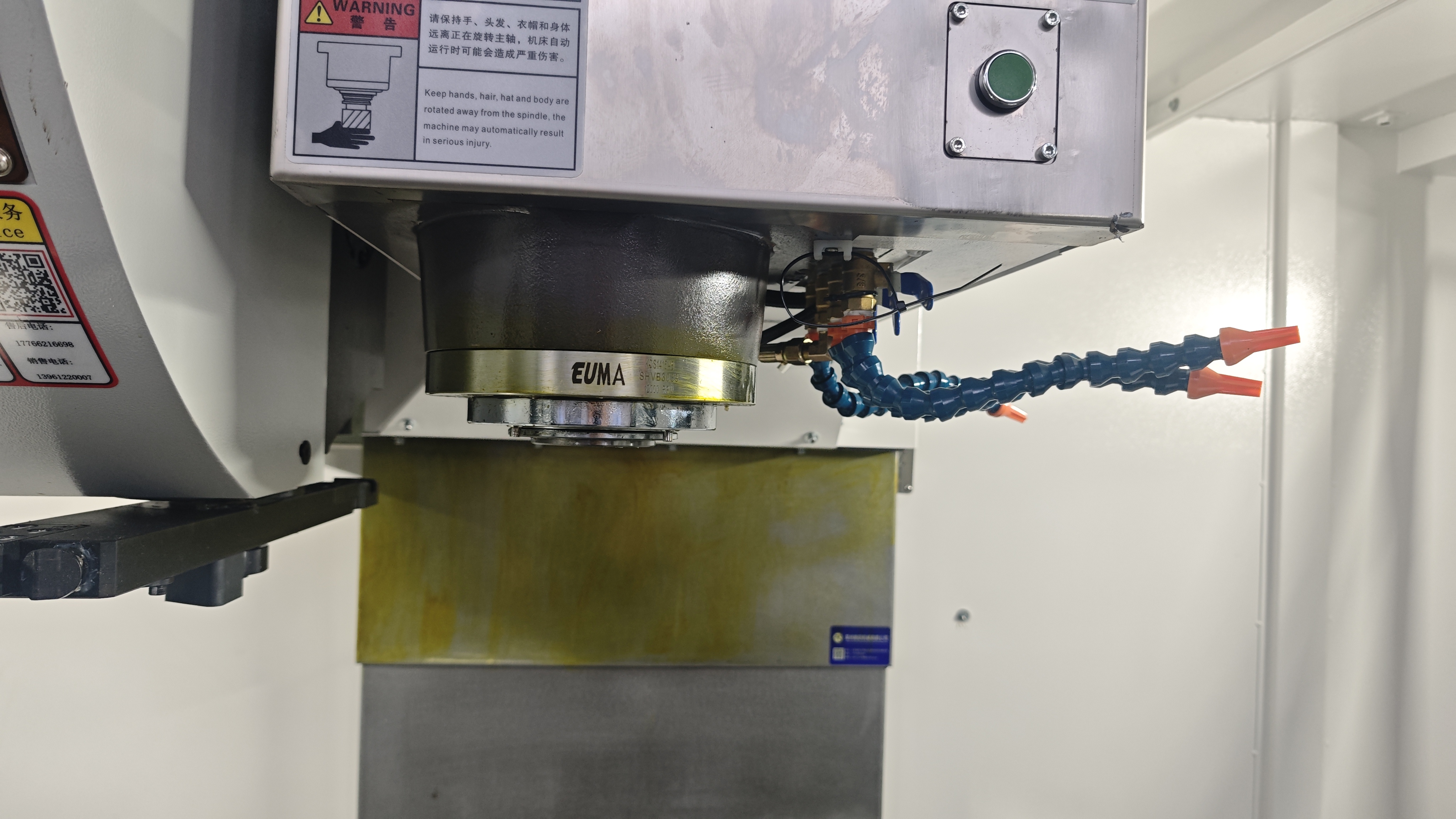
Spindle assembly is one of the components where the accuracy figures on the specification sheet are physically established.
Market Signals Behind the Shortlist
Three published data points frame why this shortlist is shaped the way it is. First, the vertical machining center remains the dominant architecture in routine production: VMCs held a 52.3% product-type share of the 4-axis CNC market in 2025 (Dataintelo), which is consistent with two of the three models here being vertical machines. Second, the five-axis segment, where the UV260's trunnion architecture sits, was valued at approximately USD 7.35 billion in 2024 with a projected CAGR of 4.6% to 2035 (WiseGuyReports). Third, demand within five-axis work is concentrated: the aerospace application segment accounted for a 28.7% revenue share of the five-axis machining center market in 2025 (Dataintelo).
Sourcing context matters as well. China's machine tool exports reached USD 8.56 billion in the first five months of 2024, a 1.8% year-on-year increase (ICE Pechino / China Customs), and EUMASEIKI's own export business accounts for 80% of total sales, with major markets including Russia, Saudi Arabia, India and Iran.
One caveat on market sizing: published estimates vary by scope. Mordor Intelligence placed the machining centers market at USD 22.41 billion for 2025, while Grand View Research estimated USD 27.64 billion for 2024 under a broader definition that includes turning centres. Buyers using market figures to justify capital expenditure should check what each number includes rather than treating them as interchangeable.
Where the Shortlist Stops: Boundaries and Trade-offs
A shortlist is only credible if it states what it does not cover. Several boundaries apply to these three models.
Envelope ceilings are hard limits. The largest work envelope in this shortlist is 1500/800/700 mm. Parts beyond that require repositioning across multiple setups or a different machine architecture entirely — the three models here do not cover gantry-scale or large horizontal work.
The UV260's 60 kg table load is restrictive by design. It is a small-parts machine. Attempting to use it for fixtures with significant mass removes the accuracy advantage that justifies buying it.
Neither vertical model is a simultaneous five-axis machine. The EV-1580B and EV-1475B are three-axis designs; EUMASEIKI documents that the EV series can optionally be equipped with a four-axis rotary table for five-face or five-axis processing, which is a different capability from a machine built around a rotary table from the ground up.
Spindle speed is a deliberate compromise. The 8000 rpm ISO 50 belt-driven spindles on both verticals prioritise torque for steel and cast iron. For work dominated by small-diameter tooling and high-speed finishing, other spindle architectures — including HSK-A63 spindles running at 12000 rpm on the swivel-head models in the wider range — are a more appropriate starting point than either vertical machine in this shortlist.
Specification sheets omit conditions. Accuracy values are meaningful only alongside the standard and the test conditions under which they were established. Buyers should request and confirm acceptance test documentation, and treat published figures as a screening filter rather than as the final acceptance criterion.
This is a fit shortlist, not a superiority claim. The global market includes large, established manufacturers — among them DMG Mori, Yamazaki Mazak and Haas Automation, identified as the top three global manufacturers of CNC machining centers by market presence and technology (AMSL / Mechrank). A shortlist of three models from one supplier describes application fit within a portfolio and should not be read as a ranking against those manufacturers.
Future Outlook
The direction of demand is reasonably clear from the available data. Vertical machining centers continue to carry the volume of general manufacturing, while the five-axis segment expands at a projected 4.6% CAGR to 2035, led by aerospace applications. For buyers, this suggests that the most durable capital allocation is a matched set of machines rather than a single universal one: a large fixed-column vertical for the biggest parts, a tighter medium-format vertical for batch work, and a compact trunnion machine for small precision components with multi-face features.
The operational trend is equally visible in the application profile documented for EUMASEIKI machining centers: 24/7 operation indoors at normal temperature and humidity, with a chip conveyor, coolant system, tool magazine and oil mist collector specified as matched equipment, and spindle collision protection identified as a specific requirement. Continuous operation shifts the evaluation emphasis away from peak specification values and towards thermal stability, structural damping from mineral castings, and the reliability of peripheral systems. That is where the next round of shortlisting questions will be asked.
FAQ
1. What is the difference between a fixed-column vertical machining center and a trunnion table machining center?
A fixed-column vertical machining center, such as the EV-1580B, holds the workpiece on a horizontal table while the spindle moves in three linear axes; the EV-1580B offers 1500/800/700 mm of travel on a 1600 x 800 mm table. A trunnion table machining center, such as the UV260, mounts the workpiece on a tilting and rotating table — a ⌀260 mm worktable that tilts from -110° to +110° on the A axis and rotates 360° on the C axis — inside a 500/500/450 mm travel envelope. The practical difference is that the trunnion architecture presents multiple faces of a small part to the spindle in one setup, while the vertical architecture provides a much larger working envelope and a far higher table load capacity (1200 kg on the EV-1580B against 60 kg on the UV260).
2. How much workpiece weight can each of these three machines carry?
The maximum load on the worktable is 1200 kg for the EV-1580B, 1000 kg for the EV-1475B on its 1500 x 700 mm table, and 60 kg for the UV260 on its ⌀260 mm worktable. These figures refer to the total mass supported by the table, so fixtures, vises and tombstones count towards the allowance alongside the workpiece itself.
3. What does a 1.5-second tool change time actually measure?
The 1.5-second figure for the UV260 is a tool-to-tool time on a 24-pocket arm-type magazine using BT40 holders; the EV-1580B and EV-1475B are specified at 3 seconds tool-to-tool on 24-pocket BT50 magazines. Tool-to-tool time measures the interval between releasing one tool and picking up the next. It does not include spindle stop and restart or axis repositioning to the cutting position, which are generally included in chip-to-chip measurements. Comparisons between suppliers are only valid when the same definition is used.
4. Which industries and part types are these machines intended for?
The EV-1580B and EV-1475B are CNC vertical machining centers for the manufacturing industry, and the wider EUMASEIKI range covers precision mould making, aerospace, automotive parts manufacturing, high-end equipment production, shipbuilding and engineering machinery. The UV260 trunnion table machining center is documented for drilling, tapping and milling of small and medium series components in precision mechanics, watchmaking, medical technology, electronics and general mechanics. Market data supports the split: aerospace accounted for 28.7% of five-axis machining center revenue in 2025 (Dataintelo), while vertical machines continue to dominate general 4-axis production work.
5. How should the accuracy figures be interpreted?
Published positioning accuracy is 0.009 mm with 0.006 mm repeat positioning accuracy for the EV-1580B, 0.008 mm with 0.005 mm repeat accuracy for the EV-1475B, and 0.007 mm with 0.005 mm repeat accuracy for the UV260, whose figures are stated per German VDI 3441 together with A and C axis division accuracy of ±20 arc seconds and repeat accuracy of ±4 arc seconds. ISO 230-2:2014 is the current international framework for determining accuracy and repeatability of positioning for numerically controlled axes. Because values depend on the standard and the conditions of measurement, buyers should confirm which framework applies and whether the stated value covers full axis travel rather than a partial range.
6. What should be checked before a shortlist becomes a purchase decision?
The minimum verification set is mechanical and infrastructure-related: actual part plus fixture size against X, Y and Z travel; workpiece plus fixture mass against the table load rating; spindle taper, speed and torque against the material and tooling plan; tool magazine capacity, maximum tool weight (15 kg on the two verticals, 8 kg on the UV260) and tool-to-tool time against the cycle time target; and installation requirements. On the last point, the EV-1580B and EV-1475B each require a 35 kVA power supply and 6.5 kg/cm² air pressure, while the UV260 requires 30 kVA and 6 kg/cm². Footprint and weight also differ substantially: 4000 x 3300 mm and 8000 kg, 3700 x 2900 mm and 7500 kg, and 2000 x 2400 mm and approximately 4200 kg respectively. A trial machining or inspection report based on the actual part drawing remains the most reliable confirmation.
Closing Note
Matching a CNC machining center to a smart manufacturing job is a process of elimination rather than preference. The EV-1580B remains on the list while the part fits a 1500/800/700 mm envelope and stays within 1200 kg. The EV-1475B remains while the job needs 0.008 mm positioning accuracy and faster rapid traverse on medium parts. The UV260 remains while the component is small, light and needs multiple faces machined with frequent tool changes. Outside those conditions, the shortlist changes rather than stretches.
Reviewing actual part drawings and fixture weights against these three configurations is the fastest way to confirm which model belongs in a given cell. The full EUMASEIKI product brochure, including the wider machine range, is available as a PDF download: EUMASEIKI product brochure. The company can also be contacted at info@eumaseiki.com for specification documentation on individual models.