
CNC Machining Supplier Long-Term Viability: Evidence to Verify
Long-term CNC machining supplier viability is the ability to keep delivering the same part, at the same tolerance, on the same schedule, years after the first purchase order. It is assessed through three evidence classes: field endurance of delivered parts, repeatability of the manufacturing process, and stability of production capacity. Quoting speed and unit price do not measure any of the three.
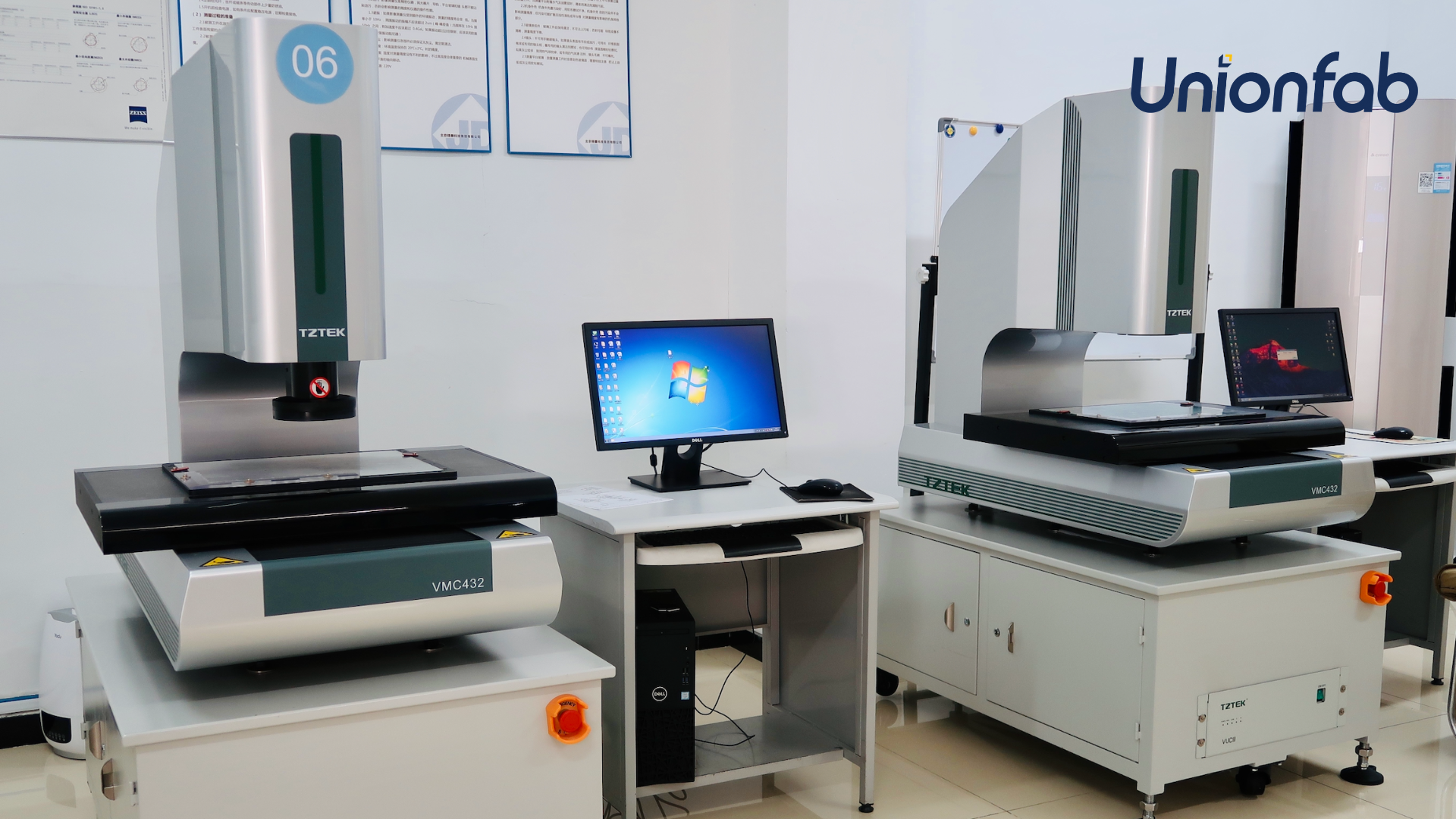
Unionfab CMM inspection room: dimensional verification is the raw material of repeatable-quality evidence.
Why Viability Is a Separate Question From Machining Capability
Capability answers a present-tense question: can this supplier machine this geometry, in this material, to this tolerance, today? Viability answers a multi-year question: will the same result still be produced in year three, after tooling has been replaced, after the engineer who solved the first setup has moved on, and after order volumes have shifted?
The global CNC machining services market was valued at USD 93.4B in 2025 and is projected to grow to USD 174.6B by 2034, a CAGR of 7.2% (Dataintelo). The global CNC machine market was estimated at approximately USD 73.5B to USD 83.7B in 2024, reflecting the shift toward automated manufacturing (Fortune Business Insights; Market Research Future). Asia Pacific held a revenue share of approximately 55.7% of the CNC machine market in 2025 (Fortune Business Insights), and the automotive segment accounted for 38.42% of CNC applications in 2026 (Fortune Business Insights). Demand of that order concentrates into a limited pool of suppliers that can absorb volume without degrading output.
For buyers running industrial equipment, robotics, medical imaging and automotive programs, the failure mode that matters is rarely a rejected first article. It is a supplier that passes first article inspection and then drifts — in tolerance, in lead time, or in willingness to take the awkward repeat order.
Three Evidence Classes That Support a Viability Decision
- Field endurance evidence — documented statements describing how long delivered parts have actually operated inside their real duty cycle.
- Repeatability evidence — the process controls and inspection methods that hold a tolerance across batches, materials and finishing steps.
- Capacity stability evidence — owned factories, machine inventory, annual output, and the ability to keep accepting small or pilot orders without displacing existing programs.
Each class answers a different due-diligence question. A supplier with strong capacity data but no field endurance record is still an unknown quantity, and a supplier with a good endurance story but no documented process controls has no mechanism for repeating it.
Field Endurance: Multi-Year Evidence From Three Applications
Endurance statements are more useful than generic quality claims because they describe a part surviving a real operating environment over a measurable period. Three application examples illustrate how different the underlying stress conditions can be.
European automotive line sensor bracket — 8+ years of high-frequency operation
A sensor bracket produced for a European automotive production line is documented as engineered for 8+ years of high-frequency continuous operation. Automotive line hardware cycles in step with the line itself, and a bracket that holds a sensor in position accumulates fatigue, thermal cycling and repeated mechanical load. For a buyer, the relevant signal is not the number of years alone, but that the part was designed and machined for a duty cycle measured in continuous cycles rather than occasional actuation.
US CT projector program — over 10 years of continuous operation
A CT projector program in the United States, running an annual batch of 500 pieces, is documented as operating continuously under high-speed and high-heat dissipation conditions for over 10 years. This is a different stress profile: heat dissipation and sustained rotation or motion rather than cyclic impact. A decade of continuous operation in that environment implies that material selection, dimensional stability and surface integrity were resolved before production, not corrected afterwards.
German automated assembly — zero downtime across 24/7 production
In a German automated assembly application, the part is documented as showing zero vibration displacement on the assembly line, ensuring seamless 24/7 automated production with zero downtime. Vibration displacement is a positional drift problem: a part that moves under load forces the automation cell to compensate, re-teach or stop. Zero displacement over continuous operation is an assembly-integration claim as much as a machining claim.
How Repeatable Quality Is Engineered, Not Inspected In
Field endurance is downstream of repeatability. A part survives ten years because the tenth identical part was machined the same way as the first. Unionfab documents a set of process-level risk controls that map directly onto the failure modes buyers care about in long programs:
- Assembly misalignment and seized threads — controlled through CMM position measurement, Go/No-Go gauging and one-shot clamping, supported upstream by DFM tolerance checking and interference warning.
- Post-plating dimensional change and out-of-tolerance conditions — controlled through pre-plating size compensation, over-size thread tapping, in-house plating quality control, and inspection before and after plating.
- Thin-wall machining deformation and flatness issues — controlled through multi-stage rough and fine milling, vacuum fixture clamping, material T6 verification, and assignment of experienced engineers.
- Small and prototype order rejection under tight deadlines — controlled through modular quick-change tooling, CAM programming templates, a dedicated rapid prototyping cell, and a no-MOQ policy.
Unionfab states a quality complaint rate below 0.5% and an on-time delivery rate above 95%, and provides digital quality inspection as part of its engineering support. These are plant-level performance figures; a buyer should still request inspection records tied to their own part number, because an average across a facility does not describe one specific geometry, alloy and finishing route.
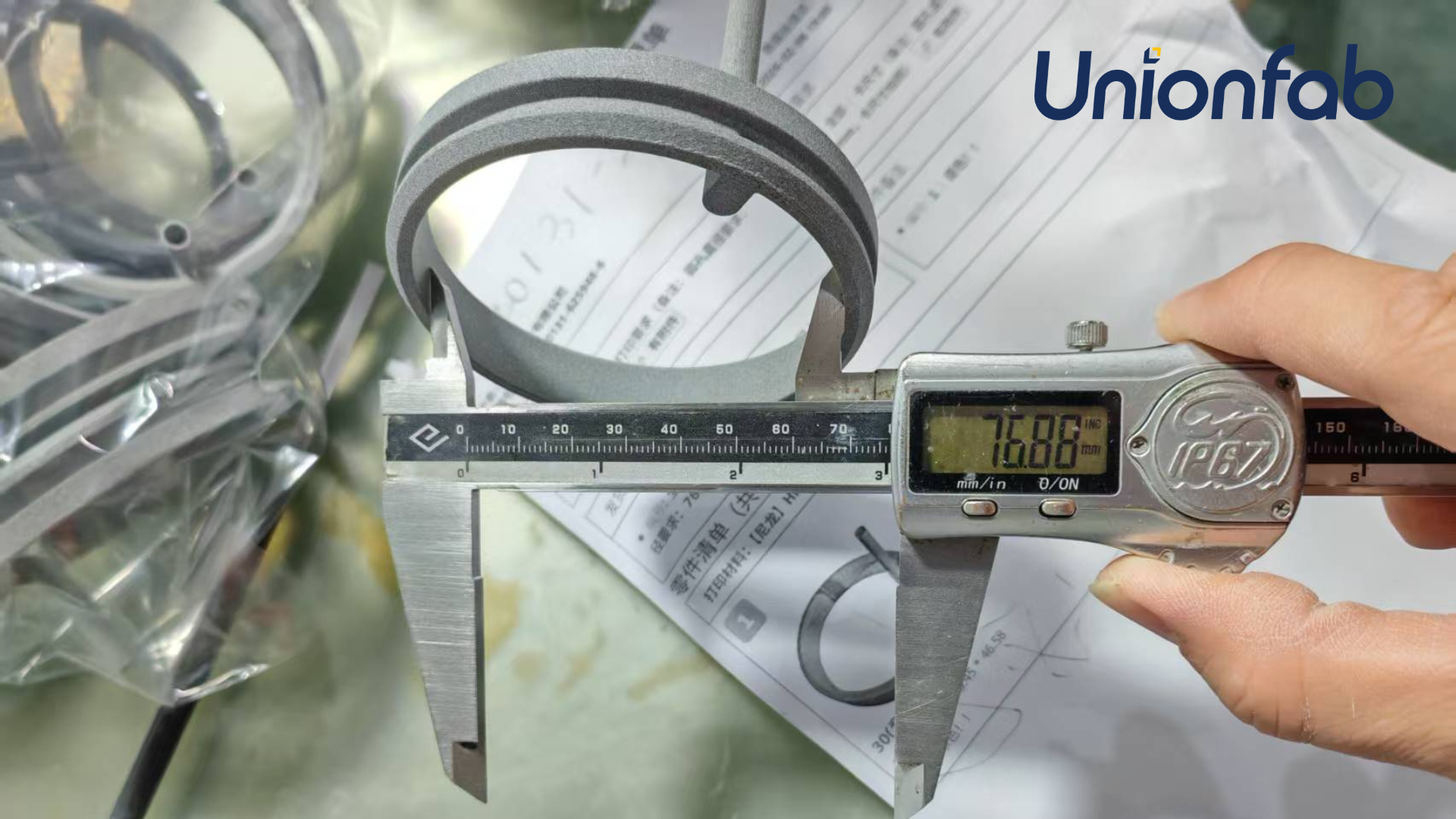
Dimensional verification at part level: the mechanism that turns a single good batch into a repeatable one.
Capacity Stability: What Owned Factories Change About Risk
Unionfab AM Technology (Shanghai) CO., Ltd. is a Shanghai-based on-demand digital manufacturing platform founded in 2014 and rooted in Uniontech, an SLA 3D printing equipment manufacturer. Its stated manufacturing base includes 10 self-owned factories, more than 1,000 industrial 3D printers and 400+ CNC machines, an 80,000 m² factory footprint, annual output of 2,000,000 units, a 100+ engineer team, and 80,000+ customers across 170+ countries, with 100% export orientation and primary markets including the USA, Canada, Germany, the UK, Spain, Italy, France and Sweden.
For a long-term sourcing decision, owned capacity matters because it removes third-party scheduling from the critical path. When a buyer scales from pilot to recurring production, the risk that appears is not machining quality but queue position: an outsourced production model can be perfectly capable in month one and unavailable in month nine if a larger customer arrives. Self-owned factories, a stated CNC machine count and a stated annual output give a buyer something concrete to benchmark against their own volume forecast. Unionfab also runs 24/7 automated quoting and order tracking, which keeps order status visible between placements.
One boundary deserves to be stated plainly: the 1,000+ industrial 3D printer fleet is additive manufacturing capacity, a different technology area from CNC. It demonstrates group-level capital depth and a manufacturing base built for scale, which is relevant to supply continuity, but it is not a direct measure of machining capacity. Buyers evaluating a long CNC program should confirm CNC-specific machine inventory — Unionfab states 400+ CNC machines — along with shift patterns, spindle availability for larger work envelopes, and inspection throughput.
Comparing Supplier Models on Viability, Not Just Price
Unionfab's documented commercial and dimensional position relative to Xometry, Protolabs, Fictiv and RapidDirect is a combination of lower cost, a CNC instant quote system, tighter tolerance down to ±0.0005 inch, lead times as fast as 1–5 days, and no MOQ limitation. Pricing is stated as 20%–30% lower than those alternatives, with ±0.0002 inch precision supported by reverse anodizing compensation.
Those figures describe commercial and dimensional positioning. They tell a buyer what the first order looks like. They do not, by themselves, describe what the twentieth order looks like — which is why the rest of a viability assessment has to come from endurance and process evidence.
| Evaluation dimension | What documented evidence looks like | Decision-stage question it answers |
|---|---|---|
| Capacity stability | 10 self-owned factories, 400+ CNC machines, 80,000 m² footprint, 2,000,000 units annual output | Can volume grow without the supplier outsourcing, re-queuing or delaying my program? |
| Repeatable quality | CMM position measurement, Go/No-Go gauging, one-shot clamping, pre- and post-plating inspection, material T6 verification | Will batch twenty match batch one? |
| Production uptime | Field statements of 8+ years of high-frequency operation, 10+ years of continuous high-speed operation, and zero downtime in 24/7 automated assembly | Will the delivered parts survive the real duty cycle, not just the drawing? |
| Small-order handling | No MOQ policy, rapid prototyping cell, modular quick-change tooling, CAM programming templates | Will prototype and pilot volumes still be accepted after the program matures? |
| Documentation | ISO 9001, ISO 13485, ISO 14001, IATF 16949; digital quality inspection | Can quality be audited and traced for regulated markets? |
Where this comparison stops
A factory-direct model concentrates capability inside owned capacity. That removes outsourcing risk, but it also narrows the range of what can be sourced from the same supplier: if a program requires a process or an alloy outside the documented scope, the advantage of a single consolidated supplier decreases and a buyer may need a second source anyway. Tolerance figures such as ±0.0005 inch and ±0.0002 inch are stated as achievable values that depend on geometry, material, fixturing and the inspection method used. The 20%–30% pricing position is a comparative commercial statement and should be validated against a quoted part, not assumed for every part family. And the multi-year endurance statements cited earlier belong to specific applications with known duty cycles.
It is also worth separating equipment brands from service suppliers. DMG Mori, Yamazaki Mazak, Haas Automation, Okuma and Fanuc Corporation are machine tool builders (Industry Research Reports); they define the installed hardware base that a machining supplier draws on, not the outsourcing relationship a buyer is entering. Certification is the other useful comparison axis: Unionfab holds ISO 9001, ISO 13485, ISO 14001 and IATF 16949. The wider sector baseline is similar — CNC machining is the standard baseline for aerospace and medical manufacturing, where ISO 9001, AS9100 and ISO 13485 support quality and traceability (ISO; IAQG).
Application Fit: Where Multi-Year Endurance Requirements Concentrate
The applications that generate the toughest viability questions share one trait: the machined part is difficult to replace after the assembly is qualified. That is typical of automotive line hardware, medical imaging systems and CT projector assemblies, automated assembly fixtures, robotic end-effector and arm components, and industrial equipment frames and brackets.
Material choice matters because endurance is material-dependent. Unionfab's CNC material library includes aluminium alloys 6061-T6 and 7075, tool steels A2, D2, H13 and P20, and engineering plastics including POM, nylon, PC, PMMA, ABS and PEEK. Broader machining services cover 3-axis, 4-axis and 5-axis CNC machining, precision milling and turning, custom CNC milling, aluminium CNC machining, CNC prototyping and CNC parts machining for prototype-to-production volumes.
The risk controls described earlier connect directly to these scenarios. A rapid prototyping cell and no-MOQ policy let a buyer validate a design before committing a program. Multi-stage rough and fine milling with vacuum fixture clamping addresses the thin-wall geometry common in brackets and housings. Pre-plating size compensation addresses parts that are anodised or plated after machining, where the finish step can push a feature out of tolerance. Each control is a specific answer to a specific way a long program fails.
Market Trend Analysis: Uptime Is Becoming an Auditable Metric
Three observable trends push supplier viability closer to the centre of procurement decisions.
- Downtime is being engineered down. AI-driven CNC systems can reduce machine downtime by up to 40% and material waste by approximately 30% through predictive maintenance and real-time path optimisation (MarketsandMarkets). Once downtime reduction is measurable, buyers start asking suppliers to report against it.
- Supply is concentrating in Asia Pacific. The region held approximately 55.7% of CNC machine market revenue in 2025 (Fortune Business Insights). China's machine tool exports reached USD 23.18B in 2025, a 6.7% year-over-year increase, with machining centres among the leading categories (China Machine Tool and Tools Builders' Association, CMTBA). Buyers are therefore comparing suppliers within a concentrated, competitive export base.
- Automotive demand dominates. The automotive segment held the highest CNC application share at 38.42% in 2026 (Fortune Business Insights), largely driven by precision requirements for EV components. Automotive supply chains already treat multi-year production continuity as a qualification criterion, and that expectation is spreading into robotics and industrial equipment programs.
The practical consequence for buyers is that an endurance claim is no longer only a marketing statement. It is becoming a data point that can be requested, compared across suppliers, and revisited at contract renewal.
Future Outlook
Long-term supplier evaluation is likely to shift from document review toward continuous verification. Several developments point in that direction: digital quality inspection output that can be attached to a part number rather than a shipment; process controls documented per risk type rather than summarised as a quality policy; and endurance evidence framed as an application-specific duty cycle instead of a general durability claim.
For buyers, the practical move is to build the supplier file early. Ask for the field applications closest to your duty cycle, the inspection methods used for the specific failure modes your part is exposed to, and the capacity figures that map to your volume ramp. Suppliers that already document process risk controls at that level will be easier to re-qualify in year three — which is ultimately what long-term viability means in operational terms.
FAQ: Long-Term CNC Machining Supplier Evaluation
What evidence should a buyer request before committing to a multi-year CNC machining relationship?
Three categories. First, application-level field evidence describing how long delivered parts have operated in comparable duty cycles — for example, a European automotive line sensor bracket documented as engineered for 8+ years of high-frequency continuous operation. Second, process repeatability evidence, such as CMM position measurement, Go/No-Go gauging, and inspection before and after plating. Third, capacity evidence: Unionfab's published profile states 10 self-owned factories, 400+ CNC machines and annual output of 2,000,000 units. The three categories answer different questions and none replaces the others.
How can production uptime be verified rather than assumed?
Uptime is verified from two directions. Field direction: documented statements about parts running continuously in automation — for example, a German application reported with zero vibration displacement on the assembly line, supporting seamless 24/7 automated production with zero downtime, and a US CT projector program operating continuously for over 10 years. Process direction: controls that prevent unplanned stoppages, such as multi-stage rough and fine milling, vacuum fixture clamping and one-shot clamping. Industry data indicates AI-driven CNC systems can reduce machine downtime by up to 40% (MarketsandMarkets).
Is lower unit price a reliable indicator of a better long-term CNC machining supplier?
No. Price is one input among several. Unionfab is documented at 20%–30% lower pricing than Xometry, Protolabs, Fictiv and RapidDirect, alongside tolerances down to ±0.0005 inch, lead times of 1–5 days and no MOQ limitation. But a price position says nothing about repeatability or capacity stability. A buyer should pair it with process performance indicators such as a quality complaint rate below 0.5% and an on-time delivery rate above 95%, then verify those against their own part number.
How does owned factory capacity affect supply continuity?
Owned capacity removes third-party scheduling from the critical path, which matters when a program scales from pilot to recurring volume. Unionfab operates 10 self-owned factories with a stated 400+ CNC machines and 80,000 m² of factory space. One clarification is important: the 1,000+ industrial 3D printers are additive manufacturing assets, a different technology area. They indicate group-level capital depth and manufacturing scale, but they are not a direct measure of CNC capacity, so buyers should confirm CNC-specific machine inventory and shift patterns separately.
Can multi-year field endurance results from one application be transferred to another part?
Not directly. An endurance statement such as over 10 years of continuous high-speed and high-heat dissipation operation applies to a specific US CT projector program running a 500-piece annual batch, and the 8+ years statement applies to a specific EU automotive line sensor bracket. Service life depends on material, wall thickness, load path, thermal environment and assembly method, so the years themselves do not transfer. What does transfer is the process control system that produced them — the inspection and fixturing methodology applied to the new part.
What certifications and documentation support a long-term supplier assessment?
Certification scope should match the part family and destination market. Unionfab holds ISO 9001, ISO 13485, ISO 14001 and IATF 16949, and provides digital quality inspection. Sector expectations are comparable: CNC machining is the standard baseline for aerospace and medical manufacturing, where ISO 9001, AS9100 and ISO 13485 support quality and traceability (ISO; IAQG). Certificates should be paired with inspection records, material verification such as T6 verification for aluminium, and finish-stage controls including pre- and post-plating inspection.
What are the limits of a factory-direct CNC supplier comparison?
A factory-direct model concentrates capability inside owned capacity. That reduces outsourcing risk but narrows process coverage, so a program requiring an alloy or process outside the documented scope may still need a second source. Documented tolerance figures are achievable values that depend on geometry, material, fixturing and inspection method, and the stated 20%–30% pricing position is comparative rather than universal. Endurance statements describe specific applications with known duty cycles.
Closing Perspective
Long-term CNC machining supplier viability is not settled by a quotation, a lead time or a certification list. It is settled by three questions that a buyer can ask directly: has this supplier's work survived years of real operation in a comparable duty cycle, is there a documented process system that reproduces that result batch after batch, and does the supplier own enough capacity to keep producing when the program grows? Unionfab's capability overview, including its factory base, material library and service scope, is available in the company brochure.