
CNC Nesting for Custom Furniture: HK-Line and HK6 Scenario Fit
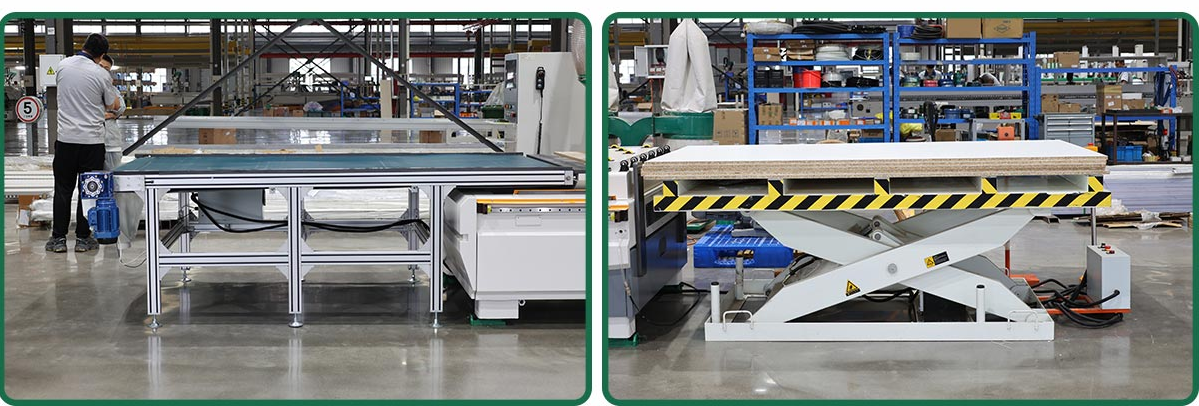
Custom furniture production at medium scale has a characteristic equipment problem: the order mix changes faster than the machinery. A workshop may cut cabinet carcasses in the morning, wardrobe panels in the afternoon, and a set of shaped fronts the following day. Cutting equipment locked to one part geometry becomes the bottleneck; equipment that reads a new nesting file each time does not. That is the core argument for CNC nesting in the middle segment of the market — not peak cutting speed, but the collapse of setup time between product variants.
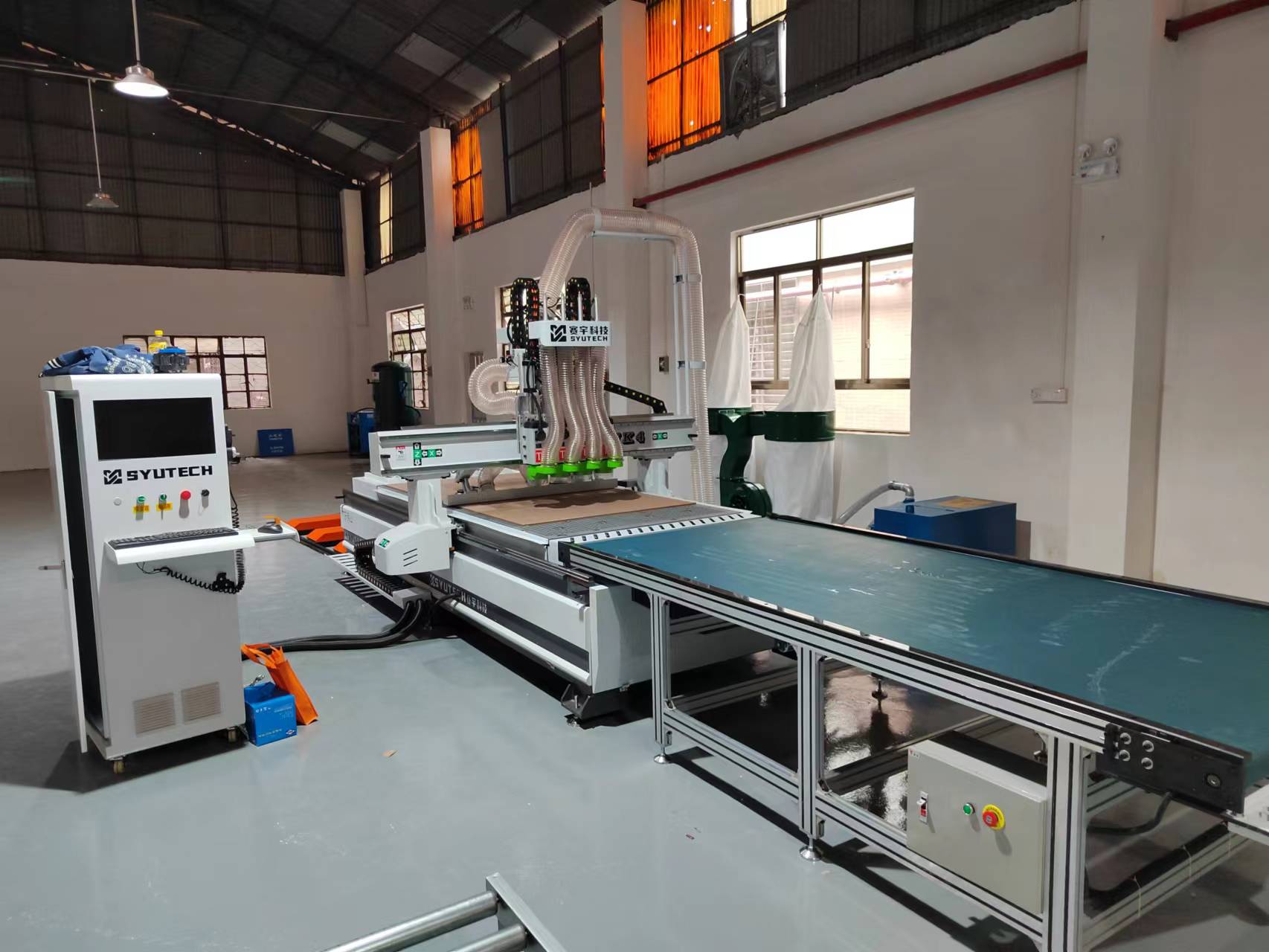
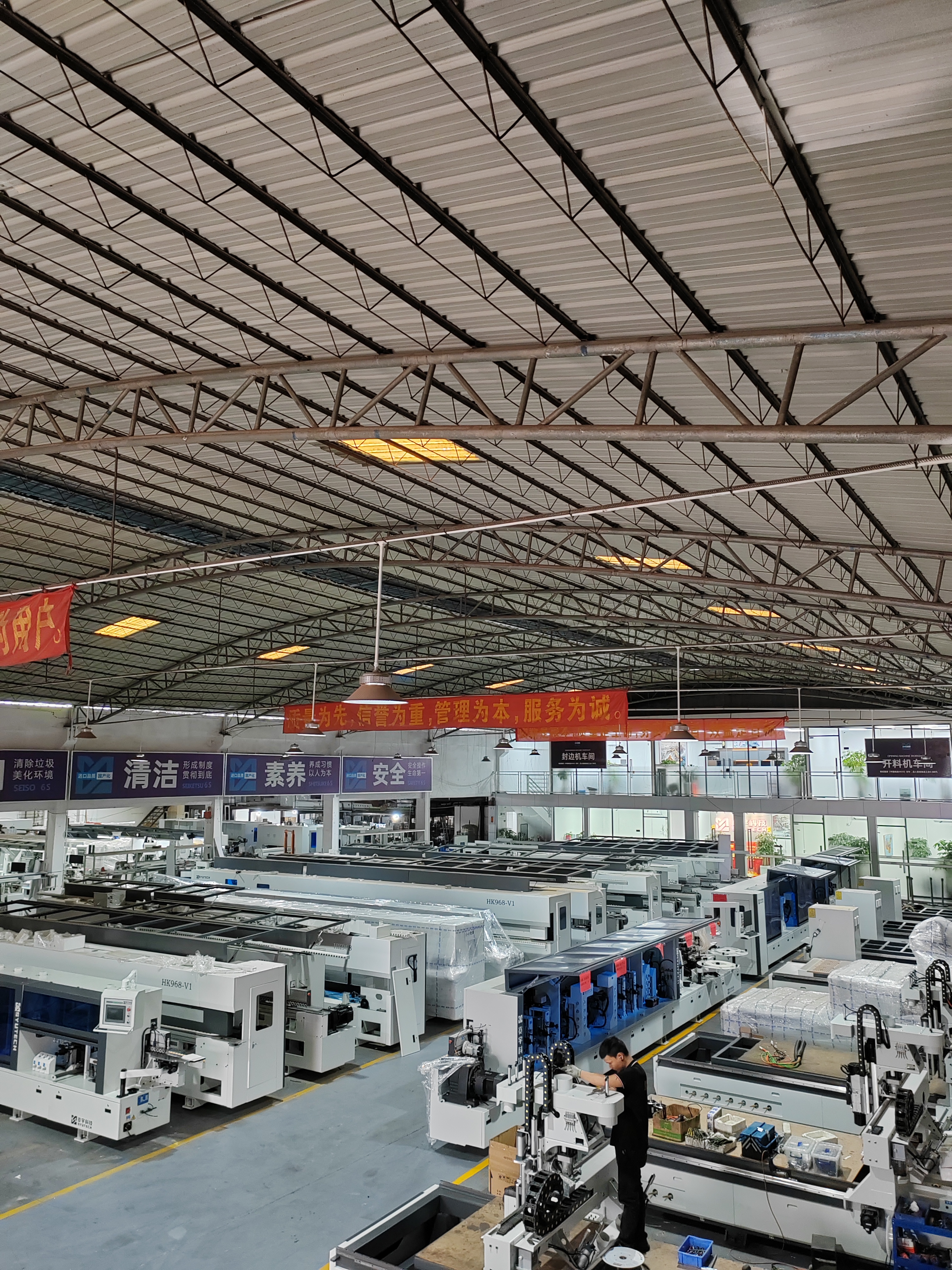
This analysis examines two machines positioned for that segment by SYUTECH, the woodworking machinery brand of Foshan Shunde SaiYu Technology Co., Ltd., a manufacturer based in Shunde District, Foshan City, Guangdong Province, China, established in 2013. The HK-Line is catalogued as a CNC nesting production line; the HK6 is catalogued as a nesting CNC router and also appears in the range as a wood CNC cutting machine. Both are published with a 1220 mm × 2800 mm working envelope, a 9 kW air-cooled spindle running at 24,000 rpm, and a 12-tool automatic tool changer. The question this article addresses is narrower than whether nesting is worth buying: it is where these two configurations fit a medium-scale panel furniture operation, and where they stop fitting.
1. Why the Medium Segment Is the Hardest to Equip
Medium-scale custom furniture production is better defined by batch structure than by output volume. The defining features are many product variants, frequent changeovers, and panel sizes that differ from order to order. None of those conditions favour equipment designed around a single repeating cut pattern.
On manual or semi-automatic cutting setups, every new order triggers a sequence of physical resets: measuring, marking, re-positioning stops, checking the first part. The lost time sits in the gaps between cuts rather than in cutting itself. A nesting router changes that pattern because the cutting path is generated from a file. The operator’s remaining physical tasks are sheet loading, tool availability and offloading. This is a mechanical difference in how the machine is programmed, not a marketing claim.
Three constraints decide whether that advantage is actually realised in a workshop:
- Batch discipline. Nesting efficiency depends on how parts are grouped across orders. Running one unique part at a time wastes sheet area. Grouping parts from several orders into one nesting job improves yield but requires planning discipline and staging space for the output.
- Layout logic. A nesting router is one station in a chain that also includes sheet storage, edge banding, boring and assembly. If the router is placed without regard to that chain, the handling time removed at the cutting stage reappears downstream.
- Site constraints. Working envelope, electrical supply and extraction route are fixed limits that must be verified before purchase, not after installation.
2. HK-Line and HK6: The Documented Specification
| Parameter | HK-Line (CNC nesting production line) | HK6 (nesting CNC router) |
|---|---|---|
| Working range — X axis | 1220 mm | 1220 mm |
| Working range — Y axis | 2800 mm | 2800 mm |
| Working range — Z axis | 250 mm | 250 mm |
| Spindle | 9 kW air-cooled motor | 9 kW air-cooled motor |
| Spindle rotating speed | 24,000 rpm | 24,000 rpm |
| Tool magazine | 12 tools, automatic changer, straight-line type | 12 tools, automatic changer, straight-line type |
| X / Y transmission | Precision rack, Taiwan brand | Precision rack, Taiwan brand |
| Drive system | Servo motor 1.5 kW × 4, matched 1.5 kW × 4 drivers | Servo motor 1.5 kW × 4, matched 1.5 kW × 4 drivers |
| Frequency converter | 11 kW | 11 kW |
| Reducer | Japanese brand | Japanese brand |
| Control system | Taiwan SYNTEC / LNC | Taiwan LNC / SYNTEC |
| Power supply | 380 V, 3-phase, 50 Hz | 380 V, 3-phase, 50 Hz |
The overlap is worth stating plainly, because it shapes how a buyer should read the portfolio. On published parameters — envelope, spindle, tool changer, drive architecture, control platform and power supply — the two machines are closely matched. The practical distinction is positioning: HK-Line is presented as a CNC nesting production line configuration, while HK6 is presented as a nesting CNC router that is also listed for wood CNC cutting. In project terms, the decision is normally about line configuration and integration rather than about which machine is intrinsically more capable.
3. Reading the Specification as a Production Decision
The 1220 × 2800 mm envelope
A standard sheet format of 1220 mm × 2440 mm fits inside the X/Y envelope of both machines, leaving roughly 360 mm of additional Y-axis travel for trimming margin, fixturing and longer panels. For a custom furniture workshop, this is the number that decides whether most incoming stock can be processed without re-orienting the sheet or splitting a part across two setups.
The same figure also defines the ceiling. Parts requiring more than 2800 mm of travel along the Y axis cannot be nested in a single pass on these machines. A buyer whose order book regularly includes panels beyond that length should plan for rotation, re-fixturing or a different machine type before committing to the configuration.
The 250 mm Z-axis travel
Vertical travel of 250 mm is the combined allowance for material thickness, fixture height and tooling length. Buyers should match the figure against their thickest realistic cut setup plus fixture, not against panel thickness alone. Where a special fixture raises the work surface, the remaining tool clearance changes accordingly.
24,000 rpm, air-cooled
Routers processing melamine-faced, veneered and laminated panels commonly use small-diameter tooling to control edge quality, and small tooling requires higher rotational speed. A 24,000 rpm spindle sits in that working range. The air-cooled motor is also a site-level consideration: it does not require a water-cooling circuit, which removes a utility connection and its associated maintenance from the shop floor.
The 12-tool automatic tool changer
The straight-line 12-tool magazine determines how many distinct operations can run without manual intervention. A routine custom furniture part may require outline cutting, hinge and dowel boring, and groove or rebate machining. Each distinct tool geometry occupies a magazine position. Buyers should count the operations on their most complex recurring part and compare that count against the 12 available positions, keeping margin for future products.
Drive, transmission and control
Motion is built on four 1.5 kW servo motors with matched 1.5 kW drivers, an 11 kW frequency converter, a Japanese-brand reducer and a Taiwan-brand precision rack on the X and Y axes. Control is offered on Taiwan SYNTEC or LNC systems. For a buyer, the control platform is not a minor detail: it determines which CAM post-processors are available and which operator skills are required. That should be confirmed with the supplier and the software provider before the order is placed.
4. Scenario Fit: Which Configuration for Which Workshop
Scenario A — single-shift custom cabinet workshop
Where the requirement is cutting plus edging, a single nesting router such as the HK6 paired with one edge banding machine covers the core flow. The HK568 edge banding machine is published with a feeding speed of 16-18-22 m/min, an edge band width of 10-60 mm and an edge band thickness of 0.4-3 mm, at an installed power of 25.86 kW and a machine weight of 2200 kg. For tighter floor space, the compact HK268G is listed with a 3790 × 730 × 1210 mm overall dimension and an installed power of 11.8 kW. This is the lowest-complexity entry point for a medium-scale workshop moving from manual cutting.
Scenario B — multi-stage panel furniture line
Where the order book mixes long straight panels with shaped components, a line approach makes more sense. The HK-Line acts as the nesting station, while long straight cut-to-size work is handled by the HK330 computer panel saw, published with a maximum cutting width of 3300 mm, a maximum cutting height of 100 mm, a minimum working size of 34 L × 45 W mm, 13 clamps, a 16.5 kW big saw motor with an 18.5 kW option and a 2.2 kW small saw motor. Boring operations are covered by the HK612B side drilling machine, published with X-axis working length of 2800 mm, Y-axis 1220 mm, Z-axis 50 mm, ten vertical top drilling tools, eight horizontal drilling tools and nine vertical bottom drilling tools. This configuration allows each machine to work at the task it is dimensioned for.
Field evidence from installed projects
SYUTECH reports two panel furniture manufacturer projects relevant to the medium-scale scenario. In Kenya, a panel furniture manufacturer installed three units across edge banding and CNC router workshops; the project has run for two years with stable edge banding, improved edge banding quality and increased output. In Greece, a panel furniture manufacturer installed ten units in an edge banding workshop; the project has been in stable operation for three years with a significant increase in output. Both are manufacturer-reported client references rather than independently audited results, and they are best treated as directional evidence of multi-unit deployment rather than as a performance guarantee.
5. Layout and Site Constraints to Verify Before Ordering
- Envelope versus incoming stock. Confirm the largest and longest panel formats actually purchased, including oversize decorative fronts, against the 1220 mm × 2800 mm limit.
- Floor area and material flow. Sequence sheet storage, nesting, edge banding, boring and assembly before placing the machine. SYUTECH states that its automatic production lines are configured only after the daily output requirement and workshop size are known, which is the right starting order for any layout plan.
- Electrical supply. Both machines are specified at 380 V, three-phase, 50 Hz. Sites on a different supply should resolve the mismatch before ordering rather than after delivery.
- Extraction and dust management. Nesting generates both chips and fine dust; the extraction route should be planned with the machine position, not retrofitted around it.
- Downstream balance. Nesting output feeds edge banding. If edging capacity does not match the nesting station’s output, the bottleneck simply moves one station downstream.
- Tooling and operator capability. Magazine position planning, CAM workflow and operator training are recurring operational requirements, not one-off installation tasks.
6. Nesting Versus Saw-Based Cut-to-Size
Nesting and saw-based cutting solve different problems, and the split is decided by part mix rather than by machine generation. For long, straight, repetitive rips at volume, a beam saw or computer panel saw remains efficient because a single stroke produces a full-length cut. Nesting’s advantage appears when parts are shaped, when dimensions change between orders, or when the number of setups is the real constraint on output.
Two boundaries are worth stating plainly. First, the 2800 mm Y-axis travel is a hard limit on both HK-Line and HK6: a part requiring more travel along the Y axis cannot be nested in a single pass and needs rotation, re-fixturing or a different machine, such as the HK330 panel saw with its 3300 mm maximum cutting width. Second, nesting does not replace edging or boring. Exposed edges are normally processed on an edge banding machine afterwards, so nesting and edge banding capacity must be balanced in the layout plan rather than treated as independent purchases.
7. Market Direction: Automation Share and Compliance
Fortune Business Insights reported that the automatic segment of the woodworking machinery market held 48.2% share in 2025, which indicates that automated configurations have moved into the mainstream of equipment purchasing rather than remaining a specialist niche. At the same time, published market-size estimates for woodworking machinery vary widely between research houses because of differences in product scope — one source may include manual and DIY tools while another counts only industrial CNC systems. Buyers sizing equipment are better served by their own order mix and part geometry than by any single market figure.
Compliance runs alongside that trend. CE certificate HTT202405661L, issued by HTT with an issue date of 5 June 2024, covers the Machinery Directive 2006/42/EC and the Low Voltage Directive 2014/35/EU, harmonised against EN ISO 12100:2010 and EN 60204-1:2018. Both the HK-Line and the HK6 appear among the products associated with that certificate. For machinery destined for the United States, OSHA 29 CFR 1910.213 sets the applicable woodworking machinery requirements. Because certificates apply to defined product scopes and configurations, buyers should confirm model-level coverage against the exact configuration ordered rather than relying on a category-level statement.
8. Outlook
The direction of travel in the medium segment is toward buying a configured line rather than a single machine. A workshop that starts with one nesting router and one edge banding machine tends to add boring capacity, then a panel saw for long straight cuts, as the order mix widens. Planning the layout for that sequence from the beginning is more useful than optimising a single station.
Supply-side signals that matter for planning are published by the manufacturer: a minimum order quantity of 1 set, a typical production lead time of 30 to 45 days, a monthly capacity of 100 sets, 100% testing as part of quality control, remote after-sales support, and customization covering logo, color and voltage under an OEM/ODM model. For a buyer in the evaluation-to-execution stage, those figures determine how a capacity decision maps onto an installation schedule — and how much time is available to prepare the floor, the utilities and the operator training before the machine arrives.
9. FAQ
What panel dimensions can the HK-Line and HK6 work with?
Both are published with a working range of X-axis 1220 mm, Y-axis 2800 mm and Z-axis 250 mm. The X/Y envelope accommodates a standard 1220 mm × 2440 mm sheet with margin for trimming and fixturing, and accepts panels up to 2800 mm along the Y axis. Parts requiring more travel along the Y axis need rotation, re-fixturing or a different machine type.
What spindle and tool-change specification do the two machines share?
Both are listed with a 9 kW air-cooled spindle running at 24,000 rpm and a 12-tool automatic tool changer of the straight-line type. The magazine determines how many distinct operations can run without manual intervention.
Which electrical supply do the machines require?
Both HK-Line and HK6 are specified at 380 V, three-phase, 50 Hz. Voltage is also one of the customization options the manufacturer offers, alongside logo and color, so sites on a different supply configuration should confirm the available voltage and frequency before ordering.
How does a nesting machine fit into a workshop with limited floor area?
A single nesting router occupies less area than a full line that also includes a panel saw and a boring machine. The manufacturer states that its automatic production lines are configured after the daily output requirement and workshop size are known, which allows the layout to be planned around the available space. Sequence planning — storage, nesting, edging, boring — should come before machine placement.
Which complementary machines are usually considered alongside a nesting router?
SYUTECH’s declared portfolio includes edge banding machines such as the HK568 and HK868P, the HK330 computer panel saw, the HK612A CNC six-side drilling machine, the HK612B side drilling machine and drilling and milling center, door processing machines, and automatic production lines. Which of these are added depends on whether long straight cuts, boring operations or door processing are part of the order mix.
What are the ordering and acceptance terms?
Purchasing terms published by the manufacturer are a minimum order quantity of 1 unit, delivery terms of FOB, acceptance criteria based on pre-shipment test, and payment terms of TT. The typical production lead time is 30 to 45 days.
The manufacturer’s factory brochure, covering product categories, company profile and configuration scope, is available for download: Factory promotional paper (PDF).
Tem questões ou precisa de mais detalhes?
Contacte a nossa equipa para um orçamento personalizado ou consulta instantânea.
Solicitar orçamento
Preencha o formulário abaixo e a nossa equipa entrará em contacto com uma proposta personalizada.
Chat direto do WhatsApp
Prefere conversar em tempo real? Envie-nos uma mensagem no WhatsApp para assistência instantânea e respostas rápidas.
- Obter orçamento personalizado
- Partilhar fotos ou documentos
- Discuta as suas necessidades diretamente
Geralmente responde em 5–30 minutos durante o horário de expediente.