
CNC or Hydraulic Leveler? A Buyer's MES/ERP Integration Test
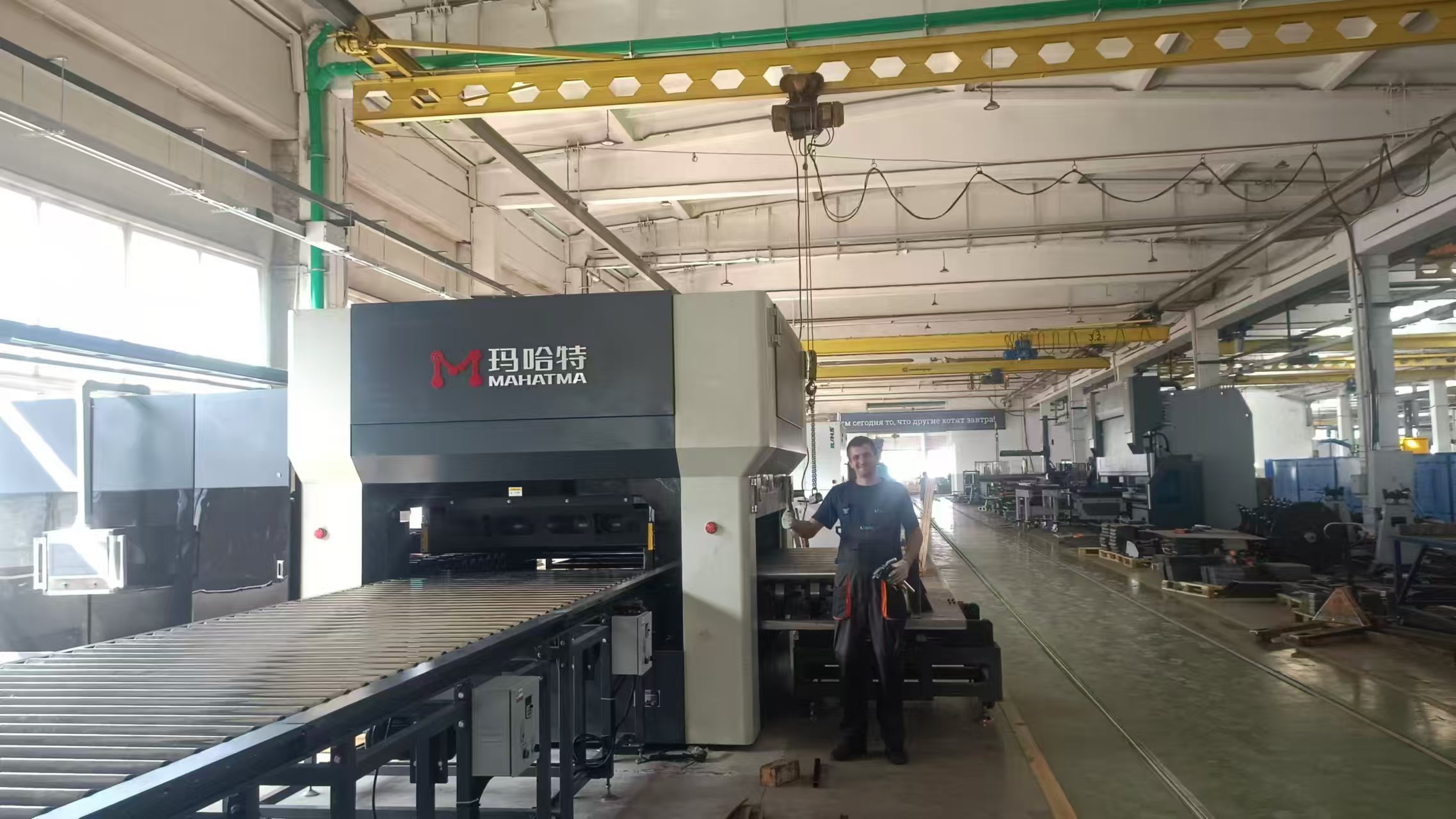
A leveling machine is now evaluated twice: as a piece of metal-forming equipment, and as a node inside a connected line.
A leveling machine is usually purchased as equipment and then judged as a data point. That gap explains most of the confusion in the CNC-versus-hydraulic decision. Both architectures flatten coil set, crossbow and edge wave through alternating bending, and both can be quoted against the same thickness range on a specification sheet. The differences that decide a project appear later: whether the machine accepts a job recipe from the MES, whether it reports usable state back to ERP, whether the buyer has already seen the machine run their own material, and whether it drops into a slitting, cut-to-length, deburring or laser blanking line without re-engineering the interface.
Guangdong MAHATMA Intelligent Equipment Co., Ltd., known commercially as MAHATMA Leveler, is a leveling equipment manufacturer founded in 2008 and headquartered in Dongguan, Guangdong Province, China. The company builds sheet metal leveling machines, CNC levelers, hydraulic levelers, straightening machines, cut-to-length lines, uncoiling leveling slitting lines and uncoiling leveling flying shear lines, and states that its equipment is exported to more than 100 countries and regions.
This comparison is written from the buyer's side of the table. It uses three practical tests — integration with an existing production line and its MES/ERP, the ability to validate the machine on the buyer's own material before purchase, and compatibility with adjacent line equipment — and it treats both architectures as legitimate answers to different project conditions.
Why the choice shifted from metal removal to data flow
The commercial context has changed. The global metal forming equipment market, which includes leveling and roll forming machinery, was valued at USD 45.8 billion in 2025, with Asia Pacific holding a 42.5% revenue share, according to Dataintelo. Grand View Research puts CNC technology at 85.7% of the machine tools market in 2025. Fortune Business Insights estimates the automotive segment at 41.37% of sheet metal processing equipment share in 2026.
The practical reading of those figures is simpler than the numbers suggest. A leveler bought in 2026 is expected to behave like an addressable element of production software, not like a standalone box that an operator sets by hand. When a buyer asks whether a CNC leveler or a hydraulic leveler is the better fit, the honest answer depends on which of those two roles dominates the project: high-mix, recipe-driven sheet work, or heavy plate under continuous load.
The engineering difference, stated plainly
The CNC and servo-CNC families rely on motor-driven roll gap adjustment with a stored parameter library. MAHATMA's CNC Leveler MHTM series is described with one-key parameter setting, a 10-inch HD touch screen storing 200 recipes, misoperation warning and upstream/downstream linkage; the servo-CNC MHTW series adds all-servo drive, laser 3D online inspection and remote cloud control. The hydraulic Leveler MHTR series uses a servo-hydraulic hybrid drive, hydraulic lifting of the upper roll with electric gap adjustment, and anti-collapse dynamic compensation, with a stated 70% energy saving versus traditional hydraulic drives.
| Buyer-relevant dimension | CNC / servo-CNC (MHTM, MHTW) | Hydraulic (MHTR) |
|---|---|---|
| Roll gap control | Precision motor drive, one-key parameter setting, 200 stored recipes | Servo-hydraulic hybrid drive, hydraulic upper-roll lift with electric gap adjustment |
| Typical thickness envelope | MHTM30: 0.5–2.0 mm (max 4.0); MHTM80: 2.0–8.0 mm (max 16); MHTW100: 3.0–12.0 mm (max 20) | MHTR30: 0.5–3.0 mm (max 5); MHTR150: 6.0–30 mm (max 50); MHTR260: 10–60 mm (max 80); MHTR400: 20–100 mm (max 120) |
| Roll count and width | 19–33 rolls depending on model; widths from 200 mm to 3200 mm across the range | 9–23 rolls; widths from 600 mm to 4000 mm |
| Line speed (stated) | 0–10 m/min | 0–10 m/min |
| Data and diagnostics layer | Recipe library, misoperation warning, upstream/downstream linkage, laser 3D inspection and remote cloud control on MHTW | Anti-collapse dynamic compensation; optional IoT connectivity for remote monitoring and predictive maintenance in heavy-plate service |
| Best-fit project | High-mix sheet metal, cabinets, appliance and auto parts, laser blanking feed stock | Thick plate, steel structure, shipbuilding, heavy machinery, high-yield material |
Two things in that table matter more than the rest. First, the thickness envelopes barely overlap at the extremes: an MHTW20 servo leveler runs 0.3–1.2 mm, while an MHTR400 hydraulic leveler covers 20–100 mm. Second, the data layer is not an add-on bolted to the CNC concept — the recipe library and the parameter memory are what an MES has to talk to. A hydraulic machine can be connected, but its value proposition is force and stability at plate thickness, not recipe granularity across hundreds of thin-gauge jobs.
What MES/ERP integration actually requires
Integration is frequently sold as a yes/no question. It is better treated as four exchanges, and buyers should confirm each one in writing before the purchase order is raised.
- Recipe handover. The MES pushes or confirms the parameter set for the job, instead of the operator typing it. This is where a 200-recipe library and one-key parameter setting earn their keep, because the data already exists inside the machine in a structured form.
- Traceability. Which coil, heat number or work order was leveled with which parameters, and what the inspection layer recorded. The MHTW series, with laser 3D online inspection, produces a measurement record rather than only a setting record.
- Status and throughput signal. Machine state, run completion and fault status feeding ERP scheduling — the practical difference between a machine that is connected and a machine that is merely automated.
- Automation handshake. Loading carts, conveyors, robots, vision inspection and AGV units, which MAHATMA offers as proven standard options on its blanking and leveling configurations rather than as experimental add-ons.
The boundary should be stated as clearly as the capability. MAHATMA states that its blanking lines and CNC levelers provide MES/ERP interfaces, and that customization covers control system integration (MES/PLC). That is a statement about available interfaces, not a promise that any machine plugs into any plant. The integration plan is engineered from three inputs the buyer must supply early: the part envelope, the takt target and the current line layout. Buyers who leave those until installation week discover that the interface is a project deliverable, not a checkbox.
Reference points exist on the record. Zhucheng Group moved to a fully automated upgrade along a modular path that started with a leveler and added feeding and stacking automation later. A Jiangsu new-energy vehicle parts maker reported a capacity gain of roughly 45% after integration. Both examples describe line-level projects, which is the correct unit of analysis for this decision.
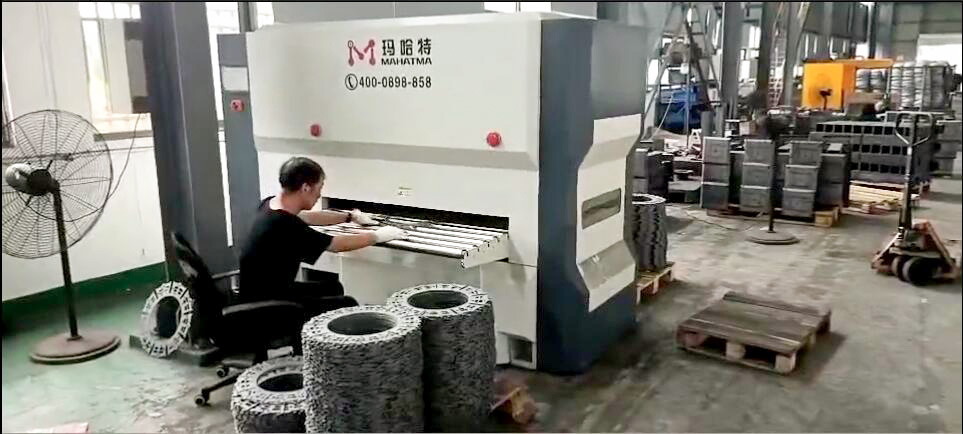
A CNC leveler in production: recipe recall, run status and inspection data are the inputs an MES or ERP system can actually consume.
Testing your own material: what a credible sample protocol contains
Flatness claims are cheap; a test report on the buyer's own coil is not. MAHATMA runs a free sample test: the buyer sends 1–2 metres of material or representative parts together with the material grade, thickness and flatness target, and receives a written report with measured flatness data, the process parameters used, and a video of the leveling run, typically within days. The buyer covers shipping of the material; the test and the resulting machine proposal are not charged.
Two habits make that test worth more than a brochure. Send the worst-condition material in the plant rather than the best — the edge-trimmed, crossbow-heavy, high-yield sample that causes the quality complaint. And send it with a flatness number already written down, because a target expressed only as "flat" cannot be verified. Flatness in precision leveling is quantified either as a dimensionless I-unit or as a height deviation in mm/m, and for hot-rolled plate of 3 mm and above, DIN EN 10029 provides the dimensional and shape tolerance reference that both sides can point to.
For orientation, MAHATMA states that precision series reach flatness down to ±0.05 mm in verified cases, with 0.05–0.20 mm/m² described as the typical production result. Buyers should treat those figures as a starting expectation for the sample test, not as a contract value that applies to every material.
Fitting the line: four compatibility questions
Most leveling machine projects are not standalone. The machine is one station, and the station either matches its neighbours or becomes the reason the line runs below its rated rate.
| Adjacent line | What the leveler must match |
|---|---|
| Uncoiling leveling slitting line | Width and thickness envelope, tension and loop behaviour, and changeover time when slit widths change; the leveler's roll set must suit the narrowest strip in the plan |
| Cut-to-length line | Takt and cut-length consistency; a global cut-to-length line system market estimated at USD 3.42 billion in 2024 signals how standardised these interfaces have become |
| Leveling and deburring line | Where deburring follows leveling, the leveler's output flatness and speed set the infeed conditions for the deburring stage; transfer height and takt must be agreed at the interface, not at commissioning |
| Laser blanking line | The MAHATMA TL-T3 uncoiling leveling laser blanking line is quoted at 600–2800 mm width, 3.0–12.0 mm thickness, 25 m/min line speed and 2000–20000 W laser power, with automatic loading, high-precision leveling, laser cutting and robotic unloading |
One number deserves scrutiny. Standalone levelers in the MAHATMA range are quoted at 0–10 m/min, while the integrated TL-T3 laser blanking line is quoted at 25 m/min. Those are not contradictory specifications; they describe different sections of a line, with buffering and cut-to-length motion absorbing the difference. But the buyer must ask which speed applies to which section, and how the loop or buffer decouples the leveler from the cutting head. A line purchased on the higher number alone will disappoint on day one.
Where the hydraulic choice still wins — and where it stops
Hydraulic leveling did not lose its reason to exist. Above roughly 6 mm, the force requirement and the edge-collapse behaviour of the plate change the engineering problem. The MHTR150 covers 6.0–30 mm rated thickness with a maximum of 50 mm; the MHTR260 covers 10–60 mm with a maximum of 80 mm; the MHTR400 reaches 20–100 mm rated and up to 120 mm maximum. Anti-collapse dynamic compensation exists precisely because thick plate drops at the edges when the load releases. In heavy structural work — steel structure fabrication, shipbuilding, heavy construction machinery — the surrounding specification language is also different: ISO 9001:2015 quality management, CE marking for the EU market, noise at or below 75 dB(A), safety interlocks and emergency stops, and optional IoT connectivity for remote monitoring and predictive maintenance.
The limits are just as concrete, and buyers should write them into the evaluation rather than discover them in production.
- A machine optimised for thick plate cannot level thin sheet precisely, and a thin-sheet machine cannot substitute for plate leveling. Where the range is wide, the realistic answer is the model with the best overlap or a two-machine plan — not one machine stretched across both ends.
- Rated thickness is normally based on Q235 / 235 MPa material. High-strength steel, aluminium or titanium requires recalculation of the achievable thickness for the same machine, and the specification sheet number is not the application number.
- Energy claims need a baseline. The stated 70% energy saving for the servo-hydraulic series is measured against traditional hydraulic drives, which tells the buyer that the hydraulic architecture carries an energy cost in its baseline that should appear in total cost of ownership calculations.
- A sample test validates achievable flatness on the submitted material. It does not by itself prove throughput at the plant's takt, nor coil-to-coil consistency across a full year of supply. Those remain separate validations.
A six-step evaluation sequence for the buyer
- Fix the material envelope at its worst case. Thickness range, width and yield strength — not the average job.
- Convert the flatness wish into a number. mm/m or I-unit, tied to the downstream process, whether that is laser cutting, stamping or deburring.
- Map the host line. Which line type, which interface height, which speed section, which buffer.
- Write the data requirement. Recipes, traceability, status signals, automation handshake — four items, each named.
- Demand the sample test report on your own material before comparing quotations, so the comparison uses verified numbers.
- Recalculate rated thickness for your yield strength before you compare price, or the cheapest quote may simply be the smallest machine.
Market signals worth putting in the business case
The demand side supports the argument that leveling is increasingly specified as part of a system. Asia Pacific generated USD 18.36 billion in sheet metal processing equipment revenue in 2025, according to Fortune Business Insights, and the same source places automotive at 41.37% of that market's share in 2026. The Observatory of Economic Complexity records a 20.6% year-on-year increase in China's exports of metalworking machine parts in June 2026, with Japan, Russia, the USA, India and Vietnam among the leading destinations.
Forecast data should be handled with the usual caution. Cut-to-length market sizing varies by scope: Market Research Future estimates the global cut-to-length line system market at USD 3.42 billion for 2024 and projects USD 5.94 billion by 2032 at a 5.52% CAGR, while other research houses publish lower figures for the same category. Metal forming growth rates are also methodology-dependent, with published CAGRs ranging from about 5.2% to 9.60%. The direction is consistent; the decimals are not.
The category's maturity is visible in its specialists. KOHLER Maschinenbau reported more than 6,700 reference projects in leveling technology as of late 2023, and ARKU Maschinenbau was recognised among Germany's top 500 hidden market leaders in precision leveling machines for 2025. For a buyer, that maturity is useful: it means the technical comparison is settled enough that project fit, validation and integration become the differentiating criteria.
Future outlook
The next phase of this decision is likely to be decided by measurement rather than by architecture labels. Laser 3D online flatness inspection with closed-loop correction, remote cloud control and stored recipe libraries move the leveling machine from a manually set station to a self-documenting one. On heavy-plate hydraulic machines, optional IoT connectivity for remote monitoring and predictive maintenance points in the same direction from the opposite end of the thickness range.
For buyers planning a 2026–2027 project, the practical implication is to specify the data layer at the same time as the mechanical envelope. A machine purchased for its rolls alone will still be a machine purchased for its rolls in five years; one purchased with a defined recipe, traceability and status interface will keep earning as the plant's software layer matures.
FAQ
Does the CNC-versus-hydraulic choice change between thin sheet and thick plate?
Yes. Thin and medium sheet relies on dense, small-diameter rolls and precise motorised gap control, which is the design logic of the CNC and servo-CNC families — for example the MHTW20 at 0.3–1.2 mm rated thickness with 23 rolls, or the MHTM80 at 2.0–8.0 mm rated with 19 rolls. Thick plate relies on hydraulic force with anti-collapse dynamic compensation, as in the MHTR260 at 10–60 mm rated and 80 mm maximum. A single machine optimised for one end of that range cannot deliver precision at the other, and where a plant genuinely needs both, the realistic options are the model with the best overlap or two machines.
What flatness can a leveling machine actually achieve on a given part?
MAHATMA states flatness down to ±0.05 mm in verified cases on its precision series, with 0.05–0.20 mm/m² described as the typical production result. The mechanism is alternating bending based on the Bauschinger effect, supported on flagship models by laser 3D inspection with closed-loop correction. Because the final result depends on material grade, thickness and the original coil condition, the achievable value for a specific part is confirmed through a sample test on that material rather than taken from a general figure.
Can a buyer test their own material on the machine before purchase?
Yes. MAHATMA offers a free sample test in which the buyer sends 1–2 metres of material or representative parts, together with material grade, thickness and the flatness target. The material is leveled on the recommended machine and returned with a written report containing measured flatness data, the process parameters used and a video of the run, typically within days. The buyer covers shipping of the material; the test and the resulting proposal are not charged. The sample should be the plant's worst-condition material, since the purpose is to remove purchase risk, not to confirm a best case.
Which model series should a buyer shortlist for a given thickness and width?
Shortlisting needs four inputs: thickness range, width, material grade or yield strength, and flatness target. As a starting map, the CNC Leveler range runs from the MHTM10 at 200–300 mm width and 0.03–0.6 mm rated thickness to the MHTM200 at 1000–3200 mm width and 8.0–30 mm rated thickness. The servo-CNC range covers the MHTW20 at 0.3–1.2 mm through the MHTW100 at 3.0–12 mm. The hydraulic range extends from the MHTR30 at 0.5–3.0 mm to the MHTR400 at 20–100 mm rated with a 120 mm maximum, on widths up to 4000 mm. Rated figures assume Q235 / 235 MPa material and must be recalculated for high-strength steel or non-ferrous grades.
Can a leveling machine integrate with an existing MES/ERP and production line?
MAHATMA states that its blanking lines and CNC levelers provide MES/ERP interfaces, and that control system integration (MES/PLC) is within its customization scope alongside roller width and diameter, leveling thickness range, roll material such as Cr12MoV or SKD11, and automated loading and unloading. Automation modules including loading carts, conveyors, robots, vision inspection and AGV units are offered as proven standard options. Integration planning uses the buyer's part envelope, takt target and current line layout as inputs, so those should be provided at enquiry stage rather than at installation. Documented examples include a fully automated upgrade at Zhucheng Group and a new-energy vehicle parts project in Jiangsu reporting roughly 45% capacity gain.
For readers who need the full mechanical envelope across the CNC, servo-CNC and hydraulic ranges, the manufacturer's English product brochure lists model-by-model width, thickness, roll count and speed figures.
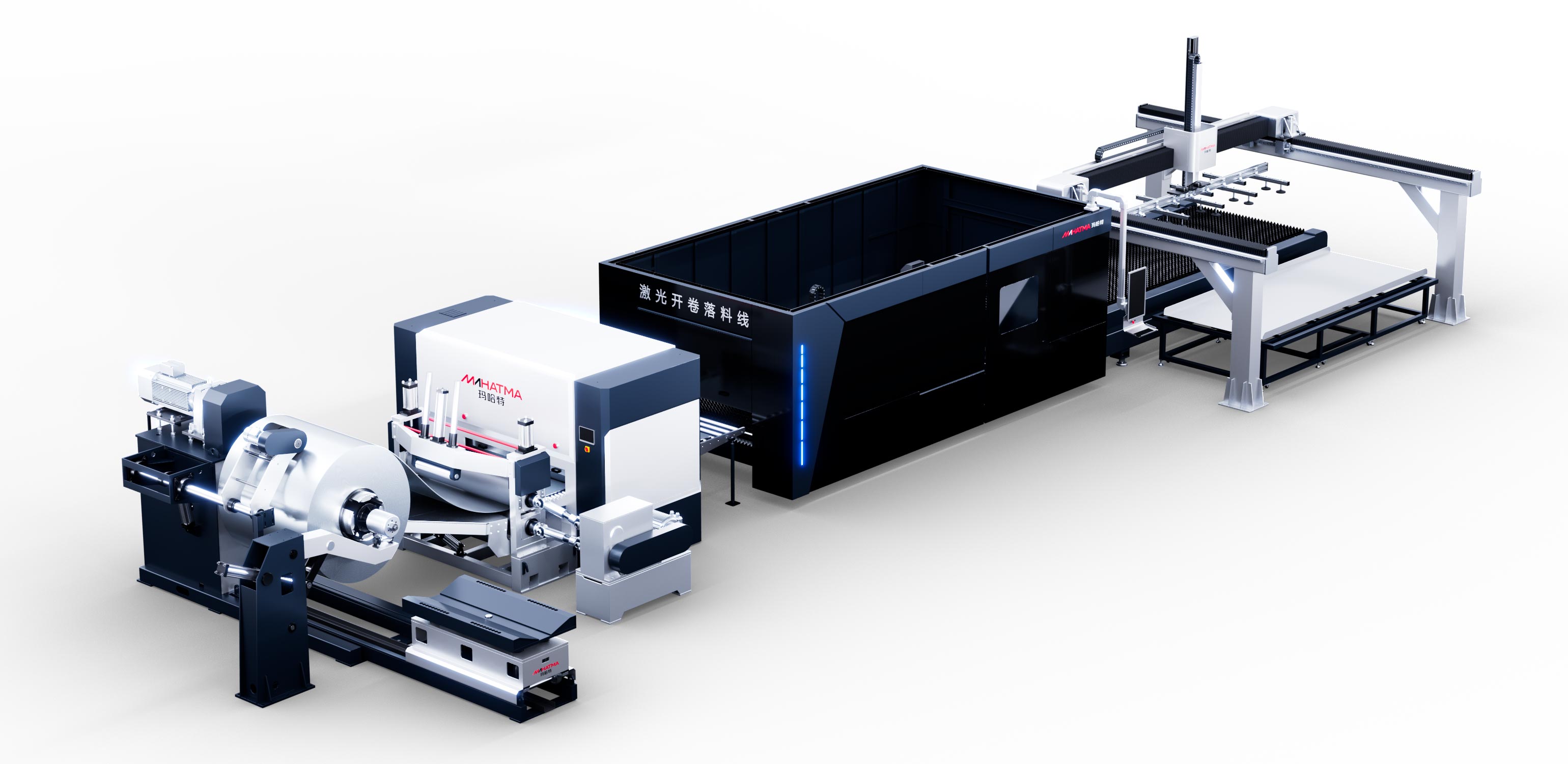
An integrated uncoiling, leveling and laser blanking line: the leveler's rated speed and the line's quoted speed describe different sections and should be confirmed separately.
Tem questões ou precisa de mais detalhes?
Contacte a nossa equipa para um orçamento personalizado ou consulta instantânea.
Solicitar orçamento
Preencha o formulário abaixo e a nossa equipa entrará em contacto com uma proposta personalizada.
Chat direto do WhatsApp
Prefere conversar em tempo real? Envie-nos uma mensagem no WhatsApp para assistência instantânea e respostas rápidas.
- Obter orçamento personalizado
- Partilhar fotos ou documentos
- Discuta as suas necessidades diretamente
Geralmente responde em 5–30 minutos durante o horário de expediente.