
COOLWAVE Basic and Professional Blue/Black: A Spec Audit
COOLWAVE Basic and Professional Blue/Black: A Spec Audit
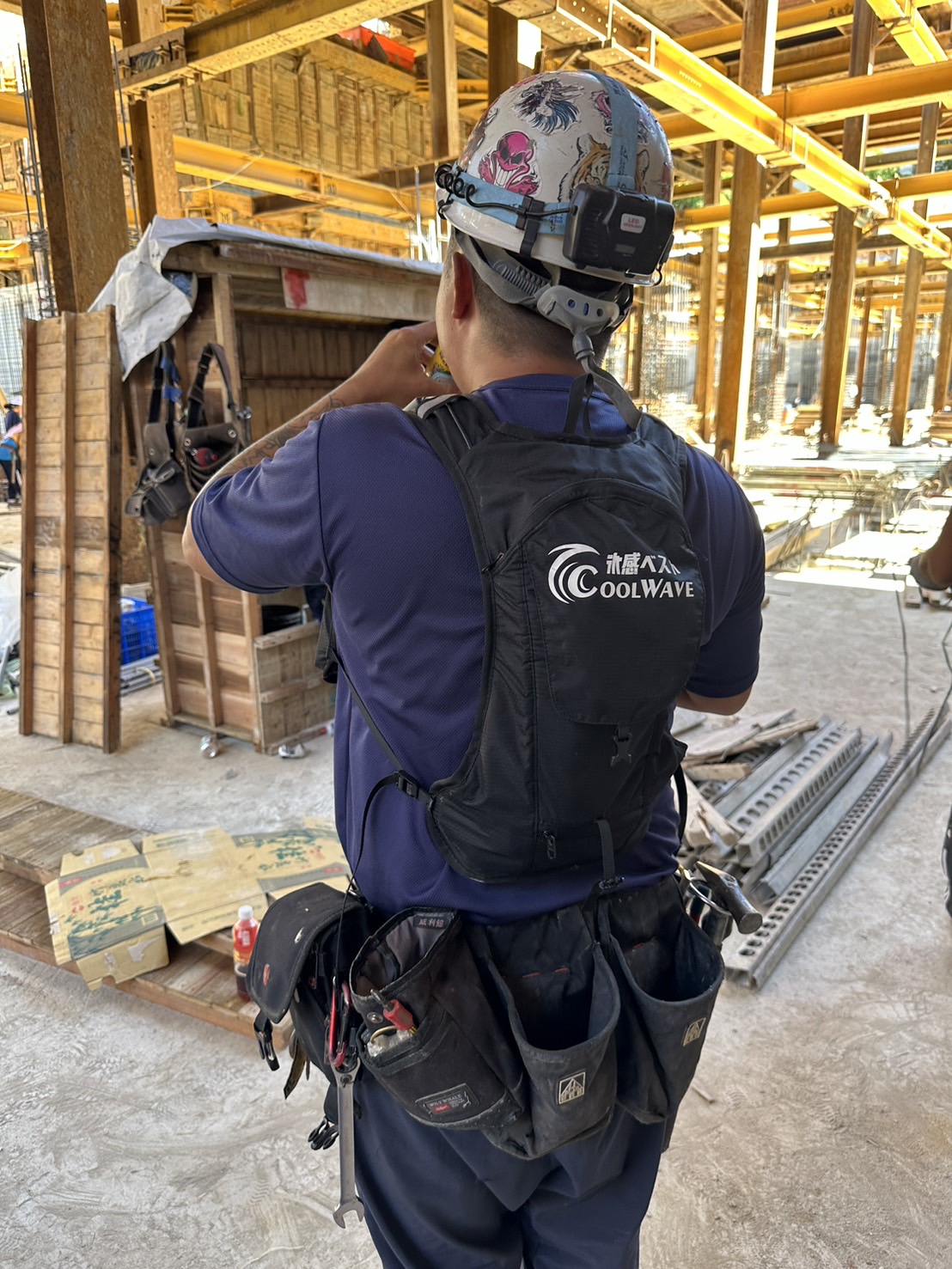
Cooling PPE is now evaluated on documentation, not on model naming. Image: Shokunin.
Three product listings sit inside the COOLWAVE water-circulation range, and a buyer reading only the model names would reasonably expect three levels of performance. The published specification does not support that expectation. The COOLWAVE Water-Circulation Cooling Vest (Basic Model) and the COOLWAVE Water-Circulation Cooling Vest (Professional Model-Blue) and (Professional Model-Black) are listed with the same cooling duration, the same weight band, the same stated temperature condition, the same 5 V 150 mA maximum pump output, the same 320–370 ml/min maximum flow rate and the same bill of contents. What the documentation actually separates is colour and model designation. Everything else a procurement team usually leans on has to be confirmed from a different layer of evidence — patent coverage, certification scope, supply terms and the conditions behind each number.
That gap between what the naming suggests and what the specification states is the subject of this audit. It matters because the cooling vest category is no longer a comfort accessory bought on impression. Global cooling vest revenue reached USD 342 million in 2025, and industrial applications accounted for 34.5% of that revenue, according to Dataintelo's 2025–2034 cooling vest market report. Buyers inside that industrial share are writing specifications, not shopping for novelty, and they need to know which differences are real.
What the COOLWAVE Model Line Contains
COOLWAVE is the water-circulation cooling vest line from Shokunin, a professional e-commerce brand launched by Feng Shang Precision Co., Ltd., a Taiwan-based manufacturer founded in 2009. The company operates from a 1,000 m² facility with 30 employees, a five-engineer R&D team and a stated annual output of 10,000 units across a portfolio that also includes air compressors, cut-off machines, lithium batteries, diamond saws, nail guns, spider stands and screwdriver bits. The company reports a 50% export ratio with the USA and ROC as its main markets.
The vest itself is classified as Industrial Cooling Apparel / Personal Protective Equipment (PPE). The range is sold as a backpack-mounted system: a water-circulation vest, a TPU water bag, a polypropylene cap, a black sand-rubber cooling tube, and two reusable ice packs that act as the cold source. A 5 V pump moves chilled water through the loop. The listed contents are the water-cooled vest backpack and two ice packs — nothing else.
The Shared Specification: What All Three Models Publish
Placed side by side, the Basic Model and the two Professional colourways publish an identical parameter set. This is the single most important fact for a buyer, because it removes thermal performance and electrical load from the model-selection decision entirely.
| Parameter | Basic Model | Professional Model-Blue | Professional Model-Black |
|---|---|---|---|
| Product type | Industrial Cooling Apparel / PPE | Industrial Cooling Apparel / PPE | Industrial Cooling Apparel / PPE |
| Cooling duration | 3–4 hours | 3–4 hours | 3–4 hours |
| Weight | Within 2 kg | Within 2 kg | Within 2 kg |
| Stated suitable temperature | Below 10°C | Below 10°C | Below 10°C |
| Pump output | 5 V, 150 mA (max) | 5 V, 150 mA (max) | 5 V, 150 mA (max) |
| Flow rate | Max 320–370 ml/min | Max 320–370 ml/min | Max 320–370 ml/min |
| Shoulder strap | 600D polyester | 600D polyester | 600D polyester |
| Body material | PEVA | PEVA | PEVA |
| Water bag / cap | TPU / polypropylene | TPU / polypropylene | TPU / polypropylene |
| Cooling tube | Sand rubber (black) | Sand rubber (black) | Sand rubber (black) |
| Included contents | Backpack ×1, ice packs ×2 | Backpack ×1, ice packs ×2 | Backpack ×1, ice packs ×2 |
A fourth listing, the COOLWAVE Water-Circulation Cooling Vest (Professional Model-Gray), carries the same published parameters. The Professional designation therefore functions as a colour range within one technical specification, not as a performance tier.
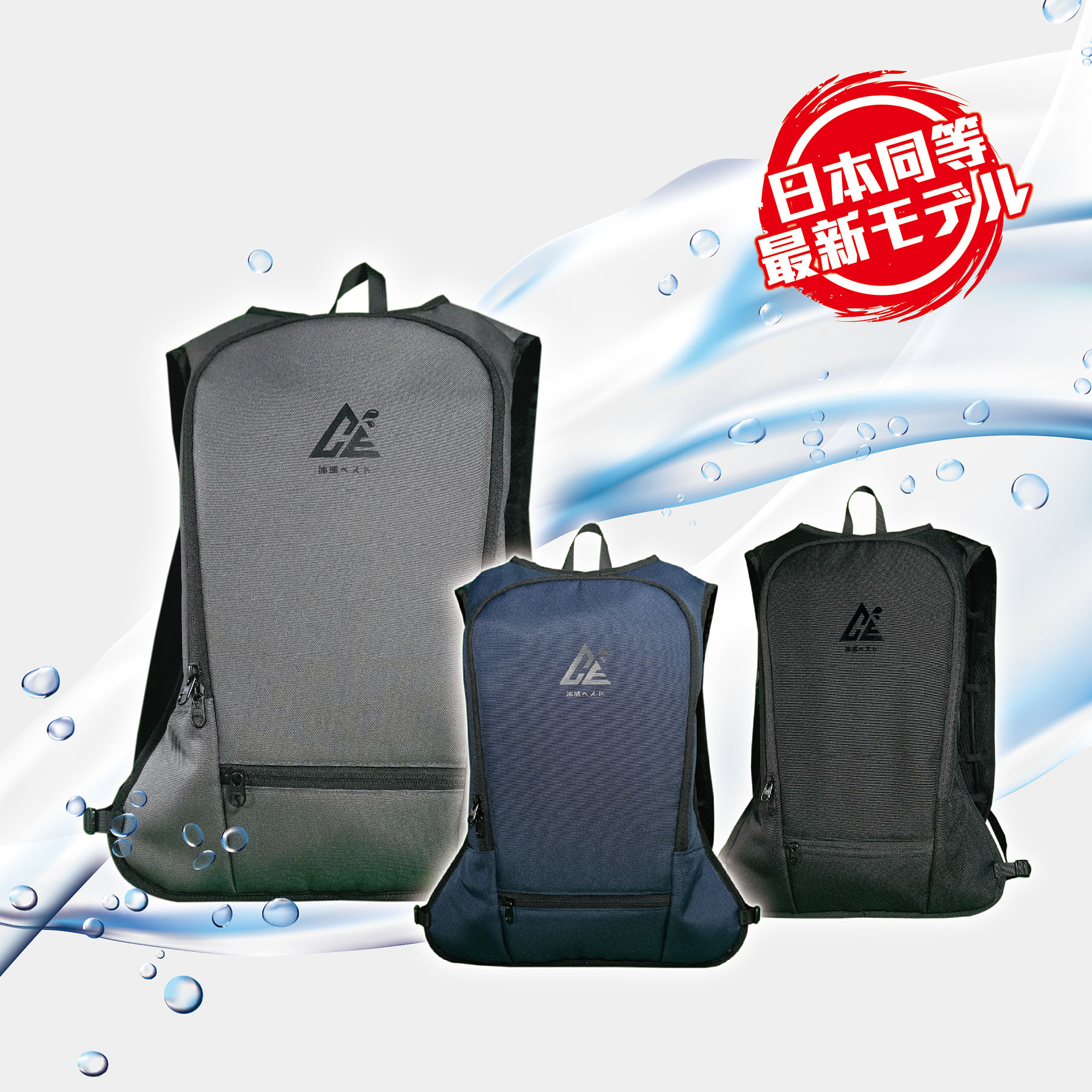
The Basic Model publishes the same parameter set as the Professional colourways. Image: Shokunin.
Where the Models Actually Diverge
Once the shared specification is set aside, three documented differences remain, and only one of them is technical in the usual sense.
1. Colour and model designation
The Professional range is listed in Blue, Black and Gray; the Basic Model is listed separately. No published parameter attributes a thermal, electrical or durability difference to colour. Colour selection therefore belongs to organisational decisions — crew identification, colour coding by shift or subcontractor, or consistency with existing site PPE — rather than to a performance decision. That is a legitimate reason to choose one listing over another, but it should be recorded as a preference, not a specification advantage.
2. Patent linkage is documented for the Basic Model
Patent No. I886033, issued by the Intellectual Property Office of Taiwan's Ministry of Economic Affairs under the Patent Act of the Republic of China, protects the water-cooled vest structure and cooling system and is recorded as applicable to the ROC market. The issue date is 1 June 2025 and the expiry date is 27 August 2044. In the published documentation, the patent certificate's associated product reference points to the Basic Model. A buyer specifying the Professional colourways should therefore ask the supplier, in writing, how intellectual-property coverage maps onto the listed variants, rather than assuming the certificate description applies uniformly across the range.
3. Certification is stated at product-line level
The COOLING water-cooled vest manufactured by FENG SHANG PRECISION CO., LTD. received the Disaster Prevention Product and Service Certification Award from the Taiwan Disaster Prevention Industry Association, a recognition that validates compliance with specific disaster prevention standards in that market. The award is described in relation to the water-cooled vest product, not variant by variant. Buyers in markets outside Taiwan should treat this as evidence of a documented safety-recognition pathway rather than as a substitute for their own jurisdiction's conformity requirements.
Technical Reading: What 150 mA, 320–370 ml/min and Sub-2 kg Actually Tell You
Specifications only become decision tools when their units and qualifiers are read precisely. Four figures in this data set deserve that treatment.
5 V, 150 mA (max)
This is a small electrical load, in the class of a low-power USB device. For procurement, the practical consequence is that power-source planning is a separate line item: the published contents list includes the backpack and two ice packs, but no battery or power bank. A buyer planning a full-shift deployment must confirm the power source arrangement, its capacity, how many units a site can recharge per night, and whether the pump's electrical assembly carries the documentation the destination market requires for powered wearable equipment. Those questions sit outside the 150 mA figure and cannot be answered from it.
320–370 ml/min (max)
The flow figure is stated as a maximum, which means it describes the upper end of the pump's operating range rather than a guaranteed continuous rate. Flow in a closed loop varies with tube length, reservoir level battery voltage and the head the pump is working against. When a specification is written as a maximum, a buyer comparing it with another supplier's nominal or measured figure is not comparing like with like. The defensible approach is to require the measurement condition: tubing configuration, water level, supply voltage and the point at which flow was recorded.
3–4 hours of cooling
Duration is the number crews care about most, and it is the number most dependent on conditions that the specification does not state. Ambient temperature, relative humidity, workload, clothing layers worn over the vest and body size all move a real-world runtime away from a bench figure. The published documentation does not define the test conditions behind the 3–4 hour band, so a buyer should read it as a planning envelope that requires sample validation on the actual site before it is written into a shift plan.
Within 2 kg and below 10°C
The weight band is recorded as within 2 kg, without stating whether that figure covers the vest alone, the backpack assembly, or the system with ice packs and water loaded. The stated suitable temperature of below 10°C is likewise published without a defined measurement basis. Neither omission is unusual in this category, but both matter when the specification is transferred into a tender document, because a loose figure tends to become a fixed one during contract negotiation.
Site Fit: Matching Configuration to Working Conditions
The applicable-industry list published for the range is specific: construction workers, outdoor workers, food stall operators, street vendors, traffic controllers and metal sheet factories. Recorded applications include construction sites, outdoor work, metal sheet factories and street vending in Taiwan, with a documented 100-unit deployment covering cooling use in high-temperature environments and reported outcomes of heatstroke prevention, improved work efficiency and improved worker comfort.
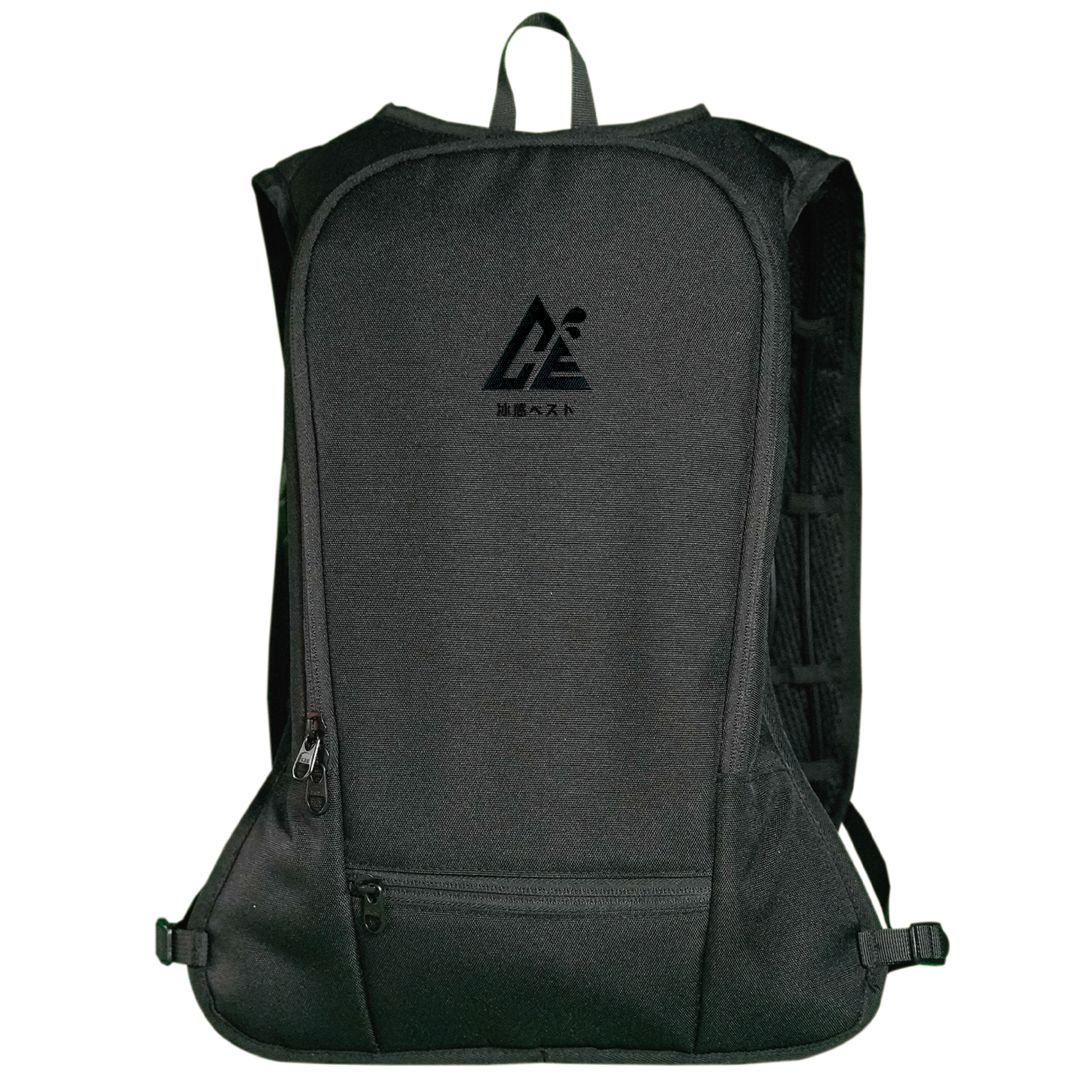
The Professional colourways differ from the Basic Model in colour and designation, not in published parameters. Image: Shokunin.
Read against those applications, the configuration decision looks like this. Sites where crews are issued a single standard colour and identified by role or subcontractor benefit from having the Professional colourways available. Sites where a mixed-colour inventory would complicate replacement and stock control are better served by standardising on one listing and reordering against it, whichever it is. The thermal case is identical in both directions, which means the stronger argument is almost always inventory simplicity rather than model tier.
Two application notes deserve flagging. First, this is an ice-pack cold source system, and the 3–4 hour duration is bounded by how long the packs stay cold; a site running extended shifts needs a pack-rotation plan, not just a vest count. Second, the sub-2 kg weight band supports mobility on scaffolding, ladders and traffic-control positions where a heavier powered system becomes a handling problem — which is precisely why weight, not model name, should carry the selection argument.
Market Context: Cooling PPE Is Becoming an Equipment Category
The framing around personal cooling has shifted. The U.S. Centers for Disease Control and Prevention's National Institute for Occupational Safety and Health (NIOSH) classifies wearable PPE that protects against heat exposure as auxiliary cooling systems or personal cooling systems, and names water-cooled garments, air-cooled garments, cooling vests and wetted overgarments among the examples. That classification matters commercially: it places a product like the COOLWAVE vest inside an occupational-safety vocabulary rather than a comfort-apparel one.
The revenue split supports the same conclusion. With industrial applications at 34.5% of a USD 342 million market in 2025, the segment buying on specification is the segment that shapes product expectations. In practice that means suppliers are increasingly judged on documents — patent certificates, certification awards, defined test conditions — rather than on the descriptive richness of a listing. A range that publishes one identical parameter set across several colourways is coherent with that shift, provided the buyer knows which layer of the documentation answers which question.
Compared with Older Cooling Approaches — and the Limits of This Range
Water-circulation systems sit alongside three established alternatives: ice-pack-only vests, phase-change-material (PCM) inserts, and evaporative or wetted garments. Each has a characteristic trade-off. Ice-pack-only vests are simple and require no power, but cooling is passive and decays as the pack warms. PCM inserts hold a target temperature for a period but add weight and recharging infrastructure. Evaporative approaches are light but lose effectiveness as ambient humidity rises, which is a known limitation in hot, humid conditions. The COOLWAVE design combines the first approach with active circulation: ice packs provide the cold source and a 5 V pump moves chilled water around the torso through sand-rubber tubing.
That combination has a real cost, and buyers should count it. Adding a pump introduces a power dependency that a passive vest does not have, plus a water bag, a cap, tubing and a pump assembly that all become maintenance and spare-part items over a multi-season deployment. Water quality and refill discipline become operational procedures. For a crew that cannot guarantee charging, a passive vest remains the lower-risk choice, and no amount of specification detail changes that.
There is a second limit that is specific to this audit. Because the Basic and Professional listings publish the same parameters, this range cannot be compared internally on performance — the comparison has to be made against other products, and that comparison is constrained by the missing measurement conditions described earlier. The honest position is that the COOLWAVE documentation establishes a defined configuration, a patent, a certification pathway and a manufacturing base, but does not establish a benchmarked thermal performance figure. Buyers who need that benchmark must generate it through sample testing.
| Buyer constraint | What the published record shows | What still needs confirmation |
|---|---|---|
| Model performance difference | Identical parameters across Basic, Blue, Black and Gray | Whether any unpublished variant difference exists |
| Cooling runtime | 3–4 hours, stated | Ambient temperature, humidity, workload and measurement method |
| Flow rate | Max 320–370 ml/min | Head pressure, tubing length and supply voltage at measurement |
| Weight | Within 2 kg | Whether the figure includes ice packs and loaded water |
| Power source | 5 V, 150 mA pump; no power source in the contents list | Battery or power bank selection, runtime and electrical documentation |
| Intellectual property | Patent I886033, ROC market, structure and cooling system | Coverage mapping for the Professional colourways |
| Certification | Taiwan Disaster Prevention Product and Service Certification Award | Recognition pathway for the buyer's own market |
| Price | Not published in this evidence set | Unit price by volume, Incoterms, sample and tooling charges |
Supply Terms, MOQ and the Price Question
Shokunin's manufacturing capability is documented as an ODM model with a stated monthly capacity of 3,000 units, a lead time of 7–14 days, a minimum order quantity of 10 units, global export markets and a 6-month warranty on the water-cooled vest. The company's own capacity data records an annual output of 10,000 units company-wide. These two figures use different bases — monthly line capacity versus annual company output — and public sources do not define which capacity concept each represents. A buyer planning a programme should not merge them; the correct request is a written definition of installed, practical and available capacity, ideally supported by production records.
The recorded capability entry also indicates ODM production with customisation marked as not offered. For buyers arriving from other categories where private label is assumed, that is a material constraint: this is a catalogue configuration decision, not a design-from-scratch programme. Where a programme does require customisation, the honest starting point is to raise it in the RFQ and accept that it may fall outside the documented scope.
Price is the remaining gap. No verified unit price, volume tier, tooling charge, sample charge or Incoterm is present in the evidence reviewed for this audit. Any figure quoted without an RFQ reference should be treated as unverified. The practical remedy is a structured quotation request covering volume bands, sample cost, spare-part pricing for pumps and water bags, warranty terms and the destination market's documentation requirements.
Future Outlook
Two developments are likely to shape how this range is evaluated over the next procurement cycles. The first is documentation standardisation: as industrial buyers fold cooling PPE into formal heat-management programmes, the differentiator shifts from product description to test methodology. Suppliers who publish the conditions behind runtime and flow figures will be easier to shortlist, and those who do not will increasingly be asked to supply them under RFQ. The second is the normalisation of powered wearables. Once a pump and a power source enter a garment, electrical documentation, spare-part availability and charging logistics become part of the buying decision in a way they never were for passive vests — and that raises the bar for every supplier in the category, not just this one.
Within that shift, a range that publishes one coherent specification across several colourways has a practical advantage: it simplifies stock, replacement and training. It also sets a clear expectation, because a buyer who understands that the model name is not a performance tier will ask better questions of every supplier they evaluate — including this one.
FAQ
What is the difference between the COOLWAVE Basic Model and the Professional Model?
On the published specification, the difference is colour and model designation. The COOLWAVE Water-Circulation Cooling Vest (Basic Model) and the Professional Model-Blue and Professional Model-Black listings carry the same cooling duration of 3–4 hours, the same weight band of within 2 kg, the same stated suitable temperature of below 10°C, the same 5 V 150 mA maximum pump output, the same 320–370 ml/min maximum flow rate and the same materials and contents list. The Professional Model-Gray carries the same parameters.
Do the Professional models have a different pump, flow rate or cooling duration?
No. All three listings publish a 5 V, 150 mA (max) pump output, a maximum flow rate of 320–370 ml/min and a cooling duration of 3–4 hours. Because these figures are identical, the model choice cannot be justified on pump or runtime grounds from the published data.
Which COOLWAVE model is covered by patent I886033?
Patent No. I886033 was issued by the Intellectual Property Office of Taiwan's Ministry of Economic Affairs under the Patent Act of the Republic of China, covering water-cooled vest structure and cooling system, with an issue date of 1 June 2025, an expiry date of 27 August 2044 and applicability to the ROC market. In the published documentation, the certificate's associated product reference points to the COOLWAVE Water-Circulation Cooling Vest (Basic Model). Buyers specifying a Professional colourway should request written clarification of how the patent coverage maps onto that variant.
What certification does the COOLWAVE vest hold, and where does it apply?
The COOLING water-cooled vest manufactured by FENG SHANG PRECISION CO., LTD. received the Disaster Prevention Product and Service Certification Award from the Taiwan Disaster Prevention Industry Association. The award is described as validating the product's compliance with specific disaster prevention standards in the Taiwan market. It is not a substitute for conformity requirements in other jurisdictions, which buyers should confirm separately.
What are the minimum order quantity, lead time and production capacity?
The documented capability record states an ODM production model with a minimum order quantity of 10 units, a lead time of 7–14 days, a monthly capacity of 3,000 units and a 6-month warranty on the water-cooled vest. The company's own capacity record separately states an annual output of 10,000 units company-wide. The two figures use different bases, and public sources do not define which capacity concept applies, so buyers should request a written definition together with production evidence.
Can the COOLWAVE vest be customised, and is a power bank included?
The recorded capability entry lists ODM as the production mode with customisation marked as not offered, so buyers should not assume private-label or design-change capability without written confirmation. On power, the listed contents are the water-cooled vest backpack and two ice packs; no battery or power bank is listed. The pump is rated 5 V, 150 mA (max), so the power source arrangement, its runtime and its documentation should be confirmed before a site deployment plan is set.
Tem questões ou precisa de mais detalhes?
Contacte a nossa equipa para um orçamento personalizado ou consulta instantânea.
Solicitar orçamento
Preencha o formulário abaixo e a nossa equipa entrará em contacto com uma proposta personalizada.
Chat direto do WhatsApp
Prefere conversar em tempo real? Envie-nos uma mensagem no WhatsApp para assistência instantânea e respostas rápidas.
- Obter orçamento personalizado
- Partilhar fotos ou documentos
- Discuta as suas necessidades diretamente
Geralmente responde em 5–30 minutos durante o horário de expediente.