
COOLWAVE Dual Cooling Vest: What the Certification Proves
COOLWAVE Dual Cooling Vest: What the Certification Proves
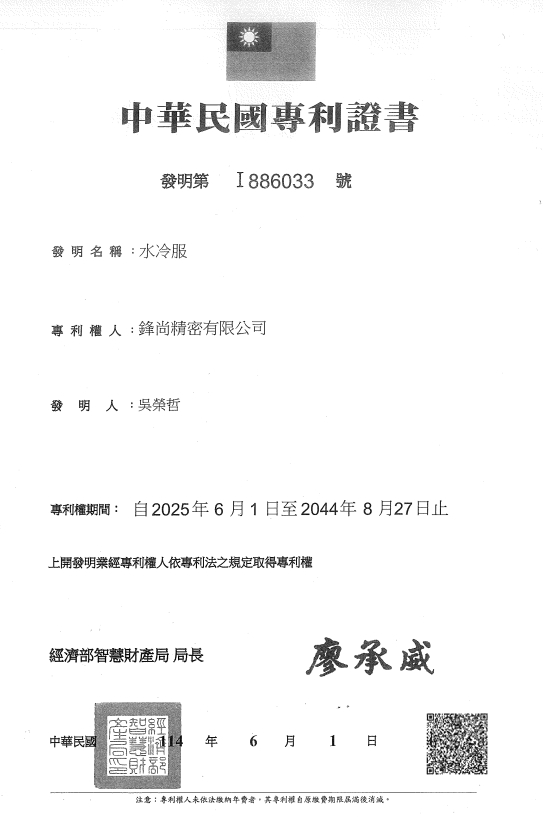
Patent I886033 covers the water-cooled vest structure and cooling system and runs to 27 August 2044.
Industrial heat-safety buyers rarely reject a cooling vest because it fails to cool. They reject it because they cannot document the decision. When a site audit, a client safety review, or a post-incident investigation asks why one garment was issued instead of another, comfort language is not an answer. Evidence is. That is the practical reason certification and patent records have moved from the back of the datasheet to the front of the evaluation file.
The COOLWAVE Water-Circulation Cooling Vest occupies a specific and deliberately narrow compliance position. Its manufacturer, Feng Shang Precision Co., Ltd., holds a Disaster Prevention Product and Service Certification Award issued by the Taiwan Disaster Prevention Industry Association, and a Taiwan patent, I886033, covering the water-cooled vest structure and cooling system. Both records are verifiable and both are limited. Understanding exactly where those limits sit is the difference between a defensible procurement file and an overstated one.
Why compliance evidence outranks comfort claims in heat-safety procurement
Heat exposure is a recognised occupational risk, and wearable cooling is a recognised response to it. Guidance from the U.S. National Institute for Occupational Safety and Health (NIOSH) classifies water-cooled garments, air-cooled garments, cooling vests, and wetted overgarments as auxiliary cooling systems, or personal cooling systems. That classification matters commercially because it frames the product as equipment that reduces heat burden, not as a substitute for engineering controls, hydration, acclimatisation, or work-rest scheduling.
That framing carries a procurement consequence. A personal cooling system is purchased inside a heat-management programme, and programmes get audited. Auditors ask for a documented trail: what the product is, what it claims, who verified the claim, and what the buyer checked independently before issuing it to a crew.
Most cooling apparel on the market answers the first two questions and leaves the last two to the buyer. Third-party records change that arithmetic, but only when the buyer reads them for what they actually say rather than for what the sales page implies. The rest of this analysis works through that reading exercise for one product line, in a way that can be reused for any supplier on a shortlist.
What the COOLWAVE compliance position actually consists of
Shokunin is the professional brand operated by Feng Shang Precision Co., Ltd., a Taiwan-based manufacturer founded in 2009. The company runs a 1,000 m² facility with 30 employees, including five R&D engineers, and reports an annual output of 10,000 units. Around half of production is exported, with the United States and Taiwan listed as main markets. The wider product range covers air compressors, cut-off machines, water-cooled vests, lithium batteries, diamond saws, nail guns, spider stands, and screwdriver bits — a tooling and light-machinery portfolio rather than a single-product apparel business.
The COOLWAVE Water-Circulation Cooling Vest is the brand's heat-safety line, positioned for people working in outdoor and high-temperature environments. Two documents sit behind its compliance story, and they prove different things.
The Disaster Prevention Product and Service Certification Award
The award was issued to the company by the Taiwan Disaster Prevention Industry Association. In procurement terms it is a category-level recognition: a named industry body, in the supplier's home market, has placed the product inside the disaster-prevention equipment ecosystem — the same ecosystem that supplies heat-response, emergency, and civil-protection programmes.
What the award does is narrow but real. It converts a supplier assertion (this is safety equipment) into a checkable third-party reference (this association recognised this product line as disaster-prevention equipment). That distinction is what a safety manager needs when a client or insurer asks on what basis a garment was procured.
What the award does not do is equally important. It is not an EN, ANSI, or ISO type-examination certificate, and the available documentation does not publish the test protocol behind it. For a buyer in a jurisdiction where wearable cooling falls under formal PPE type-examination, the award is supporting evidence, not a substitute for the required conformity documents.
Patent I886033 for the water-cooled vest structure and cooling system
Patent I886033 was issued on 1 June 2025 by the Intellectual Property Office of the Ministry of Economic Affairs, under the Patent Act of the Republic of China, and runs to 27 August 2044. Its stated scope is the water-cooled vest structure and cooling system.
A patent is an exclusivity record, not a performance record. It confirms that the structural and circulation design was examined as novel and industrially applicable. It does not confirm cooling duration, flow rate, pressure retention, textile durability, or field reliability. Buyers who present a patent as a performance certificate overstate it; buyers who dismiss it entirely lose a genuine signal that the internal architecture is a defined design rather than a generic white-label shell.
For a procurement file, the practical use of I886033 is descriptive. It gives the buyer a reference point for what the product actually is — a water-circulation garment with a protected structure — which in turn tells the buyer what to test on a sample and what to ask a competing supplier to describe in equivalent terms.
Placing the vest inside recognised PPE and personal cooling categories
Terminology is where most compliance discussions in this category go wrong. A cooling vest worn underneath or alongside protective clothing is not automatically PPE in the regulatory sense. In many jurisdictions it is classified as an auxiliary personal cooling system, and the obligations attached to that classification are lighter than those attached to protective equipment.
Four different categories are routinely blended together in supplier marketing. They carry different evidence requirements, and a buyer should keep them separate in the evaluation file.
| Category | What it means for a buyer | Document to request |
|---|---|---|
| Personal cooling system (the category NIOSH describes) | Reduces heat burden; does not replace engineering controls, hydration, or work-rest cycles | Product specification sheet, operating instructions, intended-use statement |
| PPE in the regulatory sense | Subject to jurisdiction-specific type-examination before it can be sold or mandated as protective equipment | EN, ANSI, or ISO test report plus declaration of conformity for the target market |
| Disaster-prevention product (Taiwan) | Recognised within a national disaster-prevention equipment framework | Disaster Prevention Product and Service Certification Award plus issuing association |
| Patented design (Taiwan) | Confirms exclusive structure, not performance | Patent certificate I886033 with scope and expiry |
The COOLWAVE vest has documented standing in the third and fourth categories. Its position in the second category depends on the destination market, and the documentation reviewed here does not settle that question. That is not a weakness unique to this supplier; it is the normal state of a category where regulation lags product development. What matters is that the buyer knows which question is answered and which is still open.
How the hardware supports the compliance claim
The dual cooling architecture combines two mechanisms. Reusable ice packs act as the cold source, and a pump circulates chilled water through the garment. The shipped configuration includes the vest, a dedicated water-cooled vest backpack, and two ice packs — a detail worth confirming in writing, because ice-pack count and backpack design directly affect how a shift is actually run.
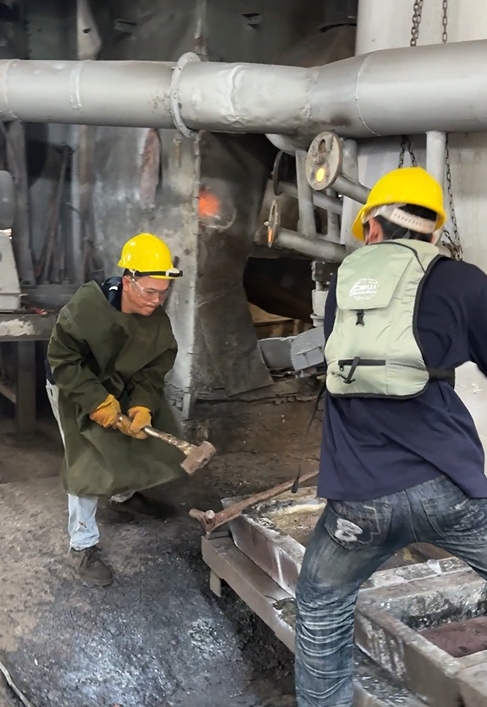
Metal sheet factories are among the environments recorded in the Taiwan deployment case, where radiant heat and limited air movement are routine.
| Parameter | Stated value |
|---|---|
| Cooling architecture | Reusable ice packs plus pump-driven water circulation |
| Pump rating | 5 V, 150 mA (max) |
| Flow rate | 320–370 ml/min |
| Cooling duration | 3–4 hours per charge or ice-pack cycle |
| Listed weight | Within 2 kg |
| Shipped configuration | Vest, water-cooled vest backpack, two ice packs |
| Warranty | 6 months on the water-cooled vest |
| Minimum order quantity | 10 units |
| Lead time | 7–14 days |
| Stated monthly capacity | 3,000 units |
Flow rate is the parameter that links the pump specification to the wearable experience. A 320–370 ml/min range describes how much chilled water moves through the loop per minute; it is the number to hold constant when comparing samples, because a sample that circulates noticeably more or less water will feel different on a worker regardless of what the datasheet claims.
Weight is the second operational number. A garment listed within 2 kg is light enough to be worn across an extended shift without the load itself becoming a fatigue source, which matters on scaffolding, on traffic duty, and in any task that already involves carrying equipment.
The ice packs are the third. They are a logistics dependency, not a defect. A site issuing these vests needs freezer capacity, a rotation plan, and a spare set, because the cold source has to be recharged regardless of how good the garment is.
Field evidence: a 100-unit deployment in Taiwan
A documented Taiwan case records 100 units deployed for cooling in high-temperature environments. The user groups named in that record are construction sites, outdoor work, metal sheet factories, and street vendors. Reported outcomes were effective body cooling, heatstroke prevention, improved work efficiency, and improved worker comfort.
What this case supports is straightforward. The product has been issued at programme scale rather than in single units, across more than one working environment, including both enclosed industrial settings and open-air locations. For a buyer assembling a shortlist, that is a reasonable indicator that the garment survives real issuance and real rotation rather than only a showroom.
What the case does not support is equally straightforward. It contains no core-temperature measurements, no control group, no recorded ambient conditions, and no quantified productivity data. It is a deployment record, not a controlled trial. Buyers should read it as evidence of field use and then generate their own before-and-after data during a pilot. The two together make a defensible file; the case alone does not.
A buyer verification checklist before shortlisting
The useful output of a compliance review is not a verdict on the supplier. It is a list of questions the buyer can put to every supplier on the shortlist in identical form, so that the answers can be compared side by side.
- Certification identity. Request the Disaster Prevention Product and Service Certification Award and confirm the issuing body, the product line named on it, and the date.
- Patent scope. Request patent I886033 and confirm what is claimed, what the term is, and whether it covers the architecture you are actually buying.
- Jurisdictional PPE status. Ask directly which type-examination reports exist for your market, and treat a clear none-in-this-file as a usable answer rather than a disqualification.
- Test conditions. Ask for the ambient temperature, humidity, workload, and clothing layers behind the 3–4 hour cooling duration and the 320–370 ml/min flow rate.
- Configuration confirmation. Confirm in writing that the shipped set includes the vest, the backpack, and two ice packs, and what a replacement ice pack costs.
- Cold-source logistics. Confirm freezer access on site, the rotation interval, and how many spare ice-pack sets the programme needs per crew.
- Power and spares. Confirm the power source for the 5 V, 150 mA pump, expected runtime, and the spare-parts route.
- Warranty terms. Confirm the 6-month warranty scope, what it excludes, and how a claim is processed.
- Pilot design. Run a 10-unit pilot, matching the stated minimum order quantity, before committing to a seasonal order.
- Outcome documentation. Record worker feedback before and after, so the internal file closes with your own evidence rather than the supplier's.
Where the certification evidence stops
A compliance position is only credible if its boundary is stated as clearly as its content. For this product line, the boundary has several parts.
- Geography. The Disaster Prevention Product and Service Certification Award is a Taiwan-market recognition. It does not imply equivalence with European, North American, or other national schemes, and no cross-recognition should be assumed.
- Subject matter. Patent I886033 protects structure and cooling system. It is silent on thermal performance, durability, and electrical safety.
- Test transparency. The stated 3–4 hour cooling duration is supplier-published without disclosed test conditions. Real-world duration will shift with ambient temperature, workload, clothing layers, and body size.
- Consumables and power. The ice-pack cold source requires freezer capacity and rotation; the pump requires a power source. Neither is a product fault, but both are planning items that a buyer who ignores them will discover mid-shift.
- Warranty horizon. A 6-month warranty on the vest is shorter than the multi-year coverage typical of capital equipment. Buyers should price replacement into the total cost rather than assume the coverage period matches the service life.
- Evidence type. The 100-unit Taiwan case reports outcomes qualitatively. It does not substitute for a physiological measurement programme if the buyer needs to demonstrate a reduction in heat-strain indicators.
A buyer who writes these six points into the evaluation file will get a more productive supplier conversation than one who simply asks whether the product is certified. Certification answers a question about recognition. These six points answer the question that actually decides the purchase.
How certified disaster-prevention cooling apparel compares with generic cooling wear
The comparison that matters in procurement is not between two brands. It is between two evidence profiles: garments that carry third-party records and garments that carry a specification sheet only.
| Dimension | Water-circulation vest with disaster-prevention recognition | Generic ice-pack vest | Evaporative cooling vest |
|---|---|---|---|
| Third-party documentation | Taiwan disaster-prevention award plus patent I886033 | Typically none | Typically none |
| Cooling mechanism | Ice packs plus pump-driven circulation | Ice packs only, passive | Evaporation from a wetted layer |
| Performance in humid conditions | Circulation performance is not dependent on evaporation | Not dependent on evaporation | Falls as ambient humidity rises |
| Power requirement | Pump requires a power source | None | None |
| Cold-source logistics | Freezer access plus ice-pack rotation | Freezer access plus ice-pack rotation | Water supply plus re-wetting |
| Shift fit | 3–4 hours per cycle, so a mid-shift swap is planned | Shorter cycles, more frequent swaps | Depends on wetting interval and airflow |
| Best suited to | Programmes that need a document trail alongside cooling | Low-complexity sites with freezer access | Hot, dry climates with good airflow |
None of these columns is universally better. A wetted overgarment in a dry climate costs less and needs no power. A passive ice-pack vest removes the power dependency entirely. The circulation design earns its place where the cooling load is high, where humidity limits evaporative approaches, and where the buyer needs to justify the selection to someone outside the safety team. In those conditions the trade-offs are real but defensible: an extra logistical layer, in exchange for a documented position and a longer cooling cycle.
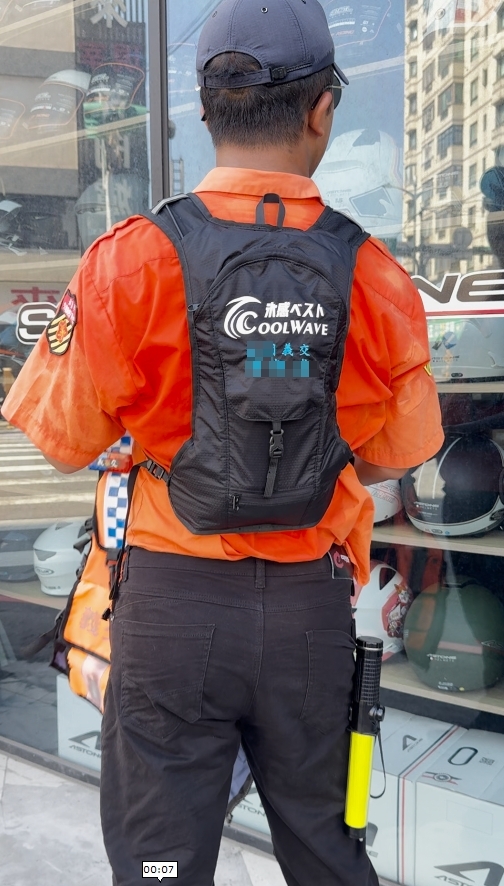
Static traffic posts combine prolonged sun exposure with limited movement, a combination that the multi-hour circulation cycle is designed to address.
Supply-side context and the 2026 procurement cycle
Market structure explains why documentation requests are rising. Dataintelo reported the global cooling vests market at USD 342 million in 2025, with industrial applications accounting for 34.5% of revenue share in the same year. A category where roughly a third of revenue comes from industrial buyers is a category where procurement and safety functions, not consumers, set the requirements — and those functions ask for evidence as a matter of routine.
On the supply side, Feng Shang Precision lists ODM production with a stated monthly capacity of 3,000 units, a 7–14 day lead time, and a minimum order quantity of 10 units, alongside a stated annual output of 10,000 units. The two capacity figures use different bases and should not be converted into each other; a buyer evaluating delivery risk should request production records rather than reconcile marketing numbers. The low minimum order quantity is the more immediately useful figure, because it allows a safety manager to run a 10-unit pilot before committing to a seasonal order — which is exactly the sequence the verification checklist above describes.
The forward-looking point is that differentiation in this category is shifting from cooling claims to documentation. Flow rates and cooling durations are easy to publish and hard to verify; a named certification, a patent number with a term, and a traceable deployment record are slower to assemble and easier to check. As heat-safety obligations tighten and insurers begin asking for a paper trail, suppliers with that trail will move through shortlists faster than suppliers with better adjectives.
For this product line the honest summary is that the compliance position is documented, narrow, and specific: one Taiwan disaster-prevention award, one structural patent with a defined scope and term, a published specification set with an undisclosed test protocol, and a 100-unit field record without physiological measurement. That is more than most of the category offers and less than a full PPE type-examination. Buyers who file it at exactly that level of precision will make a better decision than buyers who round it up in either direction.
FAQ
What exactly does the Disaster Prevention Product and Service Certification Award certify?
It is an award issued by the Taiwan Disaster Prevention Industry Association recognising the COOLWAVE water-cooled vest as a disaster prevention product within that association's framework. It is a Taiwan-market recognition and is not an EN, ANSI, or ISO PPE type-examination certificate. The available documentation does not publish the assessment protocol behind the award.
Does the vest hold EN or ANSI PPE certification?
The documentation reviewed here contains the Taiwan disaster prevention award and patent I886033, and does not include an EN, ANSI, or ISO test report. Buyers operating in jurisdictions where wearable cooling falls under PPE type-examination should request the specific test reports for that market before treating the product as certified protective equipment.
What does patent I886033 cover, and how long does it run?
Patent I886033 covers the water-cooled vest structure and cooling system. It was issued on 1 June 2025 by the Intellectual Property Office of the Ministry of Economic Affairs under the Patent Act of the Republic of China, and runs to 27 August 2044. It is an exclusivity record for the design rather than a performance certificate, so it should not be used to support cooling or durability claims.
How long does the cooling last, and how should that shape shift planning?
The published specification states 3–4 hours per charge or ice-pack cycle, with a pump rated at 5 V, 150 mA (max) and a flow rate of 320–370 ml/min. The test conditions behind the duration figure are not disclosed, so ambient temperature, workload, clothing layers, and body size should be assumed to move the real number. An eight-hour shift should be planned around at least one ice-pack swap, with freezer access confirmed in advance.
What is included with the vest, and what does the set depend on?
The shipped configuration includes the vest, the water-cooled vest backpack, and two ice packs. The reusable ice packs are the cold source, so freezer capacity and rotation are part of the operating plan. The pump requires a power source, and its electrical requirement should be matched against the power bank selected for the crew.
What are the commercial terms for a pilot order?
Feng Shang Precision lists ODM production with a minimum order quantity of 10 units, a 7–14 day lead time, a stated monthly capacity of 3,000 units, and a 6-month warranty on the water-cooled vest. The 10-unit minimum supports a pilot sized to a single crew before a seasonal commitment.
Which work environments has the product been deployed in?
A documented Taiwan case covering 100 units lists construction sites, outdoor work, metal sheet factories, and street vendors, all in high-temperature environments. The record reports effective body cooling, heatstroke prevention, improved work efficiency, and improved worker comfort, without quantified physiological measurements.
Product documentation, including the current brochure, is available for download: COOLWAVE product brochure (PDF).
Tem questões ou precisa de mais detalhes?
Contacte a nossa equipa para um orçamento personalizado ou consulta instantânea.
Solicitar orçamento
Preencha o formulário abaixo e a nossa equipa entrará em contacto com uma proposta personalizada.
Chat direto do WhatsApp
Prefere conversar em tempo real? Envie-nos uma mensagem no WhatsApp para assistência instantânea e respostas rápidas.
- Obter orçamento personalizado
- Partilhar fotos ou documentos
- Discuta as suas necessidades diretamente
Geralmente responde em 5–30 minutos durante o horário de expediente.