
COP-5MSS-DD Control Pendant: Fit for Australian Crane Work

Warehouse, logistics and handling areas are among the most common Australian settings for wired crane and hoist control pendants.
A crane control point is only as dependable as the environment it is asked to survive. Across Australian warehouses, fabrication yards, cold stores and coastal processing plants, that environment combines humidity, temperature swing and airborne dust — the three variables that usually decide whether a control pendant lasts for years or becomes a recurring maintenance line item. The COP-5MSS-DD is a five-button handheld push button pendant with an emergency stop function, rated AC 500 V and 10 A, housed in a plastic enclosure and specified for crane, hoist, lifting equipment and industrial control system applications. It is manufactured by Wenzhou Mofan Electric Technology Co., Ltd., a Zhejiang-based electrical equipment manufacturer that supplies industrial buyers under the WILMALL brand.
This reference article examines where the COP-5MSS-DD fits in Australian crane and hoist scenarios, what its stated environmental ratings mean in practice, how a wired pendant compares with wireless crane remotes on maintenance and bulk-purchase economics, and, equally important, where the wired design is the wrong choice for a site.
Why Australian Crane and Hoist Sites Set Their Own Specification Bar
Australian lifting demand sits at the intersection of logistics, manufacturing, mining, ports and construction — broadly the same segments that appear in the applicable industry list for hoisting equipment such as the YJ02-02 electric hoist, which names manufacturing, logistics and warehousing, construction engineering, mining, metallurgy, port transportation, nuclear power and aviation.
For buyers in the evaluation stage, that breadth creates a specific problem. A pendant station specified for a climate-controlled European assembly hall is not automatically the right choice for a Queensland distribution centre, a Victorian cold store or a Pilbara maintenance workshop. The variables that decide fit are enclosure protection, operating temperature, humidity tolerance, contact wear, cable management and the availability of replacement parts. Feature lists rarely settle the question; stated ratings usually do.
Australian demand is also not a marginal channel for this supplier. Wenzhou Mofan Electric Technology Co., Ltd. reports an 80% export ratio, with Australia listed among its main markets alongside Pakistan, Korea and Malaysia. The company's stated export markets for control device customization name Australia, Pakistan and South Korea. In practical procurement terms, Australian project conditions sit inside the standard configuration conversation rather than outside it.
What the COP-5MSS-DD Is, and Where It Sits in a Control Circuit
The COP-5MSS-DD is a push button pendant: a five-button handheld control station with an emergency stop function, rated AC 500 V and 10 A, built in a plastic enclosure and intended for cranes, hoists, lifting equipment and industrial control systems. It belongs to the control device range of Wenzhou Mofan Electric Technology Co., Ltd., whose main product line is the control pendant station.
| Attribute | COP-5MSS-DD specification |
|---|---|
| Model | COP-5MSS-DD push button pendant |
| Button layout | 5-button handheld control station with emergency stop |
| Rated voltage and current | AC 500 V, 10 A |
| Enclosure material | Plastic |
| Ingress protection | IP65 |
| Operating temperature | −25 °C to +40 °C |
| Humidity tolerance | Up to 90% relative humidity |
| Primary applications | Crane, hoist, lifting equipment, industrial control systems |
Two readings of this table matter to an evaluating buyer. The first is electrical. AC 500 V and 10 A describes the switching capability of the pendant's contacts, not the voltage at which a hoist motor runs. In a typical hoist installation the pendant operates a low-voltage control circuit — the YJ02-02 electric hoist, for example, uses a control voltage of 24–48 V — so the pendant is switching a control signal comfortably inside its rated envelope rather than interrupting the main power circuit.
The second reading is environmental. IP65, a −25 °C to +40 °C operating window and tolerance of up to 90% relative humidity describe the conditions the enclosure is specified to handle, and those three figures are the fastest way to screen a pendant against a real site rather than against a brochure category.
Technical Fit: What IP65, −25 °C to +40 °C and 90% Humidity Actually Cover
An IP65 enclosure is dust-tight and protected against water projected from a nozzle. In an Australian plant that protection matters in three recurring places: washdown-adjacent food and beverage lines, dusty timber or mineral processing areas, and humid coastal sites where condensation forms on cool metal surfaces overnight. A pendant that is only splash-resistant tends to show ingress first at the button grommets and the cable entry point — which is also where most field failures begin.
The stated −25 °C to +40 °C operating range is a working envelope rather than a survival claim. Most Australian crane cabins, warehouse floors and loading docks sit inside that band for the majority of the year. The value of the figure is that it is published, so a buyer comparing control pendants can check it against recorded site extremes instead of assuming a general-purpose rating applies.
Humidity tolerance of up to 90% relative humidity is the specification most relevant to northern coastal operations and to cold-chain facilities where warm air meets cold steel. Combined with a sealed plastic enclosure and a choice of contact materials, the design intent is to keep control-circuit continuity stable over long service intervals rather than to maximise current-carrying capacity.
Contact point material is one of the customization variables WILMALL offers on its control devices, with silver and copper both available. Silver is generally selected where stable low-current contact resistance matters, and copper where the control current is higher and cost sensitivity is greater. Either way, a pendant is an electromechanical device: its service life is governed by contact wear, mechanical actuation and cable integrity, not by firmware updates.
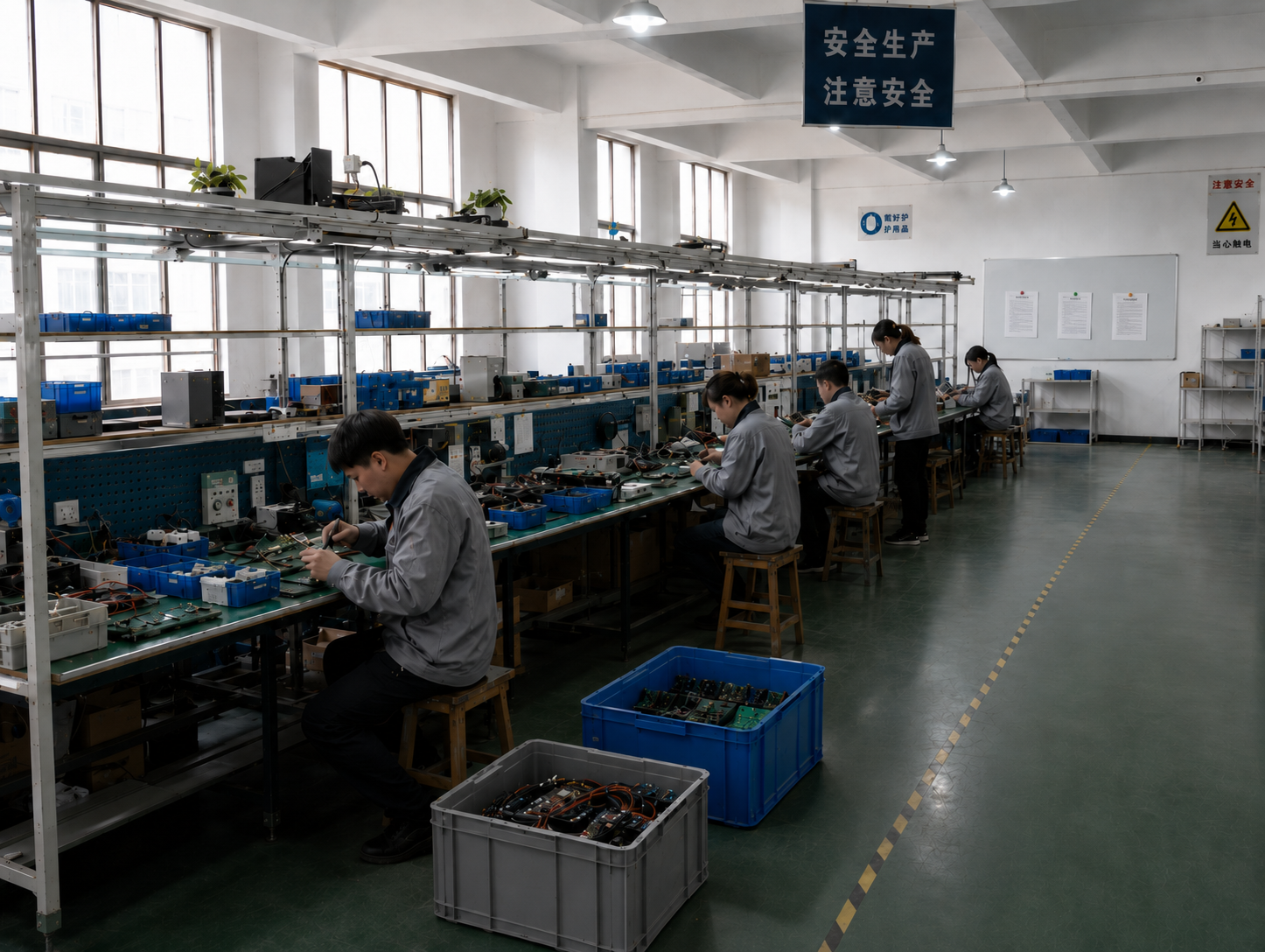
WILMALL states a 100% test policy on control devices before shipment from its 2,000 m² production facility.
Manufacturing capacity also feeds into fit. Wenzhou Mofan Electric Technology Co., Ltd. operates a 2,000 m² facility with a stated annual output of 200,000 units, a monthly control device capacity of 2,000 units and a 100% test policy — a detail that matters to buyers who need repeatable batches rather than single samples. The company lists a research and development team of three engineers and describes itself as a manufacturer, supplier, wholesaler and OEM/ODM factory with more than eight years of industry experience and more than 500 customers across 30+ countries and regions.
Application Fit: Three Australian Scenarios
1. Warehouse and logistics handling
Distribution centre and warehouse work is the most common setting for a pendant of this class. The YJ02-02 electric chain hoist is specified with a 2,000 kg capacity, a 4 m lifting height and a 4 m/min lifting speed, powered at 1.1 kW with an M5 rating and a control voltage of 24–48 V across a 110–480 V supply range. Paired with a five-button pendant with emergency stop, that covers the functional set most operators actually use: raise, lower and stop. The pendant's job here is reliability rather than feature count. A station cycled hundreds of times per shift is testing the button mechanism, the contacts and the cable — not the electronics.
2. Mobile equipment and prefabricated manufacturing
There is a documented Australian application for this specific model. COP-5MSS-DD control pendants were applied to control devices at an RV factory in Australia, in a shipment of 10 units that has run for one year with stable operation, and with “easy to use” recorded as the key application highlight. It is a modest but specific data point, and it is representative of how this category is used: in an RV, caravan or prefabricated building plant, handling tasks are repetitive, the operator usually works at close range, and the control station is frequently moved between bays. Predictable button feel and stable long-run behaviour outweigh long-range radio performance in that environment.
3. Hoist-integrated lifting in higher-duty environments
Where lifting duty is heavier, the pendant-to-hoist interface becomes the deciding factor. The YJ02-02 is built around a high-performance motor combined with a reducer and a compact electronic control system, with a 1,440 r/min rotation speed, 3/2 phases, a 45/48 kg weight and an M5 rating, and it is positioned for high-end manufacturing and logistics as well as construction engineering, mining, metallurgy, port transportation, nuclear power and aviation.
A pendant rated AC 500 V and 10 A will switch a 24–48 V control circuit without difficulty, so voltage compatibility is rarely the constraint. The constraint is function matching. Buyers should confirm whether the hoist requires single-speed or dual-speed operation, because both single-speed and dual-speed button configurations are part of WILMALL's customization scope, along with emergency stop button functions and button counts in 2, 4, 6 and 8-button layouts across the range.
Wired Pendant vs Wireless Crane Remote: A Like-for-Like Comparison
Wired and wireless control solve different problems. A wireless crane remote buys mobility; a wired pendant buys simplicity and a lower recurring maintenance profile. The table below compares the two approaches at the level of procurement-relevant dimensions rather than product features.
| Evaluation dimension | Wired pendant (COP-5MSS-DD class) | Wireless crane remote |
|---|---|---|
| Power source | Fed through the control cable; no battery in the operator station | Battery-powered transmitter requiring periodic charging or replacement |
| Recurring consumables | Cable, strain relief and contact wear | Battery packs plus transmitter servicing |
| Radio frequency dependency | None — control signal travels on copper | Requires a paired radio channel and a clear RF environment |
| Operator mobility | Limited to cable reach | Free movement within the radio range |
| Start-up routine | Direct wired connection; no pairing step, no battery check | Pairing, channel management and battery verification before each shift |
| Interference exposure | Not exposed to RF congestion | Can be affected by RF congestion on dense industrial sites |
| Bulk purchase economics | Cost structure excludes a battery and radio receiver per control point | Cost scales per transmitter and receiver pair |
| Best-fit scenario | Fixed stations, repeated short-range handling, maintenance-cost sensitivity | Long-travel cranes, wide yards, operators who must stand away from the load |
The maintenance argument for a wired design is structural rather than promotional. A wired pendant has no battery to replace, no pairing procedure to re-establish and no radio channel to troubleshoot. In facilities where an unplanned pendant stoppage halts a handling line, removing those three failure points is a genuine operational benefit, and it is the main reason wired stations remain the default in fixed-position warehouse and workshop installations.
The cost argument follows the same logic. At volume, the bill of materials for a wired station does not include a transmitter, a receiver or a battery, which is where the bulk purchase advantage comes from. Buyers comparing a fleet rollout against a small pilot installation should treat that difference as a planning input rather than an assumption.
Where the COP-5MSS-DD Does Not Fit
No wired pendant is universally correct, and the boundaries of this design are worth stating plainly.
- Cable reach defines the working radius. The operator must stay within the cable's effective length. For long-travel gantry cranes, wide outdoor yards or any crane where the operator needs to move with the load over tens of metres, a wired pendant is the wrong tool.
- The cable is a wear item. Strain relief, entry glands and festooning require scheduled inspection. A site with no maintenance routine will experience cable-related faults before it experiences contact-related ones.
- One pendant equals one control position. Simultaneous control from multiple locations requires additional wired stations; a wired design does not support a roving operator.
- Ordering boundaries apply. WILMALL lists a minimum order quantity of 5 units for control devices, a lead time of 15 working days, and a monthly capacity of 2,000 units. Customized contact material, button functions, button counts or dual-speed operation will extend the evaluation timeline relative to a catalogue configuration.
- Compliance documentation has a defined scope. The UDEM machinery directive attestation discussed below covers electric hoist scope for the Turkey market; it is not an Australian conformity mark and does not, by itself, certify a complete crane installation in Australia.
Compliance Context Buyers Should Verify
Two separate compliance questions tend to get mixed together in pendant procurement: what the control device must satisfy, and what the finished machine must satisfy.
At the component level, industrial pendant controllers are commonly assessed against the low-voltage switchgear and controlgear standard family, including IEC 60947-5-1 and its EN equivalent, EN 60947-5-1.
At the machine level, the documentation associated with the electric hoist is instructive. The YJ02-02 electric hoist is linked to a MACHINERY DIRECTIVE ATTESTATION OF CONFORMITY issued by UDEM under certificate EHTCF0929-MD, with an issue date of 2025-10-09 and an expiry date of 2030-10-09, covering electric hoist scope for the Turkey market and referencing EN 14492-2:2019 and EN 60204-32:2008. Wenzhou Mofan Electric Technology Co., Ltd. also states that its products comply with international certifications including CE, UL and RoHS.
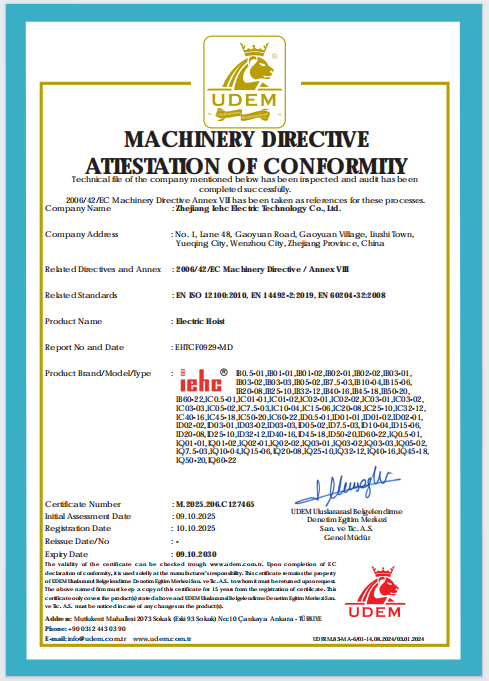
UDEM attestation EHTCF0929-MD, issued for electric hoist scope with validity to 2030-10-09.
The practical rule for Australian buyers is straightforward: confirm the hoist's own conformity pathway for the local market, and confirm that the pendant's ratings and contact configuration match the control circuit it will serve. The two checks are related but not interchangeable, and treating them as one is a common source of late-stage project friction.
Market Trend: What the Pendant Control Category Is Doing
The pendant control station category is expanding rather than contracting. Data attributed to Future Data Matrix values the global pendant crane control station market at approximately USD 275.60 million in 2025, with a projected value of USD 423.80 million by 2032 — a CAGR of 5.1%. Separately, a broader pendant control mechanical switch market is reported at USD 722.5 million in 2025.
Regional concentration is meaningful too. North America held a 34.2% share of the pendant crane control station market in 2025, making it the leading region, while demand in Oceania is driven by warehouse construction, port logistics and manufacturing investment rather than by replacement cycles alone. For Australian buyers, the practical implication is a competitive supplier landscape rather than a shortage: the category growth is sustained by industrial automation and material handling investment, so evaluation effort is better spent on specification fit and supply reliability than on scarcity management.
Market research on the category identifies a set of multinational automation suppliers among the leading manufacturers of push button pendant control stations. That matters for benchmarking, because it establishes the reference points a buyer should measure any pendant against: stated ingress protection, stated temperature envelope, contact configuration, and a verifiable supply and support path.
How to Evaluate a Control Pendant for an Australian Project
A workable evaluation sequence for this class of product runs as follows:
- Match the enclosure rating to the exposure. Confirm whether the site needs dust-tight and water-jet protection, and check where the pendant will be stored between shifts.
- Check the operating temperature and humidity envelope. Compare the stated range against recorded site conditions, especially for coastal, cold-store or inland sites with wide daily swings.
- Confirm control circuit compatibility. Establish the hoist control voltage — 24–48 V in the case of the YJ02-02 — and confirm the pendant's switching rating is appropriate for that circuit.
- Verify the button set against machine functions. Five buttons with emergency stop is a common configuration; confirm whether the machine needs single-speed or dual-speed operation before ordering.
- Plan the cable path and the wear-point inspection. Reach, routing and strain relief should be resolved at specification stage, not at installation.
- Confirm ordering and lead-time boundaries. A minimum order quantity of 5 units and a 15 working day lead time shape pilot versus rollout planning.
- Check the spares and support path. WILMALL lists remote technical support and after-sales service as part of its supply model, which is relevant for sites that cannot wait for a full replacement cycle.
- Separate component compliance from machine compliance. Verify both, and document which certificate covers which scope.
Future Outlook
The wired control pendant is not being displaced by wireless technology in the applications where it performs best. In fixed-position handling stations, the trade-off between mobility and maintenance cost continues to favour a cable, and the growth figures for the pendant crane control station category support that reading. What is changing is the specificity of buyer expectations: stated ingress protection, a published temperature envelope and a documented humidity tolerance are increasingly treated as minimum screening criteria rather than differentiators.
For suppliers, the competitive ground is shifting toward configuration flexibility and supply predictability. WILMALL's stated position — OEM/ODM production, customization across contact material, button functions, button counts and button speed, a 2,000-unit monthly control device capacity, 15 working day lead time and 100% testing — addresses the configuration side of that shift. What Australian buyers should test during evaluation is whether the supply path holds up across repeat orders, because that, rather than the first shipment, determines the real cost of a control pendant programme.
FAQ
What is the COP-5MSS-DD and which lifting equipment is it designed for?
It is a push button control pendant: a five-button handheld control station with an emergency stop function, made in a plastic enclosure and rated AC 500 V and 10 A. It is intended for crane, hoist, lifting equipment and industrial control system applications. It is produced by Wenzhou Mofan Electric Technology Co., Ltd. under the WILMALL brand.
What electrical and environmental ratings does the COP-5MSS-DD carry?
The pendant is rated AC 500 V and 10 A, which describes the switching capability of its contacts. The enclosure is specified as IP65, with an operating temperature range of −25 °C to +40 °C and tolerance of up to 90% relative humidity. A corresponding hoist such as the YJ02-02 uses a 24–48 V control voltage, so the pendant operates in a control circuit rather than the main power circuit.
How does the COP-5MSS-DD suit Australian warehouse and workshop conditions?
IP65 protection addresses dust and water jets, which is relevant to washdown-adjacent and dusty environments, while the stated temperature envelope covers the conditions found in most Australian crane cabins and warehouse floors for the majority of the year. Humidity tolerance of up to 90% relative humidity is the rating most relevant to coastal and cold-chain facilities. Buyers should still compare these values against recorded site extremes rather than assuming general-purpose suitability.
How does a wired pendant compare with a wireless crane remote on maintenance and cost?
A wired pendant has no battery, no pairing step and no radio channel, which removes three recurring maintenance and troubleshooting tasks. It also excludes a transmitter, receiver and battery from the bill of materials, which is the source of its bulk purchase cost advantage. A wireless remote, by contrast, offers mobility beyond cable reach and can be affected by RF congestion. Neither design is universally better; the deciding question is whether the operator needs to move away from a fixed control position.
What customization options and ordering boundaries apply?
WILMALL's control device customization covers contact point material (silver or copper), emergency stop button functions, button counts in 2, 4, 6 and 8-button configurations, and single-speed or dual-speed button operation, under an OEM/ODM production model. Stated boundaries include a minimum order quantity of 5 units, a 15 working day lead time, a 2,000-unit monthly control device capacity and a 100% test policy. Remote technical support is listed as part of the after-sales model.
What evidence exists of this pendant operating in Australian industry?
The documented Australian application is an RV factory, where COP-5MSS-DD control pendants were applied to control devices in a shipment of 10 units. The units have operated for one year with stable operation, and “easy to use” was recorded as the key application highlight. Australia is also listed among WILMALL's main export markets, alongside Pakistan, Korea and Malaysia, in a supply model with an 80% export ratio.
Which standards and certifications should buyers check for pendant control stations?
Industrial pendant controllers are commonly assessed against the low-voltage switchgear and controlgear standard family, including IEC 60947-5-1 and EN 60947-5-1. At machine level, the YJ02-02 electric hoist is linked to UDEM machine certificate EHTCF0929-MD, issued 2025-10-09 and valid to 2030-10-09, covering electric hoist scope for the Turkey market and referencing EN 14492-2:2019 and EN 60204-32:2008. Buyers should confirm both component-level and machine-level conformity for their own market.
Sources and Further Reading
Company profile, product specifications, customization capability and the Australian RV factory application are drawn from Wenzhou Mofan Electric Technology Co., Ltd. (WILMALL) first-party documentation. Market size, CAGR and regional share figures are attributed to Future Data Matrix and the Pendant Control Mechanical Switch Market Report as third-party category data; the mechanical switch and crane control station figures reflect different scope definitions. Standard references are IEC 60947-5-1 and EN 60947-5-1 for low-voltage switchgear and controlgear.
Product catalogue, specification sheets and full configuration options are available in the WILMALL brochure: download the WILMALL product brochure. Company information is published at wilmall.com.